On May 5, 2026, Anthropic shipped ten finance agent templates for Claude. Pitchbook generation. KYC screening. Earnings review. Month-end close. Two days later, the company pushed three new features into Claude Managed Agents, including organization-wide skill management for Team and Enterprise plans. By the end of the month, the Agent Skills specification was sitting at agentskills.io as an open standard, with Microsoft, OpenAI, Google, Cursor, GitHub Copilot, and a long list of community tools all reading the same SKILL.md format.
The substrate moved forward by a full quarter in three weeks. The enterprise org chart moved forward by nothing.
That is the story of enterprise AI agent deployment in 2026 so far. The tools are commoditizing. The deployment math is not. Forrester reported this spring that 74 percent of enterprises have already rolled back or shut down an AI agent after launch. Not in pilot. Not in a sandbox. In live production, after the kickoff call, after the demo, after the executive sponsor stood up at all-hands and announced the future. The Enterprise Agent Deployment Maturity Model 2026 puts another 86 percent of companies in what its authors call pilot purgatory, the state of agents that work in a demo and refuse to scale.
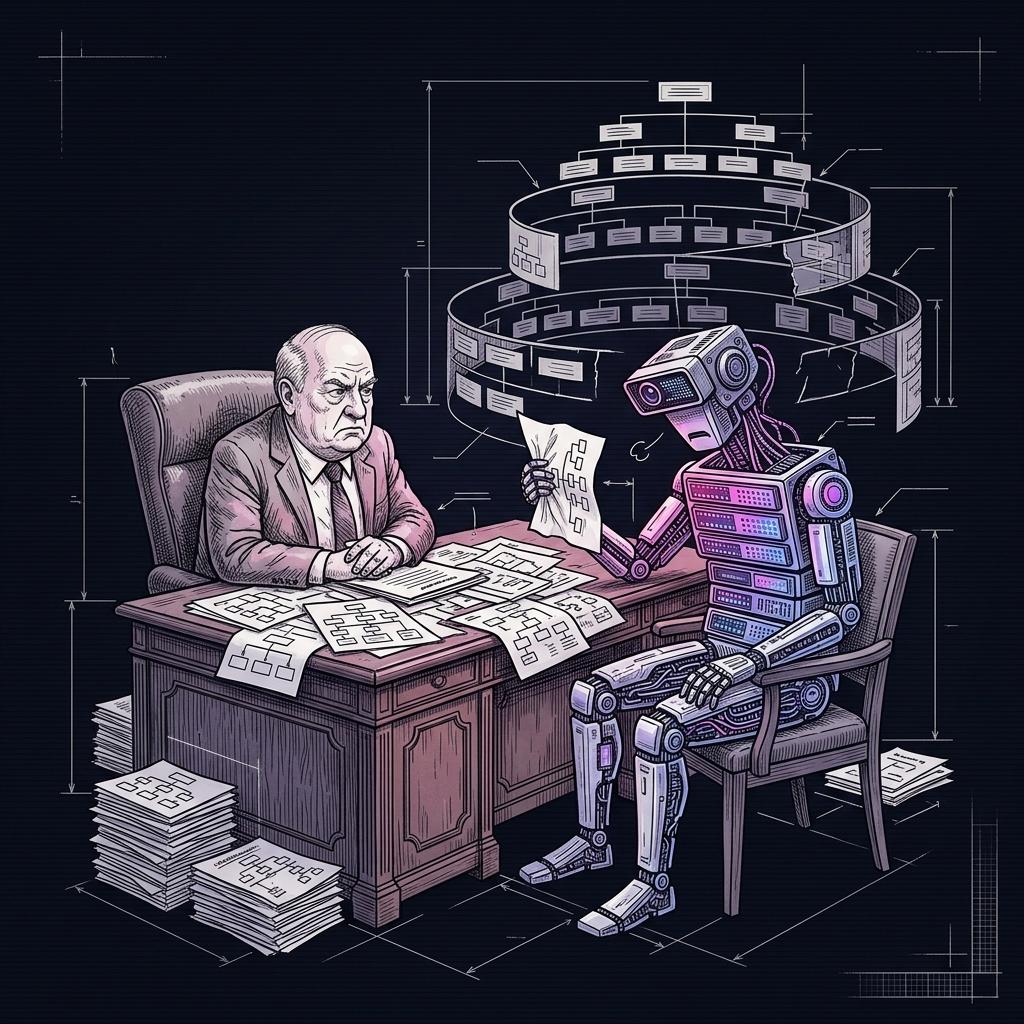
The model is not the bottleneck. The org chart is.
The Agent Has No Manager
Walk through who manages an agent at a typical Fortune 1000 company. The procurement team owns the contract. The data science team owns the model. The IT team owns the deployment pipeline. The business unit owns the use case. Legal owns the risk register. Each of these owners has authority over one slice of the agent. None of them have authority over the agent itself.
This is not a problem you can solve with a better model. It is a problem with the shape of the company.
If you hire a new analyst, the analyst has a manager. The manager sets the scope, defines success, runs the weekly check-in, reviews the work, escalates issues, fires the analyst if things go wrong. If you deploy an agent, the agent has none of these. The agent has a deployment pipeline, a vendor contract, a model endpoint, and a vague expectation that the business will see value. When the agent makes a mistake, no single person owns the cleanup. When the agent drifts, no single person notices.
Forrester's root-cause analysis on the 74 percent rollback wave attributes 41 percent of failures to unclear success criteria, 33 percent to insufficient tool and data access, and 26 percent to drift in evaluation coverage. Read those numbers carefully. None of them are model-quality problems. All three are management problems. A human first-line manager would catch all three before they killed the project. There is no first-line manager, so all three kill the project.
What Happened to Klarna
The Klarna saga is the cleanest public study in agent ownership failure. In late 2024, Klarna announced it would shut down Salesforce, Workday, and a long list of SaaS providers, replacing them with internally built AI tools. The CEO, Sebastian Siemiatkowski, talked about $2 million a year in savings and the reinvention of customer service. By March 2026, the same CEO told reporters he was "tremendously embarrassed" by the Salesforce fallout and was actively reversing course, hiring humans back for customer support.
Read the public accounts of what went wrong and a pattern emerges. The agents worked. The metrics, internally, looked good. The customer experience, externally, did not. The reason is that nobody at Klarna had been given the job of being the agent's manager. There was an engineering team building it. There was a leadership team selling it. There was no analyst sitting in a chair every morning, reading what the agent did the previous day, flagging the cases it got wrong, retraining it on those cases, and deciding when to escalate to a human. The agent had no first-line supervisor. The supervisor's job was assumed away in the cost case.
Klarna is the visible version because the CEO has been public about it. The invisible version is the 74 percent rollback figure. Most of those companies will never write a blog post about the agent they killed. They will quietly turn it off, blame "the technology not being ready yet," and write the cost of the deployment off as innovation spend.
Enterprise AI Agent Deployment Is a Hiring Problem
Most enterprise AI agent deployment plans I see start with the wrong question. They ask which agent to deploy. The right question is: what role on the org chart does this agent fill, and who is that agent's manager?
If you cannot answer the second question, you should not deploy the agent. You should redesign the org chart first.
This sounds slow. It is not. Drawing an agent onto the org chart is one afternoon of work. The reason most teams skip it is that they treat the agent as a tool, and tools do not go on org charts. The Excel spreadsheet does not have a manager. The Salesforce instance does not have a manager. So why should the agent?
Because the agent is not a tool. The agent makes decisions, takes actions, spends money, contacts customers, books appointments, files reports. The tool waits for a human to push a button. The agent acts on its own judgment, then asks for forgiveness if needed. That is the difference between a tool and an employee, and the legal and operational consequences flow from that difference.
The Stanford AI Index 2026 reported that AI agents now hit a 66 percent success rate on standard benchmarks. Only 11 percent of deployed agents are actually being used in production. The 55-point gap between benchmark capability and production use is the management gap, not the model gap. You can buy the best model and the best skill library and the best orchestration framework and still ship an agent that nobody manages. When that agent fails, the response will be "the technology is not ready yet," when the actual story is "we never staffed it."
The Substrate Has Commoditized
Here is what changed in the last six months. Anthropic's Agent Skills, released first as a Claude feature in October 2025 and opened as a standard in December 2025, is now read by Claude Code, OpenAI Codex CLI, Google Gemini CLI, GitHub Copilot, Cursor, Goose, Amp, OpenCode, Cline, and Windsurf. Microsoft folded Skills support directly into VS Code. As of May 2026, you can write a single SKILL.md file and have it executed by all five major foundation model vendors and most of the popular coding agents.
This is the deepest substrate convergence the industry has seen since the JSON API. It means that the question of which vendor to standardize on for agent deployment is now mostly a procurement question, not an architecture question. You can move skills between platforms. You can compose skills across platforms. The Anthropic finance agent templates announced on May 5, the ones that handle pitchbook generation and KYC screening and earnings review, are written in the same format that OpenAI Codex CLI and Google Gemini CLI read natively.
When a substrate commoditizes, the differentiator moves up the stack. In the agent era, the differentiator is not the model and not the skill and not the orchestration framework. It is the org chart. The company that knows how to put agents on its org chart, give them managers, define their KPIs, schedule their performance reviews, and write their deprecation plans will deploy agents that survive. The company that buys an agent the way it bought Salesforce will roll it back the way Klarna rolled back Salesforce.
The Five Things an Agent Manager Actually Does
If you do put an agent on your org chart, what does its manager do every day? Five things. None of them require an AI degree.
Scoping
The manager defines what the agent should and should not do. Forrester's 41 percent unclear-success-criteria failure mode lives here. An agent shipped without a clear scope is an agent shipped with infinite scope, which is to say a runaway. The manager sits down on day one and writes a one-page job description for the agent, the same as for a human report. What it does. What it never does. Who its customers are. What "good" looks like.
Escalation
The manager builds the path the agent takes when it does not know what to do. Most agent failures in production are not wrong answers. They are agents charging ahead in cases that should have been escalated. The manager defines the boundary and instruments it. When the agent crosses the boundary, a human gets pinged within minutes, not at the end of the week when a dashboard updates.
KPIs
The manager picks two or three numbers the agent will be evaluated on. Cases handled per hour, error rate, customer satisfaction, recovery cost on errors, whatever fits the role. The Forrester data on drift, the 26 percent of failures from "drift in evaluation coverage," lives here. If you do not measure the agent the same way every week, you cannot see when it gets worse. The agent does not have a bad mood that signals it. It just quietly degrades, and the first time anyone notices is when a customer complains.
Retraining cadence
The agent's instructions go stale, the same way a human employee's training does. The manager schedules a monthly review of the agent's SKILL.md, its tool list, its data sources, and its prompt. The 33 percent of failures from insufficient tool or data access live here. An agent that has not been retooled in six months is an agent working off last quarter's reality. Policy changed. The customer base shifted. The new product line is not in the training set. A human analyst would learn this from a hallway conversation. The agent will not. The manager has to push it.
Deprecation
The manager writes a kill plan on day one. When the agent stops being worth its inference cost, when the use case shifts, when a better agent comes along, when the regulator changes the rules, the manager pulls the agent from production. Most companies never plan this. They build for forever. Then forever ends and nobody knows who can pull the plug.
A human running an analyst team does all five of these every week without thinking about it. The argument here is straightforward. Treat your agents the same way.
Why "Just Use the Open Standard" Is Not the Answer
A lot of enterprise AI agent deployment advice in 2026 sounds like this: pick the Agent Skills open standard, pick a vendor or two, write your skills, ship. This is half right. The substrate matters. The substrate is not the bottleneck.
The 55-point gap between Stanford's 66 percent benchmark success rate and the 11 percent of agents in production use is the management gap, not the model gap. You can buy the best model and the best skill library and the best orchestration framework and still ship an agent that nobody manages. The 22 percent of agents that do reach production and deliver negative ROI at 12 months are the agents whose managers were never named.
Compare this to how a serious company hires a senior analyst. The job description is written before the recruiter is briefed. The hiring manager is named before the candidate is sourced. The first 90-day plan is written before the offer is signed. The performance review schedule is on the calendar before the analyst starts. The deprecation plan, the question of when this role goes away or evolves, is in the long-term plan.
Now compare this to how a company deploys an AI agent. The vendor is picked. The skills are written. The model endpoint is provisioned. The deployment passes its acceptance test. The agent goes live. Nobody is sitting in the manager's chair on day one. The hiring math was done. The management math was skipped. Six months later, the agent is rolled back. This is the 74 percent number, written out as a sequence of decisions nobody made on purpose.
Architect the Org Chart Before You Architect the Agent
The argument here is that enterprise AI agent deployment in 2026 is not a procurement problem and not a model problem. It is an organizational design problem dressed in the language of technology.
The procurement team can pick the right vendor. The data science team can pick the right model. The platform team can build the right orchestration. The skills team can write the right SKILL.md. If the org chart does not include the agent, the agent dies in production. The 74 percent rollback figure is the receipt.
The companies that will win the next five years of enterprise AI agent deployment will not be the ones with the best models. The substrate is open. They will be the ones with the org charts that include agents as a first-class entity, with managers, KPIs, escalation paths, retraining cadences, and deprecation plans. They will treat the deployment of an agent the same way they treat the hiring of an analyst. Because that is what an agent is.
If you are an executive at a large enterprise, the question to ask in your next agent deployment meeting is not "what does the agent do." It is "who is the agent's manager, and what is the agent's first 90-day plan." If nobody in the room can answer either, postpone the deployment, redraw the org chart, and try again. The pilot will survive. The production deployment will survive. The rollback will not happen.
Conclusion
The agent will not manage itself. The model is good enough. The skills are open. The vendors will ship anything you ask. What is missing is the management layer, and the management layer is not a piece of software you can buy. It is a set of roles, responsibilities, and authority structures that have to be built into the company, owned by named people, and reviewed every quarter.
Most enterprises will buy the next agent the way they bought the last SaaS subscription, then roll it back the way Klarna rolled back Salesforce. A few will do the harder work first. The agent will get a desk and a manager before it gets a deployment date. The KPI will be written before the model is picked. The deprecation plan will be in the file before the contract is signed. Those are the enterprises that will compound.
Agor AI Advisory exists for this part. We do not sell you an agent. We help you redesign the role on your org chart that the agent will fill, name the manager, write the first 90-day plan, set the KPIs, instrument the escalation path, and schedule the performance reviews. The substrate, you can buy off the shelf. The org chart, you have to architect.
Sources
- Anthropic launches enterprise Agent Skills and opens the standard, VentureBeat, May 2026
- Anthropic Launches Ten Finance Agent Templates for Claude, Let's Data Science, May 5 2026
- Anthropic updates Claude Managed Agents with three new features, 9to5Mac, May 7 2026
- Why 74% of Enterprises Are Rolling Back AI Agents After Launch, Medium, May 2026
- The Enterprise Agent Deployment Maturity Model 2026, AgentMarketCap, April 2026
- Stanford AI Index 2026: AI Agents Hit 66% Success Rate, BERI, 2026
- Klarna CEO Tremendously Embarrassed by Salesforce Fallout, Salesforce Ben, March 2026
- Klarna Cut Ties with Salesforce, Now Hiring Humans Back, Salesforce Ben, 2026