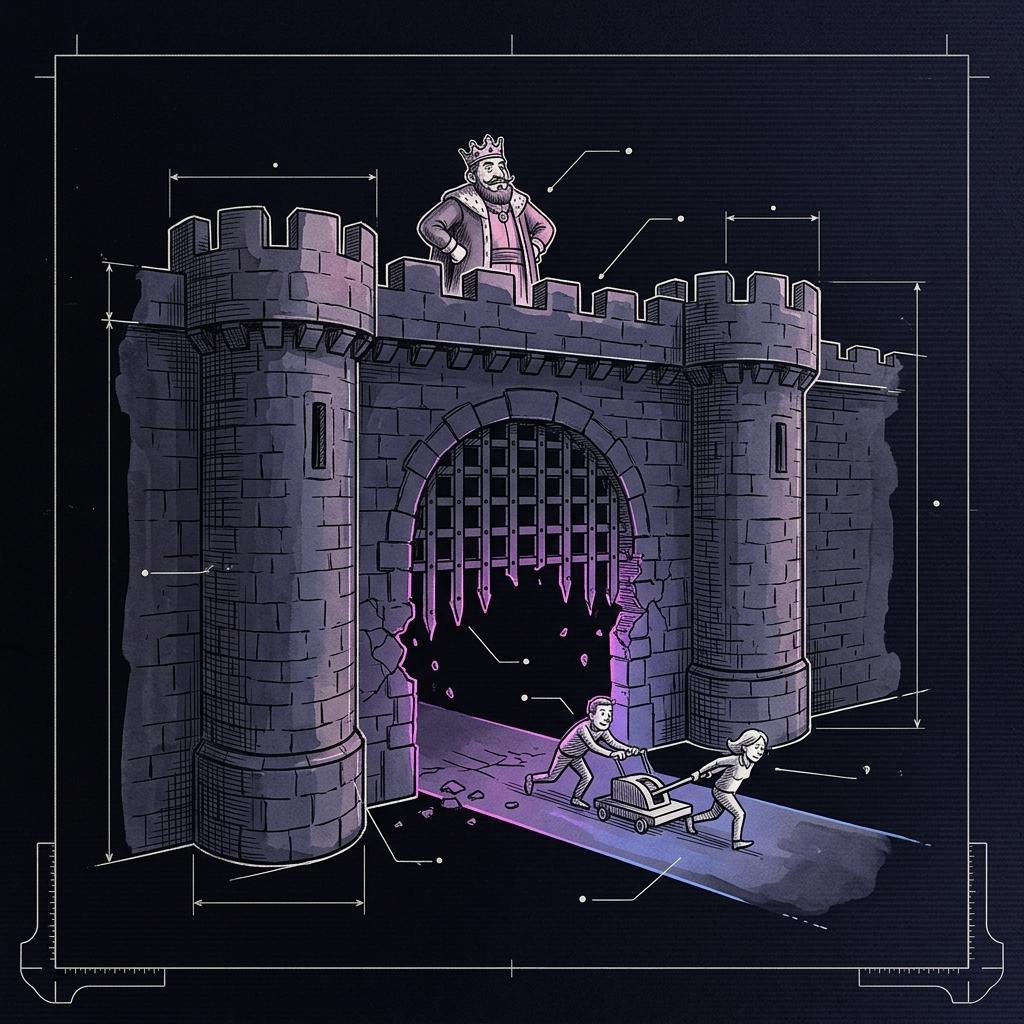
On May 28, 2026, Axios ran a story called "Corporate America enters its AI reckoning." The lede mentioned that Microsoft canceled most of its Claude Code licenses over cost. Buried four paragraphs down, an AI consultant said one of his clients spent half a billion dollars in a single month after forgetting to put usage caps on Claude.
Half a billion. One month. One vendor. No multi-year commitment to soften it.
Read that paragraph twice. Then read this one: the same client could have cancelled their Claude license the next day and moved to a different model, kept the prompts that generated that spend, plugged them into a different agent stack, and onboarded in under a week. Because the prompts are portable. The integrations are MCP-shaped. The "data" is mostly conversation history that copies in twenty seconds.
That is the structural fact every executive in 2026 has to absorb. The thing that made SaaS contracts feel permanent was never the software. It was the cost of leaving. Strip the cost of leaving out of the equation and what you have left is a lease.
Annual Recurring Revenue was always a lease. AI just exposed the rental agreement.
The Old Moat Was The Migration
Think about the last time your company moved off a piece of enterprise software you actually depended on. ERP, CRM, payroll, the data warehouse. The decision took eighteen months. The migration took another twelve. You retrained hundreds of people, rebuilt dozens of integrations, lost a year of velocity, and ate seven figures in consulting fees.
That pain was the moat. The product was usually mediocre, often hated. But the cost of changing it was so brutal that the vendor charged you 9% annual escalators for a decade and you kept signing. Three-year and five-year contracts were not loyalty. They were stockades.
Salesforce became the most valuable enterprise software company in history by riding that math. The deal terms read like a long lease on commercial real estate: term, escalator, exit penalties, custom builds locked to the platform. Marc Benioff was not selling sales software. He was selling the cost of getting out.
That whole structure assumed three things stayed true. First, that switching meant rebuilding integrations from scratch. Second, that user training was a one-time investment per platform. Third, that institutional data, once in the system, could not be easily extracted in a usable form. Take any of those three away and the contract collapses to its real economic value.
AI took all three away in eighteen months.
What Actually Vanished
Integrations went first. The Model Context Protocol, which Anthropic open-sourced in November 2024, hit production scale in 2026. Stacklok's 2026 software report found that 41% of surveyed organizations were running MCP servers in limited or broad production. The official MCP Registry counted 9,652 unique server records as of May 24, 2026, plus 28,959 total server-version records. Microsoft Copilot, ChatGPT, Claude, Gemini, Cursor, Replit, VS Code, Salesforce, Databricks, and Genesys all read the same protocol.
Translation: if your AI agent talks to Salesforce, Stripe, Snowflake, Slack, and Notion through MCP today, it can talk to all five tomorrow with a different model behind it. The plumbing is not yours. It belongs to the protocol.
Then user training collapsed. The interface to an AI vendor is mostly natural language. There is no "Salesforce Admin Certification" for ChatGPT. Training fluency transfers. A team productive on Claude becomes productive on Gemini in an afternoon. The skill belongs to the worker. The vendor never owned it.
Then the data layer thinned out. What does an enterprise actually accumulate inside an AI tool? Mostly prompts, conversation history, and a thin layer of tool configuration. Prompts are text. Conversation history exports as JSON. Tool configuration is fifty lines of YAML. There is no fifteen-year transactional database with a billion rows of business state to migrate. There is a folder of markdown.
Jason Lemkin made the call earlier this year on SaaStr: prompts are portable, integrations are MCP-shaped, switching is now a Tuesday afternoon problem. The wave of AI agent churn ahead of B2B will look nothing like the gentle 6 to 8% net revenue retention erosion that SaaS budgets have priced for two decades.
The One-Year Ceiling
Watch what enterprise procurement is doing right now. They are refusing multi-year terms.
Madrona's May 2026 piece on enterprise AI sales put it bluntly: landing the logo is easier than at any point in modern enterprise software history. Innovation budgets are real. Pilots are signed in days. Procurement teams have been told to try things. Founders are closing six-figure contracts in a single sales cycle.
And then those contracts come up for renewal in eleven months and the buyer is already looking at three other agents.
The implicit ceiling on AI contracts is now twelve months and shrinking. Some buyers are signing six-month deals and treating them as default-cancel. The pilot-to-permanent gradient that justified SaaS go-to-market math, the one where a $200K pilot becomes a $2M three-year deal becomes a $10M five-year deal, is broken. Every renewal is a fresh competitive bake-off. Every quarter is a small election.
When Microsoft cancelled most of its Claude Code licenses, that was not a negotiation. That was an exit, executed within a quarter, on a vendor that had been considered category-defining ninety days earlier. If Microsoft can do it to Anthropic at Anthropic's biggest enterprise customer, every CIO in the country can do it to whoever they signed with last quarter.
The Half-Billion-Dollar Lesson
Now revisit the $500M-in-a-month story from the Axios piece. The client failed to set usage caps. Token spend ran wild. The bill arrived.
Under old SaaS economics, a vendor surprise of that magnitude would have triggered a contract dispute and a renegotiation, but the customer would have stayed because moving was unthinkable. Under AI economics, the customer can fire the vendor on Monday and have a competing stack running by Friday. The vendor's leverage in that conversation is zero. The customer's leverage is total.
Read this carefully, because it inverts twenty years of received wisdom. The buyer of AI infrastructure now has more negotiating power than the buyer of any enterprise software category since the 1980s. Stronger than buyers of CRM. Stronger than buyers of ERP. Stronger than buyers of cloud compute, where AWS still keeps you with API surface area and undifferentiated heavy lifting.
The AI vendor wakes up every Monday and has to re-sell the account. The cost of staying signed is now visible, and it has to be justified against a real, near-frictionless alternative.
What This Does To Builder Economics
Capital allocators have started to notice. Sovereign wealth funds, which now write the largest AI checks, are not stupid. MGX in Abu Dhabi and Saudi Arabia's PIF, through HUMAIN, are not investing in OpenAI and xAI at hundred-billion valuations because they believe in soft retention curves. They are investing because they believe the winning labs will own the compute floor and the model brand, both of which are sticky in ways that agent products are not.
The layer above the model, the agent layer where most of the ARR is supposed to accrue, is where the lease economics bite hardest. A startup booking $10M in ARR with a 110% NRR projection is selling a story that depends on the multi-year contract math holding. The math does not hold. Twelve-month renewals at 70% retention, which is what the early data suggests, produces a wildly different lifetime value calculation than the deck shows.
This is why the four-acquisitions-in-five-days story from early May matters. Google DeepMind structured a deal with Contextual AI as an $80M to $90M licensing arrangement that absorbed the company's research team, with Douwe Kiela and twenty-plus researchers joining DeepMind. Meta absorbed Dreamer's team. Two more labs absorbed two more teams in the same week. The pattern is acqui-hire dressed as licensing, structured to dodge antitrust scrutiny.
Why pay $80M to absorb a team if their startup is on a credible path to $50M in ARR? Because the labs have done the lease math too. ARR built on twelve-month renewable AI contracts is worth a fraction of what ARR built on five-year ERP contracts was worth. The team is the durable asset. The contracts are not.
The Moats That Still Work
If contract length is no longer a moat, and integration cost is no longer a moat, and training cost is no longer a moat, what is left?
Four things. Each one has to be architected. None can be bought off a shelf.
Workflow Embedding
An AI agent that lives inside a regulated procurement process at a Fortune 50 industrial, with sign-off paths that match the company's delegation of authority, with audit trails that match what the company's auditors expect to see, with prompts tuned to twenty years of the company's contract language, is genuinely hard to swap out. Swapping the underlying model is the easy part. Rebuilding the surrounding workflow took eighteen months. The workflow is the moat. The model behind it is rentable.
Learning Depth
An agent that has been observing your operations for a year and has accumulated process knowledge through reinforcement on actual outcomes is worth more than a fresh agent with a better base model. This holds only if the learning is captured in a portable layer, owned by the enterprise, and applied to whichever model performs best this quarter. If the learning lives inside the vendor, you have built someone else's moat for them.
Regulated Environments
Pharmaceutical clinical operations, financial services compliance, healthcare claims processing. Sectors where the cost of validation, not the cost of integration, dominates total cost of ownership. A vendor that has been through validation with the FDA or a major regulator carries a fifteen-month head start that prompts cannot replicate. The moat here is paperwork and clock time. Notice that this moat works for the incumbent vendor against new entrants, but it also works for the enterprise buyer once they have made the regulatory investment in their own stack.
Multi-Agent Orchestration
A single AI agent is a commodity. Twelve AI agents from different vendors, coordinated through a custom orchestration layer that routes work, manages handoffs, enforces guardrails, and produces a single auditable execution log, is a system. The orchestration layer is yours. Each underlying agent can be replaced. The system persists.
Notice what these have in common. They are all things the enterprise has to build, not buy. The vendors who claim to ship them are selling another agent, which will itself be replaceable within twelve months. The actual moat lives one layer up, in the architecture choices the company makes.
What Executives Should Do This Quarter
Three concrete moves before the next budget cycle.
Audit Your Contract Portfolio
Group your AI contracts by switching cost. For each one, write down what would actually have to happen to move to a competitor. If the answer is "swap the API key, update the system prompt, reconfigure four MCP servers, retrain the team in an afternoon," that vendor is a lease and you should treat them like one. Do not pay multi-year prices for month-to-month commitments. Demand month-to-month pricing. Many vendors will give it to you, because their alternative is losing the account.
Pull Learning Into A Layer You Own
Identify the workflows where you have started to develop genuine learning depth, and pull that learning into a layer you own. If the prompts that make your agent useful live in the vendor's system, get them out. If the fine-tuning data is locked in vendor infrastructure, demand portability or replace the vendor with one who supports it. The asset has to be yours, not theirs. Every month that institutional knowledge accumulates inside a system you do not control is a month you are funding someone else's exit barrier.
Consolidate AI Procurement
Stop letting individual departments sign AI vendors independently. When every team bought its own SaaS license, it made sense, because each license carried a three-year lock-in and switching meant rebuilding integrations. In the lease economy, fragmenting your vendor relationships across thirty different agents prevents you from extracting the leverage your switching power actually creates. Consolidate procurement. Use the threat of consolidation to drive prices down. Use the reality of swapability to keep vendors honest on quality. The CIO who runs AI procurement like a public utility commissioner, with real competitive bidding every six months, will pay forty percent less than the CIO who treats it like a 2018 SaaS portfolio.
The Reckoning Is The Opportunity
The Axios story called this an AI reckoning, and it is. The headline implies that AI failed to deliver value. The actual reckoning sits one layer deeper. Value got delivered. The catch is where the value lands. It flows to whoever architects the layer the vendors plug into. The vendors themselves capture less of it than their pitch decks promised. The buyers capture more than they realize, and most are not yet acting on it.
For the last twenty years, the biggest budget line in most companies was a sequence of long leases dressed up as platforms. Every CIO knew the lease was a lease, and every CIO signed anyway, because the cost of not signing was higher. AI broke that math. The leverage shifted. Most companies are still negotiating from the old playbook, still signing three-year deals with vendors who would have taken month-to-month, still letting institutional knowledge accumulate inside vendor systems they will exit in eleven months.
The companies that will look back on 2026 as the year they pulled ahead are the ones architecting the orchestration layer, the workflow embedding, and the learning capture themselves. Treating every AI vendor as a replaceable component. Refusing to let prompts and process knowledge live anywhere but in their own systems. Negotiating like the buyer, because they finally are the buyer.
This is the work. It does not come in a procurement package. There is no vendor selling it, because the entire point is that you stop being someone else's product. It is architecture. It has to be designed by people who understand both the technology layer and the strategic structure underneath, who can read a contract and a model card with equal fluency, who know that the question "should we buy or build" has been replaced by the more useful question "where do we want the moat to live."
Agor AI Advisory works with executives at exactly that intersection. We architect the layer the vendors plug into. We help our clients turn the lease economy into a buyer's market. We do not sell a platform, because the platform is the trap.
If your AI spend is growing and your renewal leverage is unclear, that gap will not close on its own. Schedule a strategic consultation with us today.
Sources
- Corporate America enters its AI reckoning, Axios, May 28, 2026
- The Wave of AI Agent Churn To Come: Prompts Are Portable, SaaStr
- Enterprise AI Sales in 2026: Landing the Deal Is Easy. Staying In Is Everything, Madrona, May 2026
- MCP Adoption Statistics 2026, Digital Applied
- Four labs, four acquisitions in five days, StartupHub.ai, May 2026
- The 2026 MCP Roadmap, Model Context Protocol Blog
- AI Talent Wars Push Acquihiring Into the M&A Mainstream, PYMNTS