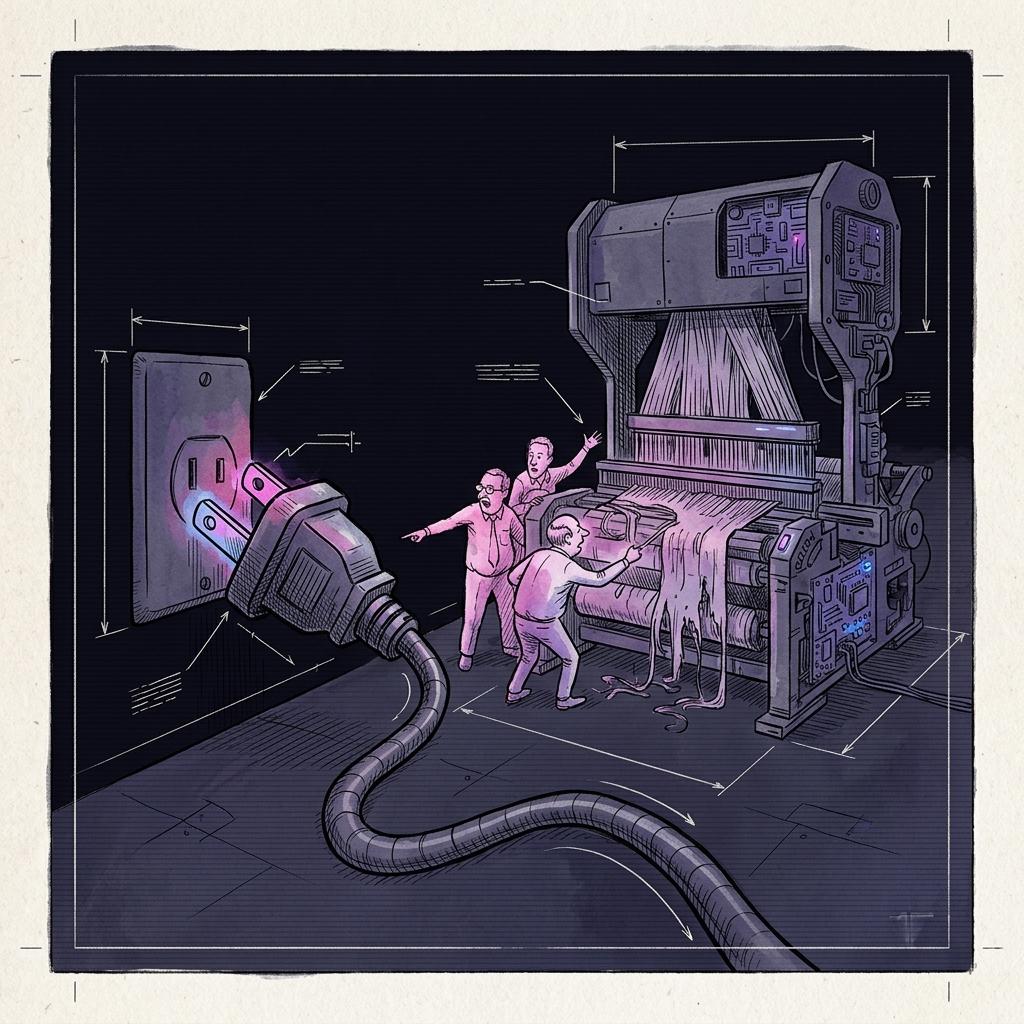
On May 13, 2026, Sinch released a survey of 2,527 senior decision makers across ten countries. The headline number ran everywhere within a day. Three-quarters of enterprises had already rolled back a live AI agent in production. Seventy-four percent of companies that had stood the thing up in front of real customers, watched it run, and pulled the plug.
That was the soundbite. The buried number was sharper.
Among the same survey's mature-governance respondents (the companies with written policies, role-based controls, audit logging, and documented escalation paths), the rollback rate climbed to 81%. The teams who took governance seriously rolled back MORE agents than the teams who treated it as a checkbox. The chart was not broken. The orgs with the best instruments pulled the cord the most.
That paradox tells you almost everything you need to know about agentic workflow implementation in business right now. Done well, it produces what looks like failure to the press release. The act of yanking the agent at 9:42 on a Tuesday morning is a sign that the architecture worked. The orgs running 74% of broken bots in production are not the ones to envy.
This piece is about why the 81% number is the correct one, what the labs admitted in May when they spun up their own deployment arms, and what an actual agentic workflow looks like inside a real company.
The 81% Is the Chart Reading Correctly
The Sinch finding had two reactions. First wave: AI agents are oversold and the rollback wave proves it. Second wave: 60% of enterprises still have live agents and 90% expect to within twelve months, so the rollback wave proves nothing. Both readings miss the structure.
Here is what a rollback actually requires.
It requires a baseline of what "working" means, captured before the agent went live. It requires a monitoring layer that can see the agent's actions in production and compare them against that baseline. It requires a routing layer that can divert traffic away from the agent the instant the signal degrades. It requires an integration contract that specifies which downstream systems the agent can touch and how it must fail. It requires a kill switch that someone has authority to pull at three in the morning without a meeting.
If any of those pieces are missing, you do not roll back. You discover the failure six weeks later when a customer files a chargeback or a partner threatens to sue.
The 74% baseline is companies that built enough of that stack to see the failure and act on it. The 81% rate is companies that built more of it. They saw more of what their agent was doing, so they had more occasions to act. The strict reading of the data is that the orgs with mature governance are the ones who actually deployed an agentic workflow, full stop. Everyone else deployed an agent and called it the workflow.
This is the central confusion in the market. Buying a model is not implementation. Wrapping that model in a SaaS UI is not implementation either. Implementation is the rollback path, the kill switch, the integration contract, and the audit log that lets you reconstruct what happened at 9:42 on Tuesday. Without those, you have a demo running in production.
The Labs Conceded This in May
On May 4, 2026, Anthropic announced a roughly $1.5 billion joint venture with Blackstone, Hellman & Friedman, and Goldman Sachs. The structure is a separate corporate vehicle whose job is to put Anthropic engineers inside the offices of mid-market companies, particularly the portfolio companies owned by those private equity firms, and rebuild those companies around Claude.
Seven days later, on May 11, OpenAI launched The OpenAI Deployment Company. A majority-owned subsidiary, more than $4 billion in committed capital. The same day, OpenAI announced it was acquiring Tomoro, a London applied-AI firm, for roughly 150 deployment engineers with delivery records inside Tesco, Virgin Atlantic, and other operational enterprises.
Two of the three labs that publish the frontier models stood up forward-deployed engineering arms inside the same fortnight. Google Cloud and BCG analyses already pegged the agentic AI systems-integration market at close to a trillion dollars. The labs read the same numbers everyone else read. They concluded that selling a model and waiting for a system integrator to install it correctly was a losing arrangement.
The market signal is simple. The companies that train the best models in the world do not believe the model is the product. They believe the install is the product. They are willing to put their own engineers on flights to install it, because they have watched too many customers buy the model and never finish the implementation.
If the labs do not believe the model is the implementation, why do enterprise buyers still write checks as if it were?
What Agentic Workflow Implementation in Business Actually Is
Treat the phrase literally. A workflow is a sequence of steps that does work. An agentic workflow is a sequence where one or more of the steps is taken by an autonomous software actor that decides what to do given context. Implementation in business means that workflow runs inside a real company, with real customers, real money, and real consequences when something goes wrong.
That definition has five concrete pieces. Skip any of them and you have a science project, not a workflow.
The first piece is intent decomposition. You need a written statement of what the workflow is trying to accomplish, what it is allowed to do on the way there, what counts as success, and what counts as failure. Most enterprises start with the agent and back-fit the intent later. That is the wrong order. The intent comes first because every other piece of the stack derives from it.
The second piece is the integration contract. You list every system the agent can touch (your CRM, your ticketing system, your billing platform, your messaging gateway, your data warehouse), and you write down what API call the agent is allowed to make against each, with what scope, with what rate limit, and with what the rollback action is if a call is made in error. Sinch found that authentication and identity failures dominated the failure mode list. That is the integration contract failing in public.
The third piece is the observability layer. Every decision the agent takes, with what input, against what context, with what tool call, and with what outcome, lands in a log that a human can read. You do not get to skip this because the agent feels too verbose. The reason mature-governance teams roll back more is that they can see what the agent is doing. Blindness is not the same thing as safety.
The fourth piece is the kill switch and the rollback path. Someone has the authority and the technical capability to pull the agent out of the loop within minutes. Traffic reroutes to humans, to a simpler rules-based path, or to a holding pattern that buys time. The rollback does not require an engineering deploy. It is a toggle. Gartner's May 26, 2026 release was blunt on this point. Applying uniform governance across all agents, treating them as one undifferentiated category, will guarantee enterprise AI agent failure. Each workflow needs its own kill path tuned to its blast radius.
The fifth piece is the institutional memory. What the agent learned, what it got wrong, what the rollback revealed, all flow back into a record that the next deployment reads. Without this, every rollback is a new disaster instead of a compounding lesson. The 81% rollback rate at mature firms is, structurally, the early innings of a feedback loop. Two years from now, the orgs that built this layer will hold institutional memory of every edge case their agents have ever hit. The orgs at 74% will be relearning the same lessons.
The Klarna Headline Was a Stand-In for the Real Story
Klarna spent eighteen months as the AI deployment poster child, then a year as the cautionary tale. CEO Sebastian Siemiatkowski said in early 2025 the company had replaced the work of 700 customer service agents with an AI bot. By mid-2025 the press cycle had flipped. Klarna was rehiring humans. Siemiatkowski said the company had focused too hard on efficiency and the quality slipped.
By February 2026 the story flipped again. Siemiatkowski clarified that the bot was handling 1.3 million tickets a month, the equivalent work of about 800 humans, two-thirds of all customer service chats, with two-minute average resolution against eleven-minute human baselines. He said the press had misread the rehiring as a retreat.
Both narratives flatten what actually happened. Klarna did not deploy an agent. They deployed a workflow with a human fallback path, and they tuned the routing live. When the quality slipped, they moved the boundary. When it stabilized, they moved it again. The chart is a routing decision that updates in production. Reading it as victory or defeat misses what is actually happening.
This is what agentic workflow implementation in business looks like in motion. The workflow is the thing. The model is one component. The human is another. The routing layer between them is the lever. A CEO who tells the press "we replaced 700 humans" or "we are rehiring 100 humans" is talking about the routing decision, not the agent. The agent has been running the whole time.
The companies that get this distinction will spend the next two years quietly tuning their routing layers. The companies that do not will keep generating press cycles every six months about whether AI works, when the actual question is whether their workflow design works.
The Failure Modes Have Names
A pattern shows up across the Sinch failures, the Gartner cautions, and the Anthropic and OpenAI marketing material. The same five things break the same way.
Authentication and identity failures break the integration contract. The agent makes a call with the wrong scope, touches the wrong record, or impersonates the wrong principal. This shows up as the single largest category in production audits this year.
Cascading actions break the blast-radius limit. The agent misclassifies a ticket, takes an autonomous action, that action triggers a downstream workflow, that workflow triggers a billing event, and by the time anyone notices, twelve customers have a duplicate charge. The kill switch lives at the wrong altitude.
Non-deterministic debugging breaks the postmortem. The same input produced a good answer on Monday and a wrong answer on Tuesday. Nobody can reconstruct why. The observability layer was logging the input and the output but not the context window the agent saw, so the trace is unreplayable.
Weak handoff design breaks the customer experience. The agent decides it cannot help, transfers to a human, and the human gets a context dump that is either too long or too short to act on. The customer repeats the problem for the third time and writes a Reddit post.
Uniform governance breaks the highest-risk workflows. Gartner called this out explicitly. A returns-processing agent and a wire-transfer agent cannot be governed by the same set of policies. The blast radii differ by three orders of magnitude. Most companies write one AI policy, apply it everywhere, and discover this when the wire transfer goes through.
Every one of these failure modes is solvable. None of them are model problems. They are workflow design problems. The agent did exactly what the workflow was designed to let it do. The workflow was designed without enough thought.
What An Implementation Engagement Actually Produces
The deliverable from doing this right is not an agent. It is a documented workflow with five artifacts.
An intent document that names the work, the success criteria, the allowed scope, and the failure modes. A list of API contracts the agent can call, with scopes, rate limits, and rollback actions per call. A logging schema that captures every decision, the context it was made in, the tools used, and the outcome. A rollback runbook that names the toggle, names the authority, names the routing fallback, and has been rehearsed at least twice. A feedback channel that pipes operational data, both wins and failures, back into the intent document and the contracts.
You will notice the model selection is not on this list. The model is a swappable component. The implementation is everything around it. Pick the wrong model and you can swap it in a day. Pick the wrong workflow design and you spend six months building toward a press cycle.
The companies running mature governance frameworks have versions of these five artifacts. That is why they rolled back more agents. They saw more of what was happening, and they had the operational muscle to act on what they saw. Their 81% is the leading indicator of an industry separating into two cohorts. One cohort treats rollback as the operating mode. The other treats rollback as the obituary.
Architecture, Not Procurement
The decision facing every C-suite right now is whether to procure agents or architect workflows. The procurement path is faster on the demo. The architecture path is the one that survives May 2027.
Procurement looks like this. A vendor pitches a vertical agent. Your team runs a pilot. The pilot demo is impressive. You sign a contract. The agent goes live. Three weeks later it does something embarrassing. You roll it back, or worse, you do not.
Architecture looks different. You start with the workflow your business actually runs. You decompose it into steps. You decide which steps are candidates for autonomous action, given the blast radius and the reversibility of each step. You write the integration contract before you write the agent prompt. You build the observability layer before you connect the model. You rehearse the rollback before you take live traffic. Then you put a small slice of traffic through it, measure, expand, and roll back when the signal asks you to.
The architecture path produces agents that look boring. They do narrow things. They have explicit fallbacks. They log a lot. They get pulled regularly. And they compound. Six months in, you have five of them running, three of them retired, and your team knows exactly which workflows are safe to extend.
This is what the labs are now selling, indirectly. The Anthropic and OpenAI deployment arms exist because the labs concluded most enterprise buyers do not know how to do the architecture. The labs would rather take a margin on the install than watch their model get blamed for a workflow failure that wasn't the model's fault. The Klarna case proves that even when the agent is doing extraordinary volume, the press will frame it as a referendum on the technology rather than on the routing design.
If you are in an enterprise that has not yet built the rollback muscle, the cost of catching up later compounds against you. You will be the 74% with the broken agent in production, or worse, the small minority who never noticed. The 81% are not the failure case. They are the cohort that knows what they are doing.
The Imperative
Agentic workflow implementation in business is an architecture discipline. It is not a procurement event. The cost of treating it as procurement is not a missed quarter. It is the loss of the operational muscle that determines whether you can run autonomous systems at all.
The companies that win the next decade will be the ones who architected the right workflows, instrumented them well enough to see what their agents were doing, and built the discipline to pull the cord without waiting for permission. Their charts will look messy in the short term. Their compounding curve will be steep.
Agor AI Advisory exists to build that discipline inside your business. We do not sell agents. We architect the workflow, write the integration contract, build the observability layer, rehearse the rollback, and stay on the engagement until the operating muscle lives inside your team. Then you own it.
If you are reading the headlines about rollbacks and wondering whether your shop is in the 74%, the 81%, or somewhere worse, that question is the engagement. We answer it together, in your data, on your floor.
Sources
- Sinch research reveals 74% of enterprises have rolled back live AI customer communications agents, May 13, 2026
- Why three-quarters of enterprises have rolled back AI agents, Customer Experience Dive, May 2026
- Dissatisfied: Three-fourths of AI customer service rollouts are a letdown, The Register, May 13, 2026
- Anthropic and OpenAI are both launching joint ventures for enterprise AI services, TechCrunch, May 4, 2026
- What is a Forward Deployed Engineer: The AI Role OpenAI, Anthropic, and Google Are Hiring in 2026, MarkTechPost, May 20, 2026
- Gartner Says Applying Uniform Governance Across AI Agents Will Lead to Enterprise AI Agent Failure, May 26, 2026
- Klarna Is Hiring Customer Service Agents After AI Couldn't Cut It on Calls, Entrepreneur