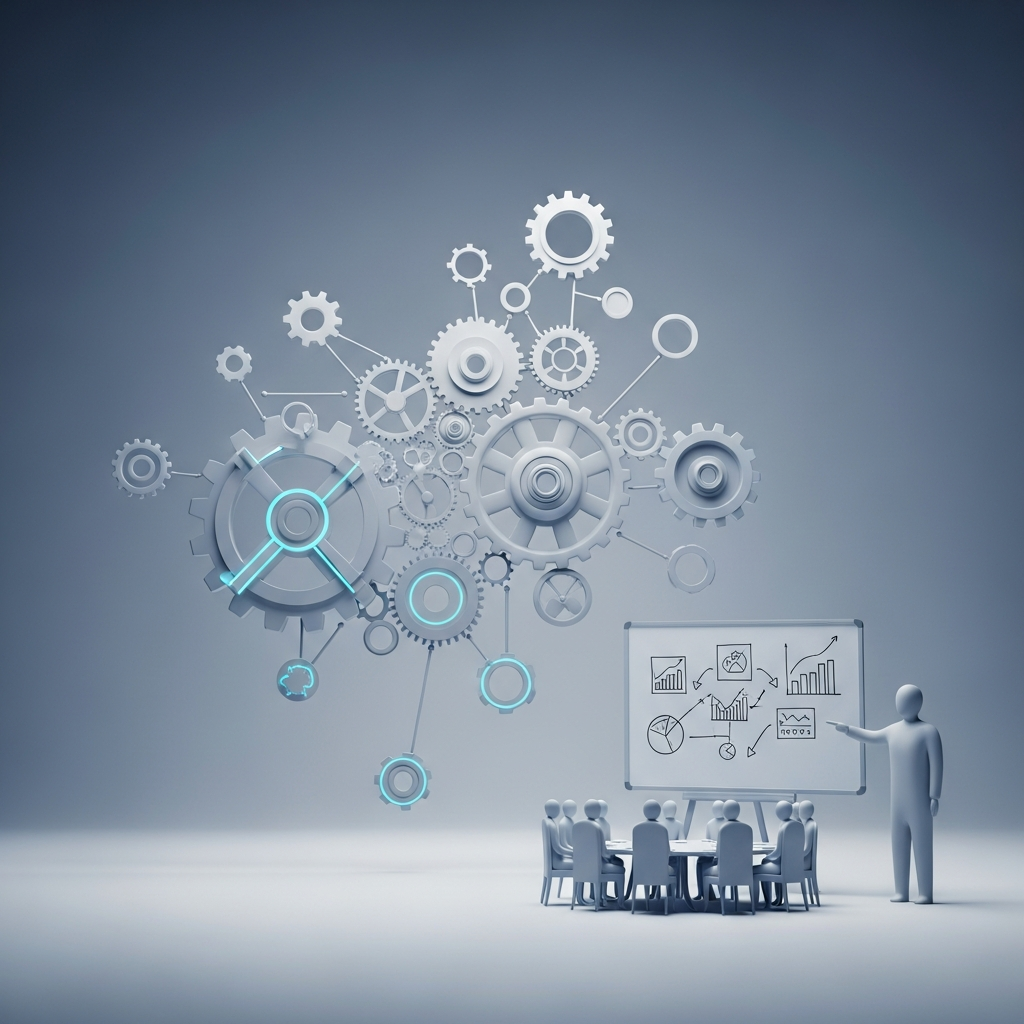
Artificial Intelligence is no longer just a buzzword—it represents a fundamental shift in how businesses operate, compete, and create value. For the consulting industry, this transformation runs particularly deep. We're witnessing the emergence of a new paradigm where the traditional consultant's toolkit of frameworks, spreadsheets, and PowerPoint presentations is being augmented—and in some cases replaced—by intelligent systems capable of processing information at scales previously unimaginable.
But here's what many get wrong about this transformation: it's not about replacement. It's about elevation. The future of AI consulting isn't about machines taking over; it's about humans and machines working together in ways that amplify the strengths of both.
The Shift to Strategic AI
For decades, consultants built their value proposition on a simple formula: gather data, analyze it, and deliver insights that inform better decisions. This model served businesses well in an era of information scarcity. Consultants had access to proprietary databases, industry benchmarks, and analytical expertise that most organizations lacked internally.
Today, that equation has fundamentally changed. AI agents can now process vast amounts of data in seconds—performing analyses that would have taken teams of junior consultants weeks to complete. Natural language processing can extract insights from thousands of documents. Machine learning models can identify patterns in customer behavior that human analysts might never notice.
So where does this leave the consultant? Paradoxically, in a more valuable position than ever—but only if they evolve. The role of the modern AI consultant is shifting from being the person who does the analysis to being the person who directs it. The critical skills are no longer about crunching numbers; they're about asking the right questions, interpreting implications in context, and translating technical possibilities into business strategy.
Consider a typical engagement: a retail company wants to optimize its supply chain. In the old model, consultants would spend weeks gathering data, building models, and identifying inefficiencies. With AI, that analytical work can be compressed dramatically. But the questions of which optimizations to prioritize, how to sequence implementations given organizational constraints, and who needs to be brought along on the journey—these remain profoundly human challenges.
Why Human Expertise Matters More Than Ever
There's a persistent narrative in technology circles that AI will eventually do everything humans can do, only better. This view fundamentally misunderstands both the nature of intelligence and the complexity of business problems.
While AI excels at pattern recognition and processing scale, it struggles with several critical dimensions of consulting work:
- Organizational Culture and Politics: Every company has unwritten rules, power dynamics, and historical baggage that shape what's actually possible. AI can't read the room in a stakeholder meeting or sense that a technically optimal solution will face insurmountable political resistance.
- Ambiguous Stakeholder Relationships: Business decisions rarely optimize for a single objective. They balance competing interests—shareholders, employees, customers, regulators, communities. Navigating these tradeoffs requires judgment that emerges from experience, not algorithms.
- Ethical Gray Areas: Many of the most important business decisions involve genuine ethical complexity. Should a company automate roles knowing it will eliminate jobs? How should customer data be used? These questions don't have objectively correct answers—they require wisdom.
- Change Management: Implementing any significant initiative requires bringing people along. It requires empathy, communication, and the emotional intelligence to understand resistance and address it constructively. No AI system has yet demonstrated these capabilities.
The most successful companies in the AI era will be those that recognize this complementarity. They'll use AI to handle what AI does best—processing, pattern recognition, optimization—while relying on human judgment for what humans do best: contextual reasoning, relationship navigation, ethical deliberation, and creative problem-solving.
The Emerging Model of Human-AI Collaboration
At Agor AI Consulting, we've developed a framework for thinking about human-AI collaboration that we call the "Elevation Model." The core insight is simple: AI should elevate human capabilities, not replace human judgment.
In practice, this means structuring engagements around a clear division of cognitive labor. AI handles the heavy lifting of data processing, scenario modeling, and pattern detection. Human consultants focus on problem framing, stakeholder alignment, ethical oversight, and strategic synthesis.
This model requires new skills from consultants. Technical literacy becomes essential—not the ability to write code necessarily, but the ability to understand what AI systems can and cannot do, to recognize when they're producing reliable outputs versus hallucinating, and to design workflows that leverage their strengths while compensating for their weaknesses.
It also requires clients to think differently about what they're buying. The value of consulting in the AI era isn't measured in hours of analyst time or pages of reports. It's measured in the quality of decisions made and outcomes achieved. The best AI consultants are those who can orchestrate both human and machine intelligence toward business results.
The Path Forward
The consulting industry is at an inflection point. Firms that cling to traditional models—billing for bodies, delivering static reports, hoarding information asymmetry—will find themselves increasingly irrelevant. The data and analysis that once justified premium fees are becoming commoditized.
But firms that embrace the new paradigm have an extraordinary opportunity. By combining AI's computational power with human wisdom, they can deliver insights faster, at lower cost, and with greater strategic relevance than ever before. They can tackle problems that were previously intractable—too complex, too data-intensive, too multidimensional for purely human analysis.
At Agor AI Consulting, we believe the future belongs to hybrid approaches that honor both what machines do well and what humans do well. Our role is to help businesses find that balance—to implement AI where it creates value, to preserve human judgment where it matters, and to build organizations capable of thriving in an era of intelligent machines.
The question for every business leader isn't whether AI will transform consulting—it already is. The question is whether you'll be among those who harness that transformation for competitive advantage, or among those disrupted by it.