On July 13, 2026, CEO World Magazine published a piece arguing that leaders should stop measuring the return on AI in dollars. Drawing from Brian Solis and Dave Wright's book Infinite, the article proposed a new metric called Return on Intelligence, ROI infinity. The idea is that classical ROI is too narrow to capture what AI actually creates, so a CEO should measure how much intelligence they are embedding into every workflow, product, service, and decision instead.
The impulse behind that argument is understandable. The proposed fix is worse than what it replaces.
BCG's AI Radar for 2026 surveyed executives across 60 countries and found that four out of five CEOs feel more optimistic about AI ROI than a year ago. A separate Forbes analysis from January reported that 56 percent of those same CEOs see zero measurable return from AI so far. McKinsey's State of AI work puts 88 percent of organizations at active use of generative AI in at least one business function, and more than 80 percent of them report no EBIT impact from it. The MIT NANDA "GenAI Divide" report from last summer counted 95 percent of enterprise generative AI pilots as producing no measurable profit-and-loss impact after $30 to $40 billion in aggregate spend. And Gartner has predicted, in a press release that Forbes revisited on July 7, that 40 percent of agentic AI projects will be canceled by the end of 2027. Gartner named three causes for those cancellations. Escalating costs. Unclear business value. Inadequate risk controls. Nothing about model quality. Nothing about hallucinations. Nothing about benchmarks. The failures are management, governance, and finance.
A competent board should recoil from those numbers. So a growing chorus of consultants is saying the problem is the way companies measure, which is correct, and then offering a softer metric layered on top of the same broken accounting, which is a mistake. Return on Intelligence has no denominator you can defend and no numerator you can measure. It is a philosophy dressed as a KPI. Any organization that adopts it will end up with an even wider gap between what the board wants to see and what the CFO can actually produce.
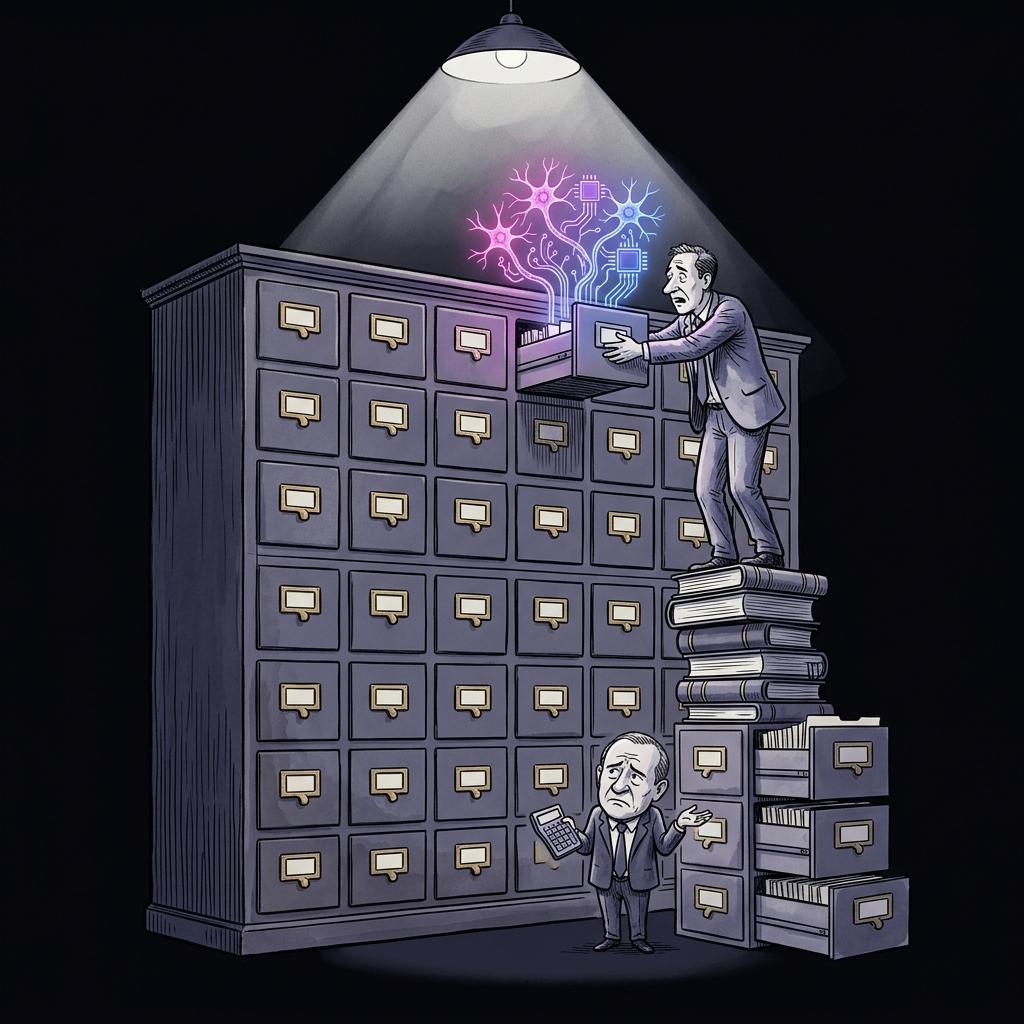
The real answer runs the opposite direction. Measuring ROI on AI initiatives requires a harder ledger, not a softer story. It requires extending the chart of accounts your company has been running for a hundred years so that it can represent cognitive infrastructure the way it used to represent property, plant, and equipment. Nobody wants to hear that. Nobody has a slide deck for it. The 40 percent of agentic AI projects that Gartner expects to die by 2027 are the projects owned by the leaders who took the slide deck instead of doing the ledger work.
The gap the CEOs already see
The disconnect is largest at the treasury level. The Futurum Group surveyed 830 global IT decision makers for its 1H 2026 Enterprise Software Decision Maker report. Direct financial impact, meaning top-line revenue growth and bottom-line profitability, nearly doubled as the primary ROI metric buyers now look for. Productivity gains fell from 23.8 percent of responses to 18.0 percent as the top metric. The market has stopped accepting "our people are more productive" as a legitimate return. It wants dollars on a P&L line.
Meanwhile the companies selling AI infrastructure are spending like the story is settled. Amazon, Google, Meta, and Microsoft together are guiding to roughly $725 billion in capital expenditure for 2026, a 77 percent jump over 2025, with nearly all of it going to GPU clusters, custom silicon, and data center construction. On June 2, Forbes flagged that the AI capex-to-revenue gap is widening and public markets are starting to notice. Hyperscalers are building the plant. Their customers cannot show the returns. Somebody's model of the world is wrong.
The reason both can be true at once is that the plant books as long-lived capital while the returns get measured on quarterly windows. When Google spends $185 billion on TPU clusters, it depreciates that spend over years and smooths the number across a decade of use. When Google's customer spends $200,000 on a Claude Sonnet 5 deployment, the CFO watches the check clear this quarter and asks for the payback next quarter. Same technology, different accounting rhythm, different verdict.
The chart of accounts was built for a different century
Every large company runs on a chart of accounts. It has categories for cost of goods sold, for research and development, for salaries and wages, for depreciation of property and equipment, for software subscriptions, for professional services. Those categories were built for a world in which every dollar you spent bought a thing with a known useful life and a known way to produce value.
An AI agent fits none of those categories cleanly. It has integration and setup cost that looks like capital equipment. It has token and inference cost that looks like a variable expense. It has an ongoing tuning cost that looks like professional services. It replaces work that used to be labor. And it produces value that shows up as some blend of faster customer service, fewer errors, new product features, and capabilities the company did not have before.
Ask a controller which line to book that against and they will pick one and ignore the others. Most pick SaaS or professional services because those are the invoices they see first. At quarter close, the finance team asks what the return was on the SaaS line. The answer is a productivity story with no dollars attached. The controller writes it down as "unclear business value." Gartner counts it in the 40 percent.
This is not a metaphor. Speak to a controller at a mid-market industrial company and they will tell you they physically cannot find a place in their ERP to book a Claude Code seat that does the work of an entry-level analyst. Book it as a subscription and it looks expensive. Book it as contract labor and the auditor asks who the vendor is. Book it as R&D and the tax treatment is wrong. Capitalize the integration effort and they need a written policy on the useful life of an agent whose underlying model gets a step-change release every eight weeks. There is no policy. So the pilot gets funded once out of a discretionary bucket, produces a fuzzy result, and dies quietly at the next budget review.
The J-curve nobody will fund
The MIT Initiative on the Digital Economy has been making a specific argument about this pattern at its BIG.AI conference in Cambridge every year. Companies that invest see a temporary productivity dip before the returns arrive, because the organizational rewiring required to get value from AI takes time that shows up on the payroll long before it shows up on the output. Economists call the shape a J-curve. Erik Brynjolfsson has been writing about it for decades. Electricity showed a J-curve. Personal computers showed a J-curve. AI is showing one now.
The trouble is that no CFO can defend a J-curve to a public-company board. A dip in productivity, followed by a rise later, followed by a defensible return in year three, is exactly the shape of investment that quarterly incentives punish. The CFO's job is to hit the number this quarter. The dip is real. The recovery is theoretical until it arrives. The theoretical recovery does not go on the earnings call.
So even when a company knows the science, the finance function will still cancel the pilot at review. Not out of stupidity. Out of correctly following the incentives that today's accounting system creates. Fix the incentives or you cannot fix the outcome.
How the surviving five percent do it
The 5 percent of enterprise AI programs that MIT counted as successful shared a trait the failing 95 percent did not. They deployed AI into a small number of high-value workflows, took on the integration friction, and measured a single workflow's end-to-end economics rather than a productivity lift across the company.
This runs the opposite direction from what most vendors sell. Most vendors sell horizontal deployments. A Copilot per employee. A chatbot for customer service. An assistant for developers. Each seat costs about $30 per month and is supposed to save some fraction of an hour of work per day. Multiplied across the company, the story adds up to millions. In practice, the productivity lift never shows up in the numbers, because it distributes into a thousand tiny slack pockets no manager can recover.
The 5 percent picked a workflow, tore it up, and rebuilt around the agent. Underwriting on a specialty insurance line. Contract review at a firm with 400 attorneys. Return authorization at a direct-to-consumer retailer. In each case the workflow had a defensible cost per unit before the deployment. After the deployment, that cost per unit dropped by a factor of three or five. The finance team could point at a specific line in the P&L and show the delta. The pilot survived budget review because the ledger could carry the story.
The lesson generalizes. Measurement only works when you own the workflow's boundaries. If your ROI number is smeared across every seat in the company, you have chosen a denominator no finance system can pin down. If your ROI number is the difference between the fully-loaded cost of underwriting a policy in April and the fully-loaded cost of underwriting the same policy in October, the finance system can pin it exactly.
How to actually measure the ROI on AI initiatives
Once you commit to workflow-level measurement, the rest of the design falls out. You need four things in place, none of which come in a Copilot license.
You need a chart-of-accounts extension that names the categories your finance team will use for cognitive infrastructure. Cognitive integration capital. Model access fees. Per-outcome inference cost. Agent tuning services. Each of these needs a written useful-life policy, a written depreciation schedule where relevant, and a governance owner who signs off on changes.
You need per-workflow telemetry that emits cost per outcome to the ledger at the same tempo the workflow runs. If your underwriting agent runs 400 policies a day, the ledger should have a running cost-per-policy number that updates daily and rolls up weekly. This is a small piece of software plumbing. Almost no company has built it.
You need a governance layer that reviews model routing, tuning changes, and vendor swaps on the same cadence, with real authority to move budget between line items in response to what the telemetry shows. When a new Claude release cuts token spend on the underwriting workflow by 30 percent, someone with signing authority needs to reallocate that savings within a week, not wait for the annual planning cycle.
You need a board-facing dashboard that shows the running J-curve so the recovery becomes visible before it lands. This is the missing artifact in almost every AI program running today. The board wants to see a number that says the program is working. The finance system can only give them productivity anecdotes and quarterly cost totals. Neither is a J-curve. A properly instrumented program produces one automatically.
Do the four things and measuring ROI on AI initiatives stops feeling like a debate about metrics and starts looking like a normal operational review. Skip any of the four and you will end up with a Return on Intelligence slide, a fuzzy result, and a canceled pilot.
Cadence has to match mutation rate
Here is the structural principle that ties the whole thing together. The rhythm of the measurement has to match the rhythm at which the asset changes.
When a company buys a lathe, the lathe does not change for twenty years, so an annual review of return on the lathe makes sense. When a company subscribes to a SaaS product, the product updates monthly, so a quarterly review makes sense. When a company deploys an agentic system on top of Claude Sonnet 5, the underlying model releases a step-change roughly every eight to twelve weeks, the agent's task graph gets edited every week, and its cost per action can shift by 40 percent in a month depending on model routing.
Reviewing that asset annually is like taking one photograph of a race car per year and using it to estimate lap times. The book value bears no relationship to the operational reality. Almost every enterprise runs its AI ROI review on the annual budget cycle anyway. The result is a measurement that is stale before it compiles, then used to make a go or no-go decision that shapes the next year of the program.
The 5 percent measure differently. They set up telemetry inside the workflow that tracks cost per outcome week over week. They compare cost per outcome to the pre-deployment baseline continuously. They can tell you today what the underwriting cost per policy is, what it was thirty days ago, and where the change came from. When the cost drops because a new model release cut token spend, they see it. When the cost climbs because a routing regression added retries, they see that too. The measurement runs at the same tempo as the asset.
Building that telemetry is architectural work. It requires the workflow to be instrumented, the ledger extended, the routing layer to expose per-action cost, and the finance system taught to consume that stream. Every one of those steps is a small custom build that vendors will not do for you. This is the friction the MIT team was talking about when it wrote that the successful 5 percent design for friction.
Nobody is going to sell you the fix
Every consultancy in the market now sells an AI ROI framework. Every vendor has a business value calculator on its landing page. Buy one and you get a spreadsheet that assumes the productivity lift you want it to assume, then hands you the number you were hoping for.
None of those tools touch the underlying problem. The underlying problem is that your existing systems, meaning your ERP, your chart of accounts, your budget process, your quarterly review, your board deck, cannot represent an agentic workforce yet. You cannot fix that with a spreadsheet from Deloitte or a webinar from Gartner. You have to build the representation inside your own house.
Return on Intelligence is dangerous specifically because it lets a leader check the box on "we measure AI differently now" without doing any of the four things above. Buying a framework is not the same as building the measurement. Attending a conference is not the same as extending the ledger. Reading Solis's book is not the same as teaching your controllers how to depreciate a Claude subscription.
Every vendor in the space knows this. They also know that most CEOs will settle for the framework, because the alternative is a real integration project across finance, IT, and the operating divisions that runs for a couple of quarters. The vendor gets the seat license. The CEO gets the checkbox. The 40 percent cancellation number gets larger.
If you have a set of pilots running today and you cannot show the P&L delta on any of them, those pilots are already dying. You have one budget cycle to build the measurement before your own CFO's spreadsheet does the cancellation work for you. And the CFO will be right to do it, because a program with no measurable return is by definition a program you cannot defend.
The imperative
Architecting an AI ROI system is the highest-leverage strategic work an operator can do in 2026. It sits upstream of every model choice, every vendor negotiation, every agent deployment, every organizational change. Companies that get it right will run their AI programs with the rigor they run their supply chain. Companies that get it wrong will spend the back half of this decade canceling pilots and wondering why their competitors pulled ahead on a cost curve they never saw.
The work cannot be outsourced to a vendor whose incentive is to sell more seats. It cannot be delegated to a controller whose training assumes assets sit still for years. It cannot be papered over with a framework that promises to measure "intelligence." It has to be architected by someone who understands the finance system, the AI system, and the operating rhythm of the business at the same time, and who has permission to change all three.
That is the work Agor AI Advisory does. We come in for the ninety days it takes to extend your chart of accounts, wire the per-workflow telemetry, set up the governance cadence, and get the first workflow measurable end to end. We leave your finance team owning the system, your operating leaders owning the workflows, and your board seeing the J-curve early enough to keep funding the program past the dip. The next planning cycle either has your ROI numbers or it has your cancellation memo. There is not a third option.
Sources
- Why 40% Of Agentic AI Projects May Be Canceled By 2027, Forbes, July 7, 2026
- Gartner Predicts Over 40% of Agentic AI Projects Will Be Canceled by End of 2027, Gartner press release, June 25, 2025
- MIT report: 95% of generative AI pilots at companies are failing, Fortune, August 18, 2025
- Enterprise AI ROI Shifts as Agentic Priorities Surge, Futurum Group 1H 2026
- BCG AI Radar 2026: As AI Investments Surge, CEOs Take the Lead
- The AI Capex-to-Revenue Gap Is Widening, Forbes, June 2, 2026
- The New ROI of AI: CEOs Must Now Measure Return on Intelligence, CEOWORLD magazine, July 13, 2026
- Business Implications of AI: BIG.AI@MIT 2026, MIT Initiative on the Digital Economy