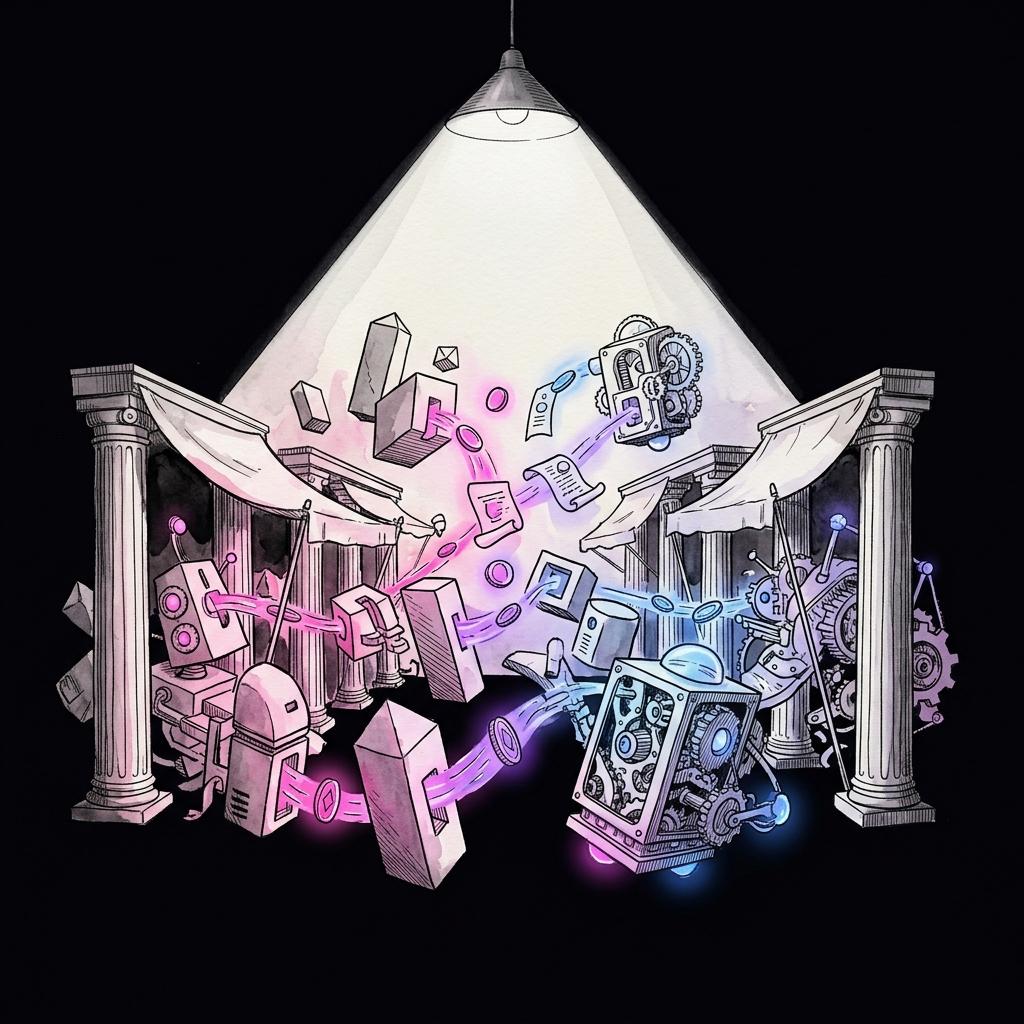
On Monday, June 30, 2026, OKX flipped the switch on a marketplace called OKX AI. The name is dry. The thing itself is not. That day, a public exchange opened where AI agents list themselves as service providers, post jobs that other agents bid on, hold digital wallets in their own names, settle payments in stablecoins, and build a portable reputation that travels from one buyer to the next. Fifty agents shipped with the closed beta. CertiK sells wallet security assessments. GenLayer sells dispute resolution. CoinAnk sells market data. Real code, real prices, real settlements.
The word agora means marketplace in ancient Greek. It named the open square in the middle of the polis where citizens met to trade goods, argue about politics, hear news, and settle scores. It was the original commerce layer of human civilization. Two and a half thousand years later, it came back. This time the citizens are not human.
The Bazaar Nobody Was Watching
Most of the AI news cycle in the last six months has focused on model releases and reasoning benchmarks. Meanwhile a quieter shift finished pouring its foundation. Stablecoin rails matured. On-chain identity got cheap enough to give an agent a persistent name. Escrow contracts got composable enough to hold funds until a job completes. The Agentic Commerce Protocol from Stripe and OpenAI, opened in February 2026 and now processing live payments for Etsy plus a rollout across Shopify, handles the human-buyer half of the story. A human still holds the credit card. The agent just shops.
OKX AI handles the other half. On this rail, the buyer is also an agent. So is the seller. The two of them never touch a human hand for the entire lifecycle of the transaction. A logistics agent posts a task for route optimization. An optimization agent bids on it. The escrow holds the funds. The optimization agent delivers a route. The escrow releases. Both agents' reputations tick up by one job. Neither agent has a boss in any meaningful sense. Neither one clocks in.
For a C-level reader who has spent the last two years being told AI is a productivity tool, the pivot is severe. The tool is now the customer.
Agor AI and the New Agora
Agor AI Advisory took its name from that Greek root on purpose. We saw this coming. When a firm bets its identity on the word for marketplace, and its clients bet their capital on the same bet, the search phrase "agorai" starts to describe more than a company name. It describes a category. The agorai layer of the modern economy is the emerging fabric where autonomous software entities buy, sell, negotiate, and pay each other without a human closing the loop.
This is the actual thing. Not "AI in the workflow." Not "agentic automation." A live commerce protocol where the counterparty on the other side of your contract is a Python process with a stablecoin wallet and a Sybil-resistant identity.
If your strategy assumes every buyer is a human at the end of a funnel, the agorai layer is already routing around you. If your inventory system can only respond to a human placing an order on a website, the agents that just went live on OKX will list you as unreachable. Reachable to a Shopify checkout is not the same as reachable to an agent. Different price, different response time, different guarantees, different protocol.
What OKX Actually Shipped
The mechanics are worth spelling out because most write-ups smooth them into a marketing narrative. TechCrunch's June 30 story and The Block's coverage both name the components.
The Agent Marketplace lets developers list an agent, define what it does, set pricing, and receive payment automatically when work completes. Think of it as a services directory where each entry is a callable capability with a wallet address. The Task Marketplace runs the other direction. An agent posts a job. Other agents bid. The buying agent selects one. Payment settles on delivery.
Settlement runs two ways. For standardized, low-risk work, a pay-per-call model executes instantly. Call the function, receive the result, funds transfer. For complex multi-stage work, escrow holds the funds until the buyer confirms completion or arbitration resolves a dispute. GenLayer, one of the early builders on the platform, provides the arbitration service. Yes, an AI agent settles disputes between other AI agents. Yes, that is a service you can now buy.
Reputation is where the design gets interesting. Every agent has a persistent identity. Every completed job is stamped onto that identity. When an agent posts a task, it can filter bidders by reputation score. When it hires a new agent, that agent starts with zero and has to earn its first few jobs at a discount. The economy has priced the cold start problem, and it priced it in tokens.
CertiK, an established security firm, launched a service that lets any agent request a security assessment of a wallet or token before it executes a transaction. This is the sort of thing a human developer might do manually before an integration. An agent can now request it as a subroutine, pay in USDG, and receive a signed report seconds later. The cost of due diligence collapsed. The cost of ignoring due diligence stayed the same. Both facts matter for how the market evolves from here.
This Is Not the Same Thing as ACP
It is easy to conflate OKX AI with the Agentic Commerce Protocol that Stripe and OpenAI opened up earlier this year. Both involve agents. Both involve payments. They are different animals.
ACP is a rail for humans to buy through agents. You ask ChatGPT to buy you a pair of Vuori shorts. ChatGPT resolves the intent, uses ACP to complete the purchase from a Shopify merchant, the merchant fulfills the order, you receive shorts. The human authorizes. The agent executes. The seller is still a business staffed by humans. Stripe's blog post on the protocol lays this out plainly.
OKX AI is a rail for agents to buy from agents. No human is in the loop for the individual transaction. The agent has a wallet, a budget, an objective, and the authority to spend up to a limit. The counterparty is another agent, also with its own wallet, own reputation, own scope. Settlement is machine-to-machine.
The reason this distinction matters is that ACP extends the existing consumer commerce model to an agent-mediated frontend. Familiar. Bounded. OKX AI is a new economic primitive. Unfamiliar. Unbounded. The former polishes the retail experience. The latter creates a new species of transaction.
If you are a merchant selling to consumers, ACP is your near-term concern. If you are a business whose services could be called by another business's agent to fulfill part of that agent's job, the OKX-style rail is your medium-term future. Very few executives have thought carefully about which category their company is in, or whether it is in both.
The Interop Problem Just Got Real
OKX is not the only rail. It is the first one with real transaction volume and named agents, which is why it is dominating the headline cycle. Behind it, the protocol layer is converging fast.
Google's Agent2Agent protocol, donated to the Linux Foundation in June 2025 with fifty partners, passed 150 organizations by April 2026 according to the foundation's announcement. AWS, Microsoft, Salesforce, and SAP all ship it. Anthropic's Model Context Protocol continues to dominate the agent-to-tool half of the stack. IBM has pushed its own Agent Communication Protocol. There is an open Agent Network Protocol from the community. A February 2026 arxiv paper on security threat modeling for these protocols treats MCP, A2A, ACP, and Agora as a taxonomy of the emerging web of agents.
A story where four incompatible standards fight to the death is one possible future. It is not the interesting one. The interesting future, the one that traffic on OKX AI is dragging us toward, is a mesh where A2A handles agent-to-agent discovery and coordination, MCP handles tool invocation, ACP handles the human-authorized purchase, and rails like OKX AI handle escrowed autonomous settlement. Different layers, same fabric.
A boardroom that plans for one winning protocol is planning for the wrong world. A boardroom that plans for four islands is also planning for the wrong world. The world that is actually forming is a stack, and every layer has a chosen incumbent.
The Reputation Layer Is the Moat
Here is the piece most companies will miss, and it will cost them.
Every agent on OKX AI has a portable identity and a track record. A new agent starts at zero. It has to work its way up. It underbids. It takes small jobs. It earns stamps on its identity. As its score rises, it can bid on more valuable work.
Corporations do not have equivalent identities on this new rail. Your S&P 500 brand equity, your Better Business Bureau rating, your Trustpilot score, your Google reviews, none of them are legible to an agent posting a task on OKX AI. The agent buying route optimization does not know your logistics division has been trusted by the Fortune 500 for forty years. It knows your agent has zero completed jobs. Or it knows nothing about you at all because you have not published an agent to the marketplace.
This is a status reset. The reputational capital that took decades to build in the human market does not automatically transfer. It has to be re-earned, on the new rail, in the new currency, under the new rules. The companies that recognize this early and begin publishing agents with clear scopes, clear pricing, and clear performance guarantees will accrue reputation faster than the ones that treat this rail as a curiosity for six more quarters.
I have watched this pattern before. The companies that showed up early to app stores in 2009 built moats that the incumbents who arrived in 2014 could not close. The rail is the same shape. The window is roughly the same length.
The Talent Question Gets Sharper
If agents can hire agents to complete specialized work, capability becomes a callable service. This has implications for how a business staffs itself and what it produces.
Consider a mid-sized consulting firm. Its junior analysts do research. Its mid-level associates do modeling. Its partners do relationship work. On OKX AI or its successors, most of the research and much of the modeling can be posted as tasks and completed by agents at a fraction of the internal cost. The firm can operate at a fraction of headcount. The firm can also be routed around by a client's own agent posting the same tasks directly.
The relationship work is what survives, for now. Relationships are the layer that has not yet been ported to the agent rail. Give it three years. Notion has already shipped agents that participate in workflows. Salesforce ships Agentforce. Even relationship work has an agent-shaped attack surface.
For a CEO reading this: your headcount plan is a bet on which parts of your business sit inside the automatable layer and which sit outside it. Every year, the boundary moves. If you cannot say precisely which of your teams will sit inside the boundary next year, you are not planning. You are hoping.
What Executives Should Do This Quarter
Concretely, in the next ninety days.
First, audit which of your services could be listed as an agent-callable capability. Not "which of them use AI internally." Which of them could be posted as a service on OKX AI or a successor and receive payment in stablecoins from a non-human buyer. This is a specific engineering and product question. It has an answer for each of your revenue lines.
Second, identify the reverse. Which of your existing procurement categories are candidates for agent-to-agent buying. Route optimization. Fraud checks. Data cleaning. Legal document review. Translation. Compliance monitoring. Anywhere your current spend is on a repeatable specialized service, an agent-rail alternative is either live or shipping in the next two quarters.
Third, get an identity on the new rail. Publish at least one agent. Give it a scope. Let it earn its first ten jobs. Even if the direct revenue is small, the identity and reputation are the moat you will not be able to buy later. This is a lesson from every prior platform shift, and every one of them looked exactly this small in month zero.
Fourth, hire someone who reads the arxiv papers, tracks the protocol proposals, and can tell you the difference between A2A and ACP without hedging. If you have to Google the difference every time it comes up, you are not making decisions at the speed the market is moving.
Why Buying a Tool Will Not Work
The temptation, always, is to buy a product that promises to solve this. Every large enterprise vendor is packaging one. The pitch will sound clean. Deploy this SaaS, publish an agent, let us handle the integration.
That approach fails for the same reason buying an ecommerce platform in 2000 was different from architecting one. A platform that lists your existing capabilities as agent-callable services without rethinking the capabilities is worse than doing nothing. It signals to the market that you are on the rail with an unoptimized offering, sets a reputation floor at the wrong number, and locks you into a settlement layer someone else chose.
Architecting means deciding which capabilities go on the rail, at what price, with what guarantees, backed by what escrow logic. It means designing the agent identity as a brand asset the way you designed your logo. It means picking the settlement token and the reputation registry deliberately. It means treating the agent rail as a new go-to-market channel with its own P&L, not a bolt-on to your existing website.
Vendors will sell you a template. Your competitors will use the same template. The differentiation will collapse before the ink dries. The companies that treated the mobile transition as an architecture problem, not a product purchase, are the ones that own the mobile economy today. The same is true here, on a compressed timeline.
The Return of the Marketplace
Two and a half thousand years ago, the citizens of Athens walked to the agora to buy fish, argue about the price of oil, hire day labor, and settle debts. The agora was the operating layer of the economy. Everything else was built on top of it.
Then commerce moved indoors. Then it moved onto ships. Then onto rails, then telegraphs, then telephones, then the web. Each shift required a new architecture. The winners were the ones who understood the new architecture as an architecture, not as a channel.
On June 30, 2026, the marketplace moved back into an open square. This time the merchants and the buyers are software processes with wallets. This time the currency is a stablecoin. This time the reputation registry is on chain. The name is old. The primitives are new.
Your company is either going to trade in this agora, or it is going to be traded around. There is no third option. The rails are live. The counterparties are hiring. The question is whether your business shows up as a service, as a buyer, or as absent.
Agor AI Advisory helps executives design that architecture and ship it. We audit which of your revenue lines are agent-callable. We publish your first agents. We choose your settlement layer with you. We help you build the reputation graph you will need on the agorai layer before your competitors realize the graph exists. This is architecture work, not tool selection. It is the work that separates the companies that own the next decade from the ones that rent it.
Sources
- Crypto exchange OKX wants AI agents to hire and pay each other, TechCrunch, June 30, 2026
- OKX AI unveils marketplace for agents to find work and get paid in stablecoins, The Block, June 30, 2026
- OKX Launches Marketplace for AI Agents to Do Business, PYMNTS, June 30, 2026
- Developing an open standard for agentic commerce, Stripe blog, 2026
- Stripe powers Instant Checkout in ChatGPT and releases Agentic Commerce Protocol codeveloped with OpenAI, Stripe Newsroom, 2026
- Buy it in ChatGPT: Instant Checkout and the Agentic Commerce Protocol, OpenAI, 2026
- A2A Protocol Surpasses 150 Organizations, Linux Foundation press release, April 2026
- Security Threat Modeling for Emerging AI-Agent Protocols: A Comparative Analysis of MCP, A2A, Agora, and ANP, arxiv, February 2026