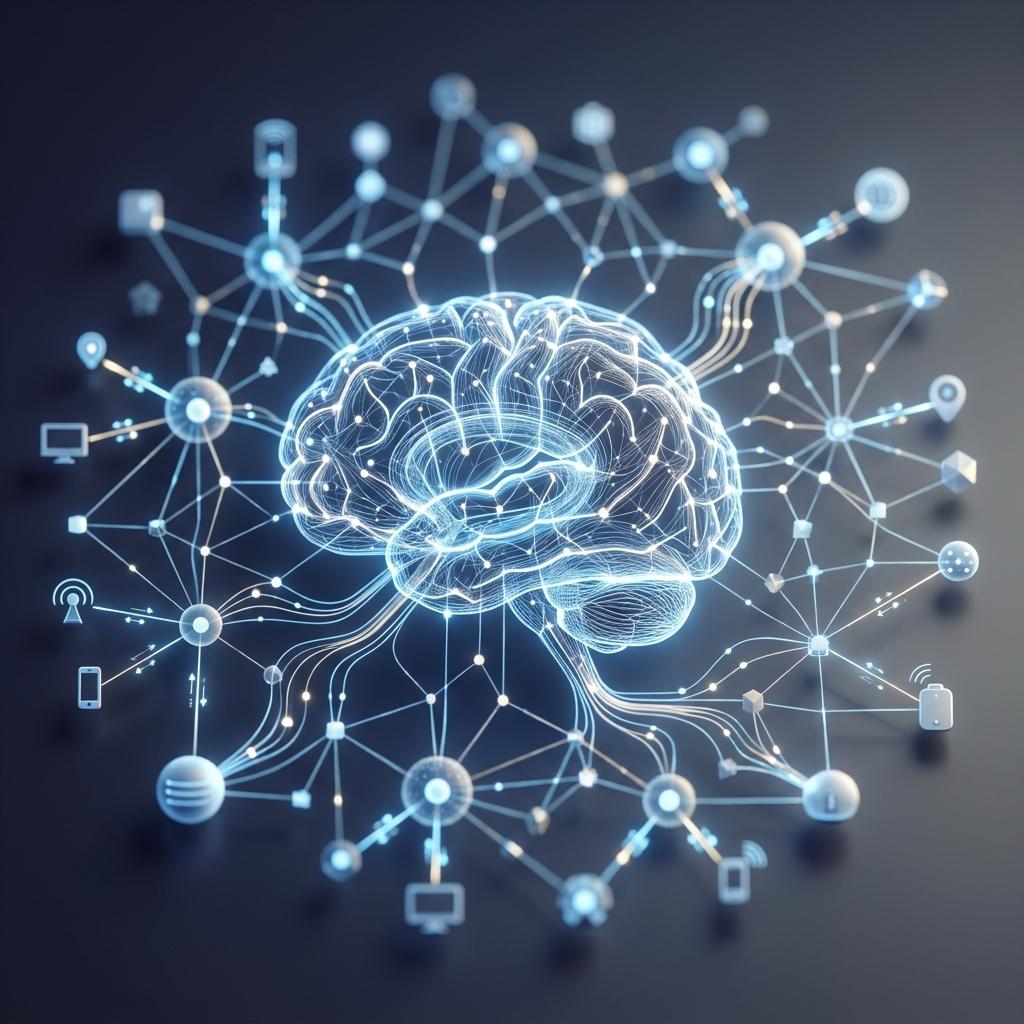
The Library Is Burning — And No One Smells the Smoke
There is a particular kind of organizational pride that precedes extinction. It manifests as reverence for the accumulated: the terabytes of Confluence pages, the SharePoint labyrinths, the Notion databases meticulously tagged and cross-referenced, the tribal knowledge captured in onboarding decks that no one reads past slide four. Executives point to these repositories the way medieval lords pointed to their castle walls — as evidence of permanence, of substance, of competitive depth.
But here is the truth that almost no one in a boardroom is willing to say aloud: your repository is not an asset. It is a graveyard. Every document filed is a thought that stopped evolving. Every process manual committed to a wiki is a decision frozen at the moment of its least relevance — the moment it was written down. Every "knowledge base" is, by definition, a base of past knowledge, calcified into formats that resist the very adaptation your organization needs to survive.
This is not a metaphor. This is a structural diagnosis.
We are witnessing the annihilation of the repository — not as a storage technology, but as an organizational concept. The idea that knowledge is something you capture, store, index, and retrieve is a paradigm born of scarcity: scarcity of memory, scarcity of processing, scarcity of cognitive bandwidth. AI has obliterated every single one of those scarcities. And in doing so, it has rendered the repository not just obsolete, but actively dangerous.
The organizations that will dominate the next decade are not those with the most knowledge stored. They are those with the most knowledge alive — circulating, mutating, connecting, and acting in real time, without human intervention, without retrieval latency, without the catastrophic entropy that turns every static document into a lie within weeks of its creation.
This is the shift from the repository to the cognitive organism. And if you do not architect for it deliberately, your competitors will — and the gap will not be one you can close.
The Fundamental Lie of "Knowledge Management"
For three decades, the enterprise software industry has sold organizations a seductive fiction: that knowledge can be managed. That the right taxonomy, the right search engine, the right tagging protocol will transform the chaos of organizational learning into an orderly, retrievable, governable system.
This fiction produced a multi-billion-dollar industry. It also produced something far more consequential: a generation of leaders who believe that the act of documenting knowledge is equivalent to the act of having knowledge. It is not. It never was.
Consider what actually happens when a senior engineer leaves your company. Theoretically, their knowledge lives in the documentation they wrote, the code they committed, the Slack threads they participated in. In practice, 80% of what made that engineer irreplaceable — the intuitions, the contextual judgments, the unwritten heuristics about which systems to trust and which to double-check — leaves with them. The repository captures the skeleton. The organism that animated it walks out the door.
This is not a failure of discipline or tooling. It is a failure of category. Knowledge is not a thing. It is a process. It is not a noun. It is a verb. The moment you freeze it into a document, you have killed the very quality that made it valuable: its capacity to connect to new contexts, to evolve with changing conditions, to generate novel insight at the intersection of disparate domains.
Traditional knowledge management treated this problem as one of better indexing. If we could just make documents more findable, the theory went, we could simulate the living quality of knowledge through superior retrieval. Enterprise search, semantic tagging, knowledge graphs — all of these were attempts to reanimate the corpse through more sophisticated embalming.
AI changes the equation entirely. Not because it makes retrieval better (though it does). But because it makes retrieval unnecessary as the primary paradigm. In an AI-native organization, knowledge does not wait to be retrieved. It acts. It does not sit in a repository hoping someone will ask the right question. It circulates through the cognitive architecture of the enterprise, connecting to decisions as they form, surfacing relevance before relevance is requested.
This is not an incremental improvement. This is a phase transition. And most organizations are still optimizing for the previous phase.
The Entropy Problem: Why Every Repository Becomes a Liar
There is a law of organizational physics that no knowledge management system has ever defeated: the half-life of documented truth is inversely proportional to the rate of organizational change.
In a stable environment, a process document might remain accurate for years. In the environment most companies now inhabit — one of continuous deployment, shifting market dynamics, regulatory flux, and AI-accelerated competitive pressure — a process document begins decaying the moment it is published. Within weeks, it contains subtle inaccuracies. Within months, it is actively misleading. Within a year, following it to the letter could produce catastrophic outcomes.
This is not hyperbole. Ask any operations leader how many of their documented processes accurately reflect current practice. The honest answer — invariably — is a fraction. The rest are organizational folklore: documents that exist to satisfy compliance requirements or audit trails, bearing little resemblance to the living reality of how work actually gets done.
The repository, in other words, does not preserve knowledge. It preserves the appearance of knowledge while the actual knowledge migrates to where it has always truly lived: in the minds, habits, and informal networks of the people doing the work.
AI-native organizations recognize this entropy not as a problem to be solved through better documentation hygiene, but as a signal that the entire paradigm is wrong. You do not fight entropy by updating documents faster. You fight entropy by eliminating the static document as the primary vessel of organizational knowledge.
The Living Document Was Always a Contradiction
The enterprise technology world spent years promoting the concept of the "living document" — a document that evolves, that multiple contributors can update, that remains current through collective stewardship. Google Docs, Notion, Confluence — all positioned themselves as enablers of this vision.
But the living document was always a contradiction in terms. A document is, by its nature, a snapshot. It has a structure that resists continuous mutation. It has an author (or authors) whose attention is finite and whose incentive to update diminishes with each passing day. It has a format — paragraphs, headers, bullet points — that privileges linear exposition over the networked, contextual, multi-dimensional nature of actual organizational knowledge.
The living document was a noble attempt to graft biological properties onto a fundamentally inert medium. It failed — not because the tools were inadequate, but because the concept was incoherent. You cannot make a document live any more than you can make a photograph breathe.
What AI enables is not a better document. It is the dissolution of the document as the atomic unit of organizational knowledge. In its place emerges something that has no precise analog in the pre-AI enterprise: a continuously regenerating cognitive layer that synthesizes, connects, and contextualizes knowledge in real time, specific to the decision at hand, without requiring anyone to have written it down in that specific form.
The Cognitive Organism: What Replaces the Repository
Imagine an organization where no one ever searches for a document — because the relevant knowledge surfaces autonomously at the moment of need. Where no one ever reads an outdated process manual — because the process itself is continuously regenerated from the actual patterns of execution. Where no one ever asks "who knows about X?" — because the organizational intelligence already knows, and has already synthesized a contextual answer that integrates what X-expert knows with what Y-expert knows and what Z-dataset reveals.
This is not science fiction. The components exist today. What does not yet exist in most organizations is the architecture — the deliberate design of an enterprise cognitive layer that transforms static knowledge assets into a living, self-updating, contextually aware intelligence.
The cognitive organism has several defining properties that distinguish it from any repository, knowledge base, or enterprise search system:
Property One: Continuous Synthesis, Not Periodic Capture
In a repository-based organization, knowledge enters the system through discrete acts of capture: someone writes a document, records a meeting, commits a codebase. Between these acts of capture, knowledge accumulates informally and invisibly — in conversations, in decisions, in patterns of behavior that no one documents.
In a cognitive organism, synthesis is continuous. Every email, every Slack message, every code commit, every customer interaction, every decision — all are continuously integrated into a living model of organizational knowledge. Not as stored documents, but as evolving understanding. The system does not record that "on March 15, the pricing team decided to adjust Tier 3 pricing by 12%." It integrates this decision into a living model of pricing strategy, connects it to customer churn data, market positioning analysis, and competitive intelligence, and makes the implications of that decision available to anyone making a related decision, without anyone needing to search for the original meeting notes.
Property Two: Contextual Regeneration, Not Static Retrieval
When you search a repository, you get a document. That document was written at a specific time, for a specific purpose, by a specific person with a specific understanding of the world. Whether it is relevant to your current need is, at best, a matter of luck and good search terms.
A cognitive organism does not retrieve. It regenerates. When a decision-maker needs to understand the company's approach to enterprise pricing, the system does not surface a pricing document from 2024. It generates a current, contextual synthesis that integrates the latest pricing decisions, competitive dynamics, customer feedback, margin analysis, and strategic direction — assembled in real time, specific to the decision at hand. The "document" that emerges has never existed before. It exists only for this moment, for this context. And it is more accurate, more comprehensive, and more useful than any static document could ever be.
Property Three: Autonomous Connection, Not Human Curation
The most valuable knowledge in any organization lives at the intersection of domains. The insight that transforms a business rarely comes from within a single department's expertise. It comes from the collision of customer behavior data with supply chain constraints, or engineering capacity with market timing, or regulatory shifts with product roadmap decisions.
In a repository-based organization, these connections depend entirely on humans — on someone who happens to know both domains, who happens to be in the right meeting, who happens to make the lateral leap. This is why cross-functional innovation is so rare and so celebrated: it requires a coincidence of knowledge that the organizational structure actively works against.
A cognitive organism makes these connections autonomously and continuously. It does not wait for a human to ask "how does our supply chain constraint affect our pricing strategy?" It recognizes the connection, synthesizes the implications, and surfaces them to the relevant decision-makers before they know to ask. The serendipity that once drove breakthrough insight becomes a systematic, continuous process.
Property Four: Self-Correcting Accuracy, Not Decaying Truth
The entropy problem that plagues every repository — the inevitable decay of documented truth — is structurally eliminated in a cognitive organism. Because the system continuously integrates new information, its model of organizational reality updates in real time. There is no "outdated document" because there are no documents in the traditional sense. There is only the current state of organizational understanding, continuously regenerated from the latest available data.
This does not mean the system is infallible. AI systems hallucinate, misinterpret, and draw incorrect inferences. But unlike a static document, whose errors persist indefinitely until a human notices and corrects them, a cognitive organism's errors are continuously challenged by new incoming data. The system is not merely self-updating — it is self-correcting, with each new piece of information serving as a potential correction to previous synthesis.
The Strategic Consequences of the Shift
The transition from repository to cognitive organism is not merely a technology upgrade. It restructures the fundamental economics of organizational intelligence — and with it, the competitive landscape of every industry.
The Death of Onboarding as a Time Tax
Today, bringing a new employee to full productivity takes weeks or months. The majority of that time is spent not learning skills, but absorbing context: understanding how decisions are made, who knows what, where the relevant information lives, what the unwritten rules are. This is the "onboarding tax" — and it is measured not just in lost productivity, but in the organizational decision quality that degrades every time an experienced employee leaves and a new one arrives.
In a cognitive organism, the context that takes months to absorb is available instantly. A new employee does not need to find the right Slack channels, identify the right colleagues, or excavate the right documents. The organizational intelligence provides contextual answers from day one — not as static orientation materials, but as dynamic, personalized synthesis calibrated to the new employee's role, current projects, and immediate decisions.
The strategic implication is profound: the organization that builds a cognitive layer eliminates the onboarding tax entirely, making talent acquisition and turnover — traditionally one of the most expensive disruptions a company faces — nearly frictionless.
The Collapse of the Expert Premium
In repository-based organizations, certain individuals command enormous informal power because they hold contextual knowledge that exists nowhere else. They are the "go-to" people — the ones everyone consults, the ones without whom certain decisions cannot be made. Their value is not in their skills but in their accumulated context.
A cognitive organism democratizes this context. When organizational knowledge is continuously synthesized and contextually available, the premium on being the person who "knows where the bodies are buried" collapses. This is not a threat to genuine expertise — deep technical skill, creative vision, strategic judgment remain irreplaceable. But the purely contextual power that certain individuals accumulate by virtue of tenure and memory becomes a commodity that the cognitive layer provides to everyone.
For leaders, this means a fundamental restructuring of organizational power dynamics. The question is not whether this restructuring happens, but whether you design it deliberately or let it happen chaotically.
The Acceleration of Institutional Learning
The most consequential advantage of a cognitive organism is one that compounds over time: the radical acceleration of institutional learning. In a repository-based organization, learning happens sporadically and incompletely. A project fails; a post-mortem is written; the document is filed; it is never read again. The same mistakes recur across teams, across years, across the organization.
In a cognitive organism, every outcome — every success, every failure, every customer interaction, every competitive shift — is immediately integrated into the living model of organizational understanding. The learning is not captured and filed. It is metabolized. It changes the way the system synthesizes future answers, the way it connects future decisions, the way it surfaces future risks. The organization does not just learn. It learns faster each time it learns — because each new piece of knowledge enriches the context for all future learning.
This is a compounding advantage. And like all compounding advantages, the gap between organizations that have it and those that do not grows exponentially over time.
The Architecture Challenge: Why This Cannot Be Bought
Here is where most organizations will fail: they will attempt to purchase this capability rather than architect it.
The major AI vendors — Microsoft, Google, OpenAI, Anthropic — are building increasingly powerful tools for knowledge synthesis, retrieval-augmented generation, and enterprise AI. These tools are impressive. They are also generic. They are designed to work adequately for any organization, which means they are designed to work optimally for none.
A cognitive organism is not a product you deploy. It is an architecture you build — one that reflects the specific topology of your organization's knowledge, the specific patterns of your decision-making, the specific competitive dynamics of your industry, the specific regulatory constraints of your domain. It requires deliberate decisions about what knowledge to integrate, how to weight different sources, how to handle contradictions, how to govern access, how to manage the inevitable tensions between transparency and confidentiality.
This architecture cannot be generic because the knowledge it metabolizes is not generic. Your organization's institutional intelligence — the particular synthesis of market understanding, operational wisdom, customer insight, and strategic vision that makes your company your company — is unique. The cognitive layer that brings it to life must be equally unique.
The companies that treat this as a software procurement exercise will end up with a sophisticated search engine. The companies that treat it as an architectural challenge — one that requires deep understanding of both AI capabilities and organizational epistemology — will build something that no competitor can replicate, because it is constituted from the irreproducible specificity of their own institutional experience.
The Cost of Waiting
There is a particular danger in the way this transition is unfolding. Because the components — large language models, vector databases, embedding systems, retrieval-augmented generation — are widely available, many leaders assume the transition can happen quickly whenever they decide to begin. This assumption is catastrophically wrong.
The value of a cognitive organism is not in the AI infrastructure. It is in the accumulated synthesis — the months and years of continuous integration that transform raw data into contextual intelligence. An organization that begins building its cognitive layer today will have, in two years, an institutional intelligence that reflects two years of continuous learning. An organization that waits two years will start from zero.
This is not a gap that can be closed with budget. You cannot buy two years of institutional learning. You can only accumulate it — starting now, or starting later, with every month of delay representing a permanent diminishment of the cognitive depth your organization will ever achieve.
The compound curve is merciless. The organizations building cognitive architectures today are already metabolizing knowledge that their competitors are still filing in SharePoint. By the time those competitors recognize the shift, the gap will not be measured in technology. It will be measured in understanding — a gap that no amount of capital can bridge.
The Imperative: Architect or Atrophy
The repository served its purpose. For decades, it was the best technology available for preserving organizational knowledge against the ravages of time and turnover. But the best technology available is no longer good enough — not because the repository has failed, but because the nature of competitive advantage has shifted beneath it.
In the emerging economy, the organizations that win are not those that know the most. They are those that think the fastest — that connect, synthesize, and act on knowledge with a speed and depth that no static repository can support. The cognitive organism is not an option or an innovation or a competitive edge. It is the minimum viable architecture for organizational survival in an era where the cost of not knowing what you already know is measured in lost markets, lost talent, and lost futures.
This architecture does not emerge from installing a tool. It does not emerge from a pilot project or an innovation lab or a quarterly initiative. It emerges from deliberate, expert design — from understanding how AI capabilities map to the specific epistemological structure of your organization, from building the integration layers that transform your existing knowledge assets into living cognitive substrates, from designing the governance frameworks that ensure accuracy without sacrificing speed.
This is precisely the work we do at Agor AI. We do not sell software. We architect cognitive transformations — designing and building the living knowledge infrastructure that transforms your organization from a repository of what was known into an organism that knows, connects, and acts in real time.
Your repository is already decaying. Your competitors may already be building the architecture that will make yours irrelevant. The compound curve has started, and every day you wait is a day of institutional learning you will never recover.