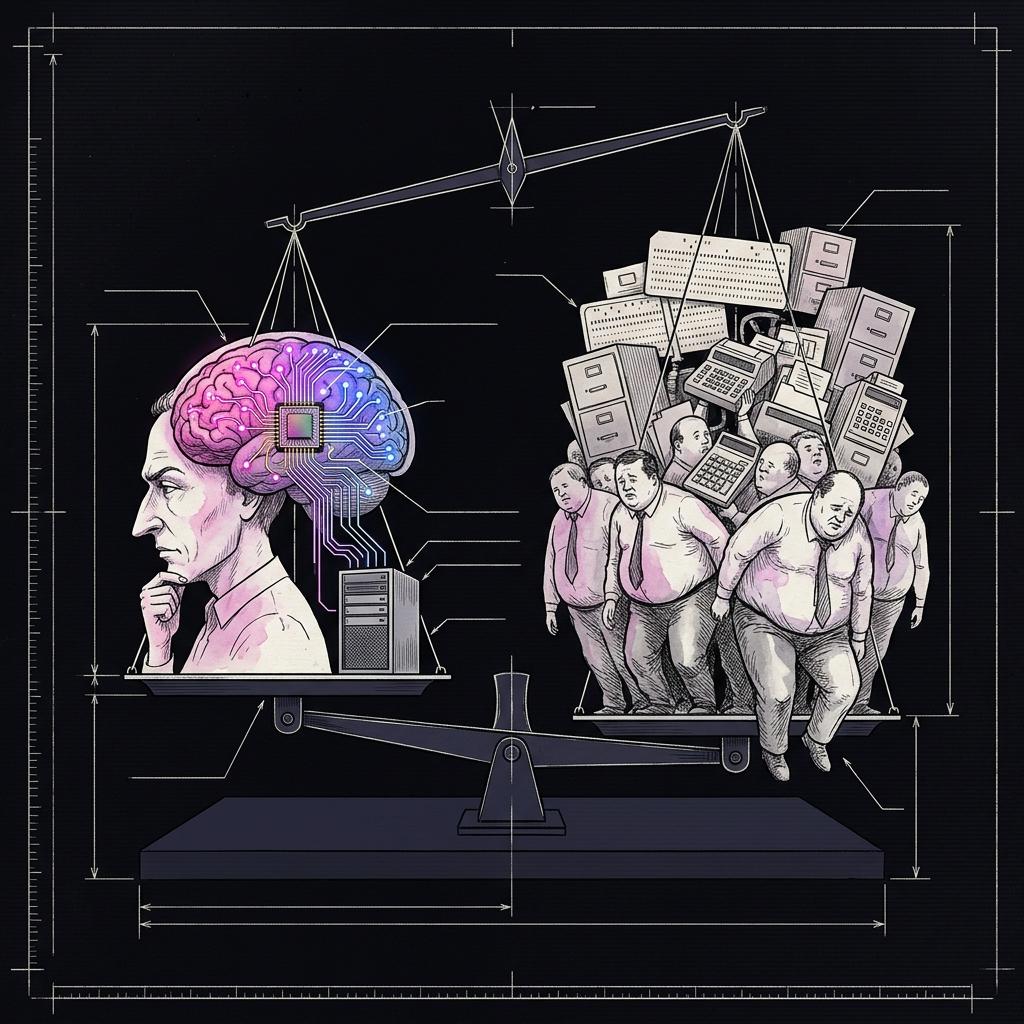
On May 14, 2026, IBM announced a quiet change to its operating model. They introduced a new delivery mechanism called Forward Deployed Units. The press release described a very specific shape of work. A unit is a pod of six human operators. These humans sit at the edges of the process. In the center sits a digital workforce of specialized agents. The agents handle coding and testing. The humans direct the agents and govern the output. IBM stated this six-person pod does the work of a traditional thirty-person team. They are rolling this structure out globally.
One day earlier, Ramp published its May 2026 AI Index. The corporate card and finance platform tracks spending across fifty thousand United States businesses. The data revealed a quiet flip in the market. Anthropic surpassed OpenAI in corporate adoption for the first time. Anthropic reached 34.4 percent of business adoption in April. OpenAI fell to 32.3 percent. Anthropic quadrupled its footprint over twelve months while OpenAI stalled.
These two events tell a single story. They expose a fundamental shift in how businesses buy and structure artificial intelligence. The market has moved past the novelty phase. Companies are no longer buying software licenses to make massive departments slightly faster. They are restructuring the departments entirely. They are replacing the massive workforce with dense, high-output pods.
The old model of enterprise growth relied on linear addition. You wanted more output. You hired more people. You built a larger management layer to coordinate those people. You paid a coordination tax. The new model relies on cognitive density. You build a tight pod of senior operators. You surround them with an array of autonomous agents. You give the pod massive compute resources. The pod scales its output without scaling its mass.
The Collapse of Linear Scale
For a century, the size of a company dictated its market power. Headcount was a proxy for capability. A company with ten thousand employees could simply do more than a company with one thousand employees. The large company could serve more clients. It could write more code. It could process more claims. The sheer mass of the workforce created an impenetrable competitive moat.
Software changed the speed of the work. Software did not change the shape of the organization. When cloud computing arrived, companies bought software as a service. They paid per seat. They gave every employee a login. The software made each employee faster. The company still needed the exact same management hierarchy. The coordination tax remained intact. A manager still had to hold meetings to align the thirty-person team. Information still moved at the speed of human conversation.
Early artificial intelligence adoption followed this exact playbook. A company bought ten thousand enterprise chat licenses. They handed the licenses to their existing workforce. They expected a massive leap in productivity.
The leap never came. Adding an intelligent assistant to a bloated process does not fix the process. The employee writes an email faster. The email still sits in another employee's inbox for two days. The employee generates a report in seconds. The manager still waits until the weekly alignment meeting to review the report. The friction in a large organization does not live in the creation of text. The friction lives in the spaces between people.
IBM recognized this mechanical failure. You cannot bolt agents onto a thirty-person team. The coordination tax devours the speed of the machine. To get the actual value of the technology, you must change the architecture of the team. You must eliminate the spaces between people. You must remove the people from the middle of the workflow.
Defining Cognitive Density
Cognitive density is the new metric of corporate leverage. It measures the ratio of human judgment to machine execution. A dense organization produces massive output with a very small human footprint. Think of a star collapsing into a white dwarf. The mass remains. The volume shrinks. The gravity becomes immense.
The Forward Deployed Unit is the physical manifestation of cognitive density. Picture the pod. Six human operators. A cluster of specialized agents. The architecture is deliberate. Humans do not belong in the middle of a process. The middle is where data gets processed and code gets written. Machines belong in the middle. Machines do not sleep. Machines do not need alignment meetings. Machines execute instructions instantly.
Humans belong at the edges. The front edge is strategy and intent. A human operator defines the goal. The human sets the parameters. The human decides what the machine needs to build. The back edge is governance and delivery. A human reviews the final output. The human ensures the product meets the standard. The human presents the result to the client.
This structure changes the economics of the firm. A thirty-person team requires managers and human resources support. A six-person pod requires none of those layers. The pod is autonomous. The humans in the pod do not spend their days coordinating with each other. They spend their days orchestrating their agents.
The density of the pod creates an extreme margin advantage. The cost of human labor is high and static. The cost of compute is dropping. The pod shifts the burden of execution from expensive human payroll to cheap silicon. The company that deploys pods will always underprice the company that deploys traditional teams. The pod company will deliver the work faster. The pod company will deliver the work with fewer errors.
Why Anthropic Won the Middle
The Ramp AI Index data perfectly illustrates this structural shift. OpenAI built ChatGPT as a destination. They built a brilliant consumer application. Employees went to the chat window, asked a question, and copied the answer back into their workflow. ChatGPT sat outside the process.
Anthropic took a different path. They designed Claude to sit inside the machine. They optimized their models for massive context windows. They built systems that could ingest entire codebases and massive document libraries. They focused heavily on enterprise API integration. In May 2026, Anthropic raised Claude Code weekly limits by fifty percent for their top-tier enterprise users. They understood what the dense pods actually needed.
Pods do not need a chat interface. Pods need a cognitive engine. They need an engine that can process millions of tokens in the background. They need an engine that can run autonomous agentic loops without constant human prompting.
The corporate market recognized this distinction. The early adopters bought OpenAI for individuals. The mature operators are buying Anthropic for their infrastructure. The Ramp data shows businesses shifting their capital from consumer-style subscriptions to infrastructure-grade compute. They are funding the middle of the pod.
The leading labs are fighting a new war. They are fighting to become the default execution engine for the corporate pod. The winner will capture the bulk of enterprise compute spend. Anthropic gained the lead by recognizing the new reality of the market. The agent is the primary user of the model. The human is simply the orchestrator.
The Capital Allocation Shift
When you transition to a pod architecture, your profit and loss statement changes shape. For decades, the largest line item for any service business was payroll. Human capital was the primary constraint on growth. If you wanted to double your revenue, you had to double your headcount. The chief financial officer spent their time managing human resources costs and real estate leases.
The pod architecture severs this direct link between revenue and headcount. The new line item that matters is compute. The financial leader of a dense organization does not track the cost per employee. They track the cost per inference. They track the API expenditure required to execute a specific workflow.
This requires a massive shift in capital allocation. Companies must stop treating cloud compute as an IT expense. Compute is the core cost of goods sold. It is the raw material of the digital workforce. The pod needs a massive, uncapped budget for API calls. If you restrict the compute budget, you throttle the agents. If you throttle the agents, you force the six human operators to manually do the work of thirty. The pod collapses.
The smartest companies in May 2026 are securing long-term compute contracts. They are locking in their infrastructure costs. They understand that compute is the new oil. They are shifting millions of dollars out of their real estate budgets directly into their cloud infrastructure budgets. They are feeding the machine.
The Margin Trap of Legacy Structures
A dangerous divide is opening in the corporate world. On one side are the legacy incumbents. They view artificial intelligence as a feature. They view it as a minor upgrade to their existing software stack. They maintain their massive org charts. They keep their heavy management layers. They buy enterprise chat licenses for every employee.
These companies are stepping into a margin trap. They are increasing their software costs while maintaining their human payroll. They get a slight bump in individual speed. They get zero improvement in organizational velocity. Their cost of goods sold remains high. Their pricing power erodes.
On the other side are the pod architects. These companies view artificial intelligence as a structural material. You must burn the old org chart to the ground. You must rebuild the company as a constellation of dense pods.
Consider a mid-sized logistics firm. The legacy version has two hundred employees handling routing and customs. The management layer alone costs millions of dollars a year. The pod version of that exact same firm has forty employees. Those forty humans are divided into specialized pods. Agents handle the routing logic. Agents process the customs documentation. The humans handle the extreme edge cases. The humans handle the strategic client relationships.
The pod firm operates at a fraction of the cost of the legacy firm. The pod firm can drop its prices by thirty percent and still maintain higher profit margins. The legacy firm cannot compete. If the legacy firm drops its prices, it bleeds cash. If the legacy firm keeps its prices high, it loses its clients. The margin trap snaps shut.
Routing Around the Middle
The transition to a pod architecture destroys the traditional concept of middle management. Middle management is an artifact of poor information flow. In a slow organization, someone has to collect data from the workers, synthesize it, and report it to the executives. Someone has to take orders from the executives, break them down, and assign them to the workers.
The manager is a human router. The manager exists to move information across the friction of the org chart.
In a pod, the friction does not exist. The digital workforce generates data instantly. The agents log their own actions. The agents synthesize their own reports. The senior operators at the edges of the pod have total visibility into the execution layer. They do not need a manager to tell them what the agents are doing. They can look at the dashboard.
This creates a massive talent inversion. For decades, companies promoted their best individual contributors into management roles. They took their best engineers and made them stop coding. They took their best salespeople and made them stop selling. The company paid a massive opportunity cost to staff its routing layer.
The pod architecture reverses this error. The best operators stay at the edges. They remain individual contributors. Their leverage is magnified a hundredfold. An exceptional engineer in a pod does not manage junior engineers. The exceptional engineer orchestrates twenty coding agents. The engineer writes the architecture, reviews the pull requests, and lets the agents write the boilerplate. The company gets the full value of the senior talent. The senior talent gets to do the actual work.
The Failure of the Pilot Program
Most large enterprises are failing to make this transition. They are paralyzed by the pilot program. They set up an innovation lab. They pick a small, low-risk process. They deploy a few agents. They declare the pilot a success. They write a press release.
Then nothing happens. The pilot never scales. The pilot stays isolated in the innovation lab. The core business remains untouched.
The pilot program fails because it treats artificial intelligence as a software deployment. You test software in a sandbox. You roll software out to a single department. You measure the adoption rate.
You cannot pilot a pod. A pod is a new operating model. It requires changing the fundamental structure of the work. You have to fire the vendors that handle the legacy process. You have to remove the middle managers who coordinate the legacy process. You have to redefine the job descriptions of the humans who remain.
IBM bypassed the pilot program entirely. They launched a global delivery model based on a new unit of labor. They changed the unit of labor from the individual human to the integrated pod. That is a structural commitment. It requires executive force. It requires a willingness to break the old machine.
Companies that try to ease into this transition will die by a thousand cuts. Their pilot programs will generate interesting data. Their pod-native competitors will steal their market share. You cannot iterate your way out of a margin trap. You have to jump.
Architecting the Pod
Building a Forward Deployed Unit requires a ruthless deconstruction of your existing business. You must look at your most expensive, slowest workflows and strip them down to their studs.
Start by identifying the edges. What is the actual input that triggers the work? What is the actual output that the client pays for? Everything between the input and the output is the middle. The middle is your target.
Map every human action in the middle. Map every email sent. Map every spreadsheet updated. Map every meeting held to discuss the spreadsheet. You will find that eighty percent of the human effort is spent on moving data from one format to another.
Replace those human actions with an agentic pipeline. Build a chain of specialized models. Give one agent the task of querying the database. Give another agent the task of drafting the response. Connect them. Let them run.
Now staff the edges. Pull your most senior, most capable operators. Put them at the front of the pipeline to define the strategy. Put them at the back of the pipeline to enforce the quality. Give them total authority over the agents. Give them the compute budget they need.
Leave the rest of the thirty-person team behind. They are no longer required for this workflow.
This is the harsh reality of the density equation. The transition to agentic pods will displace a massive amount of human labor. The jobs in the middle of the process are gone. The companies that refuse to eliminate those jobs will simply go bankrupt, taking all the jobs with them anyway. The only moral choice for a corporate leader is to build the most competitive, resilient machine possible. That machine is dense.
The Software Procurement Rewrite
The pod architecture destroys the traditional software business model. For twenty years, software companies built tools for humans. They sold those tools on a per-seat basis. If a company had ten thousand employees, the software vendor sold ten thousand licenses.
A pod of six humans does not need thirty software licenses. The twenty-four digital agents do not have email addresses. They do not log into graphic user interfaces. They interact with software through application programming interfaces.
This breaks the procurement model. Legacy software vendors are panicking. They see their seat counts dropping. They see their enterprise contracts shrinking. They try to compensate by charging massive premiums for basic automated features. The pod architects refuse to pay.
They reject human-centric software. They demand headless infrastructure. They want systems that expose every function via an API. They want data stores that their agents can query directly. They want execution environments where their agents can deploy code without a human clicking a deploy button.
If your software requires a human to click a button, it is a bottleneck. The pod routes around bottlenecks. The enterprise procurement teams of 2026 are rewriting their vendor requirements. They demand total API access. They demand consumption-based pricing. They refuse to pay for seats that will be occupied by silicon. The vendors who adapt will become the invisible infrastructure of the pod. The vendors who cling to their per-seat licenses will be ripped out and replaced.
The Infrastructure of the Pod
The software industry is racing to build the tools for this new architecture. Ramp's data shows the enterprise shift toward Anthropic. Other signals point to a massive boom in orchestration platforms. The market is moving away from individual chat interfaces and toward system-level infrastructure.
You need an orchestration layer to manage the agents. You need a strict evaluation framework to catch model hallucinations before they reach the human at the edge. You need massive, reliable compute to power the background processing.
This is why the hyperscalers are investing billions in data centers. AWS, Google Cloud, and Azure are building the factories for the pods. They know the future of enterprise compute is continuous agentic execution. A six-person pod running twenty agents generates ten times the API calls of a thirty-person team using chat interfaces. The infrastructure must be flawless.
When you architect a pod, you are making a bet on your infrastructure. If your API provider goes down, your digital workforce stops. Your six humans cannot manually do the work of thirty. They do not have the time. They do not have the context. The pod relies entirely on the continuous flow of compute.
You must build redundancy into the middle. You cannot rely on a single frontier model. You must design your agentic pipeline to route around outages. If Anthropic Claude goes down, your pipeline must instantly fall back to OpenAI GPT-4o or Meta Llama 3. The infrastructure must be as resilient as the human operators at the edges.
The Temporal Advantage
The pod architecture creates massive cost savings. Cost savings are a secondary effect. Speed is the primary benefit.
A legacy organization moves at human speed. A decision requires a meeting. A meeting requires scheduling. Scheduling requires a week. The execution of the decision requires another month.
A pod moves at compute speed. The agents process the data in seconds. The senior operator reviews the output in minutes. The pod can execute a strategic pivot before the legacy competitor has even scheduled their alignment meeting.
In May 2026, market conditions change overnight. Regulatory shifts demand instant compliance. Supply chain shocks require immediate rerouting. The company that can process reality and execute a response the fastest captures the value. The pod is a machine built for maximum velocity. It removes the latency of human coordination.
This temporal advantage compounds. The pod learns faster. The agents ingest the results of their actions and update their parameters. The human operators see the patterns and refine the strategy. The pod runs hundreds of iterations while the legacy team runs one. Over a single fiscal year, the pod company operates in the future. The legacy company operates in the past.
The Execution Imperative
We have reached the end of the headcount epoch. The metrics that defined corporate success for a century are suddenly liabilities. A massive employee base is a target. A heavy management layer is a tax. A sprawling physical footprint is an anchor.
The future belongs to the dense. The future belongs to the companies that can compress the work of thirty people into a pod of six. The future belongs to the operators who know how to build the edges and automate the middle.
IBM has shown its hand. Anthropic has captured the enterprise momentum. The tools to build the pod are available today. The only missing variable is the strategic will of the executive layer.
You cannot buy a pod off the shelf. You have to build it. You have to tear down your existing workflows and reassemble them around the principles of cognitive density. You have to make hard choices about your talent and your infrastructure.
This represents a fundamental restructuring of how your company creates value. It requires more than a software upgrade. The competitors who figure this out will hollow out your market share with terrifying speed. They will underprice you. They will render your thirty-person teams obsolete.
The density equation is unforgiving. You either architect the pod, or you compete against it.
Sources
- A New Way to Make AI Actually Work in the Real World - IBM Newsroom, May 14, 2026
- Anthropic finally beat OpenAI in business AI adoption - VentureBeat, May 13, 2026
- Anthropic sets sights on small business after enterprise push - Silicon Republic, May 15, 2026
- Anthropic Just Passed OpenAI in Business Adoption - YouTube, May 14, 2026