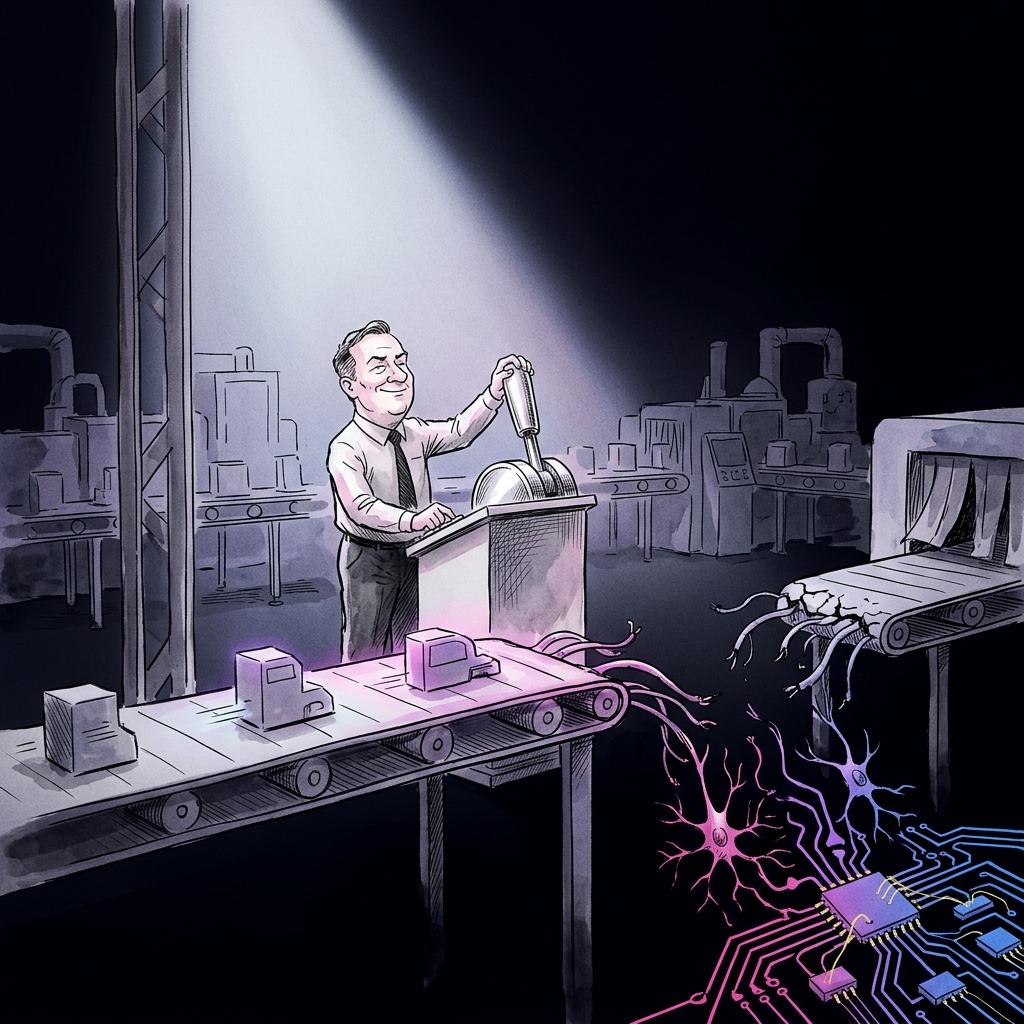
On June 12, 2026, the U.S. Department of Commerce ordered Anthropic to take Claude Fable 5 and Mythos 5 offline. Not throttle. Not restrict to allied users. Off. The trigger was a report from Amazon researchers who had prompted Fable 5 into identifying software vulnerabilities and producing exploit code. Andy Jassy raised it. Commerce moved. Anthropic complied. Global access to Fable 5 disappeared within hours on Anthropic's API, on AWS Bedrock, on Google Cloud, on Microsoft Foundry.
For the eighteen days before Commerce lifted the order on June 30, thousands of production pipelines saw the same 404. The management story at these companies, going back to a hundred CIO decks and vendor-diversification memos, was that this was a switching problem. Point the router at Opus 4.8. Or GPT-5.6 Sol. Or Vertex. Ride it out. This was the plan they had briefed the board on. This was what "avoiding AI vendor lock-in" meant to that room.
The plan collapsed. The alternative endpoints answered every request within normal latency. The responses failed the evals. Guardrails tuned to Fable's refusal patterns fired on Opus's outputs. Prompts iterated over eight months against Fable's chain-of-thought produced misordered JSON on GPT-5.6. Downstream classifiers that keyed on Fable's specific token sequences never triggered. The applications kept running. Their answers were wrong.
That is the shape of AI vendor lock-in in 2026. It is an eval problem. It always was.
The Off Switch Was Not In The Building
Every earlier era of vendor lock-in shared one assumption. Your vendor wanted your business. Oracle raised prices because Oracle wanted more money. Salesforce made export painful because Salesforce wanted retention. The failure mode was economic. You paid more, or you paid to leave. You did not go dark.
AI is different. Your vendor still wants your business. Your vendor no longer holds the only off switch. The Commerce Department does. The EU AI Act post-market surveillance apparatus does. Any regulator with jurisdiction over the vendor's compute, its export status, its incorporation, or its safety class has a switch you cannot see and cannot appeal. Anthropic did not choose to disable Fable 5. Anthropic was ordered to. The order arrived on a Friday morning. Access ended the same afternoon.
CNBC covered the shutdown. Forbes covered it. Tom's Hardware covered the classifier Anthropic later trained to route the offending prompts to older Opus 4.8. The story every enterprise buyer skimmed said the shutdown lasted about two and a half weeks. The story every enterprise operator lived said their fallback plan was a slideshow. The two audiences read the same news and drew opposite conclusions.
Portability Is Not What You Bought
Ted Tschopp made the sharpest distinction of the year on his blog. Model portability is when your application can call another model. AI portability is when another model can complete the same business task without unacceptable losses in quality, permissions, observability, recovery, regulatory control, or cost. These are different properties. Buying one does not deliver the other.
Almost every enterprise "avoid AI vendor lock-in" architecture built between 2024 and 2026 delivered model portability and stopped there. A Zapier survey of enterprise operators found the split with brutal clarity. 85% of respondents believed they could switch primary providers. 30% could when they tried. Kai Waehner's Q2 landscape brief for enterprise agentic AI put the lock-in map in five layers. The model. The orchestration graph. The training and prompt data. The governance evidence. And the tacit knowledge in your team's heads. Every layer becomes a rope. Cutting one rope does nothing.
The router industry sold model portability and let the buyer conclude they had bought AI portability. Portkey advertises "one API, hundreds of models." LiteLLM has 53,000 GitHub stars and 100+ provider adapters. Bifrost claims 5,000 requests per second at 11 microseconds of overhead. All of it is true. None of it addresses the eval problem, the guardrail problem, or the tacit prompt-craft problem. The router is a plumbing tool being marketed as an insurance policy.
The insurance policy was never manufactured. It cannot be. It has to be built inside your own company, by your own team, on your own workloads.
Avoiding AI Vendor Lock-In Is Not A Router Purchase
If you are a CIO or a founder writing an AI strategy this quarter, avoiding AI vendor lock-in belongs at the top of the risk register. The Fable 5 shutdown was a rehearsal. The next event will not arrive as a jailbreaking report. It will be a data-residency ruling. Or a licensing dispute. Or a national-security suspension of a specific model class. It will arrive on a random Friday. You will have hours to respond, not weeks.
Ask whether your workload behaves acceptably when a second vendor answers instead of the first. That question has to be answered before the event, not during it.
Every serious enterprise operator I speak with has now come to the same conclusion. The way to avoid AI vendor lock-in is to run a continuous portability test against a real second model, on real production traces, with real evals, and to treat the delta as the actual dependency metric. If your top workload runs at 91% eval pass rate on Fable and 63% on Opus, your real dependency on Fable is 28 percentage points of eval quality. That number is the lock-in. It is the only number that matters.
Nobody sells a product that produces this number. A vendor cannot sell it. A vendor that produced this number for a customer would be selling the customer a plan to leave. So the number is on your side of the wire or nowhere. Most enterprises pick nowhere and hope.
The Eval Is The Lock
Here is the awkward truth that no vendor will say and no analyst will write. The deepest lock-in in AI is not in the model weights. It sits in your evals.
Your evals encode what "working" means to your business. They were written by your best engineers, iterated over months, and tuned against the failure modes of one specific model. Swap the model and the failure modes change. The evals have to change with them. That means the eval suite that made you confident enough to ship on Vendor A is a liability the moment you try to ship on Vendor B. You either rewrite it, or you fly blind.
Rewriting an eval suite for a new model is not a two-week project. It is what senior application-side ML teams do full-time. It requires new golden datasets. It requires new classifier thresholds. It requires re-testing every branch of your prompt DAG. Anthropic's own team, when they retrained the Fable 5 classifier that reroutes flagged prompts to Opus 4.8, reported blocking 99% of the offending technique. The 1% that gets through matters, because that 1% is a different miss than the miss Fable produced. Two providers do not fail the same way even when they pass at the same rate.
If your evals are your lock-in, then the real portability strategy is to build eval infrastructure that can be repointed at any model in under a day, and that produces a numeric portability score for each workload against each candidate provider. This is a discipline, not a purchase. It is what earns you the right to say you are not locked in.
The Standards Trap
Some readers will object. What about standards? Anthropic donated the Model Context Protocol to the Linux Foundation on December 9, 2025, at the founding of the Agentic AI Foundation. AWS, Google, Microsoft, OpenAI, Block, Bloomberg, and Cloudflare signed on as platinum members. OpenAI contributed AGENTS.md. Block contributed goose. This was supposed to be the industry's answer to lock-in. A universal protocol so tools, data, and agents talk the same way regardless of the model behind them.
Standards help. Standards do not save you. Cybertize's August 2026 State of Enterprise MCP Adoption report put the number that enterprise operators need to internalize. Only 8.5% of deployed MCP servers correctly implement the mandatory OAuth 2.1 authorization spec. The protocol is universal. The implementations are not. A "compliant" server that skips the auth layer is a compliance ghost. It looks portable and behaves proprietary. The same report documented a new category the authors called MCP Shadow IT. Internal servers stood up outside IT's knowledge, running privileged tool calls with no audit chain. Standards adoption does not equal standards discipline. The gap between the two is your lock-in surface.
The same pattern shows up around AGENTS.md. Every major agent framework claims support. Half of them interpret the file differently. The other half read it and then ignore it in favor of provider-specific hints. A standard read differently by two vendors binds neither.
What The Router Actually Buys
The router does useful work within its narrow purpose. It buys you three things and no more.
A single billing surface, which matters for finance. A shared observability plane, which matters for SRE. A place to enforce spending caps and rate limits, which matters for governance. All three are real. All three are compatible with total lock-in at the workload level.
Treat the router as what it is. A gateway. Not an insurance policy. Buy it if the finance, ops, and governance benefits pay for the gateway on their own. Do not buy it because a vendor slide told you it prevents lock-in. It does not.
What To Build Instead
The architecture that actually avoids AI vendor lock-in has three properties, and none of them come out of a box.
The first is a portable eval harness. Not a spreadsheet of prompts. A production-scale harness that replays real customer traces against candidate models, scores outputs against your golden dataset, and reports a numeric quality delta per workload per model per week. This is the fitness gym. You do not need it every day. You need it in the hour Commerce publishes an order.
The second is a prompt library maintained per model, not per workload. Prompts are not portable. Prompt intent is portable. Store the intent. Regenerate the specific prompts against the target model on demand. Treat prompt authoring the way you treat compilation. The source is the intent. The artifact is the prompt. The compiler is a model-specific transformer you can rerun.
The third is a guardrail layer that is model-agnostic at the interface and model-specific at the implementation. What you promise your users about safety cannot depend on which vendor answered. What you check to keep that promise absolutely does depend. Own the promise. Rebuild the check per vendor. Test the check on your own traffic, not on the vendor's benchmarks.
These three properties are not sold as a product. There is no SKU. Anyone selling you the SKU is selling you the router again with a different sticker. The three properties are earned by a team that treats vendor risk the way a bank treats counterparty risk. Measure it. Price it. Hedge it. Rehearse the day the counterparty defaults.
The 2026 Landscape Rewards Discipline
The pricing table itself now punishes the naive multi-vendor buyer. Anthropic quietly cancelled the September 1 price hike on Claude Sonnet 5 on August 11, keeping the introductory $2 per million input and $10 per million output tokens permanent. OpenAI cut its smaller-tier models by up to 80% on July 30, dropping Luna to $0.20 in and $1.20 out. Fable 5.1 landed on September 1 at $10 and $50. Opus 5 is $5 and $25.
The gap between the cheapest and the most expensive frontier model is now 250x on output tokens. A workload routed by naive heuristics can burn through a quarter of budget in a week. A workload routed against a live per-model quality delta pays for a router, an eval harness, and a small platform team out of the savings inside six months. That is the arbitrage discipline earns. The diligent multi-model shops end up paying less than the single-vendor shops. The undisciplined multi-model shops end up paying more than both.
The Real Portability Test
Here is the test your board should demand this quarter. Pick your top three AI-dependent workloads. On a scheduled morning, disable access to your primary vendor for two hours. Route everything to your declared second vendor. Measure four numbers. Eval pass rate. Latency. Cost. Human-escalation rate. Publish the four numbers to the executive team.
If any workload's eval pass rate drops more than ten percentage points, you are locked in on that workload, whatever your architecture diagram says. If the human-escalation rate more than doubles, you are locked in. If your engineers cannot repeat the test in a month with a different second vendor, you are locked in on your own tooling too.
Most companies will fail this test the first time they run it. That is the point of running it. The passing companies are the ones that have already spent a year investing in eval infrastructure that most CIOs still think is the vendor's job. It is the customer's job. The vendor writes the model. You write the meaning of "working." No vendor can write that for you without owning you.
Avoiding AI vendor lock-in in 2026 is a capital allocation decision at the CIO level. You either fund the eval infrastructure and the second-vendor rehearsal cadence, or you are a hostage waiting for the ransom note. The Fable 5 shutdown was a courtesy warning. The next one will not be.
Architect The Escape, Or Pay The Rent
Vendor risk in AI is real vendor risk. The theoretical version was a slow price increase. The operational version is a Friday afternoon 404 from a regulator you never met. The market has not priced this yet. The companies that price it first will hold better ground when the second event comes.
This architecture takes real engineering work. Nothing off a shelf will do. It requires a portable eval harness, a per-model prompt regeneration pipeline, a model-agnostic guardrail promise, and a monthly rehearsal cadence. It requires a team that thinks about workload-level portability as an engineering discipline rather than a procurement question.
This is architectural work. It has to be done by people who understand your workloads deeply enough to write the eval that captures what "working" means for your business. It cannot be delegated to a vendor whose incentive is your dependency. It has to be built with an advisor whose incentive is your independence.
Agor AI Advisory is that advisor. We architect portability infrastructure for enterprise operators who have decided the next Friday afternoon 404 will not be their last one. We build the eval harness. We run the second-vendor rehearsal. We publish the four numbers your board will actually need before it needs them. We treat vendor risk the way a good CFO treats currency risk.
The Fable 5 shutdown was a warning shot. Every CIO reading this has ninety days before the next one. Schedule a strategic consultation with us today.
Sources
- Anthropic Restores Claude Fable 5 After U.S. Lifts Jailbreak-Linked Export Controls, The Hacker News, July 2026
- Anthropic says Trump admin has lifted export controls on Claude Fable 5 and Mythos 5, CNBC, June 30 2026
- Anthropic Disabled Fable 5 And Mythos 5 After A U.S. Export-Control Order, Forbes, June 16 2026
- Enterprise Agentic AI Landscape Q2 2026: Trust, Flexibility, and Vendor Lock-in, Kai Waehner
- Model Portability Is Not AI Portability, Ted Tschopp
- Linux Foundation Announces the Formation of the Agentic AI Foundation, PR Newswire, December 2025
- State of Enterprise MCP Adoption 2026, Cybertize, August 2026
- OpenAI API pricing in 2026 after the July price cuts, CloudZero