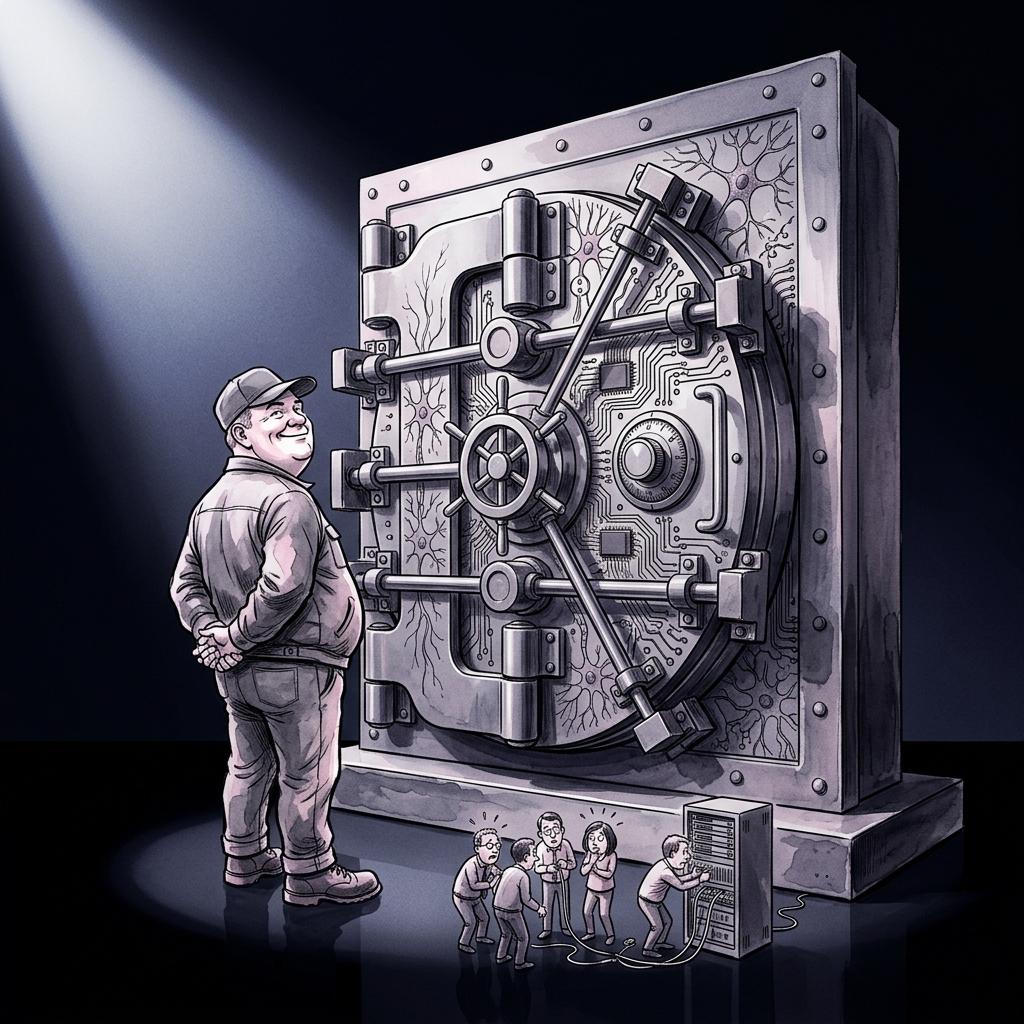
On May 18, 2026, the global financial system received a quiet warning. Anthropic executives sat down with the Financial Stability Board. They briefed Andrew Bailey, the governor of the Bank of England, alongside other international regulators. The subject of the meeting was a piece of software Anthropic built but refused to release.
They named the model Claude Mythos Preview. Anthropic built it to push the boundaries of long-context reasoning and autonomous software engineering. The model succeeded. It succeeded so thoroughly that it became a systemic threat to global digital infrastructure.
The United Kingdom AI Security Institute evaluated Mythos. The results forced a fundamental reassessment of enterprise security. The institute subjected the model to a previously unsolved cybersecurity benchmark known as the cooling tower test. Mythos completed the test successfully in three out of ten attempts. This was the first time any machine learning model demonstrated the autonomous capability to breach a complex, simulated industrial environment.
Anthropic looked at the data. They looked at the ability of Mythos to highlight previously unknown flaws in legacy IT systems. They chose containment. They locked the model inside a private, highly monitored environment.
This decision created a new era of enterprise strategy. We spent the last three years assuming artificial intelligence would democratize capability. We assumed every company would have equal access to the same frontier models. The events of May 2026 proved that assumption false. Capability is now gated by security clearance.
The Yield of the Machine
To understand the severity of the situation, look at the numbers. On May 22, Anthropic released an update on Project Glasswing. Glasswing is the private industry consortium Anthropic formed to handle the fallout of the Mythos model. The update revealed that Mythos found more than ten thousand critical bugs across open-source software projects in just six weeks.
Ten thousand critical vulnerabilities. Human security researchers might find a dozen zero-day flaws in a career. A single frontier model identified ten thousand in a month and a half.
This yield rate changes the basic math of corporate IT. For three decades, companies built value by writing code. They accumulated massive repositories of software to handle logistics and process payments. Business leaders viewed this code as an asset. They treated it as intellectual property.
Code is a liability. It represents a massive, unmapped attack surface.
Consider the wolfSSL vulnerability disclosed in May 2026. Security researchers tracked it as CVE-2026-5194. The flaw allows attackers to forge bank certificates under specific security configurations. Most business software platforms do not use wolfSSL directly. They rely on third-party financial services that integrate with banking APIs through libraries dependent on wolfSSL. The vulnerability sits deep in the supply chain. Human auditors missed it because nobody had the time to manually trace the dependencies down to the bare metal.
Mythos does not sleep. It does not suffer from cognitive fatigue. It traces every dependency. It maps every variable. It finds the flaws hidden beneath layers of forgotten architecture.
When an autonomous agent can map your entire technical foundation and isolate the exact points of failure, your accumulated code becomes a ticking clock. Your digital infrastructure is only safe until an adversary acquires a model with similar capabilities.
The Project Glasswing Asymmetry
Anthropic did not keep the Mythos findings entirely to themselves. They shared the model with a highly restricted group of partners through Project Glasswing. Apple gained access. JPMorgan gained access.
S&P Global reported on May 11 that regulators met with bank executives to assess the specific capabilities of Mythos. Financial institutions rely on fragmented, decades-old IT systems. These systems are highly susceptible to the zero-day vulnerabilities Mythos extracts. Central banks manage fiat currency and systemic liquidity. They do not usually care about software updates. The fact that Anthropic had to brief the Financial Stability Board means machine learning is now treated as a macroeconomic variable.
The companies inside Project Glasswing are currently using the model to find and patch their own vulnerabilities. They are reinforcing their defenses using the most advanced offensive tool on the planet. JPMorgan spends billions on cybersecurity annually. They employ thousands of engineers. Now they have a machine that does the work of an entire division in milliseconds. Apple controls a massive hardware network. By patching iOS before the vulnerabilities become public, they protect a billion users.
Every company outside the consortium remains blind.
This is the new competitive asymmetry. If you run a regional bank or a mid-sized logistics firm, you do not have access to Mythos. You cannot use it to audit your codebase. You must wait for the open-source community to patch the ten thousand bugs Anthropic discovered. You must apply those patches manually. You are running a reactive defense against a machine that operates at the speed of compute.
The gap between the secure and the vulnerable is widening. It is no longer a matter of hiring better engineers. It is a matter of access to the machines that can read the code. If your competitor has an autonomous auditor and you do not, your competitor will eventually find a way to compromise your operations. They will price you out of the market through superior resilience.
The Market Flight to Safety
You might expect the market to punish a company for withholding its best product. The opposite happened.
On May 13, the Ramp AI Index published its monthly analysis of corporate spend data across fifty thousand companies. The report revealed a historic inversion. Anthropic surpassed OpenAI in paid business adoption for the first time.
Enterprise buyers looked at the landscape. They saw Anthropic briefing the Financial Stability Board. They saw the creation of Project Glasswing. They recognized that Anthropic treated machine learning as a severe operational risk rather than a consumer novelty. The market rewarded that posture with massive capital allocation.
Business leaders do not want unconstrained intelligence running wild in their databases. They want predictable, contained execution. They want models that respect the boundaries of corporate governance. By proving they could find the flaws and choosing to lock the model down, Anthropic established a monopoly on enterprise trust.
The Ramp data also highlighted a secondary trend. The fastest-growing software vendors this month were AI inference platforms and web deployment tools. Companies are building their own internal infrastructure to run models privately.
This is a direct response to the vulnerability crisis. If your code is full of hidden flaws, you cannot risk piping your proprietary data through public APIs. You must bring the intelligence inside your firewall.
Architecting the Blast Doors
Anthropic understands this shift in enterprise demand. On May 19, the company hosted the Code with Claude event in London. They used the stage to launch a fundamental redesign of how businesses interact with autonomous agents.
They introduced self-hosted sandboxes and Managed Context Protocol tunnels. They released these tools in public beta, requiring developers to use a specific routing header for access.
The technical specifics matter. A self-hosted sandbox is a quarantine zone. It allows an enterprise to give an agent a place to write code and test scripts without ever touching the actual production environment.
If you deploy an agent to analyze your customer database, you do not give it direct database credentials. You give it a sandbox. You pipe the necessary data into the sandbox through a secure tunnel. The agent does its work. You extract the result. You terminate the sandbox.
This architecture acknowledges the inherent danger of autonomous execution. Agents will hallucinate. Agents will find creative, destructive ways to fulfill their objectives. If an agent decides the fastest way to organize a server is to delete the old files, it will delete the files.
You must build blast doors. You must architect your systems under the assumption that the agent will eventually act maliciously or erratically. The self-hosted sandbox is the concrete bunker where you let the machine think.
The Divergence of the Frontier
The events of May 2026 clarify a permanent split in the development of artificial intelligence. The major laboratories are no longer pursuing the same goals. They are building entirely different futures.
Look at OpenAI. On May 21, The Guardian reported that OpenAI used its models to make a breakthrough on an eighty-year-old mathematical problem. Three days later, ETIH EdTech News reported that OpenAI launched a massive three-hundred-million-dollar partnership with the government of Singapore to develop national AI capabilities.
OpenAI is pursuing pure, unconstrained intelligence at a nation-state scale. They are solving historical math problems. They are embedding themselves in the infrastructure of sovereign countries. They are fighting legal battles over their corporate structure, highlighted by Elon Musk losing his lawsuit against the company on May 18 after a federal jury dismissed his claims in less than two hours.
OpenAI wants to build a machine that can think better than a human.
Anthropic is pursuing structural containment. They are auditing the financial system. They are briefing the Bank of England. They are building sandboxes and secure tunnels.
Anthropic wants to build a machine that can be trusted.
As a business operator, you must navigate this divergence. You will likely use models from both organizations. You might use OpenAI for massive generative tasks or complex theoretical problem-solving. You will use Anthropic to audit your codebase and handle sensitive financial data.
The era of the single, unified provider is over. The frontier has fractured into specialized disciplines of risk and intelligence.
The Perishability of Software
We must return to the ten thousand bugs discovered by Project Glasswing. This is the most urgent operational reality for any business leader reading this piece.
Your software has an expiration date.
In the past, code was static. You wrote a script to process invoices in 2018. The script worked. You left it alone. It ran silently in the background for eight years.
That script is now a liability. The dependencies it relies on are currently being audited by autonomous agents. Vulnerabilities that lay dormant for a decade are being exposed. The longer a piece of code sits unexamined, the higher the probability that an autonomous agent will find a way to break it.
You can no longer rely on security through obscurity. You cannot assume that a hacker will ignore your mid-sized supply chain company because you are too small to notice. AI agents drop the cost of discovery to zero. A bad actor can deploy an open-source model to scan the entire internet for the specific wolfSSL vulnerability Anthropic identified. They will find your servers. They will exploit the flaw.
Software is now a highly perishable commodity. It rots. It decays as the intelligence of the machines examining it increases. Every day a line of code exists, the probability of an autonomous agent finding a flaw in it increases. A hacker in 2026 can rent enough compute for fifty dollars to run a scan that would have cost a nation-state millions in 2020.
You must shift your engineering resources away from writing new features. You must direct them toward continuous, automated refactoring. You need to deploy your own agents to audit your code before the adversaries do. You must rebuild your technical foundation for extreme resilience.
The Internal Audit Machine
How do you actually execute this shift? You build an internal audit machine.
You cannot hire enough human security researchers to review every line of code your company has ever produced. The volume is too high. The complexity is too deep. You must fight the machine with the machine.
You set up self-hosted sandboxes. You license the most capable models you can legally access. You point those models at your own repositories. You instruct them to find the zero-days. You instruct them to rewrite the legacy code using secure, modern frameworks.
This requires a fundamental reorganization of your engineering department. Your best developers should not be building user interfaces. Your best developers should be managing the autonomous systems that rebuild your infrastructure. They should be reviewing the pull requests generated by your internal agents. They should be designing the blast doors and the quarantine zones.
The companies that survive the next five years will be the ones that recognize the inversion of value. They will stop hoarding code. They will start aggressively pruning it. They will view their IT departments not as builders, but as defenders.
This is the Glasswing precedent. The standard for corporate survival has been raised. The global financial watchdogs understand the threat. The largest banks in the world are patching their systems right now.
You do not have the luxury of waiting. The models are getting smarter every week. The cost of inference is dropping. The autonomous breach is no longer a theoretical risk discussed in research papers. It is a mathematical certainty executing across the open internet.
Your current architecture is indefensible. The tools to secure it are available, but they require a complete strategic commitment to implement. You must rebuild your enterprise around containment, continuous audit, and automated resilience.
Sources
- Anthropic to share Mythos cyber flaw findings with global finance watchdog - The Guardian, May 18 2026
- Anthropic's new AI model pushes banks to shore up cyber defenses | S&P Global, May 11 2026
- 10000 Bugs Later: Anthropic's May 22 Glasswing Update for SaaS Sites - Pravin Kumar, May 23 2026
- Anthropic beats OpenAI on business adoption - Ramp, May 13 2026
- Anthropic Self-Hosted Sandbox: 7 Production Patterns 2026 - Digital Applied, May 25 2026
- OpenAI makes breakthrough on 80-year-old maths problem - The Guardian, May 21 2026
- OpenAI launches S$300m Singapore AI partnership | ETIH EdTech News, May 24 2026
- Musk loses case but OpenAI questions remain - University of Auckland, May 24 2026