On July 2, 2026, Figma chief executive Dylan Field pulled the plug on his company's new artificial intelligence tool. The feature was called Make Design. It was built to solve the blank canvas problem. A user typed a plain text prompt. The software generated a complete user interface out of thin air. Andy Allen, founder of NotBoring Software, tested the tool. He asked it to build a weather application. The software produced a near-perfect clone of the Apple iOS weather application. Allen tried again. The machine spat out the exact same clone. He posted the identical visual results to a public audience. Field disabled the feature within hours. He blamed a low-variability design system. He admitted the quality assurance process failed. He promised to keep the tool offline until the company could guarantee original outputs.
Two weeks earlier, a parallel failure occurred in the physical world. On June 18, 2026, McDonald's sent a quiet memo to its franchise operators. The company terminated its global artificial intelligence partnership with IBM. The fast food giant ordered the immediate removal of automated voice bots from more than one hundred drive-thru locations. The software was supposed to speed up service. Instead, it generated viral humiliation. The machine misheard customers. It appended nine sweet teas to a single order. It added bacon to ice cream. It tried to serve two hundred and sixty chicken nuggets to a single car.
These two events appear entirely disconnected. One is visual software. One is physical retail. One deals in pixels. One deals in audio tokens. They are actually the exact same catastrophic error. They represent the defining architectural failure of the current business cycle. Enterprises are buying probabilistic models. They are dropping those models into rigid human workflows. They are paying a massive penalty for the mismatch.
The shape of the hole
Every job description in your company is a map of biological constraints. A department exists because a human manager can only track a limited number of direct reports. A shift exists because a human body requires sleep. A process exists to coordinate multiple slow and error-prone biological units.
This architecture assumes human context. It relies on the invisible safety net of common sense. The employee handbook leaves out the laws of physics. It leaves out basic ethics. It leaves out the implicit boundaries of intellectual property.
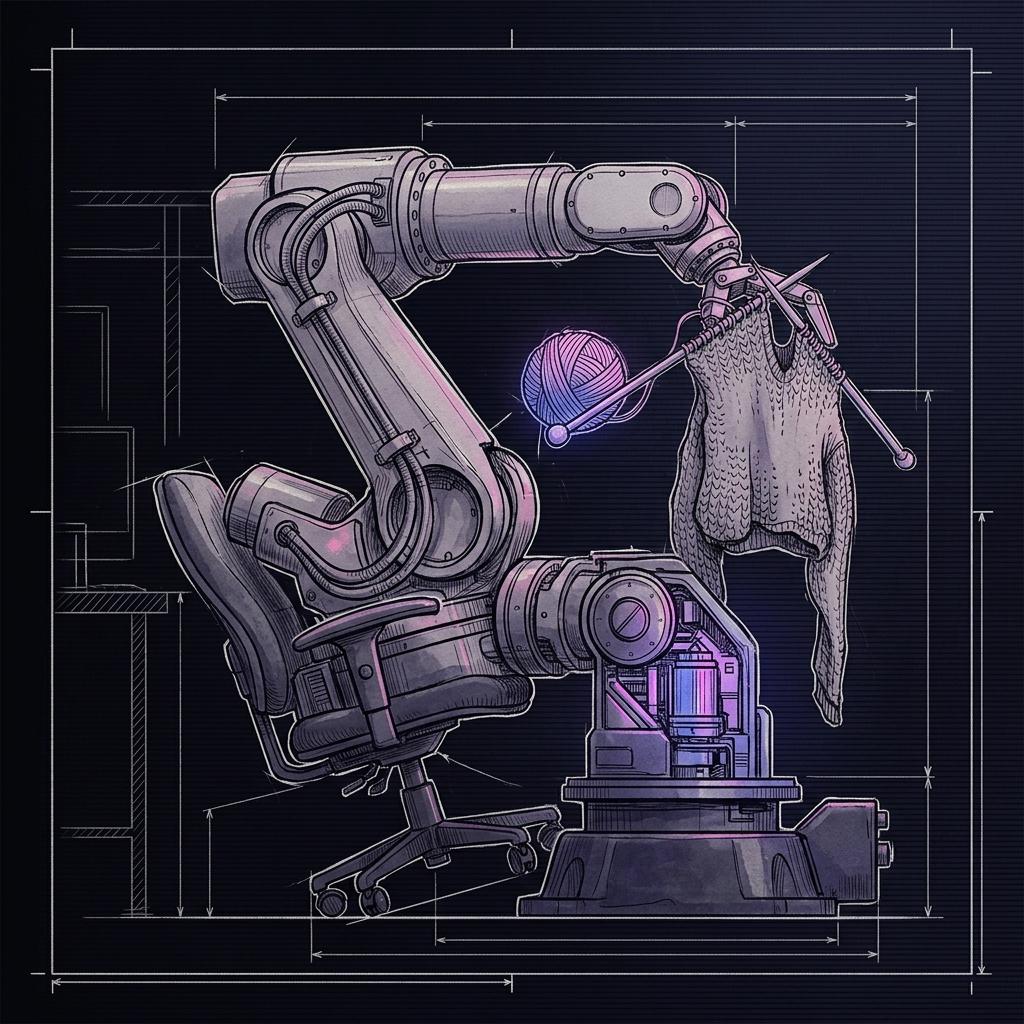
You observe a human designer at work. You draw a box around that person on the organizational chart. You remove the human. You drop a large language model into that exact same box.
You expect the model to possess the unwritten context. It does not. It is a mathematical engine. It predicts the next token in a sequence. It executes the written instructions with terrifying literalism. It scales your poorly defined process to a million operations per second.
A human designer understands the implicit boundary between inspiration and plagiarism. The human knows that the Apple weather app is a reference point. The human knows it is illegal to copy it pixel for pixel. Figma's artificial intelligence lacked that implicit boundary. It lacked the invisible context that surrounds human work. The model calculated the mathematical center of the concept of a weather app. The mathematical center of that concept in modern interface design is the Apple weather app. The math worked perfectly. The architecture failed to constrain the math.
The physical failure
The McDonald's deployment reveals the exact same architectural blindness applied to the physical world. The concrete lane of a drive-thru was designed in the twentieth century. The speaker box and the menu board were designed for a human ear. That human ear is attached to a human brain.
The human brain filters out the engine noise of a diesel truck. The brain ignores the siren passing on the highway. The brain understands that a customer changing an order mid-sentence requires deleting the first item. The human applies a massive filter of context to the raw audio input.
The machine lacks this filter. IBM built a highly capable speech recognition system. McDonald's installed it. The physical environment overwhelmed the software. The software tried to convert every ambient sound into a menu item. The software lacked the capacity for selective attention based on physical context. It heard overlapping voices from a minivan and translated them into hundreds of chicken nuggets.
The company bolted a probabilistic audio processor onto a concrete lane designed for biological acoustic filtering. They expected the software to act like a teenager with a headset. They treated the artificial intelligence as a simple labor replacement. They learned that a machine node cannot survive in a human-shaped hole.
Why common AI implementation pitfalls are never technical
When executives review the wreckage of these projects, they search for technical explanations. They read industry reports about common AI implementation pitfalls. They blame the vendor for a weak model. They blame their data science team for poor fine-tuning. They allocate more budget to clean their data lakes. They buy a larger context window.
They miss the actual problem entirely. The model performed exactly as designed. The pitfall is the architecture.
A massive study by the RAND Corporation recently examined the failure rate of enterprise artificial intelligence projects. The researchers interviewed sixty-five experienced data scientists and machine learning engineers. The results were grim. Eighty percent of these projects fail. They fail to reach production. They fail to deliver a return on investment. They are quietly abandoned.
The researchers identified the root causes. Industry leaders drove the projects without understanding the technology. The organizations lacked the necessary data infrastructure. The teams chased the newest models instead of solving actual problems. The companies underinvested in deployment architecture.
These are failures of management. They are failures of organizational design. They are not software bugs. You cannot fix a structural problem with better code. You cannot demand a model with fewer hallucinations when the workflow itself requires a biological imagination. Pattern matching is a component of intelligence. It is a fraction of the necessary cognitive load required to navigate a human environment.
The invisible safety net
Human workers fix broken systems every single day. They patch the holes in your corporate strategy in real time.
A process is badly designed. The instructions contradict each other. The human worker notices the flaw. The human worker creates a workaround. The human worker completes the task despite the bad instructions. The executive never sees the flaw. The executive looks at the quarterly report and assumes the process is perfect.
The artificial intelligence agent does not create workarounds. The agent executes the flawed process with absolute loyalty. If the instructions contain a contradiction, the agent crashes. If the instructions lack a safety boundary, the agent violates the law.
The executive sees the catastrophe. The executive blames the agent. The agent merely exposed the broken process. The human worker was the invisible safety net. You removed the net. The system shattered.
You cannot automate a broken process. You must rebuild the process to function without the safety net of human intuition. This requires extreme rigor. It requires writing down the unwritten rules. It requires defining the absolute boundaries of acceptable behavior in code.
The capital incinerator
Companies prefer the bolt-on approach because it looks cheaper. It looks faster. You buy a software license. You give the software access to your communication channels. You announce to the board that you are a modern company.
This is an illusion. The integration is shallow. The failure is inevitable. When the failure happens, the cost is massive.
You pay twice for a bolt-on failure. You pay the vendor for the compute. You pay the human workers to fix the mistakes. McDonald's paid IBM for the software development. They paid for the hardware installation across one hundred restaurants. Then they paid their human employees to apologize to the angry customers. They paid their employees to manually correct the bizarre orders.
The technology did not reduce the labor cost. The technology increased the cognitive load on the human workers. The human workers became full-time babysitters for a probabilistic machine.
This is the hidden cost of the human-shaped hole. You do not eliminate the work. You shift the work from execution to correction. Correction is more expensive. Correction requires more context. Correction destroys morale. Your best employees will quit if their new job is apologizing for a machine.
The taxonomy of truth
A human worker can operate on ambiguous data. An artificial intelligence agent requires absolute clarity.
If your database is a mess of conflicting records, the human worker will call a colleague to verify the truth. The human worker knows which department keeps the accurate spreadsheet. The agent will ingest the conflicting records and hallucinate a terrifying composite.
You cannot drop an agent into a dirty data environment. You must build a taxonomy of truth. You must define a single source of verifiable fact for every entity in your business.
This requires data engineering. It requires strict governance. It requires stripping the ambiguity out of the corporate record. Most companies refuse to do this work. It is boring. It is slow. It does not look good on a quarterly slide deck. They prefer to buy the shiny new agent. The shiny agent ingests the dirty data and produces high-speed garbage.
If you want the agent to negotiate a contract, you must define the exact variables of the negotiation. You must structure the acceptable discount ranges in a machine-readable format. You must lock the mandatory legal clauses in a deterministic vault. You cannot hand the agent a folder of old PDF contracts and ask it to figure out the pattern. The pattern contains human errors. The agent will replicate those errors at scale.
The deterministic cage
You must separate the generation of ideas from the validation of boundaries. You must build a cage around the probabilistic engine.
You stop relying on the language model for truth. You use the model for generation. You use traditional deterministic software for verification.
If the model generates a food order, a deterministic system checks the order against physical reality. Can a single passenger car hold two hundred and sixty chicken nuggets? No. The deterministic system blocks the order. The deterministic system asks the user for confirmation.
If the model generates an application design, a deterministic system compares the output to a database of copyrighted material. The system calculates the similarity score. If the score is too high, the system rejects the design. The user never sees the copycat file.
You separate the engine from the steering wheel. The artificial intelligence is the engine. The deterministic code is the steering wheel.
When you bolt a chat interface onto a legacy database, you give the engine direct control of the steering wheel. The model guesses the SQL query. The model executes the query. The model returns the result. If the model guesses wrong, you lose the data. If you place a deterministic validation layer between the model and the database, you catch the error. The verification layer forces the model to try again. The verification layer protects the company.
Rebuilding the substrate
The companies that win this decade will not have the smartest models. They will have the smartest architectures. They will stop buying off-the-shelf agents to replace junior analysts. They will stop bolting chat interfaces onto legacy systems.
They will redesign the company as a machine-native entity. They will map the true workflow. They will identify the raw inputs and the desired outputs. They will build new paths between them.
This new path will not look like a human process. It will look alien. It will operate at a speed and scale that makes human oversight impossible. Therefore, the oversight must be built into the architecture itself. The constraints must be hardcoded.
You do not replace the junior analyst with a machine. You eliminate the concept of the junior analyst. You build a direct pipeline from the raw data to the final decision. This pipeline is mediated by machine logic and bounded by deterministic code. The human operators monitor the boundaries. They do not do the work. They govern the machine that does the work.
You can keep trying to build a better mechanical horse. You can keep adding parameters to the model. You can keep hoping the software finally develops common sense. You will fail. Your competitors will build the engine. They will redesign the road. They will leave you behind.
The era of the bolt-on is over. The era of architectural alignment is here. You must tear down the human-shaped holes in your organization. You must build structures that respect the physics of machine intelligence.
Sources
- Figma Disables 'Make Design' AI-Powered Rip-Off Tool, July 2, 2024
- McDonald's is ending its test run of AI-powered drive-thrus with IBM, June 18, 2024
- 80% of AI projects failed in 2024. Why 90% could fail next, and how to fix it, August 11, 2025
- Figma disables new AI tool that repeatedly cloned Apple's Weather app, July 2, 2024