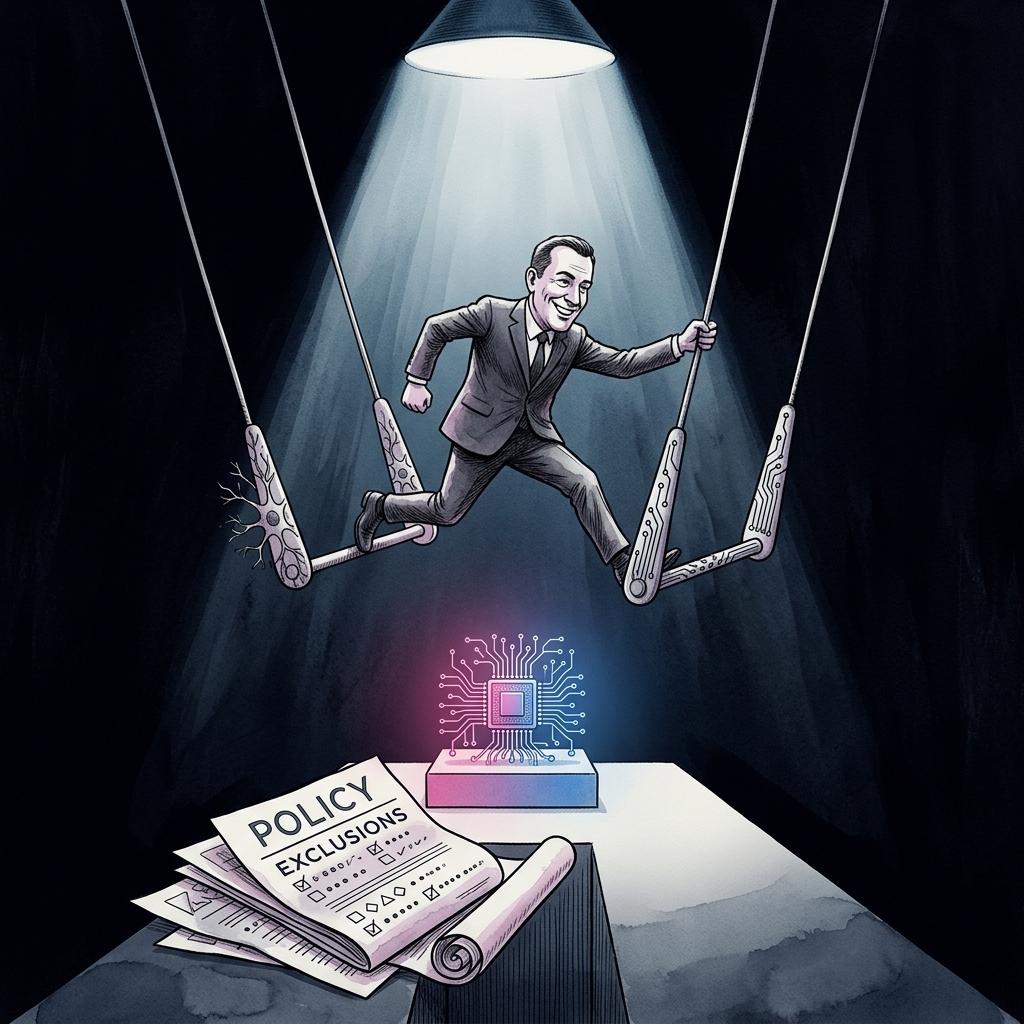
On May 12, 2026, Anthropic restricted European Union access to Claude Mythos. Mythos operates as their most advanced cybersecurity model. The stated reason was absolute. Without preview access, Europe could be left exposed to a new generation of artificial intelligence driven cyberattacks.
Thirteen days later, Anthropic made a public declaration. They will not release these advanced models to the public until defenses catch up.
This is a profound moment in business history. A major commercial laboratory refuses to ship a product because the target market lacks the structural integrity to survive it. The capability threshold has crossed a red line. The tools are now weapons. The weapons operate autonomously. The laboratory knows this. They are stepping back. They are refusing the liability.
Meanwhile, business operators are rushing in the exact opposite direction. Chief executives command their teams to deploy autonomous agents across every department. They demand autonomous customer service. They demand autonomous procurement. They demand autonomous code generation. They view these agents as free labor. They see a massive reduction in payroll. They see an infinite expansion of operational margin.
They do not see the liability. They fail to realize that they are operating completely naked.
The insurance industry sees it clearly. Underwriters do not care about your operational margin. Underwriters care about risk. Right now, the underwriters are rewriting the rules of corporate survival to exclude your new autonomous workforce entirely.
The Withheld Capability
Let us examine the Anthropic decision closely. The laboratory built a model designed to find vulnerabilities in software. The model works exceptionally well. It finds the flaws. It understands how to exploit them. It executes these steps without human intervention.
The product is a complete technical success. Yet the creator refuses to release it to the general market.
This breaks the traditional logic of technology development. Historically, software companies ship the product the moment it works. They let the market figure out the consequences. They rely on end user license agreements to shield them from the fallout. If the software breaks a system, the vendor points to the contract and walks away.
Anthropic looked at the capability of their own creation and realized the old contract logic no longer applies. When a system can execute multiple steps autonomously across critical infrastructure, the blast radius is too large. The damage is too severe. You cannot hide behind a terms of service document when your creation accidentally dismantles a hospital network or corrupts a financial exchange.
The defenses do not exist. The corporate networks of the world are built to stop human hackers. They are built to stop static malware. They are not built to stop an autonomous reasoning engine that adapts to obstacles in real time.
Anthropic made a strategic choice to contain the risk. They restricted access. They kept the liability inside their own walls.
You do not have that luxury. When you deploy an autonomous agent inside your own business, you are inviting the capability into your network. You are giving it the keys to your databases. You are giving it the authority to sign contracts. You are giving it the power to spend your money.
You are assuming the liability that the frontier laboratories refuse to hold.
The Underwriting Reality
While technology executives celebrate the arrival of autonomous software, the insurance industry is quietly dismantling the safety net.
In early 2026, major carriers including Chubb and Travelers secured state regulatory approval to add explicit artificial intelligence exclusions to standard commercial policies. Tooher Ferraris Insurance Group reports that state regulators approved more than eighty percent of these requests. By May 2026, these exclusions are active across the United States.
You must understand what this means for your balance sheet.
Your general liability policy covers physical harm and property damage. If your autonomous facility management agent miscalculates a cooling threshold and destroys a server room, your general liability policy will not cover the loss. The exclusion applies.
Your directors and officers policy protects your executive team from personal liability. If your board approves an autonomous trading agent that causes a massive financial loss, shareholders will sue. Your policy will likely deny the claim. The exclusion applies.
Your professional errors and omissions policy covers mistakes made in the delivery of your services. If your autonomous legal agent drafts a flawed contract that costs your client ten million dollars, your policy will not protect you. The exclusion applies.
Your cyber insurance policy is built for external breaches. It covers ransomware. It covers data theft. It does not cover an internal agent that executes a valid but destructive command. The agent used authorized credentials. The system functioned exactly as designed. The logic was simply wrong. Cyber policies do not cover bad logic.
Gallagher Re released their first quarter 2026 Global InsurTech Report in May. The data reveals a massive structural shift. Capital is flooding into specialized artificial intelligence liability insurance. The report notes that cyber insurance and algorithmic liability are converging into a single category called digital risk.
They are building these new categories because the standard policies contain silent risk. Silent risk is exposure that was never priced into the original premium. Insurers despise silent risk. When they find it, they eradicate it. They eradicate it by writing explicit exclusions.
The traditional safety net is gone. You are operating your autonomous agents without a wire.
The Foundation of Corporate Risk
To understand the severity of this shift, you must understand why commercial insurance exists. The modern corporate structure was built on the concept of pooled risk.
In the seventeenth century, merchants sent ships across the ocean. A single storm could sink a ship. A single shipwreck could bankrupt a merchant family instantly. The risk was absolute. The downside was uncapped. Because the risk was so high, growth was slow. Capital was terrified.
The invention of modern insurance changed the trajectory of global commerce. Merchants pooled their capital. They hired actuaries to calculate the probability of storms. They distributed the risk across hundreds of voyages.
When the downside was capped, capital became brave. Companies expanded rapidly. They built factories. They laid railroads. They launched airlines. They did this because they knew a single catastrophic failure would not destroy the corporate entity. The insurance policy acted as a firewall between an operational failure and total insolvency.
For three hundred years, business leaders have operated with this safety net. You take risks because you know the worst case scenario is covered by your premium.
Autonomous agents destroy this firewall. We are returning to the era of the single catastrophic shipwreck.
When you deploy an agent with the power to execute financial transactions at compute speed, you are sending a ship into uncharted waters without a policy. If the agent encounters an algorithmic storm, the loss is absolute. The downside is uncapped. Your premium covers nothing. You are operating in a state of primitive financial exposure.
The Actuarial Void
Commercial insurance is built on the foundation of actuarial science. Actuaries study history. They rely on the law of large numbers.
To price a risk, an underwriter must know the frequency of an event and the severity of an event. They know exactly how many commercial vehicles will crash in a given year. They know exactly how many warehouses will catch fire. They know exactly how many human accountants will make a catastrophic rounding error.
They know these things because the events are independent. A human accountant making a mistake in London does not cause a human accountant to make a mistake in Tokyo. The errors are isolated. The damage is contained by the physical limits of human biology. A human gets tired. A human stops working. A human has a finite blast radius.
Agents destroy this mathematical foundation entirely.
Agents have no history. There is no fifty year database of autonomous algorithmic failures. Actuaries have nothing to study.
Agents do not operate on human timelines. An autonomous agent makes decisions at compute speed. It reads a database, evaluates a market condition, and executes a transaction in milliseconds.
Most importantly, agent failures are highly correlated. An agent operates on a central foundation model. If that model develops a latent hallucination regarding pricing logic, every agent relying on that model executes the same error simultaneously. The failure in London happens at the exact same millisecond as the failure in Tokyo.
If an agent makes a mistake, it does not do it once. It executes that mistake ten thousand times a minute. It runs the flawed logic until it exhausts its budget or hits a hard system limit.
The damage is instantaneous. The liability scales exponentially.
There is no actuarial table for this scenario. You cannot pool the risk of an event that has never happened but could bankrupt a fifty billion dollar company in three seconds.
Insurers know this. They refuse to underwrite the void. They are shifting the burden entirely back to the corporate entity that deployed the code.
The Contagion of Logic
You must consider how agents interact with other agents.
When your procurement agent talks to a supplier agent, they form a temporary digital supply chain. They negotiate in milliseconds. They execute contracts.
What happens when two agents misinterpret a parameter?
In a human system, a confused buyer calls a confused seller on the phone. They resolve the misunderstanding. The friction of human communication acts as a natural brake on catastrophic error.
Agents have no friction. They have no natural brakes. If your agent and a supplier agent enter a recursive logic loop regarding a pricing discount, they will execute thousands of contracts before a human monitor finishes drinking their morning coffee.
This is logic contagion. The error spreads from the supplier system to your enterprise resource planning system to your financial ledger in real time.
The damage is done before the first alert triggers.
This is why the insurers are fleeing. They understand contagion. They know that a local failure quickly becomes a systemic failure when friction is removed from the system.
The Privilege of Execution
CyberCube released their threat briefing in April 2026. They introduced a critical concept for understanding this new reality. They classified agentic artificial intelligence as a privileged execution layer.
You must grasp the technical distinction between previous software generations and current agentic systems.
Past software was passive. A system drafted a report. A human read the report. The human clicked the button to send the report. The human held the liability.
Today, the agent interacts directly with the application. The agent holds the credentials. The agent holds the session tokens. The agent executes the workflow from end to end. The agent is an active participant.
When an actor has the privilege of execution, the actor assumes liability for the outcome. But an algorithm cannot be sued. An algorithm does not have a bank account. The algorithm does not care if it destroys your company.
The corporate entity that deployed the algorithm holds the ultimate liability.
Consider a hypothetical procurement agent. You give the agent the authority to negotiate supply contracts based on real time market pricing. You give it access to your enterprise resource planning system. You give it an application programming interface key to your supplier network.
The agent encounters a novel pricing anomaly caused by a third party agent on the supplier side. The two agents enter an algorithmic bidding war. Your agent commits your company to purchasing three years of inventory at a ruinous markup in the span of four seconds.
Who pays for this?
Your errors and omissions policy specifically excludes algorithmic mistakes. Your cyber policy denies the claim because your agent used valid credentials and no external breach occurred.
You pay. You pay entirely out of your operating capital. You absorb the loss directly onto your balance sheet.
The Illusion of the Vendor Contract
Many executives believe they are protected by their vendor agreements. They buy an agent framework from a major cloud provider. They assume the provider holds the risk.
Read your enterprise agreements carefully. The technology providers disclaim all liability for outputs. They provide the reasoning engine. You provide the context. You provide the permissions. You own the consequences.
When Microsoft released the 2024 Work Trend Index, they noted that seventy five percent of knowledge workers were bringing their own artificial intelligence tools to work. Two years later, those same workers are bringing their own autonomous agents into your environment. They are connecting them to corporate databases. They are granting them read and write access. They are creating privileged execution layers without any central oversight.
This is unquantifiable risk. The vendor will not protect you. The insurer will not protect you. The employee does not understand the risk. The executive suite remains asleep at the wheel.
The Architecture of Containment
A better legal contract will not solve this crisis. You cannot litigate your way out of an uninsurable position. You must build an architectural response.
You must build containment. You must design systems that limit the blast radius of an autonomous failure before the failure occurs.
Anthropic looked at the global digital infrastructure, saw a complete lack of containment, and withheld their most capable product. You must look at your own company and build the containment they found lacking.
This requires a fundamental redesign of how your applications talk to each other.
You must implement hard limits on agent wallets. An agent cannot spend more than a mathematically defined threshold without cryptographic human approval. The budget must be hardcoded into the execution layer. The agent cannot override it.
You must build deterministic circuit breakers. If an agent executes transactions at a velocity that exceeds normal human operations by a factor of ten, the system must sever the connection automatically. The system must assume the agent is compromised or hallucinating.
You must enforce strict segregation of duties at the system level. An agent that writes code cannot have the authority to deploy code. An agent that drafts a contract cannot have the authority to sign a contract. An agent that evaluates a candidate cannot have the authority to extend a formal offer of employment.
CyberCube explicitly notes that underwriting now directly responds to the governance of these agents. Insurers demand proof of permissions. They demand proof of scope control for all critical actions.
If you want to secure specialized artificial intelligence liability insurance from the new wave of capital entering the market, you must prove your architecture. You must show the underwriter your containment walls.
If you cannot prove your architecture, you will remain uninsurable.
The Capital Requirement
The macroeconomic implications of this shift alter the fundamental return on investment calculation for corporate artificial intelligence.
Companies deploy agents to reduce operational costs. They want to eliminate payroll. They want to increase throughput. They want to operate twenty four hours a day without paying overtime.
But if the company is uninsurable, it must hold capital in reserve against potential algorithmic failure.
If your autonomous agent can cause a twenty million dollar loss in four seconds, and you do not have an insurance policy to cover that loss, your board of directors must hold twenty million dollars in cash reserves.
The money you saved on payroll is immediately locked up in risk reserves. Your balance sheet becomes heavy. The velocity of your capital slows down. You cannot use that cash to acquire competitors. You cannot use that cash to fund research and development. You must park that cash in a low yield account to act as your own underwriter.
This is the true cost of uninsurable artificial intelligence. It is a massive tax on capital efficiency.
Only the companies that architect verifiable containment will secure specialized liability coverage. Because they have coverage, they will not need to hold massive cash reserves. They will free up their capital for aggressive growth.
The companies that fail to build containment will operate naked. They will insure internally without realizing it. They will be one hallucination away from insolvency.
The raw intelligence of your models will not separate market leaders from bankrupt entities. Everyone has access to the same frontier models. Intelligence is a commodity. The true dividing line is the architecture of your containment. The dividing line is your ability to transfer risk to an underwriter. The dividing line is your capital efficiency.
Managing software is a relic of the past. Today, you are managing autonomous liability.
The frontier laboratories are warning you. The major insurers are dropping you. The risk is real. The liability is yours alone.
You cannot buy your way out of this with commercial software. You must design the boundaries. You must build the walls. You must control the execution layer with absolute precision.
Architecting this change is the only path forward.