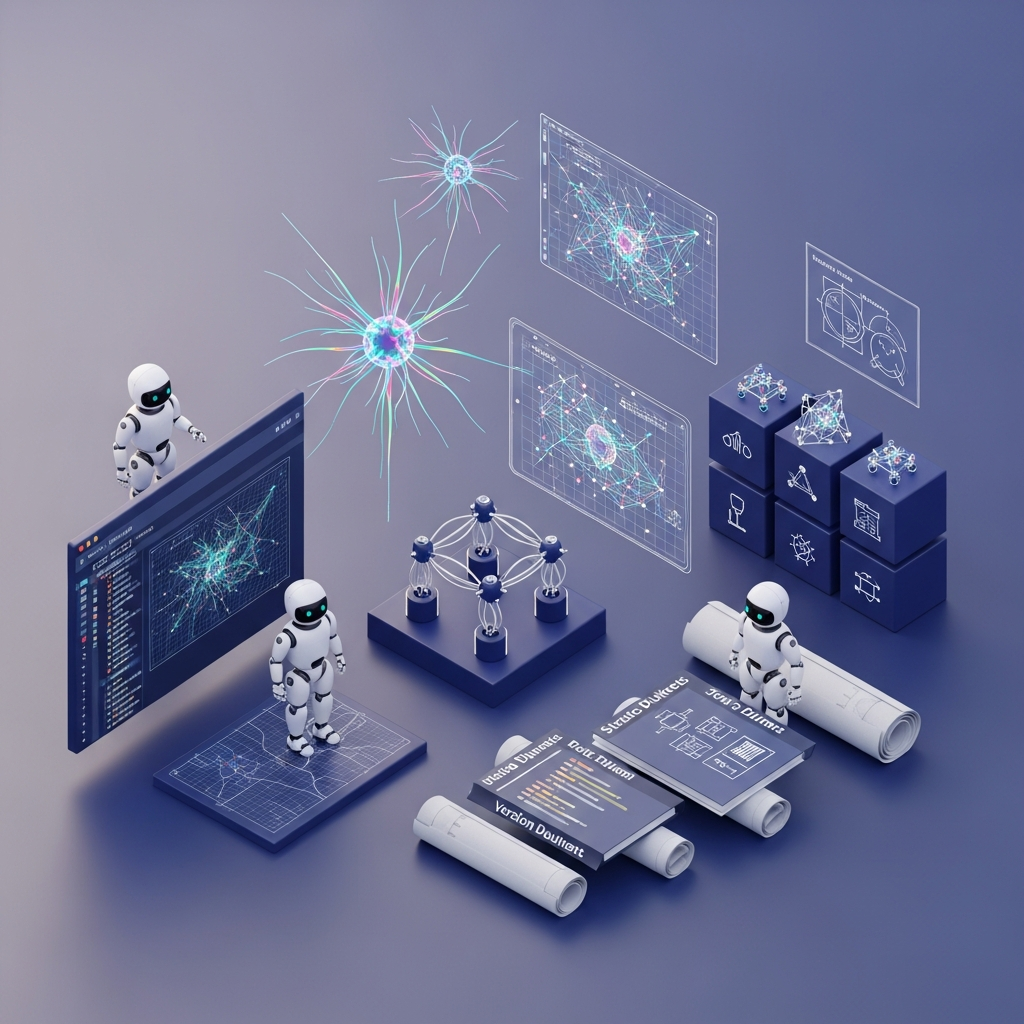
The Company That Fits in a Git Repository
Something unprecedented happened in the last twelve months. The infrastructure required to run a multi-department company — product strategy, design, engineering, testing, marketing, analytics, finance — collapsed from hundreds of employees into a directory of markdown files.
This is not an exaggeration. This is not a thought experiment. This is an architectural reality that emerged from the convergence of three forces: frontier AI models that can sustain multi-step reasoning across complex workflows, CLI-based agent orchestration frameworks that let you define agents as specification documents, and file-based coordination patterns that replace the chaos of real-time messaging with structured, auditable artifacts.
The result is what I call the Markdown-Defined Company — an organizational architecture where every role, every process boundary, every authority limit, and every inter-departmental handoff is codified in version-controlled text files. Your employee handbook is a CLAUDE.md. Your org chart is a directory of agent specifications in .claude/agents/. Your performance reviews are CI pipelines.
And the founder — a single human — operates not as the bottleneck at the top of a hierarchy, but as the exception handler for a system that runs autonomously 95% of the time.
Why the Multi-Agent Architecture Is Structurally Inevitable
The question is no longer whether businesses will run on autonomous agent teams. The question is whether you will architect that transition deliberately or have it imposed on you by competitors who did.
Consider the economics. A traditional mobile app studio employs 15–40 people across product management, design, engineering, QA, marketing, and finance. Loaded cost: $2M–$6M annually. Coordination overhead consumes 30–50% of everyone's time — meetings, Slack threads, status updates, context-switching between projects. The actual productive output is a fraction of what you are paying for.
Now consider the alternative. Thirty-seven AI agents, organized into seven departments, communicating through structured file artifacts, operating 24/7 with zero coordination fatigue. The cost is measured in API calls — orders of magnitude less than human salaries. The coordination overhead approaches zero because every handoff is explicit, every artifact is structured, and every dependency is declared in code.
This is not a marginal improvement. This is a structural discontinuity. The companies that recognize it first will operate at a velocity that makes traditional organizations look geological.
The Three Governance Models That Actually Work
Multi-agent systems are not monolithic. The mistake most people make is trying to apply a single coordination pattern across all agent interactions. Production experience from 2024–2025 reveals three distinct governance models, each suited to different workflow types.
SOP-Based Sequential Pipelines
For predictable workflows — the product development lifecycle, content publishing, financial reporting — sequential pipelines deliver the highest reliability. Each agent's output becomes the next agent's structured input. Product Manager produces a PRD. Architect transforms it into API specifications. Engineer implements against those specifications. QA validates against the original requirements. No ambiguous handoffs. No coordination overhead. No hallucinated requirements drifting through the chain.
MetaGPT demonstrated this at ICLR 2024: agents organized as explicit role chains achieved 100% task completion on software development benchmarks. The key insight is that the pipeline enforces discipline that human teams struggle to maintain — every artifact is complete before the next stage begins, because the next agent literally cannot operate without it.
Task-Queue Self-Claiming
For parallel workstreams — an engineering sprint where six agents need to implement independent features simultaneously — task-queue architectures excel. A team lead decomposes work into a task list with explicit blocking dependencies. Agents self-assign unblocked tasks using file locking to prevent race conditions. This maps naturally to departments where multiple agents work independently while respecting dependency chains.
The critical detail: blocking dependencies must be declared explicitly, not inferred. An agent working on the payment integration module must know that it is blocked by the database schema migration agent. This is not something you want resolved through emergent behavior. This is something you encode in the task specification.
CI-as-Ratchet
For high-parallelism environments — testing departments, validation pipelines, security audits — the ratchet model is optimal. Every agent works in its own isolated branch. Every pull request that passes the automated test suite gets merged. Progress is permanent. Redundant work is explicitly tolerated because it is cheaper than blocked work.
This philosophy, embodied by tools like Multiclaude, treats the CI pipeline as the sole quality gate. The test suite is not a safety net — it is the governance mechanism. If your tests are comprehensive enough, any agent output that passes them is, by definition, correct enough to merge. This requires excellent tests, but it eliminates the coordination bottleneck entirely.
The Hybrid That Scales
The architecture that works for a 37-agent studio is not any single model. It is a deliberate hybrid: SOP pipelines between departments (Product hands off structured specs to Design, Design hands off to Engineering), task-queue parallelism within departments (six engineering agents claiming tasks independently), and CI-ratchet for testing where parallel validation is the entire point.
File-Based Coordination: The Counter-Intuitive Architecture Decision
The instinct when building multi-agent systems is to reach for real-time messaging — shared memory, message queues, event streams. This instinct is wrong.
UC Berkeley's MAST study analyzed 1,600+ execution traces across multi-agent frameworks and found that 79% of failures stem from specification and coordination issues, not model limitations. The communication layer is not a plumbing detail. It is the primary failure surface.
File-based communication with structured artifacts is more reliable than any real-time alternative. Each department writes outputs to designated directories that downstream departments read:
Product writes PRDs and opportunity briefs. Design writes component specifications and asset references. Engineering writes architecture documents and code. Testing writes coverage reports and quality gate results. Marketing writes campaign briefs and analytics. Finance writes budget reports and revenue summaries. And a dedicated escalations directory captures the sparse set of decisions that require human judgment.
Each artifact follows a structured template with metadata: author agent, timestamp, status, blocking dependencies, downstream consumers. This makes handoffs explicit and auditable. When something fails, you can trace the exact artifact that caused the cascade. When an upstream agent produces garbage, the downstream agent fails cleanly at the parsing step rather than propagating a hallucinated fact through seven subsequent decisions.
This is the critical advantage over real-time messaging: failure is contained. An agent that crashes or hallucinates does not poison a shared message bus. It produces a malformed file that downstream agents reject. The blast radius is bounded by design.
Exception-Based Oversight: Protecting the Scarcest Resource
In a 37-agent organization, the founder's attention is the scarcest resource. Not compute. Not API tokens. Not engineering talent. Your cognitive bandwidth for making decisions is the binding constraint on the entire system.
The optimal autonomy level is what researchers call L4 — agents operate fully autonomously but surface key decisions for human approval. The founder's inbox should be sparse and high-signal. Healthcare studies show that providers encountering 100+ alerts daily ignore virtually all of them. The same applies to founders drowning in agent notifications.
The decision matrix is stark:
Auto-execute, no human needed: read-only operations, analysis, drafts, actions within pre-approved templates, spending under threshold, routine data processing. This should be 90%+ of all agent activity.
Exception-escalate, alert founder but continue unless stopped: unusual patterns detected, moderate-confidence decisions, performance anomalies. These appear as a daily digest, not real-time interrupts.
Hard approval gate, block until founder approves: spending above budget threshold, external communications to users or press, production deployments, pricing changes, legal or compliance actions. These should number fewer than five per week.
Confidence gating at 0.85 is the standard starting threshold. Below that confidence level, the agent escalates. Above it, the agent executes autonomously. You tune this number based on the cost of errors in each domain — financial agents gate lower, content agents gate higher.
Designing for the 41–87% Failure Rate
Here is the uncomfortable truth that most multi-agent system advocates do not tell you: production failure rates in state-of-the-art multi-agent frameworks range from 41% to 87%. UC Berkeley measured this. ChatDev achieved only 33% correctness on complex benchmarks. These are not fringe systems — these are the best frameworks available.
The critical finding is that failures stem from system design, not model limitations. Three drift patterns account for the majority:
Goal drift — the agent stops solving the right problem. This accounts for 36% of failures. An engineering agent tasked with building a payment integration gradually shifts into optimizing database performance because the context window accumulated irrelevant signals over successive turns.
Context drift — noise accumulates and old decisions bleed into new situations. Another 36% of failures. An agent remembering a workaround from three sessions ago applies it to a completely different problem, creating a subtle but catastrophic misalignment.
Reasoning drift — logic degrades over successive turns as small errors compound. Each individual step seems reasonable, but the cumulative trajectory diverges from anything useful. This is the multi-agent equivalent of a random walk — locally rational, globally nonsensical.
The antidote is not better models. It is better architecture. Session reinitialization between runs prevents context contamination. Structured handoff formats with explicit success criteria prevent goal drift. An independent judge agent that evaluates other agents' outputs catches reasoning drift before it propagates. And circuit breakers — global kill switches, per-tool rate limiters, pattern detectors that catch repeated identical actions — prevent runaway agents from burning resources on impossible tasks.
The Devin cautionary tale is instructive: independent testing found a 15% success rate on diverse coding tasks, with the agent spending days pursuing impossible solutions rather than recognizing fundamental blockers. Enterprise success only appeared for well-scoped tasks. The lesson is unambiguous: agents work within narrow, well-defined parameters. The agent specification — not the model — determines success or failure.
The Agent Specification Is Your Highest-Leverage Artifact
A single bad line in an agent specification affects every session, every task, and every decision that agent makes. The spec is simultaneously the job description, the authority boundary, the performance rubric, and the communication protocol.
A complete agent specification defines six things: what the agent does (its core responsibility), what it can do autonomously (its authority boundary), what it must never do (its hard constraints), what triggers escalation to the founder, what artifacts it reads from upstream agents, and what artifacts it produces for downstream agents.
The specification is stored as a markdown file with YAML frontmatter — version-controlled, reviewable, and diffable. When an agent misbehaves, you do not debug the model. You revise the specification. When a new workflow emerges, you do not retrain anything. You write a new markdown file. When the organization evolves, you update the repository.
This is the profound implication of the Markdown-Defined Company: organizational design becomes a software engineering discipline. You iterate on your company structure with pull requests. You A/B test management philosophies with branch deployments. You roll back failed reorganizations with git revert.
The Implementation Roadmap: Start with Five, Not Thirty-Seven
The temptation is to architect all 37 agents simultaneously. Resist it.
Production case studies are unambiguous on this point. OpenObserve deployed an 8-agent QA pipeline — Orchestrator, Analyst, Architect, Engineer, Sentinel (quality gate), Healer (auto-fix), Scribe (documentation), and Test Inspector — and grew their test suite from 380 to 700+ tests while reducing flaky tests by 85%. Eight agents. Transformative results.
Start with the minimum viable agent team: a product strategist that researches market opportunities and produces structured briefs, a coding agent that implements against specifications, a testing sentinel that serves as the hard quality gate blocking the pipeline on critical issues, an ASO optimizer that manages app store visibility, and a finance tracker that monitors revenue and flags anomalies.
Five agents. Five markdown files. One artifacts directory with five subdirectories. This is enough to validate your coordination patterns, tune your confidence thresholds, and build trust in the system before expanding.
Then add departments incrementally. Each new agent introduces coordination surface area. Each new handoff creates a potential failure point. The organizations that succeed with multi-agent architectures are not the ones that deploy the most agents — they are the ones that deploy agents whose coordination is the most precisely specified.
The Strategic Imperative
The Markdown-Defined Company is not a futuristic concept. The tools exist today. The governance patterns have been validated in production. The economics are overwhelming. A solo founder with a laptop and a git repository can now orchestrate organizational capability that previously required millions in payroll and years of institutional knowledge accumulation.
But — and this is the qualification that separates architecture from fantasy — the system demands rigorous engineering of the governance layer. The agents themselves are commodity. The specifications, the coordination patterns, the failure modes, the escalation logic, the circuit breakers — this is where competitive advantage lives. This is where the difference between a 33% success rate and a 95% success rate is determined.
The companies that treat multi-agent orchestration as a prompt engineering exercise will join the 41–87% failure statistics. The companies that treat it as a systems architecture challenge — with the same rigor they apply to distributed systems, database design, and security infrastructure — will build organizations that operate at a velocity their competitors cannot comprehend.
This is not something you figure out by experimenting with ChatGPT. This is structural engineering of autonomous organizations. And the window to architect it correctly, before your competitors do, is measured in months — not years.