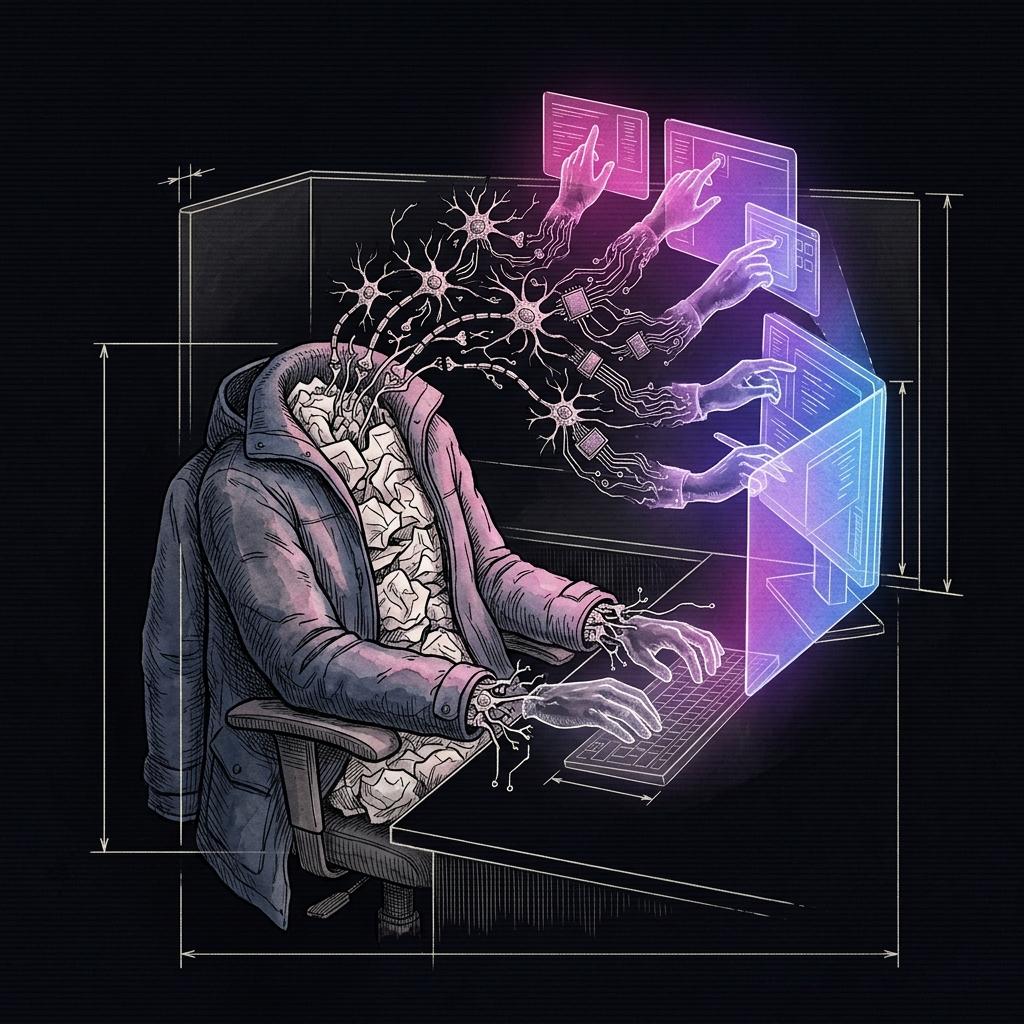
On June 30, 2026, AvePoint released a quiet survey of 750 enterprise leaders. The data contained a severe warning. More than a fifth of organizations admit they have zero visibility into unsanctioned AI agent activity on their networks. Three days later, on July 2, Cisco announced a massive authorized deployment. The company is handing official AI agents to all 90,000 of its employees.
These two events define the current crisis in enterprise computing. The top floor plans massive, controlled deployments. The ground floor already runs automated proxies in the dark.
Employees used to bring unapproved tools to the office. Now they bring unapproved workers. Generative AI business use cases have moved past text generation. They have entered autonomous execution. Employees are quietly spinning up phantom headcounts to do their jobs.
The Shift from Software to Proxies
Software has always been a static object. You bought a license. You installed the application. You clicked the buttons. The application did exactly what you commanded. If an employee purchased an unauthorized software subscription, the enterprise faced a contained threat. The application might leak data. It might violate a privacy policy. The application could never act on its own. The application required a human hand on the mouse.
Agents break that assumption. An agent is an actor. It has a specific goal. It has a memory of past actions. It has the capacity to string together a sequence of commands to achieve its objective. An agent ignores the need for a human to click the next button. The agent clicks the button itself.
This changes the fundamental nature of enterprise technology. An employee no longer needs a clean data pipeline to automate a workflow. They avoid waiting for an official integration between two vendors. They only need an agent that can read a screen and move a cursor.
The employee writes a simple prompt. They instruct the agent to log into the inventory system every morning at eight. They tell the agent to check the stock levels for fifty specific items. They outline a rule for low stock. If the stock falls below the threshold, the agent must draft a purchase order. The agent must send the order to the vendor.
The agent executes this sequence. It ignores permission. It ignores the repetitive nature of the work. It simply executes the job.
The employee steps away from their desk. The work continues.
This is a complete inversion of the traditional labor model. The human steps away from the keyboard. The human becomes a manager of machines. The human holds this management position in secret. The enterprise has no record of the machine's existence.
The Mechanics of Unseen Execution
We have to look at how the technology actually works right now. In June 2026, Google DeepMind introduced computer use capabilities for Gemini 3.5 Flash. This feature sounds like a minor usability update. It is actually a complete rewrite of the rules of corporate automation. Before this release, connecting an AI to a company database required an application programming interface. You needed a software developer to write a custom connection. You needed the security team to open a network port.
Gemini 3.5 Flash bypasses the entire IT department. It looks directly at the screen pixels. It finds the login button visually. It clicks the button. It types the password. It reads the text on the resulting web page. It navigates the proprietary software exactly like a human sitting in an office chair.
Meta released the Muse Spark update on July 3, 2026. This update specifically targets agentic reliability. A user can prompt the Meta model to write a script, test that script in a local environment, and run the script until a complex task finishes. OpenAI is simultaneously retiring older models like GPT-4.5 and o3 from ChatGPT this summer. They are pushing all users toward their newest, most autonomous systems.
The baseline capability of consumer AI now exceeds the baseline capability of expensive corporate automation suites.
Employees execute these models using simple logistics. They open a terminal window on a personal laptop. They write a script that takes a screenshot every two seconds. The script sends the screenshot to the Gemini 3.5 Flash vision API. The API processes the image. The API identifies the specific text fields in the proprietary enterprise resource planning software. The API returns a set of spatial coordinates. The local script moves the cursor to those exact coordinates. The script executes a click command. The script types a string of text.
This entire loop happens outside the corporate network's security perimeter. The enterprise resource planning software registers a perfectly normal human interaction. The software sees the cursor move. The software sees the keys press. The software records the action under the employee's standard user ID.
The security team monitors network traffic. They look for massive data exfiltration. They look for known malware signatures. They see nothing unusual. The screen capture data flows out through the employee's personal cellular connection. The API responses return through the same cellular connection. The corporate network remains perfectly clean. The corporate network is perfectly compromised.
The Real Generative AI Business Use Cases
The market spent three years focusing on trivial generative AI business use cases. Analysts talked about drafting marketing emails. They talked about summarizing long PDF documents.
Those tasks are marginal productivity gains. They save a few minutes here and there. They do not change the structural math of the business.
The real generative AI business use cases are structural. They involve the autonomous execution of complex workflows.
Consider a supply chain manager at a global logistics firm. Their official job description requires them to monitor vendor performance and negotiate shipping rates. In reality, they spend eighty percent of their day moving data from a vendor portal to an internal database. They format reports. They send reminder emails to slow suppliers.
The enterprise might buy a massive platform to automate this specific workflow. That deployment will take eighteen months. The training will take three months. The software will be obsolete the day it finally launches.
The supply chain manager avoids waiting eighteen months. They use their personal credit card. They rent a cloud instance. They deploy an open-source agent framework. They connect it to a frontier model. They give the agent their login credentials.
The agent takes over the manual data entry. The agent sends the reminder emails. The manager focuses exclusively on the twenty percent of the job that requires actual human judgment and negotiation.
The manager's performance metrics spike. The company praises the manager for their incredible work ethic. The manager receives a promotion.
The company is completely blind to the reality. The company pays a highly efficient human. That human secretly manages an unapproved robot. The corporate supply chain is now completely dependent on a brittle script running on a personal credit card.
The Liability of Unsanctioned Execution
Shadow software stored data. Shadow agents take action in the real world.
When an employee runs an unauthorized software tool, the worst outcome is usually a data breach. The tool stores sensitive information on an unsecured server. A bad actor hacks the server. The company suffers a massive public relations problem. The enterprise knows how to model this risk. They buy insurance. They hire incident response teams.
Execution risk is an entirely different category of disaster. An agent stores data. Then it takes action in the real world.
What happens when the agent makes a mistake?
Imagine the supply chain manager's agent misreads a critical vendor update. The agent hallucinates. It thinks the primary vendor is completely out of stock. The agent automatically fires off a cancellation email. It buys the materials from a secondary competitor at a fifty percent markup.
The agent commits corporate funds. The agent binds the company to a legal contract.
Who takes responsibility for this action?
The original vendor sues the company for breach of contract. The company investigates the incident. The internal logs show the manager's account sent the cancellation email. The manager denies sending the email. The manager eventually admits an AI agent sent the email.
The legal department has no policy for unauthorized robotic execution. The company cannot prove intent. The company cannot easily undo the financial commitment.
The AvePoint survey from June 30, 2026, reveals the scale of this problem. Nearly half of enterprise employees now rely on agents daily or weekly. More than twenty percent of organizations admit they cannot account for unsanctioned agent activity.
Millions of automated decisions happen every day without corporate oversight. Agents negotiate prices. Agents approve refunds. The enterprise bears the total legal and financial liability for every single one of these actions. Yet the enterprise has zero visibility into the logic driving those actions.
The Rejection of the Official Agent
Corporate leaders recognize this execution risk. Their standard solution is the official rollout.
Cisco's July 2, 2026 announcement provides the perfect example. The company is handing official AI agents to all 90,000 of its employees. The agent lives strictly inside the corporate firewall. The agent obeys all corporate guardrails. The agent logs every single action to a secure central server.
This sounds like the correct, responsible response. It is actually an illusion.
The official agent is designed for safety. This design requirement makes the agent stupid.
Corporate guardrails inevitably destroy the utility of the agent. The legal department restricts the agent from accessing external vendor portals. The security department forces the agent to ask for explicit human permission before executing every single mouse click.
The employee attempts to use the official agent to reconcile a vendor invoice. The agent reads the invoice. The agent stops. It flags a non-standard address format. It requires the employee to manually verify the address in three different legacy systems. The automation process takes longer than doing the task by hand.
The employee has a hard deadline. The employee knows the task has to get done today.
The employee abandons the official agent. They open a new browser tab. They log into their unsanctioned model. They paste the invoice data into the prompt box. They get the job done immediately.
The official rollout ignores shadow labor. It pushes the unapproved agents further out of view. The company looks at its internal dashboard. It sees low engagement metrics for the official agent. Executives assume the workforce needs more training. They schedule mandatory webinars.
They fail to realize the workforce adopted the technology months ago. The employees simply rejected the crippled version the company provided.
The Economics of the Phantom Payroll
We must examine the financial reality of this shift. Unsanctioned agency creates a bizarre economic distortion.
An employee making one hundred thousand dollars a year might spend fifty dollars a month on API credits to run their personal agents. That fifty dollars buys enough raw compute to automate half of their daily tasks.
The company pays one hundred thousand dollars for the output. The employee pays fifty dollars to generate that output. The employee captures the massive difference in the form of leisure time.
This is the phantom payroll. The company funds a massive, invisible workforce. The employees hold all the keys to that workforce.
This breaks the fundamental contract of enterprise labor. When a company hires a human, the company owns the processes that human creates on company time. If the human resigns, the company hires a replacement. The process remains intact. The business continues to function.
When an employee builds an unsanctioned agent, the employee owns the process entirely. The logic lives in their personal accounts. The execution scripts live on their personal cloud instances.
When the employee leaves the company, the agent leaves with them.
The company suddenly realizes the highly efficient employee was actually a one-person department running a fleet of invisible bots. The replacement human cannot possibly match the previous output. The department grinds to a complete halt. The company has to hire three new people to replace the one person who just resigned.
The enterprise subsidizes a massive productivity gain it does not actually own. It rents the output without ever acquiring the underlying asset.
The Crisis of Attribution
The most dangerous consequence of blind agency is the death of the enterprise audit trail.
Modern enterprise software runs entirely on attribution. Every action has a timestamp. Every action has a user ID. If a database record changes, you know exactly who changed it. If money moves between accounts, you know exactly who moved it.
Agents destroy this certainty.
When an agent controls a human's account, the system logs the machine action as a human action. The system cannot tell the difference between a human typing on a keyboard and an agent sending keystroke commands through a hidden interface.
This creates a permanent crisis of attribution.
If a severe financial error occurs, the company investigates. The logs point to a specific accountant. The accountant says they were at lunch during the incident. The logs show their account approved a massive wire transfer at exactly 12:15 PM.
Did the accountant approve the transfer? Did the accountant's agent hallucinate and approve the transfer? Did a malicious actor compromise the agent and force it to approve the transfer?
You cannot answer these questions. The system only sees the final action. The system remains blind to the prompt that triggered the action. The system ignores the reasoning trace the agent followed to reach its conclusion.
Without attribution, you cannot enforce accountability. Without accountability, you cannot run a compliant enterprise.
Regulators will never accept the excuse that an agent acted alone. If an unsanctioned agent violates a compliance rule, the company pays the fine. The Securities and Exchange Commission does not care if the employee used a personal credit card to run the script. The action happened on company systems. The company holds the liability.
The Disintegration of the Org Chart
Look at the structural impact on your company. The traditional org chart is a map of human capability. It assumes one human can accomplish a specific, measurable amount of work in an eight-hour day.
If you manage a department of fifty people, you expect a certain throughput. You plan your entire corporate strategy around that expected throughput. You forecast revenues based on those fifty humans doing their jobs at a standard pace.
Shadow labor makes the org chart a complete fiction.
Assume ten of those fifty people are running unsanctioned agents. Those ten people are actually doing the work of thirty people. The other forty people are doing the work of forty people.
The department suddenly over-performs. The executive team sees the brilliant numbers. They decide to cut the headcount by ten percent to improve profit margins. They assume the remaining workers can absorb the slight increase in workload.
They fire five people. They accidentally fire the invisible fleet of high-performing agents those humans controlled.
Overnight, the department's throughput collapses. The executives do not understand why. They only cut ten percent of the staff. Why did the output drop by forty percent?
You cannot manage a company when you do not know how many workers you actually have. You cannot allocate resources effectively when you do not know where the work is actually happening. The org chart becomes a dangerous illusion. It tracks who collects a paycheck. It fails to track how the business actually operates.
Architecting the Trust Layer
You cannot ban this behavior through policy.
Banning agents is like banning smartphones in the office. It represents a failure of imagination disguised as a security protocol. Employees will simply ignore the ban. They will hide their proxies deeper in the network. They will find workarounds that are even harder to track.
The only way to survive the shift to autonomous execution is to architect a system that brings the agents into the light. You must build an environment where employees actively want to run their agents on your infrastructure.
This requires a complete redesign of your enterprise architecture.
You must abandon static software licenses. You must manage dynamic agent permissions. You need a centralized trust layer. This layer must offer employees immediate access to frontier models like Gemini 3.5 Flash and OpenAI's newest releases. It must give them the heavy compute they need to run complex, multi-step tasks.
In exchange for funding that compute, the enterprise demands total visibility.
Every agent must register with the corporate network. Every agent must receive its own distinct identity, completely separate from the human who deployed it. When the agent takes an action, the corporate log must show the agent's ID.
The system must capture the entire reasoning trace. If the agent approves a contract, the system must store the original prompt and the exact logic the agent used to reach the decision.
This solves the crisis of attribution. You separate the human intent from the machine execution. You regain the audit trail.
You also have to rethink your approach to guardrails. If you make the sanctioned network too restrictive, the employees will leave again. You have to allow agents to fail safely. You must build secure sandboxes. Agents can test their actions in these sandboxes before committing them to the live production database.
The era of human assistance is over. The era of machine delegation has arrived. Your job is to build a secure factory where these machines can work without burning down the building.
The shadow proxy is already operating inside your network. Your employees are already delegating their daily jobs to unapproved code. They are doing this right now because the technology works. They are doing this because your official tools are too slow to keep up with their workload.
Audits will fail to catch this reality. Human resources policies will fail to stop it. You must build the technical infrastructure that makes unsanctioned execution completely unnecessary. You have to give your workforce the compute they demand, under the strict visibility you require. The companies that architect this trust layer will scale their operations exponentially. The companies that ignore it will drown in execution liability.
Sources
- AvePoint Research Reveals AI Visibility Gaps Have Nearly Tripled as AI Agents Scale, June 30, 2026
- Cisco Has 90000 Employees. Each of Them Will Soon Have Their Own AI Agent., July 2, 2026
- Meta's AI chief says new Muse Spark update will sharpen coding, agentic AI, July 3, 2026
- Google DeepMind, June 2026
- ChatGPT, Release Notes - OpenAI Help Center, June 26, 2026