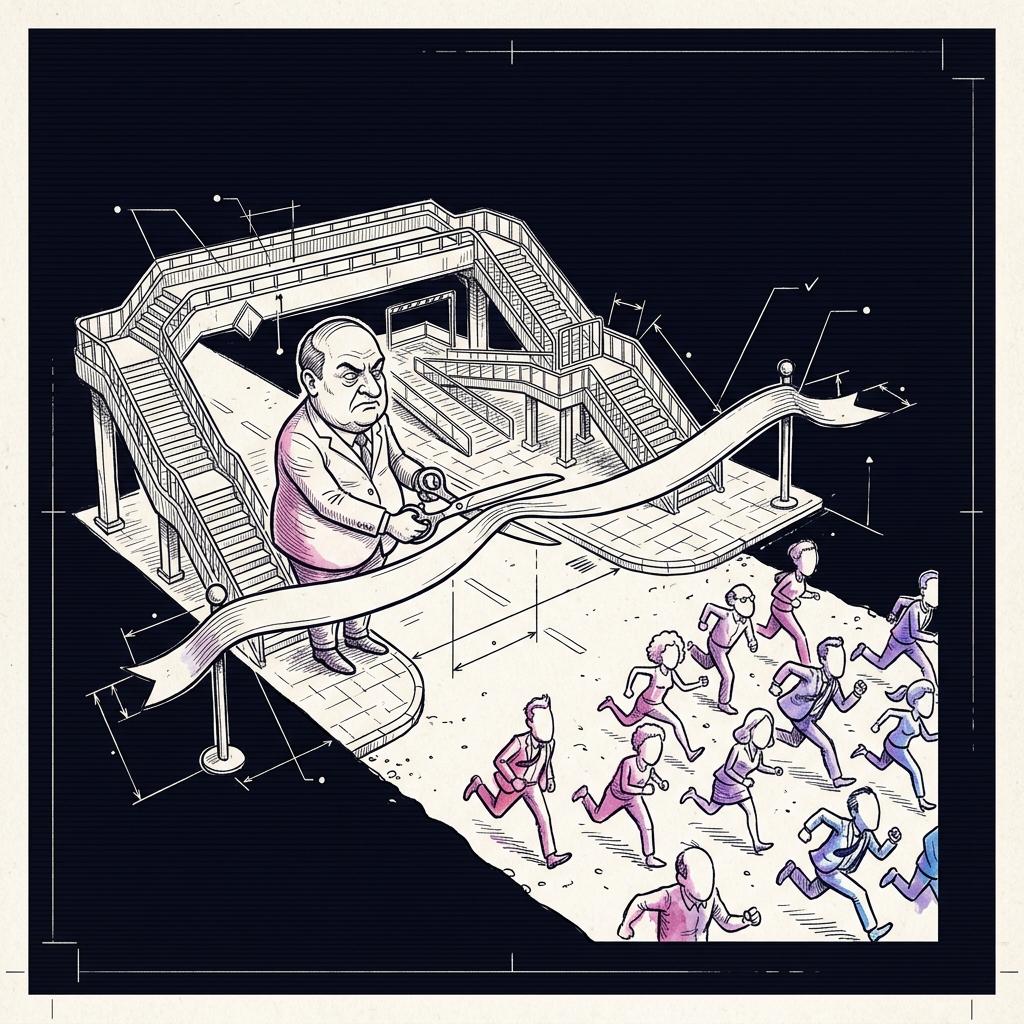
On April 7, 2026, the writing platform WRITER released a survey of 1,200 C-suite executives and 1,200 non-technical employees, conducted across December 2025 and January 2026. Three quarters of the executives, 75 percent, told WRITER that their company's AI strategy was "more for show" than actual internal guidance. Fifty-four percent said AI adoption was tearing the company apart. Sixty-seven percent suspected at least one data breach already caused by an employee using an unsanctioned AI tool. Sixty percent said they planned to lay off the workers who would not or could not adopt AI.
This is what AI change management looks like when the workforce got there first.
The shape we inherited
For thirty years, change management was a stable discipline. You drew a from-state. You drew a to-state. You wrote a transition plan. You designed training. You ran a communication cadence. You measured adoption with a survey. The deans of the field, Kotter and Prosci, taught a sequence. Create urgency. Build the coalition. Communicate the vision. Remove obstacles. Generate short-term wins.
The implicit physics was Newtonian. The organization had mass. The change agent applied force. The mass moved.
That model assumes three things AI has broken. First, that the destination is fixed long enough to plan a route to it. Second, that the workforce is slower to move than the program designed to move them. Third, that the sanctioned tool is the dominant tool. None of these hold in mid-2026.
The destination is moving in monthly increments. Claude 4.8 shipped after Claude 4.7, which shipped after a Sonnet release the quarter before, which itself replaced the planning assumptions of half the AI roadmaps written in late 2025. The workforce is moving faster than the program. Engineers at Uber, by the CTO's own April admission to The Information, were spending between $500 and $2,000 a month on AI coding tokens, individually, on personal initiative, before any official quota arrived. And the sanctioned tool is often the worst tool. The same Microsoft division that ships GitHub Copilot is the division that, according to reporting picked up across the trade press in early June, is canceling internal Claude Code licenses by June 30, 2026, because Anthropic's tool became too popular among Microsoft's own engineers to keep buying at the rate they were using it.
That is the moment we are in. AI change management has been built on a physics that no longer describes the system.
What MIT actually counted
In August 2025, MIT's NANDA initiative published "The GenAI Divide," which found that 95 percent of generative AI pilots in enterprise contexts produced no measurable ROI. The study covered more than three hundred deployments, 150 executive interviews, and 350 employee surveys. Thirty to forty billion dollars in enterprise AI spending stuck on the runway.
The headline read like a model problem. The body of the study described a coordination problem. MIT's authors traced the failures back to integration, ownership, and the learning gap between the tool and the surrounding workflow. Pilots that left workflow design untouched did not survive contact with production. Pilots driven by line operators, not by central AI offices, succeeded about twice as often. Vendor partnerships landed about two times out of three. Internal central builds landed roughly one time out of three.
The implication is uncomfortable for an industry that bills by the rollout. The discipline that calls itself AI change management has been managing the wrong thing. It has been managing the rollout of a tool. The work to do was redesigning the job around the tool, and the people best positioned to do that work were the people doing the job.
The Microsoft anomaly
In May 2026, Microsoft published its 2026 Work Trend Index. The annual report drew on anonymized Microsoft 365 productivity signals and a 20,000-worker survey across ten countries. The buried finding worth taking seriously was about managers. When a manager actively used AI in front of their team, employees reported a 17-point lift in reported AI value, a 22-point lift in critical thinking about their own AI use, and a 30-point lift in trust in agentic AI.
None of those lifts came from training. None came from a workshop. None came from a steering committee. They came from the manager opening the tool in a meeting and using it.
The 30-point trust lift is the most expensive number a change-management vendor will ever try to sell against. No certification produces it. No e-learning module produces it. The manager who uses the tool produces it. That is the entire intervention.
A few weeks later, Microsoft itself stumbled into the inverse of the lesson. The internal Claude Code cancellation across the Experiences and Devices division, the team that ships Windows, Microsoft 365, Outlook, Teams, and Surface, was not a story about a failing tool. It was a story about a tool succeeding faster than the budget assumption underneath it. The engineers had voted, with their actual work, for a product their employer did not sell. The official response was to stop buying it. The unofficial truth, captured in the trade reporting, was that the budget line had been written against a 2024 mental model of engineer token usage and reality had outrun it.
Uber experienced the same shape three months earlier. The planned 2026 AI coding budget burned out in four months. The CFO did not predict the curve because the curve was not in the FY26 plan. The engineers shipped more because they spent more. The model is closer to electricity than to software licensing. If your engineers used ten times more tokens this quarter, that is the signal that you got ten times more leverage out of them, not the signal that you have a budget problem.
These are not edge cases. They are the shape of the moment.
The shadow tools already won
A different line of research, summarized in CIO in early 2026 and built on multiple security-vendor surveys, put unsanctioned AI usage at 49 percent of the workforce. Ninety-eight percent of organizations reported some shadow AI activity. Only 37 percent had a formal AI governance policy. The leaders of those organizations were not innocent bystanders. Sixty-nine percent of C-suite respondents and 66 percent of senior VPs admitted to using AI tools their own companies had not approved.
This is the core fact AI change management refuses to face. The workforce is not waiting for the rollout. The rollout is the slow part. The fastest, most committed adopters are inside the company already, often inside the leadership, and they have been adopting in private for months. The committee that meets quarterly to plan the AI rollout is meeting on schedule while the actual adoption metric is the credit card balance on the personal ChatGPT Plus subscription of the VP running the meeting.
When approved tools matched what the employees could get on their own, the same shadow-AI research found that unauthorized use dropped by 89 percent. The governance problem is downstream of the product problem. The reason employees are pasting customer data into a personal chatbot is that the company's approved tool is two model generations behind, locked to a single department, and runs through a procurement gate that takes six weeks. Fix the product. The governance follows.
What the older shape gets paid for
There is an industry built on the older shape. The Prosci certification pipeline. The McKinsey change practice. The IBM Garage. The Big Four advisory wings. Their fee model assumes a calendar. Quarterly status reports. Steering committees. A "scale" phase that comes after a "pilot" phase, which comes after a "discovery" phase. Each phase produces a deliverable. Each deliverable produces a billable hour.
The WRITER finding that 75 percent of executives admit their AI strategy is "more for show" is, read straight, an admission that the deliverables exist and the adoption does not. The strategy deck is real. The behavior change is not. The PowerPoint was the artifact. The artifact was the costume.
This is the cosplay tier of AI change management. The work looks like change management. It uses the vocabulary of change management. It produces the artifacts of change management. The mechanism it depends on, the slow steering of a mass workforce toward a sanctioned tool, is missing. The mass is already moving. The sanctioned tool is often the worse tool. The steering is happening from below.
What actually moves the needle
The data offers a short, unsentimental answer.
The leaders have to use the tool. Daily. In meetings. In front of people. The 30-point trust lift Microsoft measured is the single highest-leverage intervention available, and it costs nothing because the manager is already in the meeting and already needs to make a decision. Open Claude. Drop the briefing in. Read the output aloud. Argue with it. Rewrite it. The team sees the workflow. The team copies the workflow. The team adopts the tool.
This is the inversion of the typical playbook. Training was supposed to come first, then leadership endorsement, then rollout. In the AI shape of the problem, leadership use comes first, and the rest follows behind it.
The workflow has to be redesigned, not annotated. The MIT data showed that pilots which left the underlying workflow untouched failed. The pilots that succeeded were the ones where the person doing the work redesigned the work. This is unglamorous. It does not produce a sixty-slide deck. It produces a new weekly meeting structure, a different report cadence, a smaller team owning a larger surface. The change-management vendor cannot sell this because the work cannot be packaged. It has to be done in the room, by the people who do the job, with someone who understands both the model's actual behavior and the job's actual constraints.
The sanctioned tools have to be at least as good as the shadow tools. If your approved AI surface is two model generations behind and locked behind a procurement gate, the governance work is wasted. The employees will route around it. They already are.
The budget has to assume the curve. The CFO who treats AI usage as a fixed line item will spend the next year watching her engineers leave for companies that treat it as a productivity input. The Uber curve, the Microsoft curve, the curve every operator can already see in their own infrastructure bill, is the same curve. Cost goes up. Output goes up faster. The ratio is what matters.
Where AI change management actually lives now
Inside the firms getting real value, the change management function has dissolved into three places.
The first is the executive's calendar. The CEO who spends an hour a week using the tool in real workflows is doing more change management than the entire HR transformation team, and producing better artifacts: working prompts, vetted outputs, documented edge cases. The CEO who delegates the AI question to a steering committee is performing the costume.
The second is the platform team. The internal group that ships the company's actual AI surface. The plumbing of context, retrieval, evaluation, observability, and tool access. This team was invisible on the org chart of 2024. It is essential on the org chart of 2026. Every successful pilot the MIT study found was sitting on top of a team that owned the integration layer with adult discipline.
The third is the line manager. The director or VP who builds the new workflow with their own team, in their own quarter, against their own number. This is where the redesign happens or fails. No central program can do it for them. The central program can give them better tools and clearer constraints, but the redesign is local.
What is missing from this list is the change-management consulting engagement, the steering committee, the 12-month roadmap, the certified change-management professional, and the quarterly strategy refresh. None of these survived contact with the actual rate of model change.
The architecture problem under the change problem
The reason all of this matters for strategy, not just for HR, is that the WRITER finding about strategy "for show" is upstream of the harder finding about layoffs. Sixty percent of those executives said they intend to lay off workers who do not or cannot adopt AI. That number is going to get acted on. The 2026 layoff cycle has already begun. Workday's February 2026 8-K disclosed a 2 percent workforce reduction, primarily in customer operations, with $135 million in associated charges, even as the company kept hiring in revenue-generating roles. The pattern is visible across the industry. Roles that consist mostly of routing, summarizing, and translating get smaller. Roles that consist of judgment, ownership, and synthesis get bigger.
BCG's research, published across the spring of 2026, puts 50 to 55 percent of US jobs on a trajectory to be reshaped within two to three years. About 23 percent of jobs fall into what BCG calls the "enabled" tier, where AI embeds into daily workflow without restructuring the role. Another 14 percent sit in "rebalanced" roles, where augmentation is bounded by demand. The smaller "amplified" tier, where AI multiplies both the capability and the demand for the work, is the one that gets bigger.
What none of those tiers map cleanly to is the inherited change-management playbook. The playbook assumes the job stays roughly the same and the tooling gets better. BCG's data, read alongside the WRITER data, says the job is moving inside the same title. The job title on the business card stayed "Marketing Operations Manager." The work has been reorganized around an AI surface the company did not buy and did not approve.
The strategic question for the CEO is not whether to manage the change. The change is already happening with or without the management function. The strategic question is whether the architecture of the company can absorb the new shape of work. If the company's value chain is built on routing and handoffs, the AI tools collapse the routing, and the handoffs disappear into the model's context window. If the company's value chain is built on judgment under uncertainty, the AI tools make every judgment faster and richer, and the company gets larger. The architecture choice precedes the change-management choice. Most companies are still trying to manage the change on top of an architecture that has not been redrawn.
That is the work. Not the rollout plan. The redrawing.
The argument for architecting the change, not managing it
The 2026 data is consistent on the point worth taking seriously. The companies getting real value from AI did not run a better change-management program. They redesigned the architecture so the change had somewhere to land. The companies stuck in the 79 percent who told WRITER they are facing challenges are running better change-management programs than ever, on top of an architecture that has not moved.
Buying a tool will not move the architecture. Hiring a Prosci-certified change-management lead will not move the architecture. Booking a four-day off-site will not move the architecture. The architecture moves when the leaders of the company sit with someone who has built AI into the core of an operating business, and they redraw the value chain on the whiteboard, role by role, surface by surface, decision by decision, until the new shape is clear enough to commit to. That is not a workshop. That is the work.
Agor AI Advisory builds with founders and operators on exactly this redrawing. We have lived inside the AI-native architecture, run the production systems, watched the cost curve and the model curve bend in real time, and know what the workflow looks like on the other side. We do not sell a costume. We sit at the whiteboard.
Sources
- Enterprise AI adoption in 2026: Why 79% face challenges despite high investment, WRITER, 2026
- WRITER Survey Finds 60% of Companies Plan to Lay Off Employees Who Won't Adopt AI, BusinessWire, April 7, 2026
- MIT report: 95% of generative AI pilots at companies are failing, Fortune, August 18, 2025
- 2026 Work Trend Index Annual Report: Agents, human agency, and the opportunity for every organization, Microsoft, May 2026
- Microsoft's quiet Claude Code retreat and the real cost of enterprise AI, The Next Web, June 2026
- Microsoft reports are exposing AI's real cost problem, Fortune, May 22, 2026
- Roughly half of employees are using unsanctioned AI tools, CIO, 2026
- AI Will Reshape More Jobs Than It Replaces, BCG, 2026