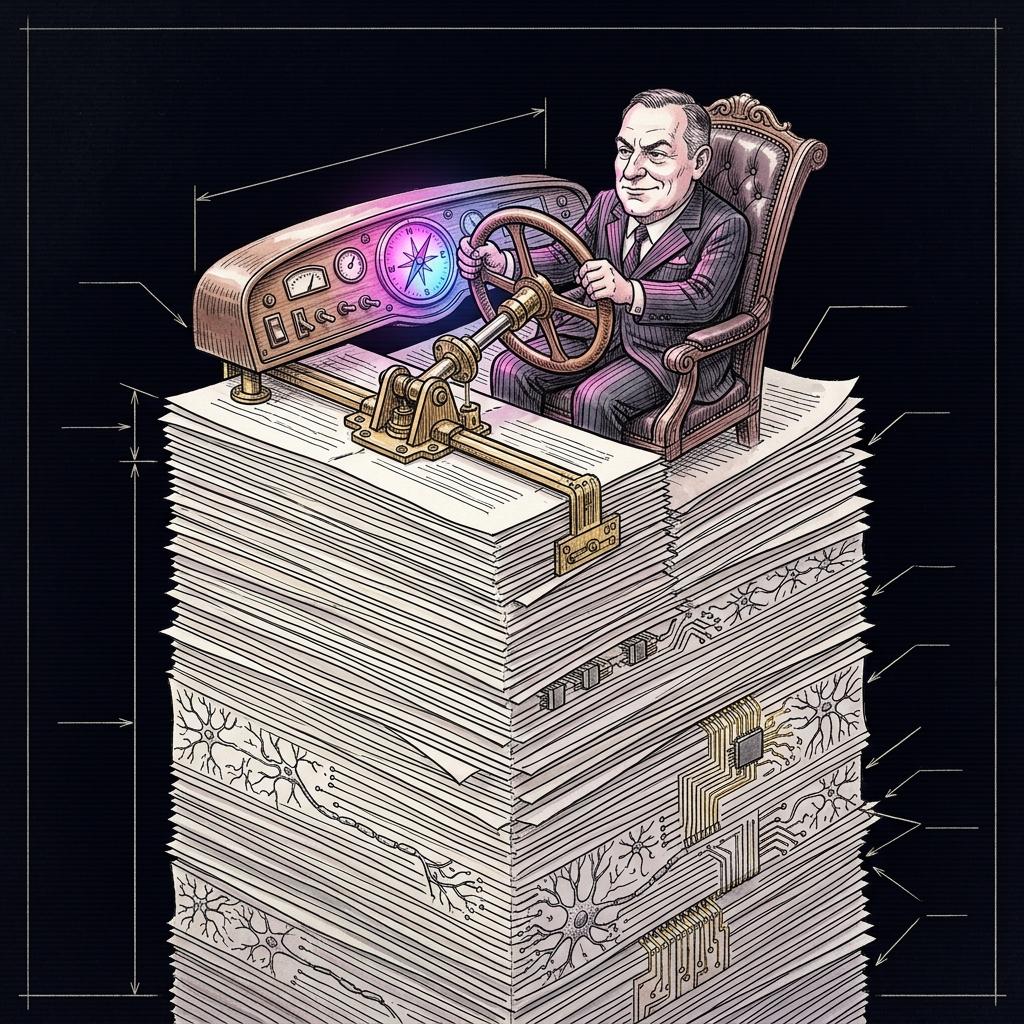
A CEO signs off on a 42-slide AI strategy deck on Monday. On Tuesday, Microsoft repositions Windows as the host operating system for autonomous AI agents. By Wednesday, three of the five workstreams in the deck describe a world that no longer exists. The deck does not get torn up. It gets routed to the PMO for "phase one execution." Six months later the company is in the 80 percent.
Microsoft Build 2026 ran June 2 and 3 at Fort Mason in San Francisco. Satya Nadella's opening keynote was not a feature parade. It was a thesis: software no longer waits for you to use it. Microsoft Scout went generally available as the first always-on autonomous agent for work. GitHub Copilot now fixes its own bugs, writes its own tests, and opens its own pull requests with no human in the loop. Azure AI Foundry began doing live multi-model routing across OpenAI, Anthropic, and open-source weights, choosing per task what to run. Windows, Copilot, Azure, GitHub, and a new line of agent-accelerated hardware converged into a single execution surface. The Cloud Factory partner readout used the phrase "the full agent stack is here."
This matters for one reason. The standard AI transformation roadmap for executives, the artifact almost every enterprise commissioned in late 2025 or early 2026, was written against a different architecture. It assumed agents lived inside a chat surface, not the operating system. It assumed vendors were vendors, not routers. It assumed humans would adopt tools, not that tools would do work overnight while humans slept. Every one of those assumptions is now wrong. The deck is not stale. The artifact itself is the wrong shape.
The number the slide industry cannot survive
RAND Corporation interviewed 65 data scientists and engineers with five-plus years of production AI experience. The result: 80.3 percent of AI projects fail to deliver intended business value. The breakdown is the part nobody wants to read aloud. 33.8 percent are abandoned before they reach production. 28.4 percent ship and produce nothing. 18.1 percent ship, produce something, and cannot justify their costs.
Multiply that against the spend. Global enterprises put $684 billion into AI initiatives in 2025. By year-end, $547 billion of that had returned no business value. That is not a forecast. That is a tally. CIO magazine called 2026 "the year of scale or fail." Pertama Partners and Folio3 both put 2026 failure rates above 80 percent and rising. Gartner's April 7, 2026 release reported that AI projects in infrastructure and operations are stalling "ahead of meaningful ROI returns."
The standard read on these numbers, the one every consulting firm published in Q1, is that the problem is data foundations, governance maturity, and clarity on success metrics. So they sold roadmaps. The roadmaps included data foundation workstreams, governance overlays, and success metric definitions. The failure rate got worse.
The slide did not help because the slide was the problem. The shape of the artifact assumes a future you can draw in advance. Build 2026 was a public demonstration that the future cannot be drawn in advance. The model frontier moves monthly. The orchestration layer moves monthly. The execution surface, this quarter, just moved from the browser into the operating system.
What an AI transformation roadmap for executives actually contains
Pull any one of these decks off the shelf. They share five elements. A target operating model. A capability heat map showing which functions get an AI uplift in which order. A phased deployment plan, almost always 24 to 36 months. A change management workstream with adoption metrics. A governance overlay borrowed from the GRC playbook. They are 36 to 60 slides. They were approved by an executive sponsor and a steering committee. They have a launch date.
They are wrong by month three. They are wrong because every element treats the AI stack as something you adopt. You adopt an ERP. You adopt a CRM. You adopt a billing platform. Those things sit still while the company wraps process around them. The AI stack does not sit still. The model you architected against in February gets deprecated by July. The protocol you standardized on in March gets a competing standard by May. The agent topology your roadmap shows as a phase-two pilot is the phase-one default by phase-one Q3.
A roadmap is a description of a route through fixed terrain. The terrain is not fixed. The roadmap has no engine.
Four assumptions that just stopped being true
Look hard at any AI transformation roadmap for executives and you will find four assumptions doing the structural work. All four were defensible 18 months ago. None of them is defensible now.
The first assumption is that the cost of producing software dominates the cost of running software. Roadmaps are built around shipping milestones because shipping was expensive. GitHub Copilot writing tests and opening pull requests on its own collapses the cost of shipping toward zero. The expensive thing is now the running, the routing, the auditing, the kill-switching, the inference bill. Roadmaps do not price any of that. They price headcount and licenses.
The second assumption is that adoption is a human change-management problem. Roadmaps allocate enormous workstreams to training, communications, and behavior change. The new generation of agents does not need a human to adopt them. They live inside the operating system. They get a wallet. They run on a schedule. The adoption curve for a Microsoft Scout instance that lives in Windows and does work overnight is not a Prosci diagram. It is a permissions matrix and a credit limit.
The third assumption is that vendors are vendors. Roadmaps separate "build" from "buy" because for thirty years that was the architectural choice. Azure AI Foundry's multi-model routing means your vendor mix is no longer your vendor mix. You picked Anthropic for a workload. The router picks something else at runtime for cost or latency reasons. The line item in your roadmap labeled "vendor selection" stopped being a slide decision and became a runtime decision. Buy versus build is now a quaint frame.
The fourth assumption is that the work itself is stable enough to plan around. Gartner's May 20, 2026 release on enterprise AI coding agents described the market as entering "a new phase of expansion and competitive realignment." Realignment is the polite word for "the shape of the work is changing." The procurement organization you were planning to redesign in 2027 may not exist as a function by 2027. IBM Consulting's May 6, 2026 announcement on expanded enterprise transformation capabilities reads, between the lines, like an acknowledgement that the consulting product is shifting from delivering decks to delivering operating systems for change.
The roadmap freezes four things the agent stack just unfroze.
The CEO is the variable
The most striking number in the failure data is the one CEOs least want to read. Projects with sustained CEO involvement succeed 68 percent of the time. Projects that lose C-suite sponsorship succeed 11 percent of the time. And here is the kicker: 56 percent of AI projects lose active C-suite sponsorship within six months.
The standard read of this is "engagement." Town halls. Internal newsletters. Quarterly all-hands. That reading is wrong. The CEO is not being asked to champion AI. The CEO is being asked to do an operational job no one else in the org can do. Re-decide capital allocation faster than the quarterly cycle. Re-decide org boundaries faster than the annual review. Re-decide what the company is for, in writing, every time the agent stack shifts the cost curve.
This is the part the roadmap silently delegates to a steering committee. Steering committees meet once a month. The model frontier moves once a week. The math does not work, and the failure rate is the proof.
64 percent of CEOs report fear of losing their job over the AI transition. 38 percent describe their stress as high or crippling. The fear is rational. They are being asked to commit to a plan in an environment where committing to a plan is the failure mode. The roadmap is what their board asked them to produce. The roadmap is what is going to get them fired.
What replaces a roadmap
Stop building roadmaps. Build the four operating artifacts the agent stack actually requires.
A wiring diagram. Not a slide. A working document that names every system of record, every model endpoint, every orchestration boundary, every human-in-the-loop checkpoint, every place a credential lives. Versioned weekly. The wiring diagram is the artifact that survives a model change because it shows what the model plugs into, not which model. When Foundry re-routes a workload from Anthropic to a small open model for cost reasons, the diagram absorbs the change. The roadmap cannot.
A kill switch register. Every agent in production needs a name, an owner, a scope, and a kill condition. The kill condition is a sentence in plain language. "Pause if it commits more than $500 of spend without a human review." "Pause if its action would change a production schema." "Pause if its monthly token bill crosses $10,000." "Pause if it touches the customer data warehouse." Part of what Gartner meant when it said infrastructure-and-operations AI projects are stalling ahead of ROI is that nobody can shut anything off cleanly. The kill switch register fixes that. The roadmap does not even know it is a question.
A re-allocation cadence. Not an annual budget exercise. A monthly reset on where compute, headcount, and model spend are flowing. The Foundry routing model is a preview of the future of every line item in the P&L. If your IT spend re-routes weekly at the workload level, your finance review needs to keep up. Most CFO calendars cannot. Putting this cadence on the calendar, and putting the CEO in the room, is the cadence.
A capability ledger written in the present tense. Not "we will have agentic procurement by 2027." Today's capability, today's gap, today's running experiment, in a single living document anyone in the company can read. The ledger replaces the heat map. The heat map shows aspiration in pastel colors. The ledger shows reality in plain text.
Together, those four artifacts do what a roadmap pretends to do. They orient the company. They differ from a roadmap in one way that matters: they survive the next model release. They are the engine the roadmap never had.
The architecting work is the work
Consultants will push back on this. They will argue the roadmap is the starting point and the artifacts are the next step, that you need both. You do not. The roadmap is the wrong starting point because it teaches the wrong reflex. It teaches the company that the answer is a plan that gets approved. The answer is a wiring diagram that gets re-versioned. The reflex matters. Build 2026 was a demonstration that the right reflex is short-cycle re-architecting, not long-cycle planning.
Some portion of the failure rate is technical. Most of it is reflex. Pertama Partners notes that 73 percent of failed AI projects "lack clear executive alignment on success metrics." Read that line again. The word doing the heavy work is alignment, not metrics, and not success. The drift between what the C-suite thought was being built and what is actually being built is the failure. Roadmaps cause the drift. Living artifacts close it.
The shape of an AI transformation roadmap for executives, then, is the shape of the failure. The roadmap freezes assumptions that will not hold. It delegates the only decision a CEO can make to a steering committee that will not meet often enough. It tells the company to adopt instead of architect. It treats vendors as procurement targets when vendors have become runtime parameters. It schedules the human change curve when the curve is no longer human. It ships in 36 slides what should ship in four living documents.
What an executive should actually do this quarter
First, ask for the wiring diagram. If the AI program lead cannot produce one in a week, the program is a deck, not a system. This is the most powerful diagnostic available to a CEO right now and it costs nothing. Most enterprises cannot produce one. That is the finding.
Second, ask for the kill switch register. If three or more production agents do not have named owners and written kill conditions, the company has a liability surface it cannot describe to a regulator, a board, or a litigator. The register converts agentic AI from a story into a managed risk. It also converts the legal department from a blocker into a participant.
Third, install a monthly re-allocation review on the CEO calendar. Live. Forty-five minutes. The CEO looks at workload-level compute spend, agent-by-agent revenue contribution, model-mix changes, and re-allocates. This meeting is what 68 percent looks like. The 11 percent number is what happens when the meeting does not exist.
Fourth, cancel the next roadmap. Redirect the consulting spend toward the four artifacts. The vendors who can produce them will do well by your company. The vendors who can only produce slides will produce slides. Use that as your filter.
The cost of producing the wrong artifact
Look at the $547 billion again. That is not money lost to bad models. The models are extraordinary. That is money lost to the gap between what the artifact assumed about the world and what the world did. Roadmaps assumed stability. The world was a Microsoft Build keynote that re-shaped the agent execution layer in a week. Roadmaps assumed humans would adopt tools. The world was an agent that lives in the operating system and never needed adoption. Roadmaps assumed buy or build. The world was a router that does both at runtime, per workload, per minute.
Every dollar in that $547 billion bought a slide that described a world that did not exist. The model was not the problem. The artifact was the problem.
The companies in the 19.7 percent did not pick the right model. They picked an artifact that could re-fit when the model changed. The wiring diagram absorbed the change. The kill switch register absorbed the risk. The re-allocation cadence absorbed the new economics. The capability ledger told the truth. When OpenAI shipped its next-phase enterprise update, those companies edited a document. The other 80 percent re-ran a six-month planning exercise.
You cannot buy your way out of this
There is no tool you can buy that solves this. No platform vendor's product replaces the architecting work. Foundry is not the answer. Scout is not the answer. Copilot is not the answer. Those are inputs. The answer is the architecture you build to absorb them and to absorb the next three things the labs ship after them.
You can buy a roadmap. You can buy a model. You can buy compute. You have to architect the relationship between them, the way it flexes when one of them changes, the way it stops when one of them misbehaves. The architecting work is the work that 80 percent of projects skip and the work that 19.7 percent of projects do. That is the entire margin.
This is what Agor AI Advisory is built around. We do not write you a roadmap. We architect the wiring diagram, the kill switch register, the re-allocation cadence, and the capability ledger with your team, in your operating environment, against your real cost curves. We do it in weeks, not quarters. We hand you living artifacts your team can edit, not slides your team has to obey. We do this because the data is unambiguous: roadmaps are how companies lose. Living architectures are how they win.
The 80.3 percent number will keep getting worse for companies that keep commissioning the wrong artifact. Microsoft Build 2026 was a warning shot. The next Anthropic release, the next OpenAI agentic launch, the next Foundry update will move the floor again. Your roadmap will not catch up. Your architecture, if you build it now, will.
Sources
- Microsoft Build 2026 news room, June 2026
- Gartner, "AI coding agents enter a new phase of expansion and competitive realignment," May 20, 2026
- Gartner, "AI projects in I&O stall ahead of meaningful ROI returns," April 7, 2026
- IBM Consulting expands AI capabilities to accelerate enterprise transformation, May 6, 2026
- Pertama Partners, "AI Project Failure Rate 2026: 80% Fail"
- Folio3, "AI Project Failure Rate in 2026: What the Data Shows"
- CIO Magazine, "2026: The year of scale or fail in enterprise AI"
- Cloud Factory Group, "Microsoft Build 2026: The Full Agent Stack Is Here"