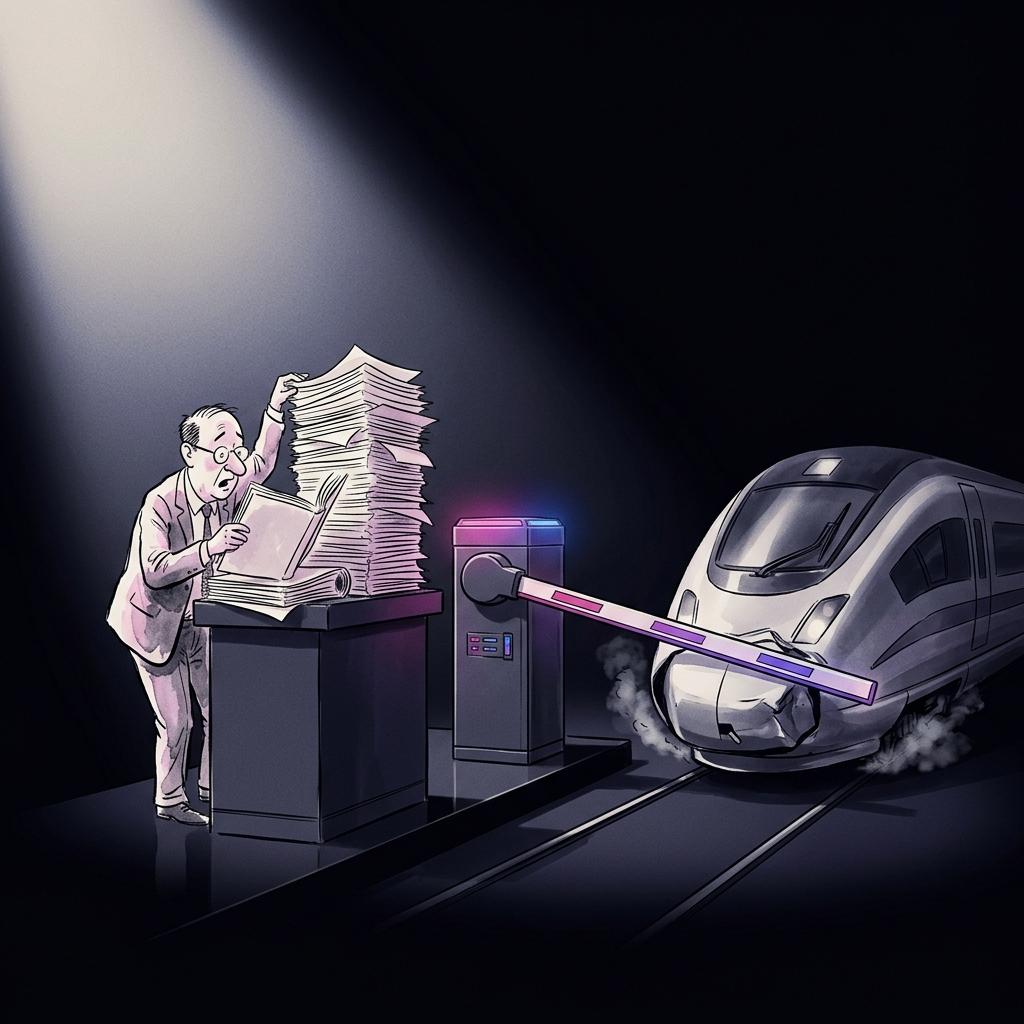
On May 26, 2026, Gartner published a warning most enterprises quietly filed away. Applying uniform governance to AI agents will end in enterprise AI agent failure. By 2027, forty percent of production autonomous agents will be demoted or decommissioned because their governance gaps surfaced only after real incidents happened in real customer environments. The Gartner analyst behind the piece, Shiva Varma, named the root cause. Enterprises treat AI agent governance as binary. Locked down or fully trusted. And that binary is the failure.
Most executives read the release, nodded, and went back to writing their AI operating model as a two hundred slide policy document.
That document will not run.
What operating models used to be
For fifty years, an operating model was a picture. Boxes and lines. Who reports to whom. Which committee approves what. A capital allocation process on page forty seven. A risk register on page ninety. The model lived in PowerPoint, in a binder, or in the tribal knowledge of a small circle of senior operators who could tell you when the rules bent and when they held.
The picture worked because the decision cadence of a large company matched human speed. A pricing change moved through a committee. A hiring choice moved through three interviews. A capital deployment moved through a quarterly review. Every consequential action had a natural pause built into it. Humans could read a policy binder and enforce it because humans were the bottleneck. The document defined the pace.
Then decisions got automated. Then decisions got autonomous. Then decisions got aggressive.
An agent using GPT-5.5 or Claude Sonnet 5 does not pause. It calls a tool, reads the result, calls another tool, edits a file, ships a change, closes a ticket. It does this in eleven seconds. If a run goes badly, the run has already left a trail through fifteen systems by the time anyone notices. The picture on the wall does not intervene.
The AI operating model has to become something else. It has to become a program.
From rulebook to runtime
Designing an AI operating model in 2026 means treating every rule in the rulebook as enforcement code that runs the moment an agent proposes an action. The gate lets the action through, escalates it, blocks it, or rewrites it. Every gate emits a trace that gets stored, indexed, and searchable. Rules that live in policy statements or training slides never become gates.
That is what a runtime is. A thing that runs.
IBM staked out this position at Think 2026 on May 5. Arvind Krishna stood on stage and said the enterprises pulling ahead are redesigning how their business operates. He introduced a four part blueprint. Agents that execute. Data that connects. Automation that runs end to end. Hybrid architecture that keeps sovereignty. The framing landed. The parts of the framing that mattered got missed. Krishna was describing a runtime. Most of his audience heard a strategy.
Strategies do not stop a bad agent action at the seam between an authorization request and the API call that would move ninety thousand dollars. Runtimes do.
The Deloitte number nobody wants to sit with
The Deloitte State of AI in the Enterprise 2026 report interviewed thirty two hundred business and technology leaders across twenty four countries and six industries. Seventy four percent are actively deploying agentic AI. Twenty one percent have what Deloitte calls a mature model for agent governance. The gap between deployment and mature governance is a canyon. Every agent operating in that canyon is running under rules that live in a Confluence page, if that.
Consider what mature governance would even mean under real load. If your operating model classifies an agent as autonomy level three (able to write to production databases without human review) and level three agents require rate limiting to one hundred writes per hour and a rolling five minute rollback window, then those two constraints have to be enforced by code that sits between the agent and the database. Not by a policy document. Not by a training slide. By code.
If they are enforced by a document, the agent is unbounded. The document has no wire to pull.
What the failure modes tell you
Deloitte and MIT's Project NANDA released complementary findings. NANDA's July 2025 GenAI Divide report analyzed three hundred public enterprise AI deployments and one hundred and fifty leader interviews. It found ninety five percent of enterprise AI pilots produce no measurable business return. The press told the story as an accuracy problem. Read the report closely and the story is different. The failures cluster by category. Forty one percent are unclear success criteria. Thirty three percent are insufficient data or tool access. Twenty six percent are evaluation drift. None of those failures are model quality problems. Every single one is an operating model problem.
Model quality never appears as the top failure category. The system around the model does.
The company that treats an agent like a hire, gives it a title, a Slack handle, and a role description, is designing an operating model for humans. The human template does not compile. Agents do not have onboarding. They have deployment. They do not have manager check ins. They have telemetry. They do not have annual reviews. They have kill switches. Every human construct that survives translation into an AI operating model does so as a technical component, or it does not survive at all.
The three primitives of a runtime operating model
I have watched enough of these failures up close to name the three primitives that actually matter when you design an AI operating model as a runtime. Every enterprise I work with in 2026 either has these built in or is about to have a bad quarter finding out why they need them.
Authority. Every action has a scope. Read this database, write to this table, call this API, spend up to this dollar amount before you must ask. Authority means a set of enforceable constraints attached to the agent identity, carried into every downstream call. When a Gartner analyst warns against binary governance, this is the layer they are describing. A twenty level ladder of authority beats a two level ladder every time. Agents doing safe internal reads get almost no friction. Agents touching money or customer data have to earn each action.
Evidence. Every action leaves a trace. Not a log line, a structured record with the input, the reasoning, the tool call, the response, the downstream effect. And the trace lives somewhere queryable. When a customer service manager asks why the refund fired, the answer surfaces in seconds because the runtime built the answer while the refund was being processed. Evidence is what turns "the AI did it" from a shrug into a diagnosis. It is what makes the operating model auditable in the way regulators now expect. The EU AI Act enforcement provisions that hit on August 2, 2026, assume you have this. Most companies do not.
Reversibility. Every action has a window. During that window, you can undo it. The window has to be a design parameter, not an afterthought. A price change on a public catalog might have a five minute window before it locks in on downstream billing runs. A calendar invite might have a forty eight hour window. A payment might have a same day window before the money clears. If your operating model treats reversibility as "we will figure it out if something goes wrong," you are running unreversed. And unreversed is the state where small model errors turn into recoverable incidents, and recoverable incidents turn into press releases.
Authority, evidence, reversibility. Three things every agent action has to be routed through, in code, at runtime. That is what designing an AI operating model actually means. Everything else is decoration for the boardroom.
What Sonnet 5 and GPT-5.5 change
Anthropic released Claude Sonnet 5 on June 30, 2026. TechCrunch covered the cheaper agent pricing, two dollars per million input tokens through August 31. The more interesting shipment landed a few weeks earlier. Anthropic added admin analytics, model level entitlements, and spend alerts for Claude Enterprise. These are runtime primitives showing up in the vendor stack. OpenAI shipped Lockdown Mode in June 2026 for enterprise data protection against prompt injection. Same pattern. Vendors are now shipping the operating model plumbing because they see what buyers are actually failing at.
Both moves are useful. Both moves are also insufficient. A vendor gives you knobs. Your operating model has to turn them. The default settings on Claude Enterprise or GPT-5.5 or watsonx Orchestrate are optimized for the median customer, and the median customer does not exist. Your bank has a different reversibility profile than your marketing team, and your marketing team has a different one than your legal team. If your operating model does not encode those differences in code that sits in front of the vendor plumbing, you are running median defaults on a non median business.
Shadow agents and the operating model
The runtime approach solves a second problem as a byproduct. Shadow AI. The Cloud Security Alliance report from April 28, 2026, found eighty two percent of enterprises discovered at least one AI agent or workflow their security or IT teams had never heard about. Sixty five percent had an AI agent security incident in the past year. Every one of those incidents had real business impact. The most common category was data exposure.
Shadow agents proliferate because official channels are slow. Employees who want to ship faster route around the operating model. When the operating model is a document, routing around it is trivial. Nobody checks. When the operating model is a runtime, routing around it requires actively bypassing enforcement code, which shows up in traces, which triggers alerts. Shadow AI does not go away because you added a page to the handbook. It goes away because the runtime notices unauthorized traffic and closes the port.
What Gartner is really saying
The May 26 warning was framed as a governance warning. Read it again and it is an architecture warning. Uniform governance fails because uniform governance is one dial. Real operating models need many dials, and the dials have to be tuned by agent, by scope, by consequence, by clock speed. That kind of tuning belongs to engineering, wearing the clothing of governance. A senior director of IT can write a memo. Only someone who understands distributed systems and business risk together can wire the enforcement layer that makes the memo real.
This is why most enterprises will fail at designing an AI operating model in 2026. They will assign the work to whoever wrote the last strategy document. They will receive another strategy document. It will sit next to the IBM Think 2026 blueprint on a SharePoint. It will not run.
Designing an AI operating model as architecture
A working AI operating model in 2026 sits in three layers, and the three layers all execute together.
At the bottom is the vendor layer. Claude, OpenAI, xAI, Mistral, Gemini, whichever open weights model you self host on AWS or Azure or Oracle Cloud. Whatever tools they expose. Their guardrails, their entitlements, their spend controls.
In the middle is the enforcement layer. This is where your rules run. Every agent request passes through here first. Authority checks, budget checks, data access checks, reversibility checks, kill switch checks. This layer is code you own, or code you deeply customize from a vendor like watsonx Orchestrate, Databricks Mosaic AI Gateway, or the open source projects filling this space. When Krishna talks about operational independence at IBM, this is what he is pointing at. Companies who let a single vendor own their enforcement layer are trading sovereignty for a slightly nicer setup week.
At the top is the observability and control plane. Every trace flows up. Every alert fires here. Every kill switch pulls from here. This is where the CEO or the compliance officer or the head of engineering can see what the whole system is doing in real time, drill into any action from the last ninety days, and pull an agent offline in one command. It is the closest thing an AI operating model has to a dashboard. If you are still asking a data team to produce a monthly deck about AI usage, you have skipped this layer entirely.
Three layers. All executing. All the time. That is what designing an AI operating model looks like when the work gets done properly.
Why the timing matters
The EU AI Act enforcement deadline for high risk systems is August 2, 2026. Thirty days away. Credit scoring, employment decisions, insurance underwriting, and other regulated domains have to comply. Fines climb to fifteen million euros or three percent of global annual turnover. American regulators are watching how the European standard settles and drafting their own. Financial services regulators are already ahead of general purpose regulators. Health regulators will follow.
Without a runtime operating model, you cannot prove compliance in the manner these regulations require. Producing a policy document is no longer the answer. Producing a trace and showing every affected decision routed through that trace is the answer. That is a runtime output. Strategy documents do not produce it.
Meanwhile, the Deloitte, MIT, and Gartner data all point at the same enterprise. Big company. Deep budget. Serious AI investment. Small percentage of that investment reaching production. Even smaller percentage reaching sustained ROI. Every one of these companies has an operating model. Almost none of them have a runtime.
The gap is the opportunity.
Design or default
Here is the choice sitting in front of every enterprise leader right now. You can design your AI operating model as a runtime, in code, with authority and evidence and reversibility wired into every agent action, and take the friction now while the volume is manageable. Or you can inherit a default operating model from your vendors, an emergent one from your teams, and a shadow one from your employees. Whichever combination you inherit becomes yours after the first incident.
The IBM Think 2026 announcement had one line that made this clear. The enterprises pulling ahead are redesigning how the business operates. The redesigning is the architecture. The architecture is the work. And the work is a program that runs continuously against every action your agents take.
Every hour that goes by, your agents call more tools, touch more systems, generate more decisions. If they are not routed through a runtime you designed, they are routed through defaults you did not.
Designing an AI operating model in 2026 is an engineering job with executive stakes. It requires someone who can hold the vendor plumbing in one hand and the board risk register in the other. It requires someone who has already built enforcement layers, already tuned authority ladders, already stood up trace ingestion and kill switch orchestration for other companies operating at your scale. It requires a partner who knows the deliverable is a running system, code that executes against every agent action every second of every day, until you decide to change what the code says.
That is the work Agor AI Advisory does. Buying another tool will not save you. Writing another policy will not save you. Architecting the runtime will.
Sources
- Gartner press release, May 26, 2026
- IBM newsroom, Think 2026 AI operating model blueprint, May 5, 2026
- Anthropic, Introducing Claude Sonnet 5, June 30, 2026
- TechCrunch, Anthropic launches Claude Sonnet 5, June 30, 2026
- Deloitte, Agentic AI is scaling faster than guardrails
- Cloud Security Alliance, The shadow AI agent problem in enterprise environments, April 28, 2026
- Fortune, MIT report: 95% of generative AI pilots at companies are failing
- OpenAI, Introducing GPT-5.5