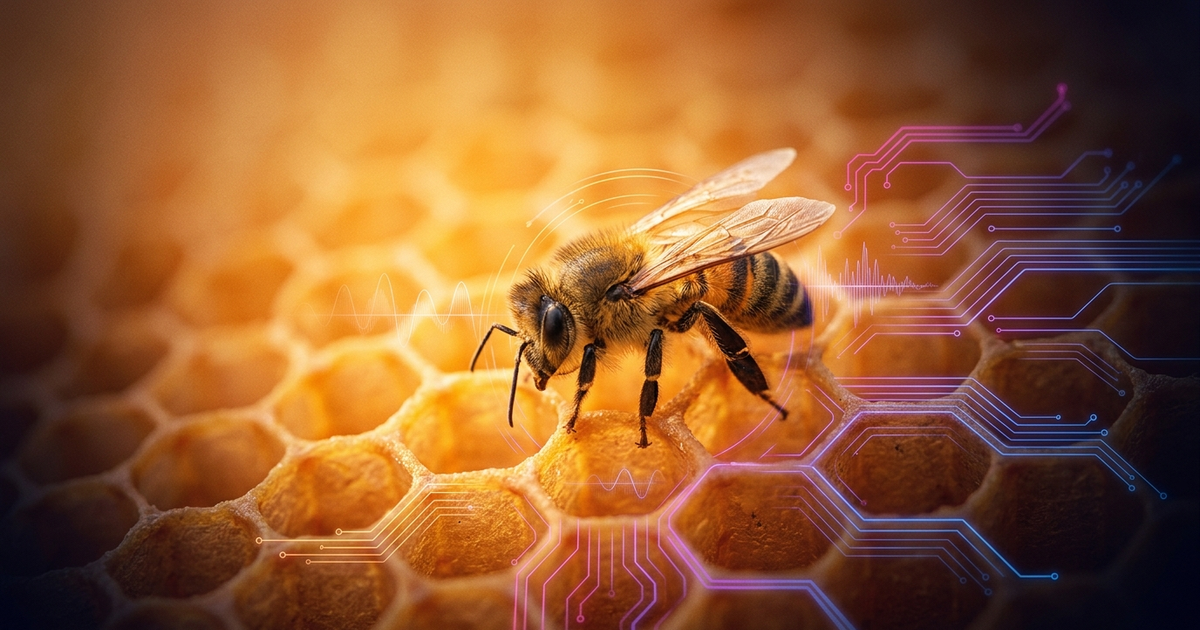
On a piece of off-grid property in Harpswell, Maine — no power line, no cell signal, miles from the nearest tower — Reuven Cohen's Cognitum One put a box next to a beehive and taught it to listen. Not to record. To listen. The presentation that came out of it, "The Hive That Remembers," is the most quietly important AI demo I have seen this year, and almost nobody is reading it as what it actually is.
Cohen is the creator of ruview, ruflow, and ruvector, and the Founder and Chief AI Officer of Cognitum One, the sovereign agentic platform he announced its founding advisory team for on June 3, 2026. The beehive build was assembled by Stuart Kerr in that Maine field. Strip away the staging and the thing on the ground is small: a hive, a microphone, a temperature probe, a vibration sensor clipped to the comb, a solar panel, and a Cognitum One "Seed" the size of a deck of cards running everything. That is the whole laboratory.
Why a beehive is the right place to point a machine
Start with the stakes, because they are not sentimental. One in three bites of food on Earth depends on a pollinator — almonds, apples, blueberries, squash, coffee — a fact the USDA puts at the center of its pollinator program. And the pollinators are failing in a way that is no longer a slow trend. The 2024–2025 U.S. Beekeeping Survey, run with Auburn University and the Apiary Inspectors of America, found beekeepers lost an estimated 55.6% of their managed colonies in a single year, the second record-breaking season in a row; a parallel Project Apis m. survey put commercial losses at 62%. More than 1.7 million colonies, gone.
Here is the cruel part of beekeeping. The hardest thing has never been caring. It has been knowing in time. A colony can go from fine to collapsed in days, and a hive is a sealed box you cannot open without disrupting fifty thousand bees — so by the time you lift the lid to look, it is usually already over.
So Cognitum One did the thing that sounds obvious and is technically brutal. They didn't open the lid. They sat beside it and listened for days. A hive is a fifty-thousand-body organism that hums, pipes, fans, and dances, and every one of those signals is a sentence about how it is doing. Nobody had built a machine patient enough, and small enough, to sit in the meadow and read them.
The build, layer by layer
What makes the demo land is that it shows you the value arriving one layer at a time.
A wooden box alone is a mystery you are blind to. Add a microphone and you learn one thing: it's alive, there is a hum, there is a heartbeat. Add signal analysis and the loudness and texture of that hum start to track the colony's size and how busy it is — now you can watch it breathe, day and night. Add an AI classifier trained on thousands of hives and the box begins to recognize the signatures of trouble — queenless, robbing, swarming — at what the team reports as up to 98% accuracy, around the clock, telling you rather than an expert. Add a vibration sensor on the comb and signals a microphone alone would miss start to surface: the queen's piping, the tremor of the colony pressing through the wax. The hive stops sounding like noise and starts to feel like a conversation.
Then the last layer, which is the whole point. RuVector and the Cognitum Seed give it memory. The device learns this colony's own normal, remembers every moment for more than a year, and searches its entire history in an instant — reaching toward the day it can say, in plain words, "they lost their queen two days ago," or "they're getting ready to swarm," or "they found food." That is the leap from a thermometer to a translator. And the system is built to be honest about it: it tells you what it heard, never what it guessed, with a confidence attached to every line.
The part that is actually hard
Anyone can strap a microphone to a hive. That is not the breakthrough, and Cognitum One says so plainly. A recording understands nothing. And out in a Maine meadow there is no internet to ship the audio to, no outlet to plug into, no server farm listening back. You cannot phone a cloud AI from a field.
So the intelligence has to live right there — outdoors, off-grid, on a few watts of sun, thinking for itself. The Seed runs real, localized AI with zero servers, towers, or connectivity, holds a year of the colony's memory on the device, and turns out a fresh reading roughly every two seconds. For most of the last decade, the industry's answer to "where does the AI run" was a cold room full of GPUs. This is the opposite claim, demonstrated in a field: the model running where the phenomenon is, on solar, alone.
And the choice of bees was deliberate. Cognitum One pointed the system at a language no human speaks — a conversation in sound and vibration that no person on Earth actually understands — precisely because if edge AI can begin to make sense of that, it can make sense of almost anything physical. In their words: the bees aren't the gimmick, they're the proof.
What this really is
For a decade "AI" has meant a brain in a jar. A model in a cold room, waiting to be prompted, fluent in language because language is all we ever fed it. It could describe the world beautifully and touch none of it.
The frontier in this demo runs the other way. Intelligence that sits inside an environment, learns its rhythms, and reads the part of the world that was never written down. Because the physical world has structure long before anyone translates it into words or charts — the hum has meaning before it becomes a dashboard. What Cognitum One proved with the bees is that a small, cheap, off-grid machine can finally sense that structure in place, and carry a memory of it.
That is a method, not a one-off. And once you see the recipe, you start seeing where else to point it.
Seven experiments we should run next
I spent a while on the obvious follow-on question: if the method works, what else deserves it? Here are seven. The pattern is identical in every case — a living system that signals in a modality we don't parse, sensed without disturbing it, an edge model that learns this particular system's normal and remembers it over time, and a plain-language read with an honest confidence attached.
1. The reef that goes quiet before it dies. A healthy coral reef is loud — the crackle of snapping shrimp and the chorus of fish form a dense soundscape that larval fish and even brainless coral larvae navigate toward. A dying reef goes silent. Put a hydrophone on a solar buoy and let an edge model learn a specific reef's acoustic baseline; it can flag the creeping silence weeks ahead of what a diver sees, and verify whether a restoration is actually taking — researchers have already shown reef recovery is "detectable in the soundscape" and that replaying healthy-reef sound pulls in up to several times more fish and larvae. No cloud, just a buoy that knows what its reef is supposed to sound like.
2. The forest that hears its own thirst. When a tree runs short of water, the sap columns in its xylem snap under tension and emit ultrasonic clicks — acoustic emissions in the 100 kHz to 1 MHz band, one click per collapsing bubble, documented since the 1980s and now being tested with passive piezo sensors on living trunks in the field. Wire a stand of trees as a listening post, learn its hydration baseline, and you get a plant-side early warning for drought stress — which is also the leading indicator of fire-readiness — weeks before satellite thermal imaging sees a thing.
3. The soil that reports its own collapse. Soil is a hidden conversation: microbial gas flux, moisture gradients, root-zone electrochemistry, the faint acoustics of soil fauna. Bury a multi-sensor probe, let it learn a field's living baseline, and have it translate the state of the biome — crashing, nitrogen-starved, waterlogged — before the crop shows any stress above ground. This is the same food-security throughline as the bees, pointed one layer down, into the ground the pollinators depend on.
4. The wetland that takes its own census. Right now biodiversity is mostly measured by humans with clipboards, twice a year. A solar acoustic node can continuously identify the frog, insect, and bird chorus and report species richness and phenology in real time — and the shift is the signal. Frogs calling three weeks early is a climate readout no quarterly survey would catch. A standing, non-invasive census that never sleeps.
5. The night sky that names the birds it can't see. Billions of birds migrate at night, calling as they fly — and those nocturnal flight calls encode species identity. Cornell's BirdCast and the Nighthawk acoustic models have shown machine listening can detect and identify them. A cheap field of edge mics that learns the calls overhead could drive real-time wind-farm curtailment and light-pollution mitigation during peak passage — protection that triggers on what is actually flying tonight, not on a calendar average.
6. The mycelium as a living biosensor. This one is further out, and I'll flag it as speculative. Andrew Adamatzky's 2022 work in Royal Society Open Science found that fungi produce electrical spike trains whose clustering resembles vocabularies of up to fifty "words," with length distributions oddly close to human languages. Put electrodes in the soil, let an edge model learn a mycelial network's baseline spiking, and the fungus itself becomes the sensor — its shifts flagging contamination, disturbance, or moisture change. We would not be decoding fungal poetry; we would be using a living network as an instrument and learning its normal on-device.
7. The river that reads its own pulse. A hydrophone, a turbidity sensor, and the infrasound of bedload sediment moving along the bottom give a river a voice. Teach an edge node the healthy signature of flow-plus-fish, and it can flag a pollution event the moment fish flee or fall silent, and time migration runs for fishway and dam operators in real time — instead of after a kill, reported upstream of a lab.
And the inverse: don't just listen, steal the algorithm
There is a second direction to all of this worth naming. The seven above are about sensing the living world. The older, deeper biomimicry is about copying its control policy. The classic case is the termite mound: Zimbabwe's Eastgate Centre was cooled with almost no conventional air conditioning by mimicking the passive ventilation of a mound. But that design was distilled by hand, once, from human observation. The Cognitum One method points at something better — instrument a living mound, let an edge model watch its airflow and CO₂ rhythms continuously, and have it learn and update the control policy a colony of termites runs in real time, then port that to our own buildings. Nature has spent forty million years tuning these systems. We finally have machines patient enough, and small enough, to sit beside them and take notes.
What ties it together
Every one of these lives or dies on the exact thing the bee project got right. The intelligence has to run where the phenomenon is — off-grid, cheap, on a trickle of power. It has to learn the specific system's normal rather than a textbook average, because a healthy hive in Maine does not sound like a healthy hive in Texas. It has to remember, so it can tell change from noise. And it has to be honest about what it heard versus what it guessed, or it is just a more expensive way to be wrong.
That is not a science project. It is an operating discipline, and it is exactly the kind of system Agor AI Advisory builds with founders and operators: AI that sits inside a real environment, learns its rhythms, and earns trust by being right about the physical world rather than fluent about it. If you are sitting on a stream of signal nobody has taught a machine to read yet — in a field, a factory, a clinic, a supply chain — that is the conversation to have.
Sources
- The Hive That Remembers — Cognitum One · BeeKeeper presentation
- Cognitum One Names Founding Advisory Team and Investors, BusinessWire, June 3, 2026
- The Importance of Pollinators, USDA
- U.S. Beekeeping Survey reveals highest honey bee colony losses during 2024-2025, Auburn University
- The sound of recovery: coral reef restoration success is detectable in the soundscape, Journal of Applied Ecology, 2022
- Acoustic enrichment can enhance fish community development on degraded coral reef habitat, Nature Communications, 2019
- Ultrasonic acoustic emissions as indicators of tree drought stress in outdoor forest settings, ScienceDirect, 2025
- Language of fungi derived from their electrical spiking activity, Royal Society Open Science, 2022
- Nighthawk: acoustic monitoring of nocturnal bird migration in the Americas, BirdCast / Cornell Lab