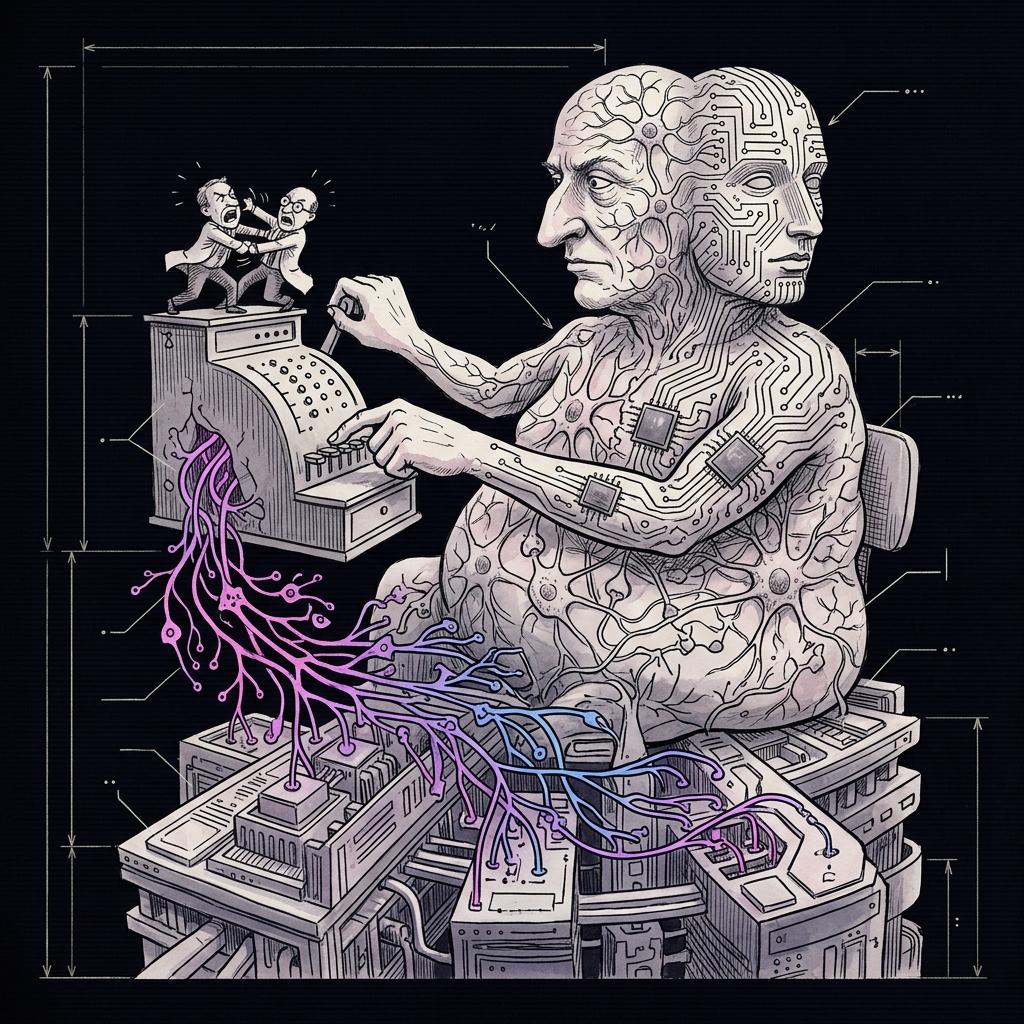
Seven days in May 2026 rewrote the enterprise AI playbook. Most people in the C-suite did not notice. Most analysts wrote it up as two separate news items. They are the same news item.
On May 4, Anthropic announced a joint venture with Blackstone, Hellman & Friedman, Goldman Sachs, General Atlantic, Apollo, GIC, Leonard Green, and Sequoia to build an enterprise AI services firm. The company will work with mid-sized organizations to embed Claude in their core operations. Applied AI engineers from Anthropic will sit alongside the firm's engineering team. Fortune called it Anthropic taking a shot at the consulting industry.
On May 11, OpenAI announced the OpenAI Deployment Company, also called DeployCo. Four billion dollars in committed capital. Nineteen outside partners led by TPG, with Advent, Bain Capital, and Brookfield as co-leads. Acquisition of Tomoro, a London-based AI consultancy founded in 2023 with offices in Edinburgh, Manchester, Singapore, Sydney, and Melbourne. The deal brings 150 Forward Deployed Engineers to OpenAI's payroll on day one.
Both moves were the same strategic decision arriving from two labs in the same calendar week. The frontier model has stopped being the product. The product is now the engineers inside your building.
Why both labs moved at the same time is worth understanding before any procurement committee writes a new line item.
The model alone does not move the needle
Every Fortune 500 CEO has had the same conversation in the last eighteen months. We bought GPT-5 Enterprise. We bought Claude Enterprise. We bought both. Adoption is patchy. The savings the McKinsey deck promised did not show up in the EBITDA. Some teams use it for memo drafting. The supply chain team does not touch it. The legal review process is still seven days. Nothing structural has shifted.
The labs heard this too. From their best customers. Repeatedly.
The diagnosis was uncomfortable. A frontier model is a horizontally distributed capability. It is the same capability for everyone. It does not know your data schema. It does not know your pricing logic. It does not know the unwritten rule that the underwriting team will not approve a deal flagged by the new model unless an analyst signs the override. The model can write the email. It cannot write itself into your operations.
That work is implementation. That work is the layer the labs do not own. That work is what Forward Deployed Engineers do.
Palantir invented the modern FDE role over twenty years. An FDE is a full-stack engineer who sits inside the customer's environment, on the customer's hardest problem, until production code is running. Not a sales engineer. Not a post-sales consultant. A builder. The Everest Group calls Palantir's FDE model a category of one. The reason Palantir compounds revenue at customers the way it does is that the FDE makes the platform inseparable from the operation.
OpenAI looked at that model. So did Anthropic. Both decided the model lab cannot scale enterprise revenue without owning the FDE layer.
That is what the May announcements actually were.
Reading the Tomoro acquisition correctly
Most coverage of DeployCo led with the four billion dollar number. The number got the headlines. Tomoro is the actual story.
Tomoro was founded in 2023 in alliance with OpenAI. It was already an OpenAI-aligned consultancy. OpenAI did not need to acquire it to keep selling tokens through it. The acquisition was deliberate vertical integration. Take the implementation arm and put it on OpenAI's payroll. Make every Tomoro engineer accountable to OpenAI's revenue line, not a separate consultancy's. Remove the layer of misalignment between what the model lab wants (deployment depth) and what the consultancy wants (billable hours).
One hundred and fifty engineers may sound small against four billion dollars of capital. It is the seed. DeployCo will hire and acquire from there. TheNextWeb's coverage put the valuation at fourteen billion dollars at close, with the four billion as outside committed capital and the rest as OpenAI's contribution and majority super-voting control. Calling this a partnership is misleading. It is a wholly directed subsidiary that happens to have nineteen co-investors writing checks.
Why would TPG, Advent, Bain Capital, Brookfield, B Capital, BBVA, Emergence, Goanna, Goldman Sachs, SoftBank, Warburg Pincus, and WCAS write those checks?
Because they see what the labs see. Implementation depth is where the recurring revenue lives. The model is a commodity in three years. The engineer who built the underwriting workflow inside the bank is not.
The consultancy paradox
The most uncomfortable detail of the DeployCo announcement is buried in the investor list. Three of the nineteen outside partners are Bain & Company, Capgemini, and McKinsey & Company.
These are the firms whose enterprise AI implementation revenue DeployCo most directly threatens. McKinsey published over forty AI implementation case studies in 2025. Capgemini reorganized its consulting practice around enterprise generative AI. Bain & Company runs a global AI center of excellence. All three sell the work DeployCo will now sell to the same buyers.
And they wrote checks into DeployCo.
The standard reading is that the consultancies are hedging. If DeployCo wins, they own a piece. If DeployCo loses, their own implementation practice keeps the revenue. This reading is too generous. The truth is they had no choice. Refusing to invest meant being locked out of OpenAI's most strategic customer-facing initiative. Accepting meant funding a competitor with line-of-sight to their accounts. Both options were bad. They picked the option that kept them in the room.
Anthropic's parallel move is even more telling. PwC entered an expanded alliance with Anthropic on the same week. Thirty thousand PwC professionals will be trained and certified on Claude. A joint Center of Excellence. The press release reads like a partnership. The structural reality is different. PwC's implementation revenue now flows through a model lab's certification program. The lab decides what counts as a certified Claude deployment. The lab sets the curriculum. The lab can pull the rug.
SAP went further. SAP and Anthropic announced at SAP Sapphire that Claude will become a primary reasoning capability embedded across SAP's AI portfolio. Not an option in a model catalog. The default. SAP's customers will receive Anthropic's intelligence as part of their existing license, with applied engineers from both companies sitting at the table during deployment.
If you are a CIO at a SAP shop, you did not choose Anthropic. SAP chose Anthropic for you. The implementation engineers showing up in your office in 2027 will have Anthropic ID badges under their SAP ID badges. The escalation chain runs through both.
Whose engineers are these
Every enterprise IT leader has had a vendor relationship before. You buy the software. The vendor sends a sales engineer to scope the deployment. A systems integrator does the work. The vendor's customer success team checks in quarterly. The integrator's people leave when the contract closes. Your team owns operation.
That model is over for AI.
The new model is that the lab's people stay. They sit at your standup. They have access to your production data. They build inside your environment, on your problem, against your KPIs, against their compensation incentives. Their compensation incentives are tied to expansion revenue at your account. Your IT director's annual review is tied to system stability. Those two incentives do not always point the same direction.
The strategic question for every C-suite in 2026 is no longer which model to buy. It is whose engineers to let inside.
OpenAI's engineers will optimize for OpenAI's account expansion. Anthropic's engineers will optimize for Anthropic's. If both labs have FDEs inside your company, you have two parallel deployment teams with two parallel agendas competing for the same internal sponsors. That dynamic is already running. It happens at every Fortune 100 that signed both an OpenAI Enterprise and a Claude Enterprise agreement in 2025. The vendors politely ignore each other in the lobby and then race for the same workflow inside.
The legacy consultancy used to be the referee. A McKinsey partner could argue for OpenAI on Tuesday and Anthropic on Thursday and be paid the same fee either way. The neutrality was real because the consultancy's product was the recommendation, not the deployment.
The labs have now bought the consultancies' deployment arm. The referee is on one of the teams.
The sovereignty problem
The C-suite question hidden inside all of this is sovereignty. Whose engineers run my AI? Whose objectives shape my workflows? Whose roadmap dictates my migration path?
Three years ago the answer was easy. You bought a SaaS tool. You owned your data. You owned your processes. The vendor was outside the wall.
Two years ago the answer got harder. You started running prompts through OpenAI's API. Some of your operational logic moved into prompt templates that lived inside vendor systems. You owned the prompts on paper. In practice the prompts were tuned for one model's quirks and would need rewriting to move.
Now the answer is on a different planet entirely. The lab's engineers built the workflow. They documented the workflow inside the lab's documentation system. They wrote tests against the lab's API. The lab's roadmap is the workflow's roadmap. If the lab deprecates a feature, your workflow breaks. If the lab raises prices, your unit economics break. If the lab signs an exclusive with a competitor, your competitive advantage breaks.
The transaction looked like a tool purchase. It was the hiring of a vendor's department.
CIOs who lived through the SAP and Oracle implementation eras of the 2000s and 2010s will recognize this dynamic. It is the implementation-driven lock-in playbook. The difference is speed. An SAP implementation that locked you in took five years. An OpenAI FDE engagement that locks you in takes nine months.
What the May moves mean for your strategy
A few things follow.
The first is that the buying decision moves up the org chart. AI procurement is no longer a CIO line item. It is a sovereignty decision that sits with the CEO and the board because the deployment partner shapes what the company can and cannot do for the next decade. If the FDE inside your office reports to OpenAI, your competitive position is shaped by OpenAI's product priorities for as long as those engineers are sitting there.
The second is that the cost of switching vendors went up by an order of magnitude. The model itself is portable. The workflow built around the model by an embedded vendor team is not. Lift and shift used to mean re-pointing an API. Now it means rebuilding the institutional understanding the FDE accumulated over months on the inside.
The third is that the role of the independent advisor changed shape. The traditional management consultancy can no longer credibly claim neutrality on AI vendor choice. The consultancies that wrote checks into DeployCo are now structurally biased. The consultancies that signed certification programs with Anthropic are structurally biased the other way. There are very few independent voices left in the room.
The fourth is the most important. The companies that win the next decade will be the ones who own the implementation layer themselves rather than rent it. They will treat AI deployment the way mature companies treated software engineering after the cloud transition. As a core internal capability. As architecture. As something hired into the company, not borrowed from a vendor.
The architecture you own
There is a path through this for the executive who is paying attention.
Refuse to outsource the deployment layer
Buy the model. Use the API. But build the integration with engineers who report to you. Keep the workflow documentation inside your repos. Keep the prompts in your version control. Keep the evaluation suite under your IP. Treat the model as a substrate, not a partner.
Make portability a design principle
Every workflow should pass through an abstraction layer that lets you swap models without rebuilding the workflow. The labs hate this design. They will tell you it is over-engineering. They will tell you their FDE will handle migration if you ever need it. On engineering effort, they are right. On strategic effort, they are wrong. The cost of portability is real. The cost of non-portability is unbounded.
Scope the badge
If you do let a vendor's engineers inside, scope the access. Treat their commit access the way you treat a contractor's. Treat their data access the way you treat a third-party processor's. Their badge is not your badge.
And it requires an architecture partner whose only product is your architecture. Not a model. Not a deployment service. Not a certification program. Just the design that lets you use any model, switch any vendor, and keep the strategic optionality that has been the competitive advantage of every well-run enterprise for two centuries.
What the next twelve months look like
The labs are not going to slow down. DeployCo will hire aggressively through the second half of 2026. Anthropic's services firm will scale alongside. SAP will roll out Claude integrations to thousands of mid-market customers. PwC will graduate certified Claude practitioners by the thousand. Capgemini's investment in DeployCo will translate into hundreds of OpenAI-aligned engineers in European banks.
By the end of 2026, the average Fortune 500 will have FDE-shaped engagements with at least one frontier lab and probably two. The lab inside your wall will be a structural feature of your organization, not a temporary engagement.
CEOs who treat this as a procurement exercise will end up locked into one lab's roadmap with no exit. CEOs who treat this as an architecture question will end up with optionality. The first group will run their company on a vendor's product calendar. The second will own their stack.
The labs are doing the right thing for themselves. They are vertically integrating into the layer where customer value compounds. The integration is rational. The investor list is rational. The Tomoro acquisition is rational.
The question on your side is whether you build the same kind of capability inside your own walls before someone else builds it for you, and then runs it.
The independent path forward
This is the moment to architect, not to buy.
If your AI strategy in 2026 is a vendor selection, you have already lost. Every vendor in the room is now structurally aligned with one of two model labs. The third option, the option the labs do not sell, is the one your company actually needs. Own your deployment layer. Own your evaluation framework. Own your portability story. Treat the models as interchangeable substrates and treat the architecture as the moat.
This is the work Agor AI Advisory was built to do. We do not sell a model. We do not collect referral fees from a lab. We do not have an investor on the other side of the table. We work with founders and operators to design the AI architecture they will own for the next decade, independent of which lab wins the next benchmark and which consultancy gets acquired by which platform.
The seven days in May 2026 told you what the labs are building. The question is what you will build.
Sources
- OpenAI launches the OpenAI Deployment Company, May 11, 2026
- Anthropic, Building a new enterprise AI services company, May 2026
- Anthropic and PwC expanded partnership, May 2026
- SAP and Anthropic: Claude on SAP Business AI Platform, May 2026
- Bain & Company invests in OpenAI Deployment Company, May 2026
- Capgemini strengthens its position in enterprise AI with investment in DeployCo, May 12, 2026
- Fortune, Anthropic takes shot at consulting industry, May 4, 2026
- Axios, OpenAI launches AI consulting arm valued at $14 billion, May 11, 2026
- TheNextWeb, OpenAI acquires Tomoro as founding piece of $14 billion Deployment Company