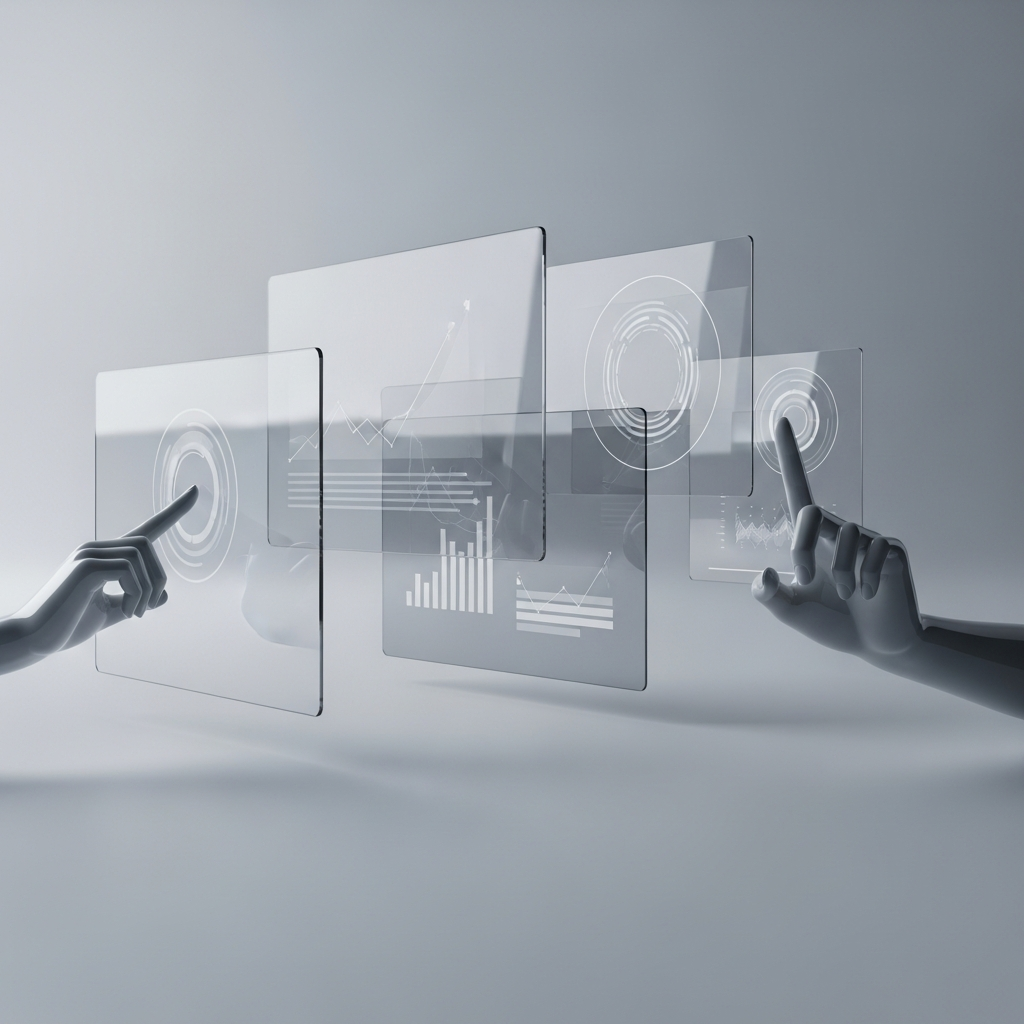
We used to think of "media" as distinct categories. Text was one thing; images were another; video was a third; code was something else entirely. We built separate tools to handle each—Word for documents, Photoshop for images, Premiere for video, VS Code for programming—and we developed separate mental models to understand them. Professionals spent years mastering each tool, each format, each workflow.
That era is over. The most significant development of late 2025 isn't a faster processor or a larger context window—it's the collapse of these distinctions. The frontier models we're seeing now don't just "support" multiple modalities; they treat them as interchangeable tokens in a unified high-dimensional space. To the machine, a pixel, a phoneme, and a Python function are just different dialects of the same universal language.
The Biological Precedent
This unification is profound because it mirrors biology. Your brain doesn't have a separate "operating system" for vision and another for hearing. It has a unified cortex that processes sensory inputs and generates motor outputs through a common substrate of neural activity. The visual cortex and auditory cortex use the same basic computational machinery—columns of neurons firing in patterns. What differs is the input, not the processing architecture.
We are finally building silicon brains that work the same way. The transformer architecture, it turns out, is remarkably medium-agnostic. Feed it text tokens, and it learns language. Feed it image patches, and it learns vision. Feed it audio spectrograms, and it learns sound. Feed it all three together, and it learns the relationships between them—that the word "dog" corresponds to a furry shape and a barking sound.
This is what the cognitive scientists call "grounded intelligence." Language alone is symbol manipulation—moving tokens around according to statistical patterns. But language connected to vision and audio becomes something closer to understanding. The word "red" stops being just a four-letter string and becomes a reference to an actual quality of experience.
The Death of the Format
For decades, we organized digital work around file formats. A .docx was fundamentally different from a .jpg, which was fundamentally different from a .mp4. Each format had its own applications, its own workflows, its own specialists. The organization chart of a media company reflected these divisions: writers in one department, designers in another, videographers in a third.
The unified model dissolves these boundaries. When you can describe an image in words, generate it, edit it with more words, animate it with a sentence, and add music with a phrase—all in one continuous workflow—the concept of "format" becomes vestigial. You're not working with files; you're working with ideas that happen to be rendered in whatever medium serves the moment.
Consider what this means for a marketing team. Today, creating a campaign requires coordinating copywriters, graphic designers, video editors, and web developers. Each handoff is a potential point of friction, delay, and miscommunication. The designer interprets the brief differently than the writer intended. The developer can't quite match the designer's vision.
In the unified world, one person (or one AI agent) can maintain a coherent vision across all media. The campaign exists as a single conceptual entity that expresses itself fluidly in text, image, video, and code as needed. The translation losses disappear.
The Universal Interface
For business, this means the "Universal Interface" is arriving. The friction of translating intent into action is vanishing. You don't write a spec, then design a mockup, then code a prototype. You show the system a video of a problem, discuss it in natural language, and it generates the solution in code. The specialized silos of creation are dissolving into a fluid continuum of expression.
This is not just faster—it's qualitatively different. When the cost of expression drops to near zero, you can iterate in ways that were previously impossible. Don't like the color scheme? Describe what you want. Need the video to feel more energetic? Say so. Want to see how the same idea would work as an interactive web experience? Just ask.
The implications for product development are profound. Prototyping, which used to require weeks of specialized work, becomes a matter of conversation. You can explore the design space—trying dozens of variations, testing edge cases, refining details—at the speed of thought rather than the speed of production.
The Semantic Layer
We are moving away from the era of "files" and "formats" toward an era of fluid semantic data. The barrier between "reading" and "doing" is disappearing. A document is no longer a static artifact; it's a living entity that can be queried, transformed, and extended. An image is no longer a grid of pixels; it's a description of a scene that can be modified at the conceptual level.
This semantic layer changes how we think about content management, version control, and collaboration. Instead of tracking changes to files, we can track changes to meanings. Instead of merging code branches, we can merge conceptual intentions. The computer finally understands—at some level—what we're trying to do, not just what buttons we're pressing.
The transition won't be instant or complete. Legacy systems, organizational inertia, and human habits will slow the shift. Many professionals have built careers around mastering specific tools and formats; they won't abandon that expertise overnight. But the direction is clear.
The Dream Made Manifest
In this new world, creating a software application is as natural as describing a dream. The gap between imagination and implementation—which has always been the fundamental bottleneck of creation—is collapsing. The only remaining question is: what do you want to make?
This democratization of creation is the most significant shift since the printing press. Gutenberg made it possible for anyone to distribute ideas. The unified interface makes it possible for anyone to manifest them—in any medium, at any scale, with near-zero marginal cost.
We are all becoming directors of our own movies, architects of our own software, designers of our own worlds. The tools have finally caught up with the imagination. What we build with them is now the only question that matters.