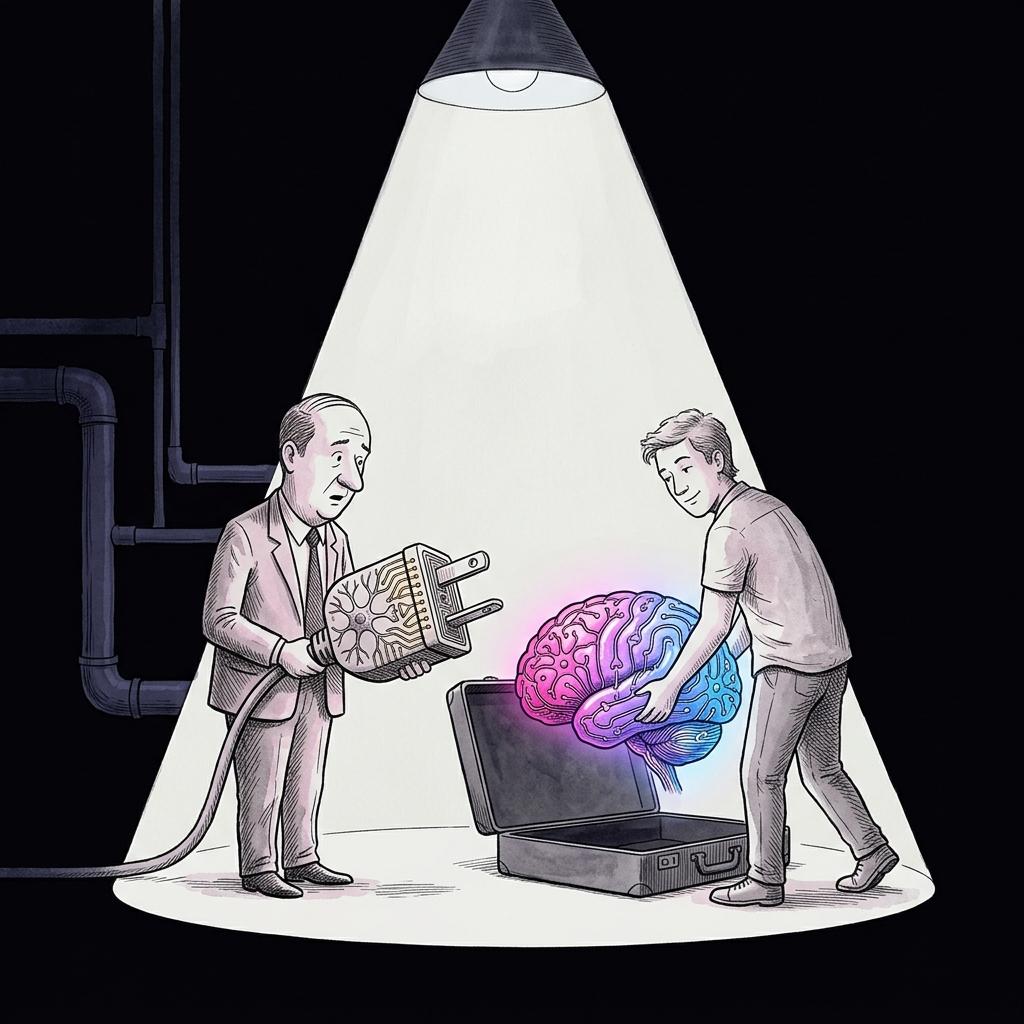
On May 21, 2026, a working group quietly locked a specification. The Model Context Protocol release candidate reached the point where its core could no longer change without a major version revision. The Linux Foundation had taken governance back in December 2025. By late May the public registry held 9,652 server records. OpenAI shipped MCP support. Google DeepMind shipped MCP support. Microsoft shipped MCP support. The thing Anthropic released as a research curiosity in November 2024 became the universal serial port of agentic software.
The story did not lead any technology news cycle. It should have led every CFO briefing.
Every executive deciding when to build vs buy AI in June 2026 is making that decision against an infrastructure picture that did not exist in March. The plumbing got standardized. The cost of plugging any agent into any system fell off a cliff. Almost nobody in a boardroom has updated their build-vs-buy framework to match.
Nine days before MCP locked, on May 12, 2026, Sinch published the survey everyone was talking about. Seventy-four percent of 2,527 senior decision makers had pulled a live AI customer agent. The number climbed to 81% among teams with mature governance. Headlines treated the data as a verdict on AI. The data was a verdict on what those companies had bought.
Two stories, one underlying shift. The thing you can buy got cheaper to plug in and more dangerous to commit to. The thing you can build got cheaper to assemble and harder to staff. The right answer to when to build vs buy AI is no longer a procurement question. It is a question about what part of your stack still belongs to you after deployment.
The frame that broke
The old build-vs-buy frame went like this. You sized the problem. You priced internal engineering against a vendor SKU. You weighed time-to-value. You picked a side. The decision was sticky because integration was expensive. Once you wired the vendor into your pipelines, you stayed. Once you wrote the in-house code, you maintained it.
That frame assumed three things. Vendors were stable. Integration was a one-time cost. Your competitive advantage lived inside the application you bought or built.
All three assumptions broke this spring.
Salesforce launched Agentforce in October 2024 with a $2-per-conversation pricing model. By late 2025 it had three pricing models running in parallel and was offering steep discounts to a customer base that historically never saw them. SaaStr reported that of roughly 5,000 announced Agentforce deals through mid-2025, only about 3,000 were actually being paid for two quarters later. Vendors are no longer stable. Their commercial models are rewriting themselves on quarterly cycles because nobody, including the vendors, knows what an agent costs to run at scale yet.
Integration is no longer a one-time cost either. With MCP standardized, the plumbing cost of swapping one model or one agent for another is approaching zero. Stacklok's 2026 software report shows 41% of surveyed organizations have MCP servers in limited or broad production. The Linux Foundation governance means no single vendor can foreclose on the protocol. What used to be a six-month integration project is now a config change.
The application is not where your edge lives anymore. The model in the application is rented from Anthropic or OpenAI or Google DeepMind. The orchestration layer is rented from Salesforce or Microsoft Copilot Studio. The connectors are standardized. The interface is a chat box. None of that is yours.
When to build vs buy AI now turns on a different question
The build-vs-buy decision used to be a triangulation between cost, control, and time. Today it is a single question. What survives the vendor?
If you buy a Salesforce agent, what part of your AI investment will still work if Salesforce raises prices 40% next year, if the underlying model gets deprecated, if the contract ends, or if the platform pivots? If you build an internal agent on top of a vendor model, what part of your work persists when the model is replaced?
The honest answer for most companies is very little.
Most enterprises that bought agentic AI products in the last eighteen months have nothing portable to show for it. Their prompts live in a vendor console. Their evaluation suites run against a vendor benchmark. Their incident reports spread across three SaaS dashboards. Their team's mental model of "how our AI works" is shaped by a vendor's abstractions. When they leave, none of that comes with them.
Kai Waehner's analysis of the agentic landscape, published April 6, 2026, cited a survey finding that 81% of enterprise leaders are concerned about vendor dependency. Only 6% said they could switch providers without material disruption. The other 94% were aware of the trap and inside it.
Gartner's June 2025 forecast that 40% of agentic AI projects will be canceled by end of 2027 reads, in this light, as a forecast about how badly companies misjudged the durability of what they bought. The cancellations are not failures of the AI. They are failures of the buy.
Where the lock-in actually lives
Vendor lock-in used to be technical. You had a proprietary API. You had a specific data format. You had a clunky export. You called the migration consultants. You moved.
That kind of lock-in is fading. With MCP and similar protocols, the technical exit cost on agent infrastructure is collapsing. Anyone who has tried to swap a vendor in the last six months can see the difference.
The lock-in moved upward. Today it lives in five places, in order of how expensive they are to recreate.
The eval suite. The body of prompts, edge cases, regression tests, golden examples, and grading rubrics that tell you whether your agent is doing its job. Most companies have outsourced this to their vendor. The vendor's eval dashboard is the only place this work exists. When you leave, you do not just lose a tool. You lose three years of accumulated insight into your own customers' edge cases. The eval is the durable asset. Most CFOs do not know it exists.
The governance trail. Every decision an agent makes generates evidence. Who asked, what was returned, what tools fired, what was approved, what was overridden. Some vendors are now charging extra for export of this trail. Some make it impossible. A regulator who shows up in 2027 to ask why an agent did what it did in 2026 will not accept the response that the vendor owned the logs.
The prompt library. The specific phrasings, system messages, refusal patterns, and tone calibration that took your team months to dial in. Some vendors treat these as "your data." Others treat them as platform IP. Some are silent on the question. Read the contract.
The integration topology. Even with MCP, the specific way you wired your agents to your CRM, your billing system, your ticketing platform, and your data warehouse is non-trivial. The plumbing standard does not standardize the pipes you laid.
The team's mental model. The hardest to recover. When the people who run your AI think in a vendor's vocabulary, switching vendors means retraining humans, not just rewiring software. This cost rarely appears in the proposal.
What to build, what to buy
The new framework is simple. It is also unpopular.
Buy the parts of the stack that move fast and commoditize fast. Foundation models. Standard connectors. Hosting infrastructure. Common-pattern agents like meeting summarizers, support routers, and document classifiers. The argument here is not that you cannot build these. You can. The argument is that building them puts you on a treadmill where you race Anthropic, OpenAI, and Google DeepMind, whose business model is to make this part cheaper every quarter. You will lose. You should want to lose. Their loss is your gain.
Build the parts that compound. Your eval suite. Your governance trail and its export path. Your prompt library, version-controlled in your own repository, not a vendor console. Your domain-specific orchestration logic. Your audit-ready incident response. These are the durable assets. These are what survives the vendor.
The hybrid frame is not new. McKinsey, Bain, and a dozen other firms have written variations of "buy commodity, build differentiator" for two years. What is new in June 2026 is that the line between commodity and differentiator has moved sharply. With MCP standardized, the orchestration layer that used to look proprietary is now plumbing. With Sinch's 81% mature-governance rollback rate, the deployed agent that used to look like the asset is now a liability if you do not own the eval and the trail.
The line has moved up. Things that count as commodity now reach further into what used to look like differentiator territory. Things that count as differentiator have narrowed to a smaller set of higher-value components. Most enterprises are still buying as if it were 2024 and building as if they were Anthropic. Both sides of the line have shifted under their feet.
The Klarna correction
Klarna's reversal is the case study every executive thinking about agents in 2026 should read.
In 2024, Klarna replaced roughly 700 customer service positions with an AI assistant built in partnership with OpenAI. The company reported the assistant was handling 75% of customer chats, or about 2.3 million conversations in 35 languages, by February 2024. The story was a poster child for "buy the model, fire the people." It was repeated everywhere.
By May 2025, CEO Sebastian Siemiatkowski was on the record saying the cost cuts had gone too far. Klarna was hiring agents again. The company specifically called out lower quality and customer dissatisfaction. The new model puts humans on the premium tier and complex cases. AI handles high-volume routine work.
Klarna did not fail at AI. Klarna outsourced its understanding of its own customer base to OpenAI's model, and its own quality benchmark to whatever the chat assistant happened to produce. When quality drifted, Klarna had nothing internal to compare it to. No eval suite tuned to its customers. No regression test catching edge cases. No prompt library specific to its categories of complaint. The thing it bought worked at first because the use case was simple. The thing it should have built was the apparatus for knowing when the bought thing was no longer enough.
Notice what survived the vendor at Klarna. Almost nothing. The team had to rebuild from a low base. The story was reported as a hiring announcement. The underlying lesson was about ownership.
The neutrality pitch is half true
The fastest-growing sales line in enterprise AI right now is "model-agnostic" or "vendor-neutral." Run any model. Swap any time. Pay no premium.
The pitch is half true and worth careful reading. The infrastructure layer is becoming more neutral, thanks to MCP and the Linux Foundation. The model layer is becoming more neutral, thanks to a competitive frontier where Anthropic, OpenAI, Google DeepMind, Meta AI, xAI, and Mistral are within a generation of each other on the benchmarks that matter.
Neutrality is a property of the lower layers, not the higher ones. When a platform vendor tells you they are model-agnostic, ask where your evals live. Ask where your prompt library lives. Ask where your governance trail lives. Ask what file format the export uses. Ask how long the export takes. Ask what your data scientists, customer service leads, and compliance officers will have to relearn if you switch.
The honest neutral platforms answer these questions in writing. The ones that hedge are positioning you for the second-year price increase.
A short test
Before you sign your next AI procurement contract, run this test. Print the names of every component of the system you are about to buy. Next to each, write the answer to one question. If this vendor doubled the price next year, what would it cost us to leave?
If the answer for any high-value component is "we would basically have to start over," do not buy that component. Build it, or buy from someone who will write the export terms into the contract.
This test is uncomfortable. It blocks the easy "buy a platform, ship by Q3" path that most enterprises took in 2024 and 2025. It will slow your deployment. It will make some procurement leaders unhappy. It will also be the difference between an AI program that compounds for five years and one that gets quietly replaced after the third pricing letter.
Build what stays
The strategic question for executives in June 2026 is no longer whether AI works. It does. It is no longer whether your competitors are using it. They are. It is no longer whether you should build or buy. You will do both.
The question is which side of the line each component sits on, and whether you have the architectural judgment to draw the line in a place that holds for three years instead of three quarters.
This is not a tool problem. There is no SKU that solves it. The Sinch rollback rate climbs with governance maturity because better operators see the trap sooner. Vendor pricing volatility hits platform buyers hardest because they made the irreversible commitment without an exit plan. The MCP standardization helps only the companies that knew how to use a standard to begin with.
Architecting this decision is the work. Tool selection comes after. Proof of concept comes after. The work is drawing the line between what you rent and what you own, between what survives the vendor and what gets swept away with the contract.
That is the work Agor AI Advisory does. We come in before you sign the platform deal, or after you have already signed one and need to recover the parts of your stack that should have been yours from day one. We map your eval suite, your governance trail, your prompt library, your integration topology, and your team's mental model. We tell you which parts of your current architecture will still be working in 2029 and which parts will not survive your vendor's next pricing letter. We help you draw the build-vs-buy line in the place it actually belongs.
If you are six months into an agent program and the rollback rate at your peer companies is making you nervous, that is the right time to call. If you are six weeks from signing a platform contract and want a second pair of eyes, that is the right time to call. If you have not started yet and want to skip the lessons that 74% of operators are currently learning the expensive way, that is the right time to call.
Sources
- Sinch research reveals 74% of enterprises have rolled back live AI customer communications agents, May 2026
- Gartner Predicts Over 40% of Agentic AI Projects Will Be Canceled by End of 2027
- The 2026-07-28 MCP Specification Release Candidate, Model Context Protocol Blog
- Enterprise Agentic AI Landscape 2026: Trust, Flexibility, and Vendor Lock-in, Kai Waehner, April 2026
- Salesforce Now Has 3+ Pricing Models for Agentforce, SaaStr
- Klarna Reverses Course on AI Customer Support, Resumes Human Hiring, FinTech Weekly
- 2026: The Year for Enterprise-Ready MCP Adoption, CData