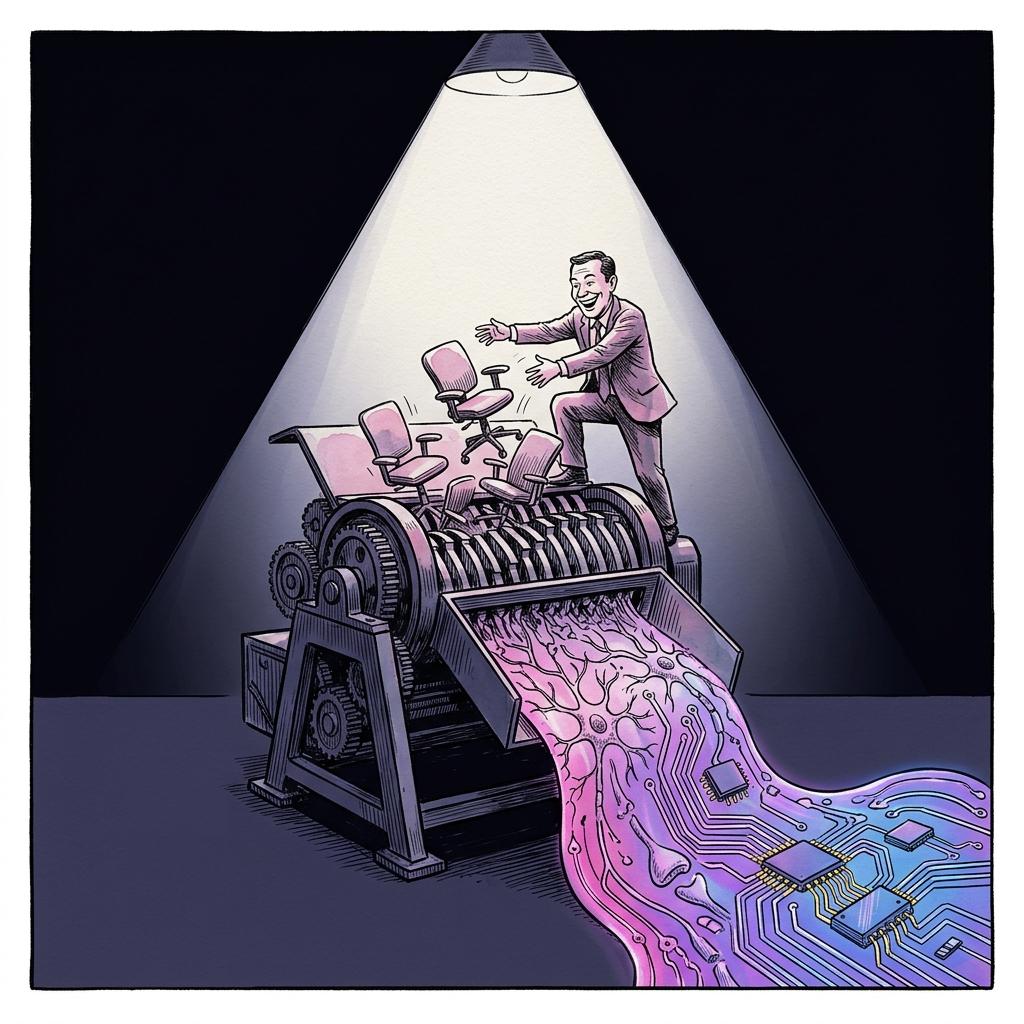
On July 1, 2026, Gartner published a press release warning that $234 billion in enterprise application software spend is at risk from agentic AI between now and 2030. Roughly twenty percent of enterprise SaaS revenue. The number is meant to alarm CFOs. It should alarm them, but not for the reason they think.
Hours later, Microsoft's July 1 base-suite price adjustments went live. Microsoft 365 E5 with the Copilot add-on now runs about $90 per user per month before a single Copilot Studio agent burns a credit. E3 all-in with Copilot lands near $69. Copilot Studio agents bill on top, at $0.01 per credit, or $200 for a prepaid pack of 25,000 credits. The seat kept its shape. Microsoft added a metered coworker line beside it.
Read those two headlines together. Gartner says seats are collapsing. Microsoft raises seat prices the same day. Both are true. That contradiction is the essay.
The $234 Billion Number, Read Slowly
Gartner's press release, and the CIO writeup by Nick Barney the same week, describe "agentic arbitrage." AI agents complete tasks across multiple systems, so users no longer log into each one. The seat disappears because the login disappears. If ten agents do the work of a hundred sales reps, you no longer buy a hundred Salesforce licenses.
That framing is right at the atom, wrong at the molecule. What Gartner counts is at-risk revenue, not lost revenue. The vendors know this. They have been rebuilding the pricing model in public for eighteen months.
Salesforce announced the Agentic Enterprise License Agreement at Dreamforce 2025. Miguel Milano, the company's president, told UpperEdge subscribers the AELA is "for customers that have already experimented. They're ready to scale. They want to go all in, so we agree on a flat fee, and then it's a shared risk." The AELA collapses per-seat licensing, Data 360 consumption, MuleSoft, and Slack into a single flat fee across a two- or three-year term. In March 2026, per reporting compiled by Redress Compliance and echoed on LinkedIn by Adam Mansfield, The Adecco Group signed one of the first major AELAs, covering more than sixty countries with unlimited Agentforce 360 access. Salesforce reported Agentforce ARR at $1.2 billion in its Q1 FY27 transcript, up 205 percent year over year.
Microsoft did the same thing under a different name. Agent 365 launched as a unified control plane bundled into a new E7 SKU stacking M365 E5, M365 Copilot, and the agent registry. On May 5, 2026, ServiceNow announced an expanded partnership with Microsoft that publishes ServiceNow AI Control Tower agents directly into the Microsoft Agent 365 Marketplace. The June 2026 AI Control Tower release added the ability to push a managed ServiceNow agent to the Agent 365 directory from the asset record itself. Two vendor governance planes, one bidirectional pipe, one control point for who ships what into your Microsoft 365 tenant.
Read the sequence. Vendors that priced seats now price agents, on longer contracts, through marketplaces they own, under governance planes they built for each other. The $234 billion at risk from agentic arbitrage is at risk from independent buyers, not from the vendors on the other side of the invoice.
Replacing Software Seats With AI Agents Is A Contract Rewrite
The pitch executives keep hearing is that replacing software seats with AI agents will strip out the fat. Fewer users. Fewer licenses. Lower run rate. That is a description of the meter. Who owns the workflow is a different question.
A seat, procurement-wise, is a contract instrument dressed as a pricing model. It let a vendor bill for expected use without measuring actual use, and it let a buyer estimate cost without instrumenting anything. The seat was a fiction both sides kept alive because the friction of accurate metering exceeded the friction of over-buying licenses.
Agents change the metering. They do not change the instrument. AELA is a longer, deeper instrument built by the same vendor. Agent 365 is a shorter instrument stacked on top of an existing seat. In both cases, the workflow migrates onto the vendor's platform, the data model stays on the vendor's schema, and the switching cost gets computed in years of embedded process, not weeks of user retraining.
Salesforce told finance analysts, per Yahoo Finance's coverage of the Q1 FY27 call, that the company is "OK with losing money" on AELA deals in the early years. That is a pricing footnote, not a concession. The margin returns in year four, when the customer is contract-locked, workflow-locked, integration-locked, and has to renegotiate under the threat of ripping Agentforce out of MuleSoft, Data 360, and Slack in the same quarter. Ask any CIO who ever tried to move a Salesforce data model. Now imagine that data model with three years of agent decisions written into it.
Microsoft's version is quieter. The E7 SKU exists because Microsoft wants to bundle Agent 365 into a base-suite renewal rather than sell it as a top-up. The July 1 price hike on E3 and E5 makes the incremental cost of Copilot look smaller when framed as a percentage of the new base. This is the oldest move in enterprise software. Raise the anchor, sell the anchor as included, keep the customer inside the tenant. The seat kept its shape. It got renamed and inflated.
The Adecco Term Sheet, If You Could Read It
Everyone in the AELA press cycle talked about the Adecco Group deal like it was validation. Sixty-plus countries, unlimited access, one flat fee. What the coverage did not include, because the term sheet is not public, is what year four looks like. Salesforce's internal framing is that AELA converts customers from license buyers into "outcome partners," which is a lovely phrase for "you can no longer downsize by cutting seats."
Under a per-seat model, a company that automates a workflow saves money by dropping seats. Under AELA, that same company automates the workflow and keeps paying the flat fee. The savings do not accrue to the buyer. They accrue to the vendor's gross margin, until the contract ends and the vendor prices year four using the outcome data collected during years one through three.
Nick Kramer at Development Corporate frames the sector-level story as "repricing, not apocalypse." He is right about the sector, less right about the specific CIO. For the SaaS index, this is repricing. For a specific CIO signing AELA in July 2026, this is a bet that Salesforce, MuleSoft, Data 360, and Slack are all differentiated enough to stay locked to, forever, in exchange for a discount that shows up on this year's operating budget.
Ask that CIO how many of those four products they would separately re-buy from Salesforce today, if the choice were open. The honest answer is one or two.
Klarna Was Never About The AI
Klarna is the case study every executive brings up. In February 2024, Sebastian Siemiatkowski said the company's AI assistant was handling the work of seven hundred customer service agents. Then, per Fast Company's May 2025 coverage and Forbes' follow-up, satisfaction cratered, Klarna rebuilt human capacity on a gig platform, and the company shifted to a hybrid architecture where agents handle routine flows and humans handle escalations.
The lesson that got printed everywhere was that AI cannot fully replace humans yet. That is a comforting lesson. It also happens to be wrong.
The real lesson is procurement-shaped. Klarna's customer service tooling ran on a stack whose vendor did not sell the AI that replaced the agents. When the AI failed, Klarna could not roll back to a hybrid inside a single vendor contract. The company had to rebuild human staffing on a gig platform, re-integrate the ticketing, and reset the escalation logic. The reversal was expensive because the initial replacement was structural. Klarna owned the swap. The fallback belonged to somebody else.
Contrast that with an AELA-era Klarna. Under AELA, the same vendor that provided the CS platform would also provide the Agentforce specialists that replaced the CS agents. If satisfaction cratered, Klarna could theoretically dial up the human tier inside the same tenant. That sounds better. It is worse. The vendor that sells you both the replacement and the fallback has no incentive to make the fallback cheap.
Klarna's real cost was trying to escape the vendor without escaping the vendor's abstractions. The 2026 buyer who signs AELA is doing the opposite. Staying inside the vendor's abstractions and calling that autonomy.
Own The Orchestration Or Lease It Back
The strategic move is neither AELA nor Agent 365. Both are answers to the wrong question.
The right question is which layer of your stack should the vendor own, and which layer should you own. Every enterprise runs three layers, whether or not the org chart admits it. The system of record (Salesforce, Workday, ServiceNow, SAP). The system of engagement (Slack, Teams, email, phone). The system of orchestration, which decides what each agent does, when, using which context, escalating to whom.
Before agents, the third layer barely existed. It lived inside human heads, inside runbooks, inside org charts. That is why nobody procured it. Now agents make the third layer concrete. It becomes code, prompts, tool definitions, guardrails, escalation logic, memory graphs. And every vendor selling you agents is racing to own that layer, because the layer that decides what agents do is the layer that decides which system of record they read from and which system of engagement they write to. Own the orchestration layer and you own the routing. Own the routing and you own the workflow. Own the workflow and every other line item is a passthrough.
AELA is Salesforce claiming the orchestration layer, priced flat so you stop counting. Agent 365 is Microsoft claiming the orchestration layer, priced per seat plus per credit so you stop noticing. AI Control Tower is ServiceNow claiming the governance meta-layer above the orchestration layer, priced by asset, so it looks neutral. None of these vendors is neutral. Each of them has a system-of-record product downstream.
The architecture that survives the next four years puts orchestration on infrastructure the enterprise controls. Not self-hosted as a lifestyle. Controlled as a contract. The code, the prompts, the tool schemas, the memory store, the guardrail policies, the model routing. You buy models from Anthropic, OpenAI, Google DeepMind, xAI, whoever is cheapest per capable token this quarter. You buy connectors to Salesforce, Microsoft, ServiceNow, whoever holds your data. You do not let any of those vendors write the orchestration layer, because whoever writes it owns the workflow, and the workflow is the actual company now.
Replacing Software Seats With AI Agents, Priced Honestly
Take a mid-market enterprise, two thousand knowledge workers, running Microsoft 365 E5 with Copilot and a Salesforce estate. Before July, the CFO could line-item every seat and negotiate the Copilot uptake as an add-on. After July, the base suite ticked up. The all-in E5 with Copilot lands at roughly $90 per seat per month, and every Copilot Studio agent burn draws from prepaid credit packs at $200 per 25,000. The Salesforce estate sits inside an AELA the CFO cannot cut mid-term. The old procurement muscle memory of dropping seats to save money no longer works. The vendor priced the flex out of the contract.
Now stack the governance layer. ServiceNow's AI Control Tower registers every agent in the estate, publishes selected ones into the Microsoft Agent 365 Marketplace, and becomes the source of truth for compliance. It is a fine product. It is also, once your compliance story runs on it, a switching cost. The three vendors are already building bidirectional publishing pipes between each other's marketplaces. Two years from now, the compliance argument for any of them will be that the other two consume it natively.
The Gartner press release you started with was correct about $234 billion at risk. What it did not say, because Gartner sells its reports to both sides, is that the risk is transferring from finance departments that used to over-buy seats to finance departments that will now under-forecast credits. The vendors get to charge for both.
A CFO who reads the July 1 Gartner note and asks how to cut this year's SaaS bill is asking the 2024 question. The 2026 question is where the workflow lives when the smoke clears. If it lives inside AELA, inside Agent 365, inside the AI Control Tower registry, the answer is that your workflow is now leased from the same three vendors who used to sell you seats. If it lives on orchestration you built, the answer is that you own something for the first time since the shift to SaaS in 2011.
Architect The Layer, Then Buy Everything Else
None of this is an argument against Salesforce, Microsoft, or ServiceNow. Each of those companies makes products that will stay foundational for a decade. This is an argument against buying the orchestration layer from any of them.
Concrete moves for a 2026 board.
Draw a map of the three layers. Mark every workflow that touches customers, sales pipeline, or hiring. Ask which system of record the workflow reads, and which system of engagement it writes. The orchestration layer sits between. Right now, in most enterprises, that layer is empty or filled with human labor. Do not let a vendor fill it before you name it.
Refuse to sign multi-year AELA-style contracts for workflows that are your differentiation. Sign them, if you must, for workflows that are pure infrastructure. Salesforce's own case for AELA is strongest exactly where it is weakest for you. At the workflows that lock you in.
Instrument agent-generated actions with your own audit trail. Ship the events to your own ledger, in your own storage, under your own schema, before you also send them to a vendor governance plane. The vendor plane is convenient. It is also convenient to the vendor.
Assume vendor governance planes will consolidate. Microsoft, ServiceNow, and Salesforce are already publishing each other's agents into each other's marketplaces. In two years, one of these vendors will buy the other's control tower. Do not build your compliance story on which marketplace you happen to be in this quarter.
Hire for orchestration literacy. The most valuable person in the enterprise for the next four years is not the head of AI. It is the person who can look at a workflow, decide which parts should run on your infrastructure, which parts on a vendor's, and how the seams get audited. That person, in most companies, does not currently have a title.
The Only Question That Matters
Replacing software seats with AI agents rewrites the enterprise's relationship with its vendors. The cost reduction is the marketing frame. The contract rewrite is the substance. Done badly, it swaps a flexible seat contract for a rigid outcome contract with the same vendor and a longer term. Done well, it separates the layer that used to belong to vendors from the layer that now has to belong to you.
Every CFO who signs a flat-fee agentic contract in 2026 is answering, implicitly, a question the vendor set. Every CEO who ratifies that signature is either doing so on the CFO's math, which is short, or on architecture that names the layers, which is rare. Most executives are looking at the wrong denominator. They are asking how many seats they can replace. The real question is which vendor writes the orchestration code that decides what the agents do after the seat is gone.
You get one shot at this. The AELA you sign this year defines your workflow for the next three. The Copilot Studio credits you burn this quarter train your teams to think inside Microsoft's abstractions. The AI Control Tower you adopt as source of truth for governance becomes the API surface you cannot exit. Every one of those decisions reshapes the architecture in ways your successor will inherit, and once they compound, the migration cost is quoted in years, not quarters.
At Agor AI Advisory, we help companies architect the orchestration layer before a vendor architects it for them. The move is to buy differently. Models as commodities, connectors as passthroughs, orchestration as the one thing you own. Get this wrong and you spent the SaaS decade paying seat rent and the agentic decade paying outcome rent to the same landlord. Get it right and you spent the transition building the first piece of infrastructure your company has actually owned since 2011.
Sources
- Gartner Says $234 Billion in Enterprise Application Software Spend Is at Risk from Agentic AI, July 1, 2026
- CIO, Nick Barney, "Agentic AI puts $234B in enterprise SaaS spending at risk, Gartner says," July 2026
- IT Pro, "Agentic AI breaks the traditional SaaS seat licensing model," 2026
- ServiceNow Newsroom, "ServiceNow expands AI agent governance through deeper integration with Microsoft," May 5, 2026
- ServiceNow Community, "AI Control Tower: What's new in the June 2026 release"
- Forrester, "AI Agents Become Economic Actors: Salesforce Rewrites The Rules Of Pricing"
- Yahoo Finance, "Salesforce says it's OK with losing money on AI agents for now"
- Fast Company, "Klarna tried to replace its workforce with AI," May 2025