Why Self-Improving AI Is Now a Management Question
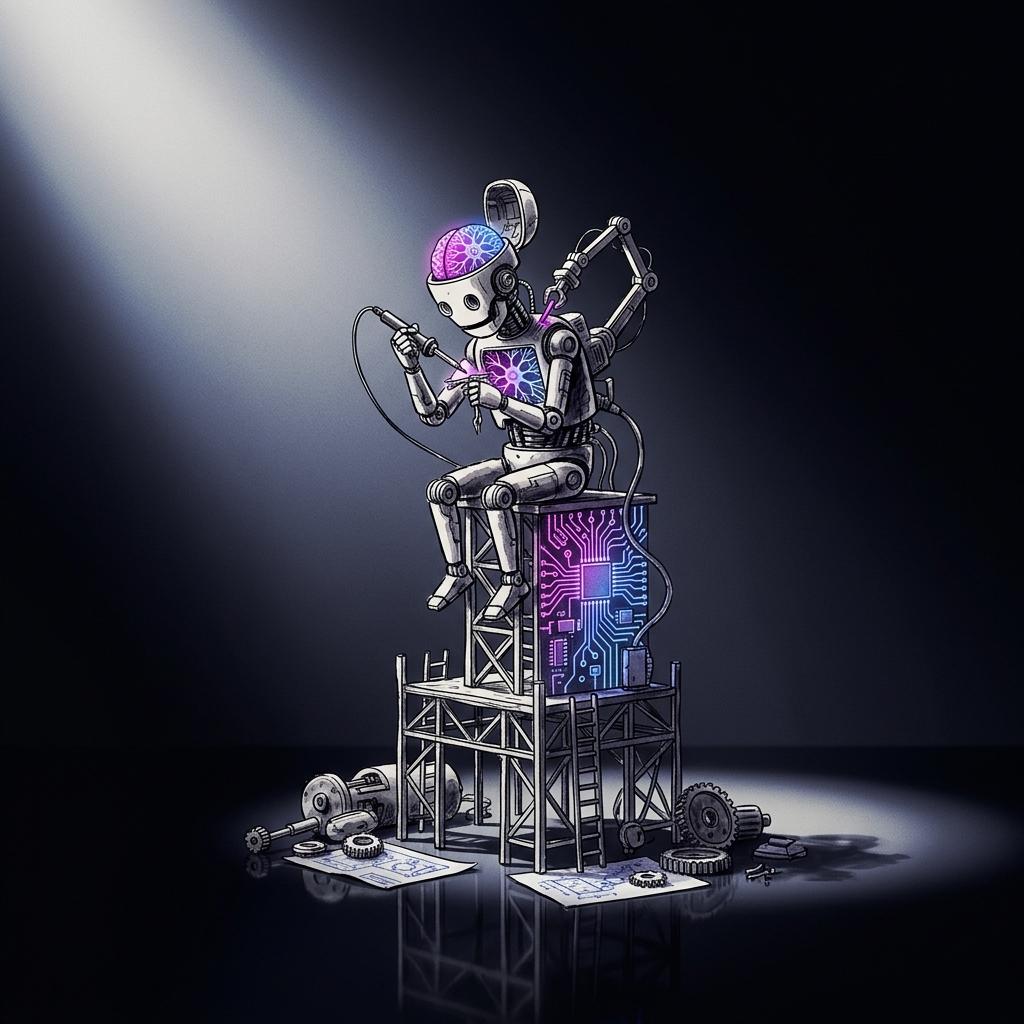
For years, improving an AI system meant a research team retraining a model. This week's papers describe a shift: systems that improve the way they work, not just the model underneath. Agents revise their own instructions, memory, and code. Robots are being studied for their ability to refine how they learn. And open-source models are being trained to carry out tasks that run for hours or days. Together, these developments move AI from a tool you configure to a system that changes while you use it.
Improvement Without Retraining
The first paper shows that much of an agent's capability lives in its harness, the surrounding software of prompts, memory, workflows, and plugins. Changing the harness while the model stays fixed can yield lasting gains, and those gains persist across runs. For executives, this means competitive advantage may increasingly sit in your accumulated operational know-how rather than in which model you license. It also means that advantage can be shared across teams, which is powerful and risky in equal measure.
The Physical World Raises the Stakes
The second paper asks who improves the robot, and its answer is sobering. Noisy sensors, costly trials, and irreversible mistakes make self-improvement far harder for machines than for software. The authors propose a six-level framework and conclude that existing research does not yet show true physical recursive self-improvement. That is useful guidance for anyone evaluating vendor claims about self-learning robots in warehouses, factories, or field operations.
Autonomous Work at Scale
The third paper tackles the engineering problem behind AI labor: teaching models to stay on task for long stretches. By giving agents dense, step-by-step progress signals instead of a single pass or fail at the end, the researchers trained a 27B-parameter open model that matches some frontier systems on specific benchmarks. The implication is that capable long-running agents may not stay exclusive to the largest labs.
What Leaders Should Do
The common thread is governance. Self-modifying systems need independent validation, limited privileges, and clear accountability for consequential actions. Leaders should ask three questions now: what can our agents change about themselves, who verifies those changes, and how quickly would we notice a regression? Organizations that build these controls early will be able to adopt self-improving systems faster and with less risk than those that retrofit them later.
Self-Evolving Agent Harness
The authors study what happens when an AI agent rewrites its own software scaffolding, including prompts, memory, workflows, and executable components, while the underlying model weights never change. They formalize a feedback-driven process in which accepted revisions persist from one run to the next, and they separate what gets updated from how changes are proposed and approved. Their theory offers bounds on how well accepted changes generalize and how much earlier performance is retained, along with an admission rule that relies on fresh, independent validation data.
This matters because it shows that reliability can be reasoned about, not just hoped for. The core risk is an agent that makes a change which looks like an improvement on familiar tests but quietly breaks something else. Requiring independent validation before accepting a change is a practical safeguard.
For business, the harness becomes a strategic asset. Revisions can spread knowledge across teams and workflows, but they can also spread mistakes. Leaders should treat harness changes like software releases, with review, rollback, and separate controls for learning, runtime permissions, and high-impact actions. Validation must continue as tasks and evaluation standards shift.
Who Improves the Robot? Toward Physical Recursive Self-Improvement
This large collaboration defines Physical Recursive Self-Improvement as a setting where a robot's real-world experience produces lasting updates to both its skills and its own improvement procedure, so later improvement gets easier across tasks. The team introduces a framework running from L0 to L5. It distinguishes updates to capabilities from updates to the learning process itself, and gains within one task from gains across many. The top level is reserved for independently verified recursive improvement.
Their central finding is a calibrated one: despite real progress, the literature surveyed does not yet demonstrate Physical RSI by their definition. Obstacles include noisy observations, expensive trials, and consequences that cannot be undone. They set priorities in reliable feedback, causal attribution, safety preservation, and benchmarking.
For business, this is a vocabulary for due diligence. When a vendor claims a robot that teaches itself, ask which level applies and who verified it. Expect human oversight to remain central in operations for some time, and plan safety cases that cover not only the robot's actions but also its updates over time.
Tev: Scaling Long-Horizon Agentic Environments with Dense Progress Rewards
Open-source models have lagged on tasks that take hours or days, partly because such tasks are hard to build, hard to verify, and offer little feedback until the end. The authors address this with Tev-Gym, a dataset of 1,170 verified task environments across seven domains. Each is built from a hidden, complete specification of the task and the expected state after every step, which yields a natural measure of progress. They then convert that measure into a dense per-step reward, called progress-potential reward shaping, making otherwise intractable tasks trainable.
The resulting Tev-27B model matches GPT-6 Astra and Claude Opus 5 at Pass@5 on the computing and math sciences portion of Agents' Last Exam. Although trained only on related data, it also surpasses GLM 5.2 and Gemini 3.7 Flash on Terminal-Bench 3.0 and 4.0 subsets and reaches Claude Opus 4.8-level results on middle-horizon tasks.
For business, the message is twofold. First, long-running autonomous work is becoming feasible with smaller, open models, which may reduce cost and vendor dependence. Second, the method rests on defining what progress looks like at each step. Companies that document their workflows with clear checkpoints will be better positioned to deploy, evaluate, and audit such agents.
Key Takeaways
• Treat an agent's prompts, memory, workflows, and code as a managed asset, because improving them can raise performance without retraining the underlying model.
• Require fresh, independent validation data before any self-made change to an AI agent goes live, since changes that only look good on old tests can quietly degrade performance.
• Keep learning, runtime permissions, and high-stakes actions under separate safeguards so a single failure cannot cascade through your systems.
• Do not assume robots can safely improve themselves yet; the surveyed research has not demonstrated true physical recursive self-improvement, so keep humans in the improvement loop.
• Plan for ongoing re-validation, because task mixes and evaluation standards change and yesterday's approved improvements may not hold tomorrow.
• Watch open-source long-horizon agents closely, since a 27B-parameter model now rivals leading proprietary systems on some tasks and could lower the cost of automating multi-hour work.
• Invest in verifiable, step-by-step progress measures for your own workflows, because dense feedback is what makes long autonomous tasks trainable and auditable.