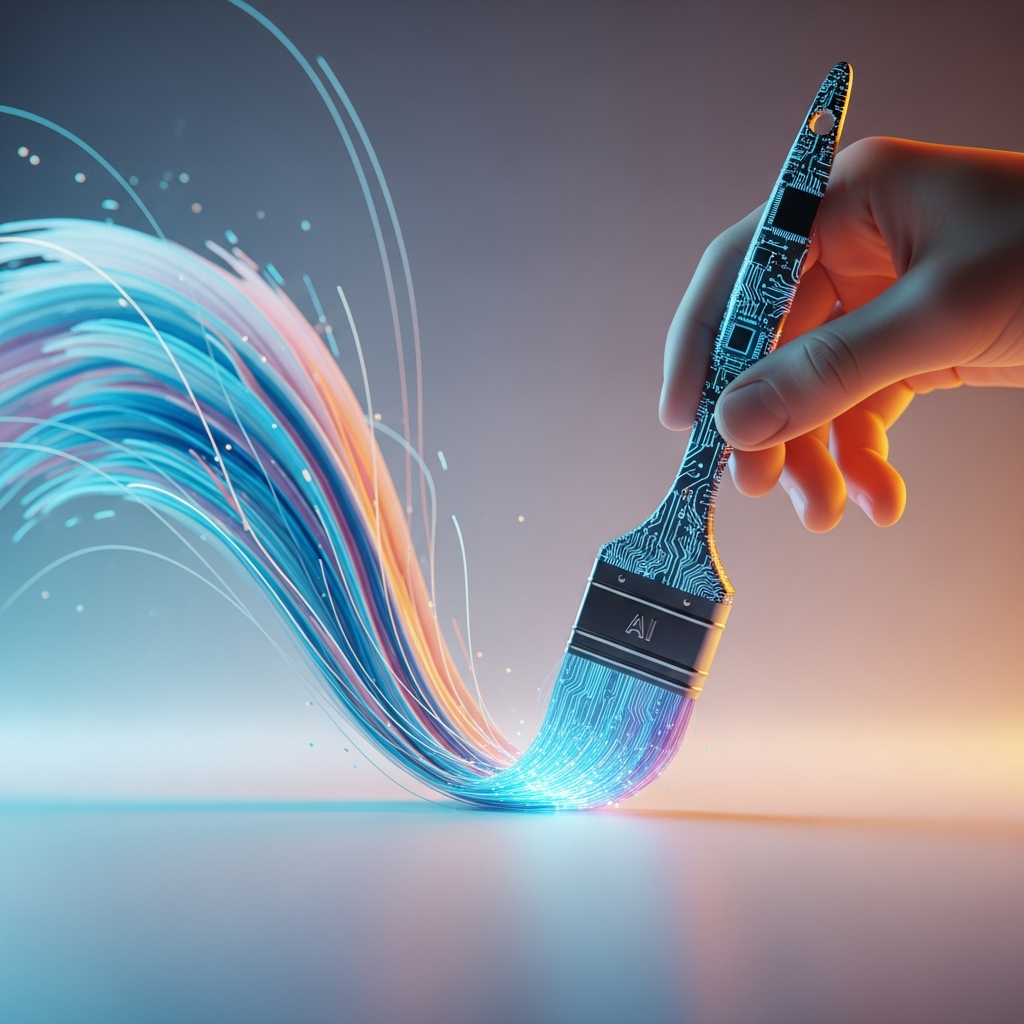
The panic over AI art was understandable. When a machine can paint in seconds what took a human a lifetime to master, it feels like theft. It feels like the end of something precious—the hard-won skill, the years of practice, the personal vision expressed through laborious craft. Many artists looked at the first wave of generative images and saw their obsolescence.
But look at what is actually happening in the creative studios, a year into this revolution. The story is more nuanced than either the doomsayers or the utopians predicted.
The Tool Transition
Artists aren't putting down their brushes; they are picking up new ones. Tools like Flux, Midjourney, and Stable Diffusion have become the "imagination engine" for creative professionals. They use them to storyboard—quickly visualizing scenes before committing to detailed execution. To ideate—exploring aesthetic directions in hours instead of weeks. To texture—generating base materials that they then refine. To explore—seeing variations they might never have conceived.
This parallels previous technological transitions in art. Photography didn't kill painting—it freed painters from the obligation to document reality and enabled impressionism, expressionism, and abstraction. Photoshop didn't kill illustration—it gave illustrators new capabilities and new markets. Each tool that seemed threatening became, in time, an expansion of what was possible.
The key insight is that new tools change what artists do without eliminating that they do. The skills shift; the role persists. Painters who once competed with photographs pivoted to work that photographs couldn't capture. Illustrators who once competed with photo manipulation pivoted to work that combined both.
The Centaur Model
We are seeing the rise of the "Centaur"—the human-AI hybrid. The name comes from chess, where human-AI teams outperformed both humans alone and AIs alone. The combination was stronger than either component. The human provides strategy and creativity; the machine provides calculation and pattern recognition.
In creative work, the centaur model means the human provides intent, taste, and curation. They know what they're trying to achieve. They recognize quality when they see it. They make the choices that give the work meaning. The machine provides execution and variation. It generates options at machine speed, producing far more possibilities than a human could create manually.
Together, they produce work that is better than either could alone. Better than pure AI output, which lacks genuine creative direction and tends toward the generic. Better than unassisted human work, which is limited by the speed of physical execution and the narrowness of individual imagination.
The Curation Economy
Art is not about the stroke of the brush; it is about the choice. The value in a painting isn't the physical act of applying pigment to canvas—machines could always do that—but the decisions about what to paint, how to compose it, what to emphasize and what to omit. The artistic eye selects from infinite possibility the particular vision that communicates meaning.
AI multiplies the choices available to us. Where an artist once had to commit hours to see a concept realized, they can now generate dozens of variations in minutes. This doesn't diminish the importance of choosing—it increases it. When options are abundant, curation becomes the central skill.
This is the creative economy of the 21st century: machines generate, humans curate. The generation is commoditized; the curation is valuable. Anyone can produce images now. Not everyone can produce meaningful images that resonate, that communicate, that achieve a creative goal.
New Skills, New Roles
The centaur artist develops new skills. Prompt engineering—the craft of describing what you want in ways the AI can interpret. Iterative refinement—the dance of generating, evaluating, adjusting, and regenerating until the vision is realized. Multi-tool orchestration—knowing when to use AI generation, when to switch to manual editing, when to combine both.
New roles emerge. The art director who can guide AI systems to produce coherent visual languages. The concept artist who uses AI to explore vast possibility spaces before committing to detailed execution. The creative technologist who bridges artistic vision and technical capability.
The artists most threatened are those whose value proposition was pure execution—producing competent work to specification without distinctive creative vision. If all you offered was the ability to render what others imagined, AI can do that. But if you offered creative direction, distinctive vision, and the ability to know what's worth making—that remains valuable, arguably more valuable than before.
The Integration Ahead
We're still early in this integration. Current AI tools are powerful but crude, often producing images with subtle flaws that require human correction. The interfaces are clunky, the control is imprecise, the results are unpredictable. Better tools are coming—tools that give artists finer control, more reliable output, deeper integration with their existing workflows.
The panic was premature. Artists aren't being replaced; they're being amplified. The centaur is stronger than the horse or the rider alone. And the creative work emerging from human-AI collaboration is beginning to exceed what either could achieve independently.
The future of creative work isn't human or machine. It's human and machine, working together in ways we're only beginning to understand. The brush is changing, but the artist remains.