July 29, 2026, delivered a brutal lesson in corporate finance. Two technology giants reported second-quarter earnings on the exact same Wednesday afternoon. The market reaction exposed a massive failure in how buyers understand artificial intelligence.
Meta reported a 28 percent year-over-year revenue increase to $60.8 billion. The advertising machine worked flawlessly. Yet shares fell nearly 10 percent in after-hours trading. The punishment came from the cash flow statement. Meta revealed that free cash flow plummeted 91 percent to a mere $784 million. The company spent $31.1 billion on capital expenditures in a single quarter. Management then raised the lower bound of their full-year 2026 capital expenditure guidance to an astonishing $130 billion. The ceiling remained at $145 billion. Analysts on the call demanded a timeline for quantifiable return on invested capital. Management offered optimism. The market offered a selloff.
Three hours later, Microsoft reported $90 billion in quarterly revenue. The narrative sounded completely different. Microsoft highlighted its cloud dominance. The company announced that Microsoft 365 Copilot crossed 20 million paid seats. Wall Street applauded the software revenue. The market rewarded the company selling the subscription. The market punished the company building the physical infrastructure.
Enterprise buyers commit the exact same error every day. They buy cognitive capacity as a monthly software subscription. They measure the return on that subscription using the tired metrics of the software era. They track adoption rates. They commission studies to prove a tool saves a worker twenty minutes a day.
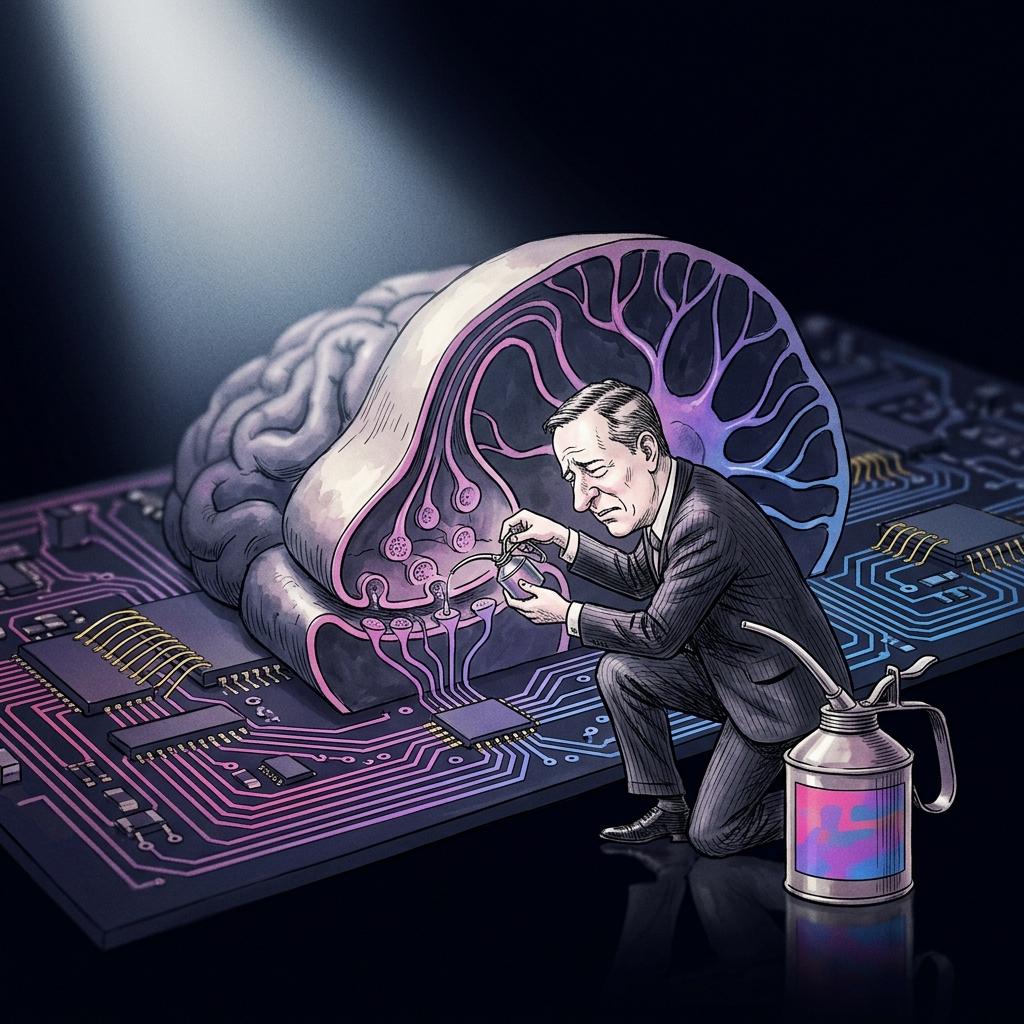
Measuring ROI on AI initiatives fails when leaders apply software logic to heavy industry. You are leasing a cognitive factory. You must evaluate it like a factory.
The Financing Story Versus The Operating Story
Two weeks earlier, on July 14, JPMorgan Chase posted a quarterly profit of $21.2 billion. This was the highest quarterly profit ever recorded by a United States bank. Every bank chief executive mentioned artificial intelligence during the July earnings calls. The framing was identical across the financial sector. The banks view the technology as a capital formation opportunity. They view it as a deal flow generator. Bank of America helped raise nearly $500 billion for related companies since 2025.
The financial sector understands the infrastructure buildout. They are funding the massive data centers. They are underwriting the graphics processing units. They know exactly how much concrete and steel goes into a modern compute cluster.
Yet when asked about internal operational efficiency, the banks offered almost nothing. JPMorgan briefly mentioned a 30 to 40 percent job reduction in unspecified areas. No analyst asked a follow-up question. No executive offered a hard financial metric for internal productivity gains.
The banks know how to finance the machine. They do not know how to measure its internal output. The enterprise buyer suffers from the exact same paralysis.
The Software Hangover
We spent thirty years buying software. The software-as-a-service model trained executive teams to evaluate technology using a highly specific playbook. You buy a license. You assign a seat to an employee. You measure how much faster that employee completes their daily tasks. The software acts as a lever. The human remains the engine.
This model dictates how companies justify their technology budgets. A vendor promises a productivity increase. The buyer calculates the hourly wage of the target employee. The buyer multiplies the time saved by the hourly wage. If the phantom savings exceed the license cost, the purchase wins approval.
This exact logic drives the current wave of corporate adoption. Companies buy Copilot seats for thirty dollars a month. They read reports from analyst firms like Forrester. A recent Forrester study projected a massive return on investment for users upgrading to new hardware. These reports rely heavily on self-reported survey data. Users claim they save twenty or thirty minutes a day. The enterprise declares victory.
The math looks clean. The math is completely useless.
Software creates leverage. Compute creates labor. A lever helps a human move a rock. A motor moves the rock independently. When you measure a motor, you track the output of the machine itself. You calculate the cost of the electricity required to run it. You track the total tonnage moved per hour.
When you ask an employee how much time an agent saved them, you ask the wrong question. You center the human in a process where the human is rapidly becoming peripheral. The employee might use the saved time to do more valuable work. The employee might use the saved time to browse the internet. The saved time does not automatically translate to enterprise value. The value lives exclusively in the work product generated by the compute.
The Physical Reality of Intelligence
To understand the flaw in the software measurement model, look closely at the Meta earnings report. Look at the staggering scale of the spending. A company does not spend $130 billion in twelve months on code. Meta is buying land. Meta is buying electricity substations. Meta is buying cooling towers and fiber optic cable. Meta is buying hundreds of thousands of physical processors.
This is a heavy industrial buildout. The hyperscalers are constructing the largest factories in human history. These factories consume gigawatts of power. They require massive physical footprints. They depreciate rapidly. They require constant maintenance.
The cloud computing era abstracted the physical reality of servers away from the enterprise buyer. You swiped a credit card and received a virtual instance. The current market pushes this abstraction to an extreme. You pay a fraction of a cent for a token. You pay thirty dollars for a monthly seat. The pricing model looks identical to a basic email subscription.
The pricing model hides the underlying economic reality. The hyperscaler absorbs the brutal capital expenditure. The hyperscaler takes the massive depreciation hit. The hyperscaler manages the complex power contracts. The enterprise buyer receives a clean operating expense.
This arrangement creates a dangerous cognitive dissonance for the buyer. The buyer thinks they purchased a lightweight application. The buyer evaluates the application using lightweight metrics. The buyer completely misses the industrial nature of the transaction. They are renting access to a global manufacturing plant. They use it to draft internal memos.
The Flaw in the OpEx Model
Capital expenditures require rigorous financial justification. When a manufacturing company builds a new plant, the board demands a detailed analysis of unit economics. The board wants to know the cost of raw materials. The board wants to know the maximum throughput of the assembly line. The board wants to know the exact unit cost of the finished product. The factory must produce enough inventory at a low enough cost to pay back the initial investment.
Operating expenses rarely face this level of scrutiny. A company buys a software subscription. The manager checks if the team likes the interface. The manager checks if the software makes the team feel more productive. The subscription renews automatically.
Enterprises classify cognitive compute as an operating expense. They treat it like a standard software purchase. This accounting decision infects the strategic deployment of the technology.
When you treat intelligence as an operating expense, you distribute it evenly across the organization. You buy a license for every manager. You buy a license for every analyst. You treat it as a corporate perk. You hope the aggregate productivity of the workforce drifts upward over time.
This approach guarantees mediocre returns. The technology is too powerful to serve as a mere accessory to human effort. Distributing licenses to ten thousand employees generates a massive cloud bill. It rarely generates a measurable increase in top-line revenue. It rarely generates a measurable decrease in operating costs. The time saved evaporates into the friction of corporate bureaucracy.
The hyperscalers understand the industrial reality. Meta is spending $130 billion because the leadership team believes the compute will generate direct returns. Microsoft is pushing subscriptions because they want to capture the operating budgets of the Fortune 500. The vendors treat intelligence as a capital asset. The buyers must learn to do the same.
The False Comfort of the Pilot
This accounting mismatch explains why corporate pilot programs fail to produce meaningful financial data. The standard enterprise pilot is designed to test human comfort. It isolates a small group of employees. It provides them with the new tool. It surveys them after ninety days.
The results are universally predictable. The active usage rate spikes in the first two weeks. The employees report high satisfaction. The novelty wears off. The active usage rate plummets. The employees revert to their legacy workflows.
The pilot proves nothing. It tested human tolerance for changing habits. The capacity of the machine remained completely untested. You cannot pilot a commercial factory by asking the workers to use the assembly line part-time. You must route live production volume through the machinery.
A valid test requires removing the human safety net. You must take a live business process and hand the execution entirely to the compute. You must measure the failure rate. You must measure the cost per transaction. You must measure the latency of the resolution.
If the system fails, you tune the system. You refuse the urge to ask the human to step back in and finish the work manually. Manual intervention ruins the unit economics of the factory. The pilot must break the existing process to discover the true capacity of the new architecture.
The Yield Metric
Measuring ROI on AI initiatives requires a total rejection of software era metrics. You must adopt the metrics of the factory floor. You must measure yield.
Yield is a strict measure of output relative to input. In a traditional factory, you measure the number of defect-free products generated per hour of machine time. In a cognitive factory, you measure the volume of resolved business decisions generated per dollar of compute.
Consider a supply chain team managing daily freight bids. In the software model, the company buys a tool to help the pricing analysts write emails faster. The company measures success by asking the analysts if they saved time. The analysts say yes. The company declares a positive return on investment.
In the industrial model, the company builds an agentic system to execute the freight bids directly. The system reads the incoming requests from the logistics partners. The system analyzes the historical pricing data. The system generates the competitive bid. The system submits the bid. The human analysts only review the extreme exceptions.
The measurement of success changes entirely. The company tracks the total number of bids processed by the system. The company tracks the win rate of those automated bids. The company calculates the exact compute cost required to process one thousand bids. The company calculates the revenue generated by those one thousand bids.
This is decision yield. It ignores human time entirely. It measures the direct financial output of the machine.
You can apply this metric to any department. Look at the information technology service desk. The legacy approach gives the support technicians a tool to draft faster responses to password reset requests. The industrial approach deploys an agent to read the request, access the active directory, reset the password, and close the ticket. You measure the cost of the compute required to close the ticket against the fully loaded cost of a human hour.
Look at financial data management. S&P Global recently highlighted the challenge of entity resolution. Companies struggle to link subsidiary records to parent companies in massive databases. The legacy approach hires data entry clerks to manually verify the links. The industrial approach uses language models to resolve the entities autonomously. You measure the volume of records resolved per dollar. You measure the accuracy rate of the machine against the accuracy rate of the clerk.
Every department in the enterprise possesses a core unit of work. The customer service team resolves tickets. The legal team reviews contracts. The finance team reconciles invoices. The engineering team ships code.
To find the true return on investment, you must isolate this core unit of work. You must route this work through the compute engine. You must measure the cost of the compute against the volume of the output. If the compute resolves the ticket cheaper than the human baseline, you have a positive yield. If the compute reviews the contract faster and with fewer errors, you have a positive yield.
Abandon the measurement of the human process. Measure the output of the machine process.
The Depreciation of the Task
The transition to industrial metrics exposes a fatal flaw in the standard time-saved calculation. The time-saved metric relies on a static human baseline. That baseline is disappearing.
Imagine a corporate compliance team. They spend forty hours a week auditing expense reports for policy violations. The company deploys a language model to assist the team. The model highlights suspicious expenses for human review. The team completes the weekly audit in twenty hours. The company claims a twenty-hour financial savings.
Six months later, the company upgrades the system. The new architecture audits the reports entirely autonomously. It checks the receipts against the corporate policy. It flags the violations. It automatically emails the offending employees for clarification. The system completes the entire weekly workload in three minutes.
How do you calculate the return on investment now? Do you claim a thirty-nine hour and fifty-seven minute savings? The calculation becomes absurd. The human baseline is no longer relevant. The task itself has depreciated to zero.
When the cost of execution approaches zero, the value of the individual task evaporates. The enterprise value shifts from the execution of the task to the orchestration of the system.
You cannot build a strategic advantage by optimizing a worthless task. Your competitors possess the exact same compute. Your competitors can reduce the cost of their expense audits to zero. The optimization provides no durable edge. The edge comes from what you do with the surplus capacity.
The durable edge comes from reinvesting the yield. The physical factory that produces widgets at a lower unit cost has strategic options. The factory can choose to lower prices and capture market share. The factory can choose to maintain prices and capture margin. The factory can choose to produce ten times as many widgets and flood the market.
The cognitive factory offers the exact same choices. When the compute engine drives the cost of contract review to zero, the legal team can review ten times as many contracts. The company can bid on smaller projects that were previously unprofitable due to legal overhead. The company can expand into new markets with lower margins.
The return on investment does not appear in the human resources budget. The return on investment appears in the expansion of the business model. You stop measuring how much money you saved by avoiding the work. You start measuring how much new revenue you generated by executing the work at a massive new scale.
Architecting the Factory
Capturing this industrial yield requires a complete restructuring of the enterprise. You cannot simply layer the compute over the existing organizational chart. The legacy organizational chart was designed to manage human latency. The legacy reporting structures were designed to catch human error.
When you replace the human execution with machine execution, the management layers become obsolete. The reporting structures become bottlenecks. The approval workflows become liabilities. The machine does not need a weekly check-in. The machine does not need a middle manager to review its output before passing it to a director.
The companies that will survive the next decade are currently dismantling these legacy structures. They are architecting their operations around the compute.
This architecture requires a new type of leadership. The executive team must stop acting like software buyers. The executive team must start acting like plant managers.
The plant manager understands the physical constraints of the machinery. The plant manager monitors the power consumption. The plant manager optimizes the assembly line for maximum throughput. The plant manager relentlessly tracks the unit cost of output.
The cognitive plant manager monitors the token usage. The cognitive plant manager optimizes the agentic workflows for maximum decision yield. The cognitive plant manager relentlessly tracks the compute cost per resolved ticket.
This is a painful transition. It requires abandoning decades of management dogma. It requires firing vendors who sell productivity mirages. It requires confronting the reality that much of the white-collar workforce is currently engaged in tasks that the machine can execute for pennies.
The hyperscalers have already made their choice. Meta is spending $130 billion to build the factory. Microsoft is scaling the factory to tens of millions of users. The infrastructure is in place. The massive industrial compute is available.
The only remaining question is how you will use it. Will you buy a seat license and hope your employees type faster? Will you measure your success by counting the minutes saved on drafting internal emails?
Or will you recognize the industrial reality of the moment? Will you treat the compute as a capital asset? Will you restructure your operations to maximize the yield of the machine?
The software era is over. The industrial era of cognition has begun. Architect your company for the factory floor.
Sources
- Meta Reports Second Quarter 2026 Results, July 29, 2026
- Microsoft Cloud and AI strength fuels fourth quarter results, July 29, 2026
- What Q2 Earnings Calls Are Actually Revealing About Enterprise AI ROI, July 14, 2026
- Microsoft Copilot Statistics 2026: Adoption, ROI & Trends, July 10, 2026
- Proving the AI ROI through Entity Resolution, July 14, 2026