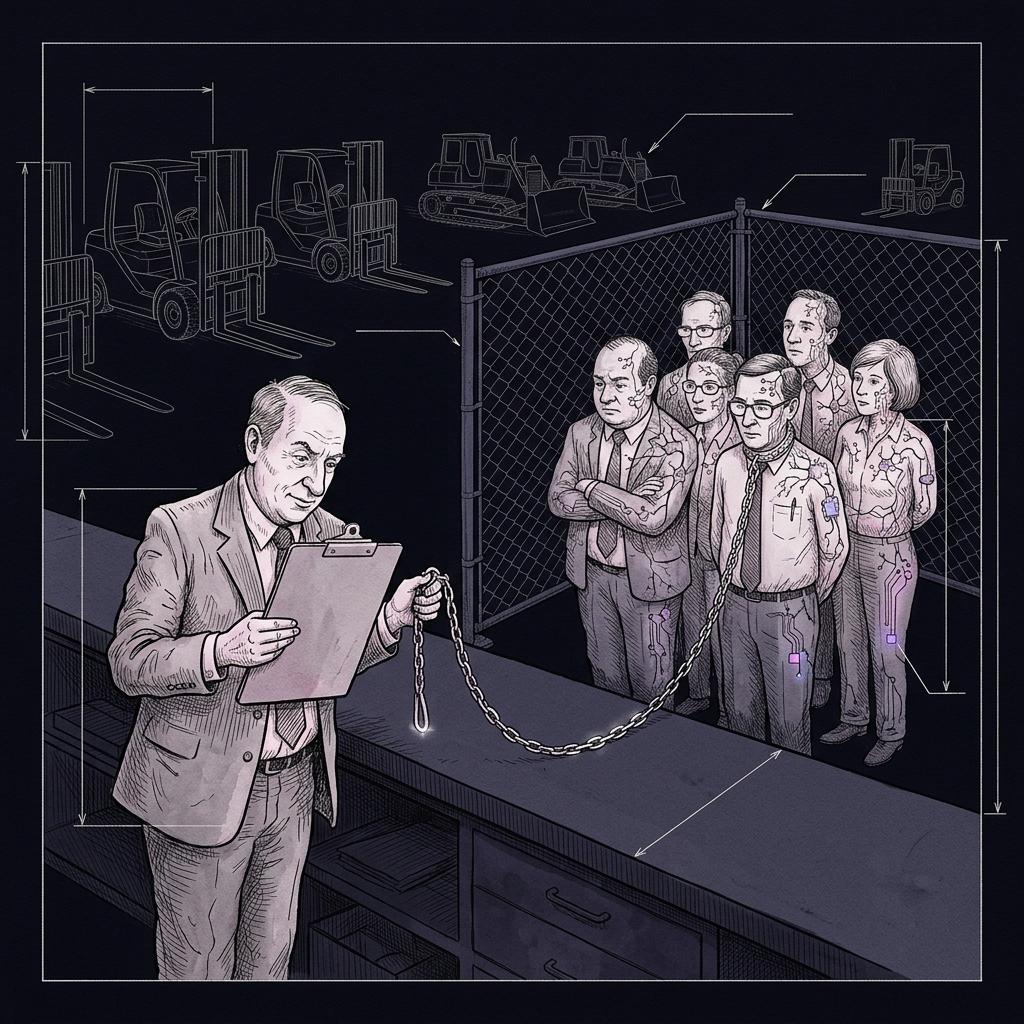
On July 30, 2026, TechCrunch put a label on a hiring pattern that had already gone through a phase transition. "Forward-deployed engineers are the AI industry's latest talent obsession." The story reported that at the start of the year, five to ten percent of companies planned to hire an FDE, and mostly for small pilots. By the end of the second quarter, that number sat at seventy percent.
That is a phase transition. A five to ten percent adoption rate at the start of the year, seventy percent by the end of Q2, and no obvious ceiling in sight. A market collapsing into a single answer to a question most leadership teams thought they were still asking. The question was how to build an internal AI team. The market's answer, arriving faster than any of the surveys could keep up, was to rent one from the lab that makes the model.
The staffing agencies wore lab coats
Two months earlier, on May 5, 2026, OpenAI spun out The Deployment Company. It raised over four billion dollars from a consortium led by TPG, with Advent, Bain Capital, and Brookfield as co-leads, plus Goldman Sachs, McKinsey, Bain and Company, and Capgemini as founding partners. Its stated job is to embed forward-deployed engineers inside enterprises.
In July, Anthropic followed with Ode with Anthropic, built on the acquisition of Fractional AI, financed by Blackstone and Hellman and Friedman with Goldman Sachs, General Atlantic, Apollo, GIC, and Sequoia in the syndicate. Ode's job is identical: send engineers who put Claude to work inside client operations.
Read those two sentences carefully. Both firms carry standalone brands, independent capital stacks, and their own governance. The two frontier labs with the deepest model capability built dedicated staffing agencies, capitalized in the billions, whose only product is human beings sent to your office.
Anyone building an internal AI team in the second half of 2026 is trying to hire against those two payrolls, plus Meta, plus Google, plus every other lab that has watched what a McKinsey partnership looks like from the model provider side and decided to keep the fee for itself.
The math does not favor you
Divogue's July 2026 accounting of the shortage put 1.6 million AI engineering roles open globally against 518,000 qualified candidates. Three companies chasing every hire. CIO.com's 2026 State of the CIO survey named lack of in-house talent the top blocker to enterprise AI strategy, cited by forty percent of respondents. ManpowerGroup's 2026 Talent Shortage Survey put AI skills at the top of its global difficulty ranking for the first time in the survey's history.
Then there is the Meta line item. Andrew Tulloch reportedly signed for a package worth up to $1.5 billion over six years to run superintelligence work. Sam Altman confirmed on a June podcast that his researchers were fielding one hundred million dollar signing offers. Meta paused its hiring spree in late July after landing more than fifty senior researchers, a pause that reads less like restraint and more like a warehouse manager telling suppliers the docks are full.
Median AI engineer pay ran roughly sixty-seven percent higher than comparable software roles in 2026, with year over year compensation growing fifteen to twenty percent in competitive markets. This is what the labor market looks like when the supply curve has almost no slope.
Against that background, a mid-market operator budgeting for a Head of AI, two senior ML engineers, an MLOps lead, and a data engineer is doing capacity planning for a fleet of cars they cannot afford to lease, using rate cards that were true in the previous calendar quarter.
Why the labs won the recruiting fight
MIT's Project NANDA released "The GenAI Divide: State of AI in Business" in 2025 and has tracked follow-on cohorts through 2026 that landed on the number which has since done more damage to enterprise AI strategy than any competing benchmark. Ninety-five percent of generative AI pilots deliver zero measurable return on the profit and loss statement. RAND put the broader AI project failure rate above eighty percent, roughly twice the failure rate of conventional IT projects. That number has not moved in 2026.
Read those percentages carefully. The models are the least broken part of the stack. Claude Opus 5, released on July 23, 2026, ships a one million token context window and an xhigh reasoning mode that a year ago would have looked like fiction. GPT-5 shipped on August 2, 2026, with a one trillion parameter base and multimodal inputs.
What broke was everything that sits between a model and a decision a business will actually make. Data foundations. Workflow integration. Executive sponsorship that outlasted the second earnings call. Definitions of success that survived contact with a real user. Every root-cause analysis of the ninety-five percent lands on the same class of problem, and none of it is a modeling problem.
The labs saw the failure rate and drew the correct conclusion faster than the buyers did. The bottleneck lived downstream of model quality. The last mile from capability to business outcome is where enterprises drowned, and that last mile is human. If the labs could staff the last mile themselves, they would capture the workflow, the integration budget, and the account expansion that used to flow to systems integrators. So they built the staffing agencies.
Building an internal AI team when the labs run the market
If you are the person on a leadership team charged with building an internal AI team in this environment, three concentric rings are worth drawing before the first requisition goes out.
Ring one: judgment
This is yours. It never moves. Judgment is the set of decisions that only your company can make, because they sit downstream of your customer relationships, your risk tolerance, your regulatory position, your board's appetite for reputational exposure. What problems are worth solving. What answers you refuse to accept, no matter how confident the model. What the failure mode of a wrong answer costs you. Which promises you are willing to make to a customer that a model has produced.
Judgment is the most valuable layer, the smallest headcount, and the layer you cannot outsource to a lab. A forward-deployed engineer from Ode has never met your customer. A Deployment Company engineer cannot tell you why your last three product bets failed. The knowledge you need in this ring compounds inside your building or it does not compound at all.
Ring two: composition
Below judgment sits the layer that composes. This is where the actual internal AI team lives, and the recruiting brief looks nothing like a machine learning team from four years ago. You want operators who think in agents. Researchers who think in models are the previous generation of hire. You want people who read the runbook every day and can rewrite it every week. You want the person who is comfortable saying that a workflow the team spent nine months building is now three prompts and a queue, and can explain why without ceremony.
Six of these hires beat sixty. Say it out loud, and then hold the number when the CFO asks for justification. Every added seat in the composition layer either raises the throughput of the ring or slows it, and the second is more common than the first. The best builders I have watched inside client organizations this year are running twenty or thirty agents apiece, deploying to production every day, and reading model diffs from the vendor releases the same way an operator used to read S1 filings. Their org chart is a foreman crew. Their tooling is a queue.
Ring three: rented depth
Below composition sits the layer where the labs win. Fine-tuning a domain-specific model. Building a retrieval graph over a peculiar corpus. Standing up an evaluation harness for a regulated workflow. Wiring a specific tool call across a legacy ERP. These are jobs where an FDE from the Deployment Company or an Ode engineer will genuinely finish the work faster than your team, at a price that is defensible against the counterfactual of a two-year internal build that misses the model window twice.
Rent this ring. Sign the contract. Take the deliverable. Then insist, in the statement of work, on documentation that lets your composition layer own what the FDE built the day the FDE leaves. Otherwise you bought a nine-figure ticket to a vendor lock the lab designed on the way in.
The two failure modes
There are two ways this shape breaks, and both are already happening.
The first is the CIO who reads the FDE headlines, cancels the internal hiring plan, and lets the lab run the whole build. The composition layer never forms. Every new workflow is a fresh statement of work with a vendor. The judgment layer atrophies because it has nothing to argue with. Six quarters in, the company is a customer of the lab, and the lab has a live map of every one of your bottlenecks. The next time a competitor of yours calls the same account manager, that map is on the table.
The second is the CIO who reads the same headlines, decides the labs are a threat, and tries to build every ring internally. That team spends two years hiring against Meta's and Anthropic's rate cards, misses the last two model releases, and ships a workflow tuned to a Claude version that has been deprecated for a full generation by the time the pilot lands. The MIT ninety-five percent claims them too.
The pattern that survives is neither of those. Small, high-judgment leadership. A composition crew whose job is to run the foreman shift, ship agents, and refuse any architecture that only a vendor can maintain. Rented depth for the model-adjacent work that has a genuinely faster deliverable from an FDE than from a Tuesday standup. A written policy on what the labs are permitted to see, learn, and take home.
What the lab really sells
A forward-deployed engineer is a hybrid product. Half of the person is a delivery unit for the lab. The other half is a scout. Every workflow the FDE touches teaches the lab where your business is fragile, where your data is rich, and where the next dollar of expansion revenue lives. The FDE will likely be one of the sharpest engineers you have worked with. That does not change the structural role of an embedded engineer employed by a vendor whose price of capital assumes account expansion.
Palantir has been running this play for two decades. Roughly eighty percent of the very top-tier FDEs in the U.S. work there. The frontier labs have taken the receipt.
If your internal AI team does not have someone whose named job is to read every FDE deliverable, own the meaning of it, and decide what the lab is allowed to keep from the engagement, you have a receiving dock for a supplier. The word team is generous.
The renamed org chart
The old data science org chart was five to fifteen headcount reporting to a VP of Data, running quarterly experiments against a backlog, and shipping a model into a queue that some other team owned. That org chart is a fossil. Nobody wearing a CFO hat in 2026 wants to look at it.
The new shape is a leadership layer of two to four, a composition crew of four to twelve, and a rented specialist workforce that flexes with the roadmap, contracted out of the frontier labs' new agencies with clear IP and knowledge-transfer terms. Total permanent headcount is smaller than the fossil. Total capability is much larger. Total operating leverage sits with whoever built the composition layer well.
If your organization chart still shows a Head of Data reporting parallel to a Head of AI reporting parallel to a Head of Analytics, you are running the fossil. The FDE market that formed this summer will price you out of building anything else, and the frontier labs will happily fill the vacuum.
Architect this, do not buy it
The single most consequential decision a CEO or CIO can make in the back half of 2026 is where the line falls between work the internal AI team does and work rented from the lab. Put the line in the wrong place and you either bankrupt the composition layer or hand your architecture to a vendor whose interests diverge from yours the moment your renewal comes up.
This is architectural work. Procurement will not save you here. A hiring plan on its own will not save you either. Building an internal AI team in this market is a design problem with three rings, a labor market that is priced against you, and a vendor class whose long-run business model depends on absorbing the function you are trying to keep.
The right partner in the room is one who has watched a hundred of these org shapes take form, who can tell you the difference between a job that belongs to your foreman crew and a job that belongs to an Ode statement of work, and who has no interest in selling you seats of anyone's model.
Agor AI Advisory is that partner. We build the composition layer, we write the rules of engagement with the labs, and we leave your team owning the judgment and the runbook. Schedule a strategic consultation with us today.
Sources
- Forward-deployed engineers are the AI industry's latest talent obsession, TechCrunch, July 30, 2026
- OpenAI's $150 million enterprise push puts forward deployed engineers inside client operations, MarketScale
- What Is a Forward Deployed Engineer, MarkTechPost, May 20, 2026
- What's holding back enterprise AI? Shortage of talent, CIOs say, CIO.com
- The 2026 AI Engineer Shortage: Why Demand Is Outpacing Supply, Divogue
- 95% of Enterprise AI Projects Fail. The 5% Do This., The Data Experts
- Meta hires five Thinking Machines Lab founders including a reported $1.5 billion engineer, TheNextWeb
- GPT-5 Launch 2026: OpenAI's 1-Trillion-Parameter Model, AI Tool Duel, August 2, 2026