On May 11, 2026, GitLab CEO Bill Staples sent a memo announcing a 7 percent workforce cut, an exit from 22 countries, three management layers flattened, and the R&D division reorganized into roughly 60 autonomous teams with end-to-end ownership. He called the moment the "agentic era." The stock fell. The trade press treated the story as another line in the AI capex ledger. It is an AI story on the surface. Underneath, it is an organizational design decision with a delayed cost that nobody in the memo priced.
On July 6, Microsoft eliminated about 4,800 jobs, roughly 2.1 percent of its workforce, primarily in the Xbox division and commercial sales. Microsoft's leadership described the cuts as a capital reallocation, freeing budget for a fiscal year the company has projected at around $190 billion in capex on AI infrastructure. Every large enterprise is now running some version of the same trade. AI and organizational design have finally become the same conversation, and most executives are having it with the wrong data on the whiteboard.
They are answering one question. What work does a human still need to do?
Very few are asking the second question. What work does a human need to do in order to become the human who does that first work well twelve years from now?
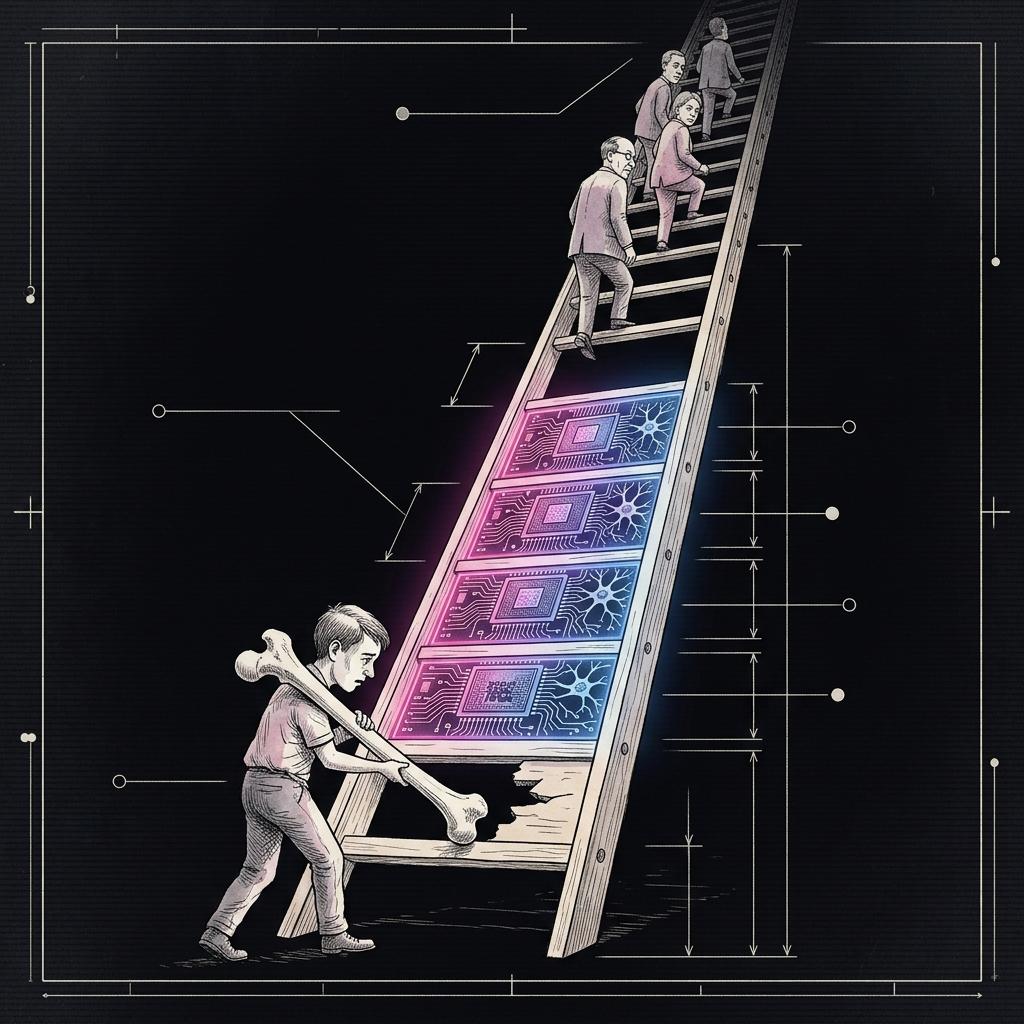
Middle management was never one job. It was two. One was oversight. The other was apprenticeship. Modern models eat the oversight function cleanly. They cannot eat the apprenticeship function at all. Companies are cutting both because they only ever priced the first.
The pipeline nobody put on the balance sheet
Every organizational chart is also a hidden training program. The junior analyst learns by drafting the memo the senior partner rewrites. The engineering manager learns by mediating a design dispute her director escalates to her. The regional VP learns by carrying a P&L smaller than the one she will inherit in six years. Every layer above the entry point exists partly to produce the layer above it. That is the apprenticeship.
The 2026 wave of cuts treats management layers as pure overhead. Gartner told the market a year ago that 20 percent of organizations would use AI to flatten half their management ranks by 2026. The forecast now looks conservative. Oracle has cut somewhere between 20,000 and 30,000 roles, most of them at the manager tier. Amazon has restructured into what industry analysts describe as AI-native business units and reduced middle management by roughly 35 percent. Meta ran a year of efficiency and then a second one. GitLab publicly argued that eight layers of management were slowing the company down and that decision-makers needed to be closer to the code.
None of those cases is wrong on its own terms. The eight-layer company was slow. The 35 percent reduction did surface capacity for capex. The bottom quintile of any large company's managers was scheduling meetings, not managing people. The oversight function had gotten fat, and the tools to replace it are cheap and improving. On the oversight side, the cuts are a rational response to a real change in technology.
On the apprenticeship side, the same cuts are quietly deleting the training ground for whoever runs these companies in 2034. Nobody has re-underwritten the leadership pipeline. The line item does not exist on any P&L. It is not in the S-1. It is not in the analyst deck. So it does not get defended when the McKinsey slide shows the layers stacked in red.
A CFO can defend R&D against a cost cut because R&D produces a patent portfolio the market can price. Nobody can defend apprenticeship on the same terms because apprenticeship produces a person eight years from now, and that person is not on any discounted cash-flow model.
What Harvard actually found
The pipeline damage is not a projection. It is already in the data.
A recent working paper out of Harvard's Digital Data Design Institute, with collaborators at Stanford, tracked employment across tens of thousands of U.S. firms from 2015 through the first quarters after ChatGPT's release. Overall junior employment across the tracked sample fell about 9 percent at firms that adopted generative AI. Among firms in the most exposed occupations, entry-level hiring dropped roughly 80 percent per quarter after adoption. Career-focused outlets covering the leadership pipeline gap have picked up the number and started running the counterfactuals.
Read the figure again. Not shifted. Not slowed. Cut by four fifths.
The mechanism is obvious. A generative model does the work a first-year associate used to do. It drafts the memo. It cleans the data. It writes the first pass at the analysis. The senior lawyer or PM or director still edits, but the human who used to do the first pass is not being hired. Which means the human who was going to become the senior editor in five years is not being trained. Which means the human who was going to run the practice group in fifteen years is not being identified.
The economist Peter Cappelli has spent two decades calling this pattern out under a different name. He calls it the disappearing bottom rung. Management researchers at INSEAD, Wharton, and MIT Sloan have started publishing under related terms: the hollow ladder, the training deficit, the missing tier. Whichever label sticks, the underlying claim is the same. AI is doing the repetitions. Humans are watching the repetitions happen.
You do not learn to make hard calls by watching a model make easy ones.
The 2034 bill
The story has no Q3 headline. The lag is what makes it dangerous.
The major consulting firms are already sitting on client engagements where the executive team is realizing, three years into an efficient-organization program, that they cannot fill VP roles internally. The bench that used to promote is not there. The company hires externally at a 40 to 60 percent premium and gets someone who does not know the business. The external hire misfires within eighteen months. The company runs the search again. Multiply that by every director slot in a Fortune 500 company across a decade, and the number climbs into billions of dollars of dead weight the S&P will happily absorb in aggregate.
At the top, the effect is worse. CEO succession looks like a hire. In practice it is a graduation. The finalists in a serious CEO search have typically run a $2 billion P&L. They have made a wrong call and survived it. They have fired a friend and rebuilt trust with the team. They have watched a market turn against them and steered through the pivot. Those experiences are not available on Coursera. They are the by-product of running a real business at real scale with real consequences.
If your organization has flattened its middle to fund inference, the humans who would have run the $2 billion P&L in 2034 are, in 2026, doing the individual-contributor work an agent could not quite finish. They are supervising a model. That is a different job. Nobody is going to promote a supervisor of models into a role that requires the repetitions a supervisor of models never got.
The 2034 CEO does not exist yet at most companies making 2026 cuts. When the vacancy hits, the failure will look like a leadership shortage. The cause will be a training decision made in the quarter that closed today.
Work charts, org charts, and the seat that trains
Microsoft's AI leadership team said publicly this year that traditional org charts will soon be replaced by "work charts": task-focused, ephemeral teams that assemble around a decision and dissolve when the decision is made. The frame is right. The implementation, at most companies attempting it, is wrong. The work charts get built around agents. Humans are inserted at the failure modes. Nobody is asking which of those human insertion points is also a training seat.
An agent-first organization that means to survive its own success has to build two things a naive flat org does not automatically produce. First, a rotation apparatus. Every entry and mid-level human has to touch a dozen genuinely different decisions per year, each with an outcome the human owns. Owning a decision an agent could not have owned alone. Not supervising the agent. Actually deciding. Second, a real after-action layer. What went wrong. What went right. What decision am I now qualified to make that I was not qualified to make a quarter ago.
Both cost money. Neither shows up in the same efficiency dashboard that justifies the cuts.
The Amazon reorganization is a useful natural experiment. Amazon has publicly moved toward what it calls AI-native business units, and analysts have documented roughly 400 cross-functional AI teams stood up during the 2024 to 2025 efficiency drive. Those teams are structurally sound as delivery vehicles. Whether they are training vehicles depends entirely on whether the humans inside them get promoted for having owned a decision or promoted for having ridden an agent successfully. The first path produces a bench in 2034. The second path produces a class of well-compensated operators who will not know how to sit in the seat above the one they hold today.
This is where AI and organizational design stop being separable problems. The agent choice determines the org chart, and the org chart determines the leadership bench. Cutting one without redesigning the other rents you a quarter of efficiency in exchange for a decade of hollowness.
The move most executives will not make
The contrarian architecture is straightforward. Cut the oversight layer. Expand the training layer. Publish a five-year plan for how humans get promoted, not only how agents get deployed.
Almost nobody does this because the returns are backloaded. The efficiency dashboard shows the layer removal in Q1. The pipeline damage shows up in Q17. The CFO is measured on Q1. The apprenticeship a board approves in 2026 pays out in 2033. The AI capex a board approves in 2026 shows up in the earnings release in six months. The compensation committee is not built to reward the first pattern over the second.
Boards can fix this. Very few will. The ones that do will still own their leadership bench in a decade. The rest will pay to rent it from a search firm that saw the whole thing coming and priced accordingly.
The trap is deeper than a staffing question. It is a design failure with a specific name. Every company using AI to shrink its middle is optimizing an org chart against the wrong utility function. The right function is not "output per human." It is "output per human, holding constant the flow of humans qualified to run this thing in ten years." Solve for the first, break the second, and you have rented the company back to yourself while calling the transaction efficiency.
Why an off-the-shelf tool will not solve this
You cannot buy a leadership pipeline. You architect one. Every large HR software vendor is selling an AI succession-planning module. Those tools optimize the wrong constraint. They rank the humans you already have. They do not answer why the humans you have are qualified for the level they are at. They do not answer why the humans below them are or are not becoming qualified for the levels above. They are matching engines pretending to be gardens.
The company that solves this problem treats human throughput as a designed pipeline. Named stages. Explicit skills at each stage. Agent-augmented but human-owned work at every level. A rotation schedule that guarantees multi-year exposure for every promising employee. A real feedback loop that names the specific decisions each human is now qualified to make. Nothing you can install fixes this. It is an operating-system change to the company itself.
Agor AI Advisory works with founders and executive teams on exactly this class of problem. The architecture of the human-in-the-loop layer, the rotation design, the retention of experiential learning as agents absorb the routine work, and the survival of the leadership bench through the transition. This is where the money saved on inference has to be reinvested if you intend to still have a company in a decade with a bench of humans who can actually run it.
The class of 2034 is being trained, or not, right now. If you cut the layers where that training happens, you are choosing rentership over ownership of your own future leadership. Do not make that choice by accident.
Sources
- GitLab cuts 7% of staff in 'agentic era' restructuring, TNW, May 2026
- Microsoft cuts 4,800 jobs as Xbox unit plans to spin studios, CNBC, July 6, 2026
- Microsoft to cut 4,800 jobs, joining the wave of AI-driven tech layoffs, NBC News, July 2026
- Management Cuts Today Are Shaping A Leadership Shortage, Forbes, June 30, 2026
- AI Is Closing the Front Door to Leadership, Lead With Purpose, 2026
- AI agents are flattening corporate hierarchies, Fortune, June 9, 2026
- When Every Employee Manages 200 AI Agents, Forbes, July 13, 2026