On July 24, 2026, Anthropic shipped Claude Opus 5 with a reasoning tier called "xhigh," sitting above the old "high" and below a new uncapped "max." The tier is priced for a single kind of workload: agentic runs that last 30 minutes or more and can spend multi-million-token budgets on one task. Two weeks earlier, Walmart's supply-chain group described a Self-Healing Inventory layer that detects stock imbalances and reroutes product to where it will sell out first, without waiting for a merchandising decision. On May 11, GitLab flattened up to three layers of management in one memo and split its R&D division into roughly 60 autonomous teams.
None of those three events is a technology story. Each is a decision loop story. The loops used to have a physical shape. They don't anymore.
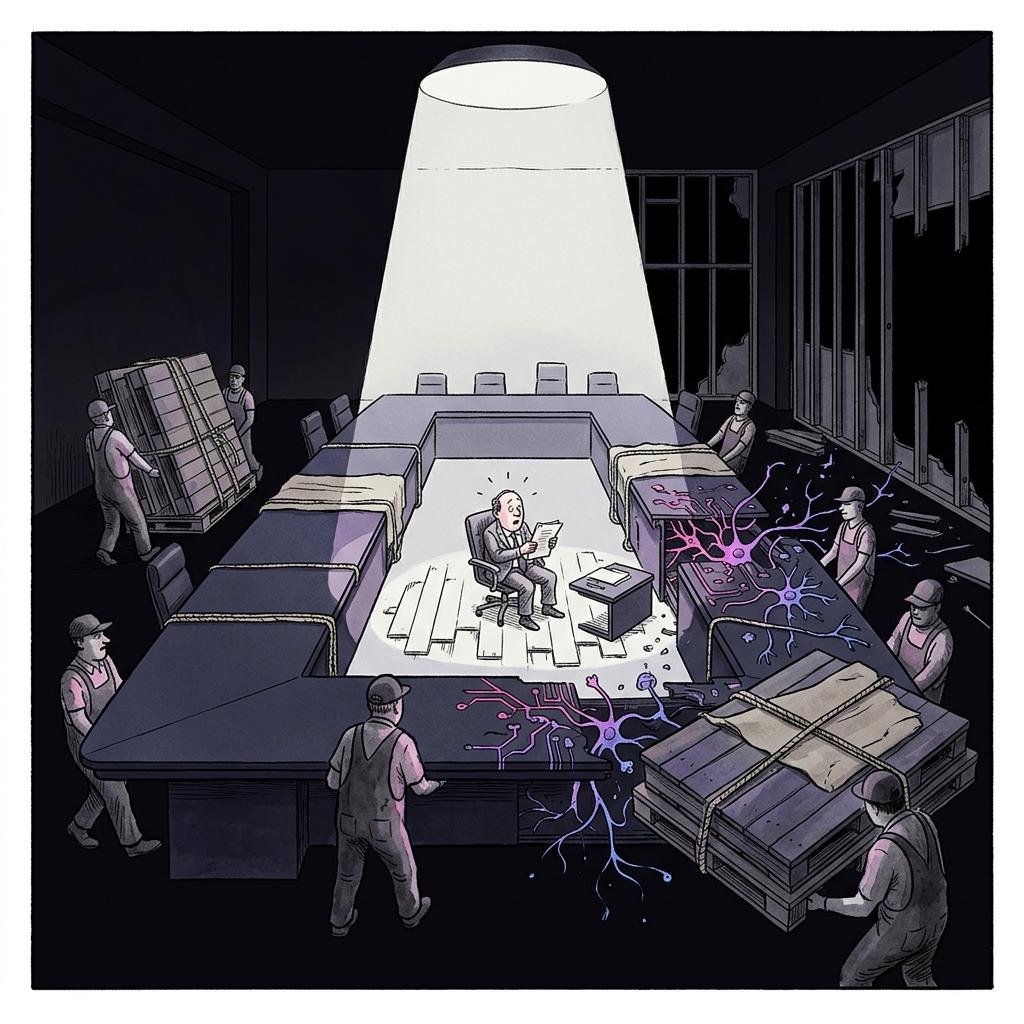
The loop had furniture
For most of the last century, a corporate decision looked like a room. Someone gathered information. Someone else framed the choice. A meeting happened. A decision was recorded. An action followed. A review cycle came around a quarter later to see if the decision had held.
Every piece of that loop had furniture. The gathering was a research team. The framing was a strategy deck. The meeting was a conference table. The recording was an ops queue. The action was a project. The review was a QBR. Cost accounting attached a headcount line to each piece of furniture.
The loop was measured in weeks because the furniture demanded weeks. A merchandising call cannot be scheduled for Wednesday if the buyer is in the air until Thursday. A hiring decision cannot move faster than a panel interview loop can be scheduled. An investment committee runs on the meeting calendar of five partners with overlapping travel. The clock speed of the enterprise was set by the availability of its most important calendars.
Increasing decision velocity with AI is the phrase everyone uses now for what happens when that furniture stops carrying the weight of the business. It sounds like a productivity story. Read it as a real-estate story. The furniture is coming out. The room itself was the latency.
What the OODA loop looked like when the box was cheap
John Boyd built the OODA loop for pilots in dogfights. Observe, orient, decide, act. The pilot who ran the loop faster than the opponent did not need a better plane. He forced the opponent to react to a scene that had already changed. Boyd's insight was that speed compounds inside the loop; once you get ahead, each iteration widens the gap.
Corporate strategy borrowed the metaphor for decades. It was mostly rhetoric. The four steps ran on human throughput and human throughput was fixed. You could shorten the observe phase with better data. You could shorten the orient phase with better dashboards. You could not move the decide-act step below the calendar clock speed of the people who owned the sign-off.
That last step is where the room lives. That is where AI agents are quietly changing the arithmetic.
The Walmart tell
Walmart's Fulfillment Engine, described in its July 17 supply-chain playbook, uses multiple agents and real-time decision logic to pick a store or a fulfillment center for each order. The system balances availability, speed, capacity, and a dozen other constraints. It does not propose. It picks. Human oversight moves to the design of the constraint set, not the individual pick.
The number that matters is not the 20 percent improvement in unit cost the company has cited. It is the disappearance of a class of daily calls. The merchandiser used to run through overnight stock movements at 8 a.m. Central. The buyer used to reconcile with the fulfillment planner at noon. Those meetings existed because the loop could not close inside a shift. They stopped being necessary because the loop now closes inside a request-response cycle.
Every removed meeting is a compression of the decide-act step from hours to seconds. The people did not get faster. The room got smaller. Then the room stopped needing to exist.
What Opus 5 changed in agentic work
Anthropic's Opus 5 pricing tells you what they think the market wants. At $5 per million input tokens and $25 per million output, it undercuts the previous flagship at the same class of intelligence. The novel piece is the xhigh reasoning tier, engineered explicitly for runs that do not fit in a single request-response cycle. Long-horizon coding. Multi-hour agent runs. Tasks that need to think through a hundred model calls without a human in the middle.
Most enterprise conversations about generative AI in 2025 assumed the model was a smart participant in a meeting. The meeting still happened. The model just contributed faster. Opus 5's design targets a different shape of work. The model is the meeting. It reads the input, holds the state, generates the options, evaluates them, picks one, executes, checks, corrects, and reports the result. The 30-minute session is the loop, and the loop closes without a human interrupt.
For finance, this is the JPMorgan LOXM pattern moved one layer up. LOXM has been running for years, cutting equity execution costs roughly 20 percent by adapting to real-time market conditions. It still requires trader approval for each trade. Opus 5-style agents remove that approval step for a class of decisions whose consequences are bounded, reversible, and cheap to audit after the fact. The trader is not gone. The trader is now the person who set the policy the agent runs against.
Where the human belongs after the room disappears
The trap in the "increasing decision velocity with AI" conversation is to treat the human as a bottleneck to be routed around. That framing gets the architecture wrong and produces the worst kind of failure: fast, confident, wrong decisions at scale.
Boyd's loop had a Decide step for a reason. Decide is where framing lives. It is where purpose gets injected into observation. An agent that observes and orients well can execute a policy inside the loop, but it cannot generate the policy without a human deciding what game is being played. IDC's projection that enterprises with agentic AI will respond 50 percent faster to IT disruption in 2026 assumes those enterprises defined "disruption" in a way the agent can act on. Where the definition is thin, the speed compounds the wrong action.
The correct move is to raise the human up a level, from decision maker to constraint author. The constraint author writes the boundaries: what counts as safe, what counts as reversible, what counts as a customer harm the agent must escalate. Then the loop runs.
GitLab's memo made this move explicit. Sixty autonomous teams with end-to-end ownership, three management layers removed. The claim is that management was middleware. In a world where an agent can close its own loop against a policy, the middleware layer that used to translate exec intent into weekly plans is a tax on the clock speed of the business. The tax was invisible when the loop ran at meeting speed. It is expensive when the loop wants to run at request-response speed.
The three flavors of failure
Companies chasing decision velocity as an outcome without changing the architecture underneath produce a recognizable set of failures.
The first is the copilot ceiling. A large team adopts an AI assistant. Individual decisions get faster inside the meeting, but the meeting still happens, on the same cadence, with the same approvers. The velocity gain hits a wall at the meeting boundary. The bill goes up. The clock speed stays flat. Somebody senior gets frustrated and asks why the productivity improvement did not compound. The answer is that the room was the constraint. The AI made the participants sharper. It removed no furniture.
The second is the shadow autonomy problem. An agent gets deployed to close its own loop, but the policy governing it is inherited from a decade of memos rather than written explicitly. When the agent behaves unexpectedly, the audit trail is worse than the pre-AI version because the reasoning happened inside a model context that no one archived. Anthropic's push around the MCP 2026-07-28 spec, with a stateless core and proper OAuth and OIDC authorization, is a direct response to this pattern. The spec assumes agents will run production loops and demands the loop leave traces a compliance team can read.
The third is the mistranslation of speed into confidence. A fast loop with a fragile framing produces the LOXM inversion: the agent picks correctly against a stale objective. The trading floor version is a bad execution against a market that has moved. The corporate version is a hiring decision that maximizes for last year's talent profile because the constraint author never updated the policy. Speed without a live constraint review is a system that gets wrong faster.
What the architecture actually looks like
A compressed loop has four pieces and each one is a design decision.
First, an observation layer that reads the world without polling. Event-driven, not batch. If the observation happens on a schedule, the schedule is the ceiling on the loop. Walmart's Self-Healing Inventory works because the inventory signal is a stream and not a nightly report.
Second, a policy layer written by the humans who own the outcome. The policy has to be legible to auditors and legible to the model. Legible to both means machine-readable rules that carry the reasoning behind each rule in a form the model can quote when it explains a decision. The rules are versioned. The reasoning is versioned with them.
Third, an action layer with a reversibility budget. Some actions are cheap to undo. An agent can take those without asking. Some actions are expensive or irreversible. Those escalate on a fast path to a named human who can be reached inside the time budget the loop allows. The reversibility budget is set per class of action, not per decision. This is where most in-house implementations quietly fail: the escalation path exists on paper and takes 40 minutes to complete in reality, so the loop stalls or the agent takes the action anyway because someone told it to try harder.
Fourth, a memory layer that lets the loop learn without a quarterly review. What worked, what did not, and what the constraint author needs to see this week. This is the piece that turns increasing decision velocity with AI from a one-time efficiency gain into a compounding advantage. If the loop learns, next quarter's loop is faster than this quarter's. If it does not, the speedup plateaus.
Buying an AI tool gets you one of the four. Sometimes two. Never all four, because the policy layer and the memory layer are specific to your business and no vendor can write them for you.
The compounding is the point
Decision velocity is not a linear improvement. It is a compounding one. A team that closes its loop in two days learns twice as fast as a team that closes in four. Over a year, the fast team runs 180 iterations against the slow team's 90. Even if each iteration is only marginally better, the fast team's 180th iteration is qualitatively different from the slow team's 90th because the constraints have been retuned 90 more times.
That is why AI-native firms like Anthropic, OpenAI, and Perplexity have been able to reshape their own products at cadences that publicly traded incumbents cannot match without a memo like GitLab's. The market they are building for has a different shape after 90 constraint tunings than after 6. The competitive claim of the current wave of agentic systems runs deeper than cost reduction. The space of decisions you can afford to make grew by an order of magnitude, and that changes what a product can be.
Every incumbent has to answer a specific question in the next 12 months. Which of my loops can compress from weekly to hourly. Which of my sign-offs is actually a policy that could be written down. Which of my managers is a translator of intent into plans, and could instead be a constraint author whose policy runs against an agent. The companies asking those questions are quietly rewriting their org charts. The ones that treat AI as a productivity tool for the existing loop are producing sharper participants in the same slow meeting.
What to do about it
Increasing decision velocity with AI is a claim you earn by rebuilding the shape of the loop, and buying a tool is nowhere near the same thing. The tool is table stakes. The architecture is the strategy. The companies that get this right in the next year will not look like their previous selves. They will look like a smaller set of humans authoring policies that run against a larger surface area of the business than the humans ever touched directly.
That work does not come out of a vendor demo. It comes out of a rigorous audit of which loops in your business are actually decision loops, which of those loops are gated by furniture that can come out, and which parts of the constraint set carry structural weight your team has never written down. It is hard, specific work, and the wrong version of it produces the shadow autonomy failure at production scale.
Agor AI Advisory does exactly this work. We design compressed decision loops with you, write the constraint layer with the operators who will own it, and instrument the memory layer so the loop compounds instead of plateauing. We work with founders and executive teams who understand that the room is coming out and want to be the ones who redesigned the building before their competitors did.
Sources
- GitLab Act 2, GitLab, May 2026
- GitLab cuts 7% of staff in 'agentic era' restructuring, The Next Web, May 2026
- Claude Opus 5 launch, xhigh mode and 1M context, BitsMinds, July 2026
- Anthropic ships Claude Opus 5 at half the cost, EnterpriseDNA, July 2026
- Walmart's U.S. supply chain playbook goes global, Walmart Corporate, July 2026
- Four ways Walmart is scaling AI to unify its supply chain, Supply Chain Dive
- JPMorgan's AI trading system LOXM, DigitalDefynd
- Decision velocity as the AI ROI metric that matters, Cloud Desk IT