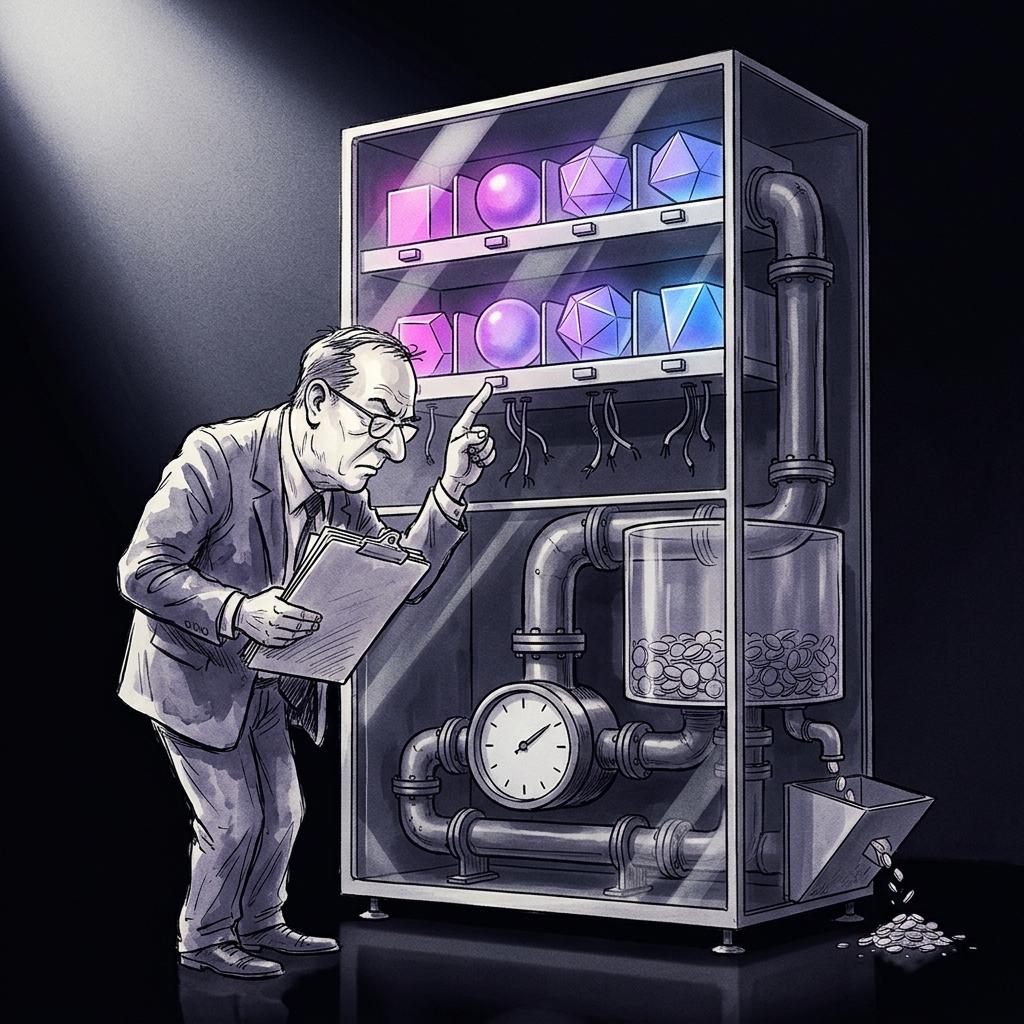
On October 21, 2026, OpenAI said it would sell its frontier models, including GPT-6 Astra, and its Codex coding agent through Google Cloud "in the coming weeks." Reuters reported the detail that matters most to anyone choosing between AI vendors. Customers can buy the models through Google Cloud Marketplace and pay for them out of the cloud spending commitments they have already signed. Google is the third big cloud to carry OpenAI. Microsoft's exclusive distribution deal ended in April, and Amazon Web Services started offering OpenAI models after that. Anthropic's Claude was already on all of them. Every frontier model can now be bought from every major cloud, and the model you end up running is increasingly the one you have already paid for.
My argument is simple, and I think most executive teams have not caught up to it. The vendor decision you spent last year arguing about (OpenAI or Anthropic or Google) is now the cheap, reversible part. The expensive and sticky decision sits a layer below it. Your enterprise discount agreement with a cloud provider, the governance plane you route requests through, and the habits your prompts have picked up from one model's quirks all now shape which model you use more than any benchmark does. If you do not design those layers on purpose, your cloud contract will choose your AI vendor, and you will think you chose.
Every model, every cloud
It helps to lay out the facts plainly, because they changed fast.
Analytics Insight's write-up of the October 21 deal says OpenAI's models will show up in Google Cloud's Model Garden, its Marketplace, and its Antigravity coding tool. Customers in regulated industries can wrap OpenAI models in Google's access controls and data governance tools. The same piece called the arrangement "a commercial arrangement between competitors." OpenAI already ran parts of ChatGPT and its API on Google infrastructure. Now Google also gets to resell it.
The cloud providers want this because it makes their marketplaces the place where AI money gets spent. Analytics Insight reported Google Cloud growth of about 82% in the second quarter, against 37% for Amazon and 42% for Microsoft. A cloud that carries every model gives the customer no reason to sign a second contract. That convenience pulls hard, and it is meant to.
For buyers, the old question ("which lab do we bet on?") has turned into a new one. Through which meter do we buy all of them, and how hard is it to stop?
The sixteen cents
Anthropic's IPO filing, as Reuters reported it on September 30, 2026, shows how much of the market already runs through cloud meters. Sales through cloud marketplaces came to about $2.16 billion in 2025, or 47% of Anthropic's annual revenue. That share was 11% in 2023 and 32% in 2024. Reuters estimated Anthropic paid roughly $351 million in distribution fees to the platforms, which works out to about 16 cents of every marketplace dollar. The cloud providers also held 60% of the $909 million in customer bills outstanding at the end of 2025.
Anthropic's own filing names the tension. It said its reliance on a small number of partners "creates complex dynamics that could give rise to conflicts of interest and adversely affect our access to compute." It also said cloud access enables "market penetration at a scale we believe would be difficult for any single organization to directly replicate."
Read both sentences from the buyer's chair. The model labs need the clouds to reach you. The clouds take a cut on the way through. Your committed spend is the pipe the money flows down. When a CFO sees that a model can be "paid for with existing commitments," the model starts to look free at the margin, because the money is already gone. That feeling drives most AI vendor selection in large companies, and it barely shows up in any evaluation memo.
Committed spend is a good tool. Drawing down a commit you would otherwise miss is real savings, and nobody should leave money on the table. The trouble starts when the commit shapes the choice without anyone saying so. Prepaid capacity makes the second-best model feel cheaper than the best one, and the gap between them never appears on a line item. It shows up later as worse output, more human review, and a slower team.
Choosing between AI vendors is now two decisions
I would split the decision in two and give each half a different clock.
The plane, which you choose for years
The first decision is the plane. Through which cloud or gateway do requests travel, whose identity and logging system wraps them, where does the data sit, and whose invoice does finance reconcile? This choice is sticky, and it should be. Security reviews, data residency, procurement terms and audit logging all take months to set up, and they pay off over years. You want few of these and you want them to last.
The model, which you choose by the month
The second decision is the model. Which weights answer which task this month? This choice should be loose. Model prices and quality are moving too fast for annual decisions. On October 7, 2026, Anthropic released Claude Haiku 5.5 at $0.10 per million input tokens and $0.50 per million output tokens for prompts up to 100,000 tokens. Anthropic's launch page said it "is priced 90% lower than Claude Haiku 4.5 for requests up to 100,000 tokens, and 50% lower for requests over 100,000 tokens," and that "on average, it now costs around 75% less to run." A pricing decision made in September was out of date two weeks later.
Most companies fuse these two decisions. They pick a lab, then pick the cloud that lab is "native" to, then wire the model's name into a few hundred places in their code and prompts. The plane and the model get locked together. When the October 21 news makes the model portable across clouds, a fused company gains nothing from it, because its real lock-in was never at the cloud. Its lock-in sits in its own habits.
The GitLab example from this month shows the other way to work. On October 13, GitLab added Google DeepMind's Gemini 4 Argon to its Duo Agent Platform, which already listed Claude Sonnet 5.5, Claude Haiku 5.5, Gemini 3.1 Pro, Nemotron 3 Ultra, Qwen3.6 and several others. Self-managed customers can plug in any model that speaks the OpenAI API specification. GitLab is selling itself as the plane and treating every model as a part you can swap. Whatever you think of GitLab, that is the right shape, and you can build it inside your own company without buying anyone's platform.
The per-token price lies
The most common mistake I see in AI vendor comparisons is a spreadsheet of per-token prices. A token is not a fixed unit, and per-token price tells you very little about what a task costs.
The Haiku 5.5 launch shows this well. DataCamp found its new tokenizer produces about 30% more tokens than Haiku 4.5 for the same text, according to AI Weekly's coverage. Artificial Analysis put Haiku 5.5 at its maximum effort setting at roughly 162,000 output tokens per task, against roughly 54,000 for OpenAI's GPT-6 Luna at its maximum setting. A model can be cheap per token and still spend three times as many tokens getting to an answer. One can be expensive per token and finish in a third of the words. The only number that matters is the cost of a finished, correct task on your work.
For illustration, take the 162,000-token figure at Haiku 5.5's headline output rate of $0.50 per million. That comes to about eight cents of output per task. Suppose a rival model charges three times as much per token but needs a third as many tokens; the bill comes out roughly even, and the decision then turns on which answer your reviewers have to fix less often. Price per token cannot settle that. Only a test on your own tasks can.
This is also why the commit trap bites. A procurement team holding a price sheet and a prepaid balance will pick the model that looks cheapest on the sheet and draws down the balance. Neither number tells you the cost of a correct task. Both are easy to put in a slide.
The switching cost lives in behavior
Executives usually think they can switch AI vendors faster than they can. Zapier surveyed 500 U.S. enterprise executives on vendor lock-in. 89% said they could switch AI vendors within four weeks, and 41% guessed two to five business days. Of the 66% who had actually tried a migration, 58% said it failed or took a lot more effort than they expected. Only 6% said they could stop using their primary AI vendor without interruption. 47% said at least one key business function would stop working correctly.
The gap between belief and experience comes from where the dependency actually sits. People imagine it sits in the API call, which really is easy to change. It sits in everything built on top of the model's habits. Merritt Baer, CSO at Enkrypt AI and a former Deputy CISO at AWS, put it in one line to VentureBeat: "Switching vendors changes output formats, latency characteristics, safety filters, and hallucination profiles."
Each item on her list is a hidden contract. A downstream parser expects one model's JSON layout. A customer-facing flow was tuned around one model's response time. A compliance team signed off on one model's refusal behavior. An agent's retry logic was calibrated to one model's failure modes. None of these is written down anywhere as a dependency. Each one breaks quietly when the model changes, and the first sign is usually a customer complaint or a bad number in a report.
This is the real reason the October 21 deal changes less than it seems for most companies. Being able to buy GPT-6 Astra through Google Cloud is worth exactly as much as your ability to run it in place of whatever you run today. For a company whose prompts, parsers and reviews have grown around one model, that ability is close to zero, whatever the marketplace says.
Washington can make the choice for you
There is a harder reason to keep the model layer loose. Sometimes the choice is taken away.
On October 17, 2026, DeepSeek released DeepSeek-V4.1-Flash-1017 with better benchmark scores. On October 19, the Department of Homeland Security disclosed an order, signed in July by Secretary Markwayne Mullin under the Federal Acquisition Supply Chain Security Act of 2018, directing federal civilian agencies to "exclude and remove all DeepSeek technology," including versions supplied by other companies. VentureBeat's coverage noted that the FY2026 defense authorization law separately bars the Pentagon and its contractors from using DeepSeek AI to perform defense contracts. Senators have reportedly drafted a provision to extend the Pentagon's ban to ten more Chinese AI companies.
This is not only about Chinese models. In March 2026, VentureBeat covered a federal directive ordering U.S. government agencies to "cease using Anthropic technology," with a six-month phaseout and a supply chain risk designation, so that companies doing business with the Pentagon had to show their workflows did not touch Anthropic. Within one year, Washington has forced vendor changes on a Chinese lab and an American one.
If you sell to government, or sell to companies that sell to government, your AI vendor choice now carries regulatory risk that can change in a week. VentureBeat's advice for suppliers comes down to designing for portability. Pin explicit model versions, test at least one alternative on your real tasks, and set things up so a forced switch is a configuration change. That advice is correct, and almost nobody follows it, because the payoff only shows up on the bad day.
What a sane selection process looks like
Here is how I would run AI vendor selection in a company of any size this quarter. It has more to do with plumbing than with picking winners.
Write down the work before you test the models
Pick the 20 or 30 tasks that carry most of your AI spend or most of your AI risk. For each, collect real inputs and the outputs a senior person would accept. This set of tasks becomes your exam. It will outlast every model you test with it, and it is the one artifact in your AI program that only you can build. Labs publish benchmarks about their models. You need a benchmark about your business.
Price the finished task
Run every candidate model through the exam. Record tokens in, tokens out, latency, and how often a human had to fix the answer. Turn that into cost per accepted task, with the reviewer's time counted at its real hourly rate. Put that number next to the per-token price sheet in every vendor meeting. The difference between the two numbers is usually the most useful thing anyone says in the room.
Keep two models live on everything that matters
For each important workflow, keep a primary model and a tested second model running in the same plane, with a small share of real traffic going to the second. Watch the output formats and failure patterns of both. When prices drop (as they did on October 7), when a new model ships (as Gemini 4 Argon did on October 13), or when a regulator acts (as DHS did on October 19), you move traffic. Nobody needs a migration project. The second model costs a little each month, and that cost is your insurance premium against the 58% outcome in Zapier's survey.
Negotiate the commit as a currency, not a vendor
When you renew a cloud commitment, ask a narrow question. Which models, from which labs, can this money buy, and will that list stay open for the life of the contract? Since October 21, the answer at Google, AWS and Microsoft includes models from more than one lab. Get that written into the agreement. A commitment that can be spent on any frontier model keeps your choices open. A commitment tied to one lab's models quietly makes the AI decision for you, years ahead.
Separate the plane owner from the model owner
Give the plane to platform and security people, who should be slow and careful. Give model choice to the people who own the exam and the outcomes, who should be fast and skeptical. When one team owns both, the plane's caution leaks into model choice, and you end up running last year's model on next year's budget.
The strange part
A year ago, choosing between AI vendors felt like choosing a religion. You picked a lab, learned its ways, and defended it in meetings. The October 21 deal shows how far the market has moved from that. OpenAI, which spent years selling through Microsoft alone, now sells through its search rival. Anthropic, which competes with Google's Gemini, made nearly half of its 2025 revenue through Amazon and Google marketplaces. The labs have stopped treating distribution as a loyalty test, and buyers should stop too.
What replaces loyalty is a pair of assets most companies have not built. The first is an exam that measures models against your own work. The second is a plane that lets you act on what the exam says. A company with both can treat every model release as a price cut it can collect in days. A company without them treats each release as a debate, then a pilot, then a migration that, by the numbers, more than half of the time goes worse than planned.
I find it a little funny. The industry built a market where the most powerful software ever made can be swapped through a dropdown in a cloud console, and most buyers have arranged their companies so the dropdown does nothing.
Build the switch before you need it
You cannot buy this. No marketplace listing, no orchestration platform, no AI gateway gives you an exam built from your own work or a team structure where model choice moves at the speed of the market. Those you have to design. They decide whether this year's price cuts land in your margins or in a cloud provider's 16 cents. They also decide whether the next government order costs you a config change or a quarter.
The window is open right now because the October 21 deal is new and most enterprise commitments come up for renewal over the next year. Every renewal you sign without a model-portability clause, and every workflow you ship without a tested second model, makes the next switch more expensive. Choose the plane slowly. Choose the model monthly. Build the exam first, because without it you are choosing by price sheet and prepaid balance, which means your cloud contract is choosing for you.
Agor AI Advisory designs this architecture with executive teams: the task exam, the cost-per-accepted-task model, the two-model routing, and the contract language that keeps your commitments spendable across labs. We do it before the renewal is signed and before the regulator calls. Schedule a strategic consultation with us today.
Sources
- OpenAI to sell its top models on Google Cloud in latest enterprise push, Reuters via The Star, October 21, 2026
- OpenAI on Google Cloud: GPT-6 Astra Reaches Enterprise Buyers, Analytics Insight, October 21, 2026
- Anthropic IPO prospectus lays bare deep dependence on Big Tech partners, Reuters via Khaleej Times, September 30, 2026
- Anthropic Cuts Claude Haiku 5.5 Price 75% Below Haiku 4.5, AI Weekly, October 7, 2026
- GitLab Duo Adds Gemini 4 Argon, Now 10+ AI Models, Tech Insider, October 2026
- DeepSeek-V4.1-Flash-1017 arrives just as the U.S. government bans it from agencies, VentureBeat, October 2026
- Pentagon vendor cutoff exposes the AI dependency map most enterprises never built, VentureBeat, March 4, 2026
- AI vendor lock-in survey, Zapier