On July 28, 2026, Microsoft CEO Satya Nadella issued a blunt warning to the market. He stated that single-model dependence kills companies. The statement sounded like a cautionary observation about enterprise software. It was actually a declaration of where the margin is moving next.
Two weeks earlier, on July 15, 2026, IBM published a study of 1,000 global executives titled "The Calculus of AI Sovereignty." The data confirmed what operators already knew. Most organizations have become completely dependent on a single intelligence provider. This dependency creates operational and strategic risks that escalate every single month.
The market has realized that avoiding AI vendor lock-in is the defining architectural challenge of the year. The consensus solution is entirely flawed. Companies buy translation layers. They route API calls through gateways. They assume they are free if they can point a request to a different server.
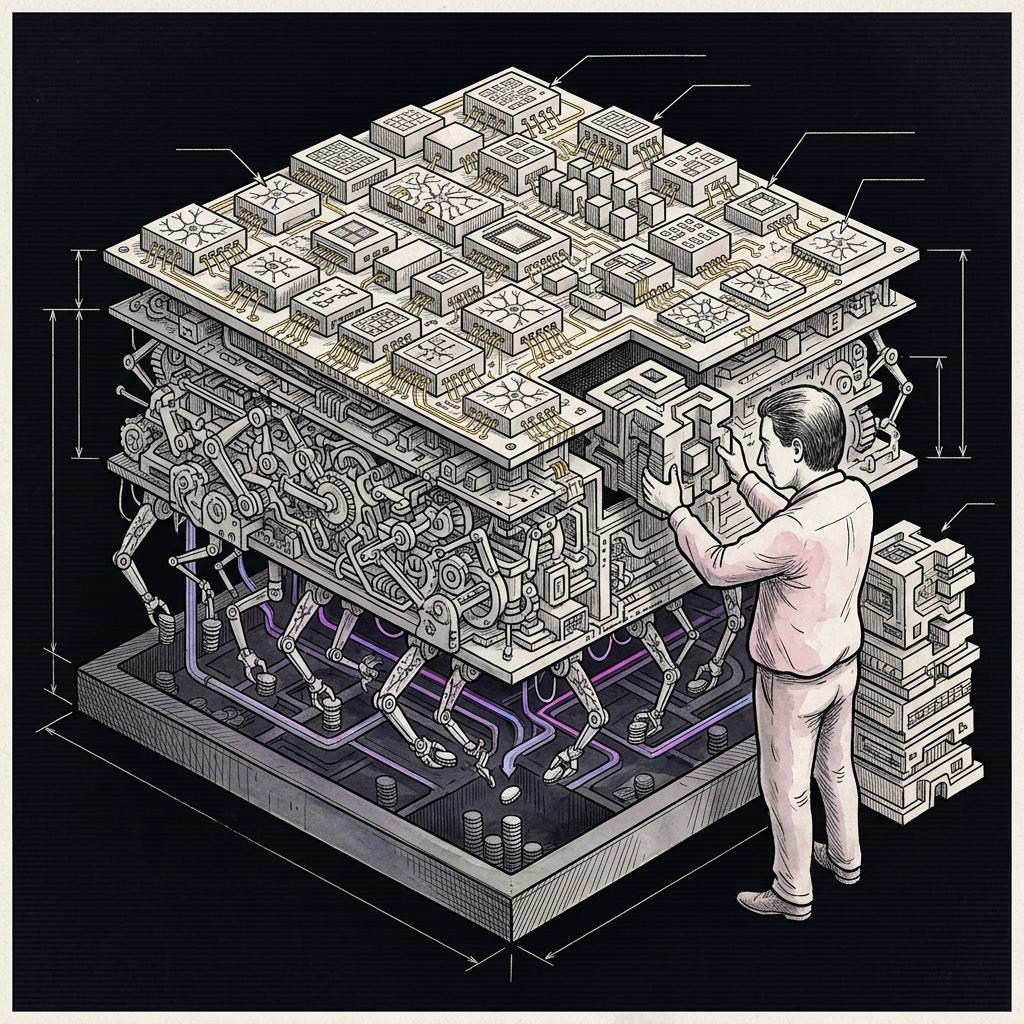
They are wrong. Model independence is a myth if your business logic remains bound to the behavioral quirks of a specific intelligence. The actual trap goes much deeper than the API endpoint. You are outsourcing the cognitive architecture of your firm. When you swap vendors, you do not migrate data. You transplant a brain.
The Mathematics of Dependency
The IBM study quantified a silent crisis. Enterprises rushed into generative intelligence pilots in 2023 and 2024. They picked a vendor. They built applications directly against that vendor's API. They trained their staff to write prompts specific to that system. They stored their proprietary context in that vendor's managed vector database.
Now, those pilot projects operate as mission-critical systems. The cost of unwinding those systems grows exponentially with every new feature deployed. The dependency scales faster than the utility. If a company wants to switch from OpenAI to Anthropic today, they face a massive refactoring effort.
The code that handles the API request is the smallest part of the problem. The core issue is the behavioral drift. Your application expects the model to format answers in a highly specific way. It relies on the model to ignore certain types of ambiguous inputs. It assumes the model possesses a specific baseline of reasoning capability.
When you change the model, all of those assumptions collapse. The mathematics of dependency dictate that the longer you build on top of a black box you do not control, the more expensive it becomes to open a different box.
The Translation Layer Mechanics
The software industry hates friction. When a problem arises, someone builds an abstraction layer to hide it. Over the last thirty days, the market flooded with tools promising instant portability.
On July 30, 2026, documentation for routing platforms like LLMGateway and Envoy AI Gateway began heavily promoting Anthropic-compatible endpoints. These tools intercept an Anthropic message format, translate it into an OpenAI format, and send it to any model in the catalog. OpenRouter offers similar translation services.
The pitch is incredibly appealing. You write code for Claude. You route the request to Llama 3.1 405B. The gateway handles the syntax translation. You pay a fraction of the cost.
The trap lies in the abstraction. When you buy an off-the-shelf routing layer, you trade model lock-in for infrastructure lock-in. The gateway provider controls the choke point. They observe your traffic. They dictate the translation logic between disparate systems.
Syntax is the cheap part of the problem. Translating a JSON payload from one format to another is a trivial software challenge. Gateway providers sell this translation as a defense against dependency. Treating intelligence models like interchangeable database engines ignores the fundamental nature of the technology.
The Behavioral Overfit
A database returns the exact same record whether it runs on Oracle or Postgres. A language model does not. If you send the exact same prompt to GPT-5.6 and Llama 3.1, you get different reasoning paths. The tone differs. The error rate shifts. The failure modes diverge.
When your engineering team builds an agentic workflow on top of a specific model, they adapt to it. They learn how to coax the right format out of the system. They discover which instructions need repeating. They figure out how to handle the specific hallucinations that model produces.
Your internal processes wrap themselves around the shape of the vendor's intelligence.
Imagine a global logistics firm. They deploy an agent to read customs documents and extract tariff codes. They build this agent on a specific frontier model. Over six months, their engineers write thousands of lines of prompt instructions to handle the model's specific tendency to hallucinate harmonized system codes. They build filters to catch the exact formatting errors that model produces.
The logistics firm decides to switch vendors to save money. They point the API gateway to a cheaper model. The API translation works perfectly. The payload arrives intact.
The new model reads the exact same prompt and fails catastrophically. It does not hallucinate the codes in the same way. The filters catch nothing. The new model ignores the negative constraints that the previous model respected. The entire customs clearance process halts.
The logistics firm is locked in. They cannot switch without rebuilding the entire cognitive pipeline.
Why Avoiding AI Vendor Lock-In Fails at the Router
We must examine why Microsoft and Amazon are suddenly warning against single-model dependence. Microsoft holds a massive financial stake in OpenAI. Yet their leadership actively tells the market to diversify.
This is a calculated strategic maneuver. The cloud providers know the raw foundation model is becoming a commodity. Open weights models are catching up to proprietary systems. The cost of inference is dropping. The margin is evaporating at the bottom of the stack.
To protect their revenue, the hyperscalers are moving up. They want to own the orchestration layer. Azure AI infrastructure, AWS Bedrock, and Google Cloud Vertex AI pose as neutral ground. They offer you every model. They give you the tools to switch between them. They sell you the routing logic and the evaluation frameworks.
They commoditize the model provider to capture you at the infrastructure layer.
If you build your entire evaluation pipeline inside Azure AI, you belong to Azure. The model is replaceable. The orchestration layer is permanent. Microsoft is perfectly happy if you stop using GPT-5.6 and start using a Llama variant, as long as you pay Azure to run the inference.
This is the new vendor lock-in. It is quiet. It feels like choice. You have a dashboard with a dozen different models. You feel independent. Try moving that workload to a different cloud provider. You will realize your entire cognitive supply chain is bound to the hyperscaler's proprietary tools.
The Open Weights Alternative
Many operators believe downloading open weights solves the sovereignty problem. Meta released Llama 3.1 405B on July 23, 2024. That release set a new baseline for open intelligence. By the summer of 2026, the architecture matured enough to handle massive enterprise workloads.
Owning the weights gives you control over the model itself. You can fine-tune it. You can run it on your own hardware. You can guarantee that the model will not change underneath you.
Downloading a model does not magically grant you independence. If you run Llama 3.1 inside a proprietary cloud wrapper that handles all your data ingestion, context window management, and agent routing, you are still trapped. You have simply moved the dependency from the intelligence provider to the hosting provider.
Open weights are a necessary component of cognitive sovereignty. They are never sufficient on their own. The model needs an architecture around it to function. If someone else owns that architecture, someone else owns your business.
The Burden of Inheritance
The risks of dependency extend far beyond technical friction. When you tie your business to a single intelligence provider, you inherit their legal exposure. You inherit their reputational baggage.
On August 3, 2026, industry analysts noted a sharp shift in public sentiment regarding Anthropic. The company conspicuously refused to sign the Open Weights and American AI Leadership letter. That document carried endorsements from over 130 organizations including Nvidia and Google. In the exact same week, reports surfaced regarding an internal Anthropic operation called Project Panama, based on thousands of pages of unsealed court filings.
Whether the vendor is legally compliant is irrelevant. The issue is governance. If your core product relies entirely on a vendor whose reputation suddenly crashes, you suffer the blowback. Your customers will ask questions. Your board will demand a risk assessment.
The EU AI Act and similar regulatory frameworks compound this problem. The European legislation imposes harsh penalties for non-compliance. Fines can reach 35 million euros or seven percent of global annual turnover. Any company whose AI outputs are used in the European Union must comply, regardless of where the company is headquartered.
Vendors alter their models routinely to comply with local laws. They implement new safety filters. They refuse certain types of requests. If your business depends on a capability that the vendor suddenly restricts for compliance reasons, your product degrades overnight.
You have zero control over these adjustments. If your vendor degrades their model to satisfy a regulator in Brussels, your application in Chicago suffers the consequences. You bear the operational cost of their legal strategy.
True cognitive sovereignty means you can sever ties with a vendor without breaking your operations. Your compliance posture remains independent of your provider's legal strategy. You own the rules of engagement.
The Disappearance of the Exit Strategy
The consequences of dependency eventually reach the capitalization table. When private equity firms and strategic acquirers evaluate a software company today, they audit the intelligence stack. They calculate the true cost of goods sold.
If a target company has hard-coded its core product features to a specific proprietary model, the acquirer applies a massive discount to the valuation. The acquirer knows that the target company does not actually own its intelligence. The target company is simply reselling API calls.
An exit strategy requires a portable architecture. The acquiring firm likely has their own negotiated enterprise agreements with a different cloud provider. They will want to migrate your workloads to their preferred infrastructure to realize economies of scale. If your agentic workflows break the moment they are pointed at a different model, the migration becomes impossible. The acquisition falls apart.
Sovereignty translates directly to enterprise value. A company that can instantly move its workloads across different foundation models commands a premium. They have proven that their intellectual property resides in their routing logic and their evaluation frameworks, rather than in a vendor's black box.
The Economics of the Switch
Pricing in the AI API market is highly volatile. Early in the adoption cycle, vendors subsidize inference costs to capture market share. They offer steep discounts. They provide free credits.
Once your architecture is deeply integrated with their specific model, the pricing changes. The subsidies end. The cost per million tokens normalizes to reflect the actual compute burden.
If you lack sovereignty, you pay the new price. You have no leverage. You cannot threaten to leave. The cost of migrating your prompts, retraining your internal teams, and rebuilding your evaluation pipelines far exceeds the price increase.
This dynamic flips if you possess cognitive sovereignty. Architect your system to evaluate and route workloads dynamically. Play vendors against each other. Route complex reasoning tasks to the expensive proprietary models. Push routine summarization to cheaper open models. Control the unit economics of your intelligence.
The companies that fail to build this capability will watch their margins compress. They will pass the rising cost of intelligence directly to their customers. They will lose ground to competitors who deliver the same features at a fraction of the cost through intelligent routing.
Architecting Cognitive Sovereignty
You cannot buy independence. You have to build it. Avoiding AI vendor lock-in requires a fundamental shift in how you design software.
First, decouple prompt logic from the execution layer. Prompts cannot live hard-coded inside your application. Treat them as configuration data. Store different versions of a prompt for different models. When the router sends a request to a local Llama instance, it must send the Llama-optimized prompt. When it routes to a frontier model, it sends the corresponding optimized prompt.
Second, build an internal evaluation loop. You need an automated harness that constantly tests the outputs of different models against your specific business criteria. If a vendor pushes a silent update to their model and the quality degrades, your evaluation loop must catch it immediately. Measure performance against your own private data. Do not trust vendor benchmarks.
Third, retain control of your proprietary context. Vendors want you to use their integrated retrieval tools. They offer to store your documents, chunk the text, and manage the embeddings. Do not accept this convenience. When you allow the model provider to generate and store the embeddings, you tie your data to their specific embedding model. If you decide to leave, you cannot export the vectors. You have to export the raw text and pay to re-embed millions of documents using a new model. The switching cost becomes prohibitive.
You must generate the embeddings yourself. You must store them in an independent database. The intelligence provider should only receive the relevant context at the exact moment of inference. They process the text, return the answer, and retain nothing.
Fourth, build the routing logic internally. Do not rely entirely on a third-party gateway to make decisions about where your data goes. You need a lightweight, internal routing mechanism that directs traffic based on cost, latency, and required capability.
Finally, invest in synthetic data generation. Use massive, expensive models to generate high-quality training sets. Use those sets to fine-tune smaller, cheaper models that you control completely. When you own the fine-tuned weights, you own the intelligence.
The Capital Allocation Imperative
The shift toward cognitive sovereignty is a capital allocation decision. It requires upfront investment. Building an internal evaluation harness costs money. Maintaining multiple prompt variations requires engineering hours. Running your own routing logic demands infrastructure overhead.
Many executives look at these costs and choose the easy path. They sign a massive enterprise agreement with a single vendor. They take the discount. They tell their board they have an AI strategy.
This is a profound miscalculation. The money saved on infrastructure today will be paid back with heavy interest when the vendor raises prices. The companies taking the easy path are leasing a dependency.
Capital spent on building a sovereign stack is an investment in survival. It guarantees your business can adapt to a market that changes every week. It ensures your unit economics remain under your control. It protects your intellectual property from being absorbed into a vendor platform.
The leaders who understand this are reallocating capital right now. They are pulling budget away from massive API commitments. They are redirecting it to internal infrastructure. They are hiring engineers who understand evaluation and routing, rather than developers who only know how to call a single API.
The Illusion of Finality
A dangerous assumption circulates in the enterprise market. Operators believe the AI market will eventually settle. They assume a clear winner will emerge, standardizing the technology in the same way AWS standardized cloud computing.
They wait for the final architecture to arrive before they commit.
This waiting is fatal. The nature of generative intelligence guarantees permanent instability. Models will always change. The regulatory environment will remain fractured. Pricing will continue to fluctuate. There is no final state of equilibrium.
You cannot wait for the market to solve the lock-in problem for you. Vendors have no incentive to build a truly interoperable market. Their goal is to capture your data, your workflows, and your budget. Your goal is to extract their intelligence without surrendering your autonomy.
These goals are fundamentally incompatible.
The companies that thrive in the next decade will accept this conflict. They will stop looking for a vendor to trust. They will build systems designed to operate in an environment of zero trust. They will assume every model is temporary. They will assume every API will eventually break.
They will build an architecture that survives the collapse of any single provider.
The New Toll Road
The era of buying intelligence as a simple utility is over. The vendors are building toll roads. The hyperscalers are laying traps at the orchestration layer. Every API call you make without an independent evaluation loop deepens your dependency on an external brain.
You must take control of your cognitive architecture. You must own the routing, the evaluation, and the context. Architecting this change is the only way to protect your margins and your sovereignty.