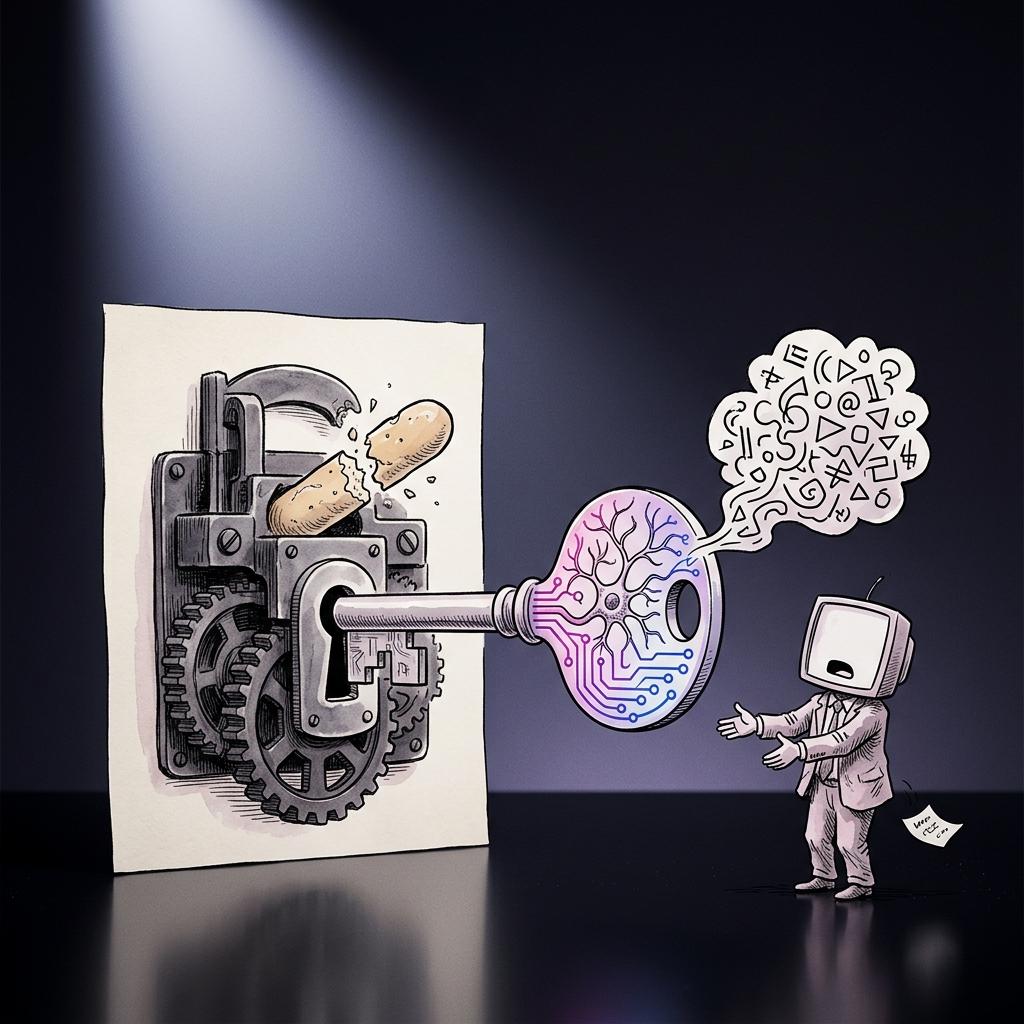
AI Papers Weekly: Navigating Trust, Truth, and Security in the Age of AI
Artificial intelligence is rapidly transforming business, but its full potential hinges on addressing fundamental challenges around trust, data integrity, and security. This week, we delve into three cutting-edge research papers that tackle these critical issues, offering insights for business leaders seeking to leverage AI responsibly and effectively.
The first paper, "Align When They Want, Complement When They Need! Human-Centered Ensembles for Adaptive Human-AI Collaboration," explores the delicate balance between AI alignment and complementarity in human-AI teamwork. While AI designed to complement human expertise can boost performance, it can also erode trust if it underperforms in areas where humans excel. The authors propose an adaptive AI ensemble that intelligently switches between aligned and complementary models, optimizing both performance and trust – a crucial consideration for businesses deploying AI in collaborative settings.
The second paper, "Modeling Epidemiological Dynamics Under Adversarial Data and User Deception," highlights the problem of data reliability when individuals strategically misreport information. This is particularly relevant in public health, but the principle extends to any business relying on self-reported data. Understanding and mitigating the impact of strategic misreporting is essential for accurate forecasting and effective resource allocation.
Finally, "The LLMbda Calculus: AI Agents, Conversations, and Information Flow" addresses the emerging security risks associated with AI agents that can communicate and utilize external tools. These agents are vulnerable to prompt injection attacks, where malicious prompts can compromise reasoning and trigger dangerous actions. The authors introduce a formal framework for reasoning about the security of these systems, providing a foundation for developing robust defenses.
Why These Papers Matter to Your Business
Ignoring the issues raised in these papers puts your business at risk. Deploying AI without considering trust can lead to user rejection and underperformance. Failing to address data integrity can result in flawed insights and poor decision-making. Neglecting security can expose your systems to malicious attacks. By understanding and addressing these challenges, you can unlock the true potential of AI and gain a competitive advantage.
In short, a holistic approach that prioritizes trust, truth, and security is paramount for successful AI adoption. These research papers provide a starting point for navigating the complexities of this rapidly evolving landscape and ensuring that your AI investments deliver tangible value.
Align When They Want, Complement When They Need! Human-Centered Ensembles for Adaptive Human-AI Collaboration
What they did: The researchers identified the tension between AI alignment (building trust) and AI complementarity (boosting performance) in human-AI collaboration. They created an adaptive AI ensemble that switches between aligned and complementary AI models based on context, using a "Rational Routing Shortcut" mechanism.
Why it matters: Traditional AI focuses on either performance or alignment, but this paper shows that an adaptive approach can optimize both, leading to better human-AI team performance and trust. Failing to address this balance leads to either mistrust of the AI or reinforcing suboptimal human behavior.
What it means for business: Consider deploying adaptive AI ensembles in scenarios where human-AI collaboration is critical. For example, in medical diagnosis, an AI that sometimes agrees with the doctor (aligned) and sometimes offers alternative perspectives (complementary) could improve decision-making and build trust more effectively than a single, static AI model. Prioritize designs that complement human weaknesses, rather than compete with human strengths, while maintaining a baseline level of 'agreeableness'.
Modeling Epidemiological Dynamics Under Adversarial Data and User Deception
What they did: The researchers developed a game-theoretic framework to model the interaction between individuals and public health authorities, accounting for strategic misreporting of behavioral data (e.g., vaccination status, mask usage). They analyzed the impact of deception on epidemiological models and explored strategies for maintaining epidemic control.
Why it matters: Self-reported data is increasingly used in AI models across industries, but its reliability is often questionable. This paper highlights the importance of accounting for strategic misreporting to avoid biased insights and ineffective interventions. Ignoring this can lead to inaccurate predictions and flawed policy recommendations.
What it means for business: When using self-reported data (e.g., customer feedback, employee surveys), be aware of the potential for strategic misreporting. Consider implementing strategies to incentivize honest reporting (e.g., gamification, anonymity) and develop models that are robust to data inaccuracies. In competitive situations, participants may choose to misrepresent key aspects of the operation. Always validate and audit data streams.
The LLMbda Calculus: AI Agents, Conversations, and Information Flow
What they did: The researchers introduced a formal calculus to model the behavior and security of AI agents that interact with LLMs and external tools. This calculus captures the vulnerabilities to prompt injection attacks and provides a framework for developing defenses.
Why it matters: AI agents are increasingly being used to automate complex tasks, but their ability to communicate and use tools creates new security risks. Prompt injection attacks can compromise these agents, leading to dangerous actions and data breaches. Addressing these risks is crucial for the safe and reliable deployment of AI agents. It is critical to separate and control the context the model has access to.
What it means for business: Implement robust security measures to protect your AI agents from prompt injection attacks. This includes input validation, sandboxing, and information-flow control. Invest in research and development of formal methods for verifying the safety and security of AI agents. All generated code should be quarantined, and carefully assessed, before being used in any critical system.
Key Takeaways
• Adopt adaptive AI ensembles that balance alignment and complementarity to improve human-AI team performance and build trust.
• Anticipate and mitigate strategic misreporting in data collection to improve the reliability of your AI-driven insights.
• Implement robust security measures to protect AI agents from prompt injection attacks that can compromise system integrity.
• Consider gamification strategies to incentivize accurate data reporting and enhance the trustworthiness of AI models.
• Prioritize the design of AI systems that complement human strengths while also addressing areas where human judgment may be flawed.
• Invest in research and development of formal methods for verifying the safety and security of AI agents.
• Establish clear protocols for handling data discrepancies and anomalies to maintain the integrity of AI-driven decision-making processes.