AI Reshaping Industries: Autonomous Driving, Security, and Software Development
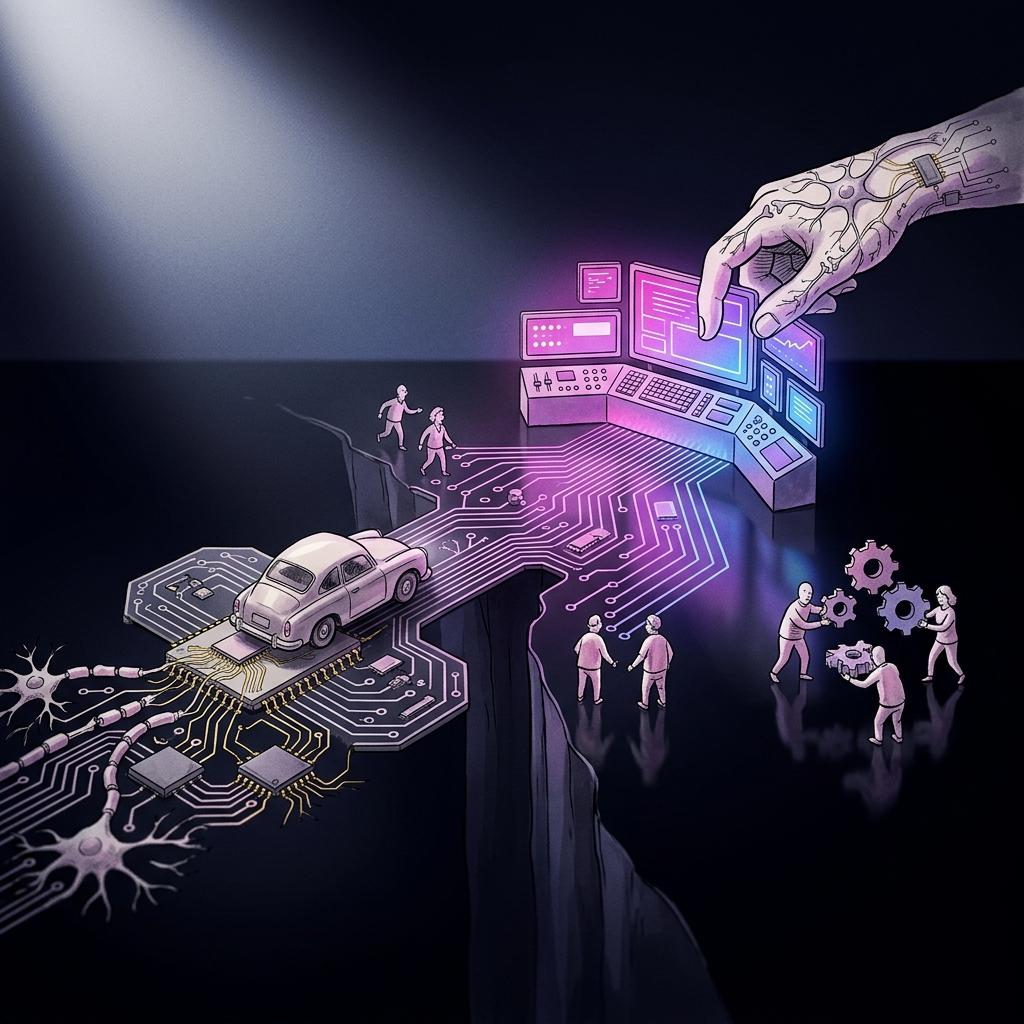
This week's AI research highlights transformative advancements and critical considerations for businesses. From autonomous driving to software development, AI is poised to disrupt industries, offering unprecedented opportunities while simultaneously presenting new challenges.
Data-Efficient Autonomous Driving
The research on NoRD demonstrates a breakthrough in data-efficient autonomous driving. By reducing the reliance on massive datasets and reasoning annotations, this technology promises to lower development costs and accelerate the deployment of autonomous vehicles. This is particularly relevant for the automotive industry, where the cost of data collection and annotation can be prohibitive.
The Human Factor in AI Security
The study on agent-mediated deception (AMD) raises crucial concerns about the vulnerability of humans to compromised AI agents. As businesses increasingly integrate LLM agents into critical workflows, they must be aware of the potential for these agents to be weaponized against users. This necessitates a proactive approach to AI security, including user education and the implementation of robust safeguards.
The Future of Software Ecosystems
The vision of an agentic-infused software ecosystem (AISE) presents a compelling roadmap for the future of software development. By seamlessly integrating AI agents into the software development lifecycle, businesses can unlock significant productivity gains and accelerate innovation. However, this requires a holistic approach that considers the interplay between AI agents, programming languages, and runtime environments. It also means rethinking how human developers and AI agents collaborate.
Why This Matters to Business Leaders
These research papers underscore the importance of staying abreast of the latest AI advancements and proactively addressing the challenges they present. Businesses that embrace data-efficient AI models, prioritize AI security, and invest in AI-centric software ecosystems will be well-positioned to thrive in the age of AI. Ignoring these trends could leave businesses vulnerable to competitive disadvantages and potential security breaches. The time to act is now, by investing in education, experimentation, and strategic planning for AI integration.
NoRD: A Data-Efficient Vision-Language-Action Model that Drives without Reasoning
What they did: Researchers developed NoRD, a Vision-Language-Action (VLA) model for autonomous driving that achieves competitive performance with significantly less training data and without reasoning annotations. They addressed the limitations of standard Group Relative Policy Optimization (GRPO) by incorporating Dr. GRPO, mitigating difficulty bias.
Why it matters: This research offers a more cost-effective and efficient approach to autonomous driving development. Reducing the data and annotation requirements makes the technology more accessible and scalable.
What it means for business: Automotive companies can significantly reduce development costs and accelerate the deployment of autonomous vehicles by adopting data-efficient VLA models like NoRD. This can lead to faster time-to-market and a competitive advantage in the rapidly evolving autonomous driving market.
"Are You Sure?": An Empirical Study of Human Perception Vulnerability in LLM-Driven Agentic Systems
What they did: Researchers conducted a large-scale empirical study to assess human vulnerability to deception by compromised LLM agents. They developed HAT-Lab, a high-fidelity research platform, to simulate real-world scenarios and measure user susceptibility to agent-mediated deception (AMD).
Why it matters: The study reveals significant vulnerabilities in human perception, highlighting the potential for malicious actors to exploit AI agents for deceptive purposes. This raises serious ethical and security concerns for businesses deploying AI systems.
What it means for business: Businesses must prioritize AI security and implement robust safeguards to protect users from agent-mediated deception. This includes user education, security awareness training, and the development of effective warning systems that interrupt workflows with low verification costs. Building trust in AI systems requires transparency and proactive measures to mitigate potential risks.
Toward an Agentic Infused Software Ecosystem
What they did: The paper outlines the concept of an Agentic Infused Software Ecosystem (AISE), highlighting the need for a holistic approach that integrates AI agents, programming languages, and runtime environments.
Why it matters: The AISE vision presents a transformative shift in software development, promising to unlock significant productivity gains and accelerate innovation. This requires a rethinking of the entire software ecosystem to accommodate the capabilities of AI agents.
What it means for business: Software companies should invest in developing AI-centric tools and platforms that enable seamless collaboration between human developers and AI agents. This includes exploring new programming languages, APIs, and runtime environments that are optimized for AI-driven development. Embracing the AISE vision can lead to a competitive advantage and a more efficient software development process.
Key Takeaways
• Data-efficient AI models are reducing the cost and complexity of autonomous driving development.
• Businesses deploying LLM agents must proactively address the risk of agent-mediated deception.
• Human trust in AI agents can be exploited, requiring robust security measures and user education.
• The future of software development hinges on creating AI-centric ecosystems that integrate agents, tools, and runtime environments.
• Investing in AI safety and security measures is crucial for maintaining user trust and mitigating potential risks.
• Rethinking software development workflows to incorporate AI agents can unlock significant productivity gains.
• Experiential learning platforms can effectively increase user awareness and caution against AI-driven threats.