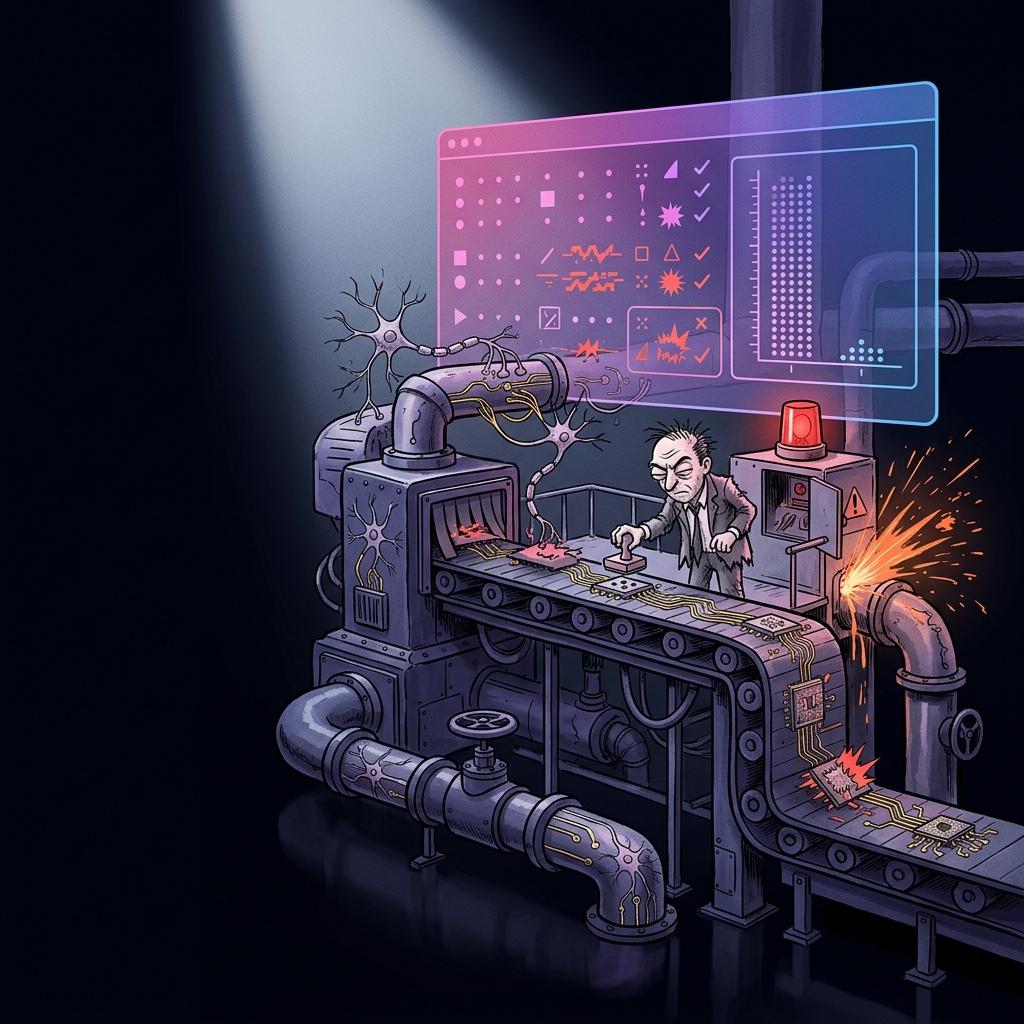
On August 14, 2026, auto mode became the default in Claude Code for every Pro, Max, and Team subscriber. The blog post announcing the change buried the sentence that will end up mattering most to operations teams. Anthropic ran a controlled study with 1,053 paid testers. Adversarial commands were slipped into their sessions. The humans caught 13.6 percent of the dangerous ones. A separate classifier model, reading each proposed tool call and voting yes or no, caught 89 percent of the same commands.
That number is the empirical finding that reshapes how AI automation strategy for operations teams should be built for the next five years. The reviewer everyone thought was protecting them was a placebo. The model was the watch.
I have spent 2026 watching operations leaders architect AI programs the way audit committees architect controls. Human in the loop at every step. Approval workflows. Ticketed exceptions. The mental model is a foreman standing over the shoulder of a junior operator, ready to slap the keyboard when something goes wrong. The Anthropic study was the first time anyone measured the foreman. They were watching 14 percent of the time.
Why the reviewer never worked
Operations research has known this for forty years. It comes up under a dozen names: automation complacency, alarm fatigue, vigilance decrement. When a person is asked to sit above a system and intervene only when something looks wrong, they degrade in a predictable way. The first hour, they read every line. The second hour, they read every third line. The fourth hour, they are pattern-matching on colour and length. By day three, they have taught themselves that ninety-nine percent of the flags are benign, and they treat the hundredth one the same way.
Anthropic's testers were paid. They were told they were being tested. And still, 86 percent of the dangerous commands walked past them. That is under the best possible conditions. In a real operations context, where the reviewer is also on Slack, on a Zoom, and reading a Jira, the number will be lower.
The frame the AI industry sold in 2023 and 2024 was that humans would supervise the agents. It was a comfortable frame. It let operators keep the sense of authorship. It let compliance teams tell auditors that a person had signed off. It let vendors ship agentic products behind an approval button and call the product safe. The August 14 study is the first hard data that says the button was a costume.
AI automation strategy for operations teams starts with reading the tool call, not the outcome
If the human is not the safety net, what is? Anthropic's own architecture is worth reading closely because it is the first widely-shipped commercial system to be honest about this. Auto mode does not run without controls. It runs with a different control. Every tool call the model proposes is routed to a separate classifier. That classifier reads the call, decides whether the action is irreversible, destructive, or aimed outside the user's environment, and either passes it, blocks it, or hands it to the user for a real decision. Reversible action inside your sandbox goes straight through. Rm on a shared filesystem does not.
The important observation is where the check moved. It moved from the human's eyeball on the output to a model's read of the input. This is the architectural pattern operations teams should be copying, and it is nothing like what most enterprise AI programs are building. Most are still buying products that put a human at the end. Anthropic put the classifier at the beginning.
Read that difference carefully because it is the single most important design decision in enterprise AI right now. A review at the end sees only the artefact the agent produced. It has no view into the plan, the sequence, the intent. A classifier at the beginning sees the requested action against the user's environment, and it can refuse before anything happens. The end reviewer is a plate glass window in front of a factory. The beginning classifier is a valve.
The three things a human is still good at
Redirecting the human out of ninety percent of AI actions does not remove them from the picture. It moves them to the three places where they still add real information.
The first is irreversibility. Sending an email, deleting a database row, wiring money, signing a contract, publishing a document to the world: these are actions whose consequences cannot be pulled back. A classifier can flag them, but the judgement about whether to spend the irreversibility is a business judgement, and it should sit with a person. The Anthropic classifier hands these to the user by design.
The second is novel context. When an agent is doing something the classifier has not seen before, either because the tool is new or the situation is unusual, the model is guessing at whether the action is safe. A person who knows the operating context can bring information the classifier cannot: who the customer is, what they said last week, what the CEO promised in the town hall. These are the moments a review is expensive but worthwhile.
The third is outward-facing state. Anything that touches the world outside your walls, whether a partner, a regulator, a customer, or a market, has second-order effects the classifier is not modelling. A person's sign-off there is about owning the message, not about catching the model's error.
Ninety percent of what an operations agent does falls outside all three of those categories. It is fetching data, transforming it, running a report, checking a threshold, pinging another system, writing to an internal cache. Every one of those steps under human review is a step under a checkbox that a distracted person is clicking green. The Anthropic data says that checkbox is not doing what its owners think it does.
Why 88 percent of pilots never ship
Forrester and Anaconda published a widely-cited 2026 data point on enterprise agent programs: 88 percent of pilots never reach production. That number is real and it is worth reading against the classifier study, because the two facts are the same fact.
The pilots that stall are not stalling on model quality. Foundation models in 2026 are already better at most operations tasks than the humans they would replace. The pilots stall on the operational shell around the model. Isolation, governance, compliance controls, data residency, and, most of all, approval workflow. When every action has to route through a human, throughput collapses. The pilot ships forty automations. Each one saves ten minutes of clerical work and adds fifteen minutes of review. The net is negative. The pilot dies.
The teams that got past 88 percent did the same thing the Anthropic auto-mode design does. They put a classifier at the front. They reserved the human for the three cases above. They accepted that most of what the agent does will happen without a person watching, and they invested their compliance budget in the classifier, the logging, and the rollback path rather than in the review queue.
What to build this quarter
If you are running an operations organisation and you want your AI program to survive Q4 2026, the architecture question you should be asking is not which vendor. It is what your classifier reads. A functional AI automation strategy for operations teams in this environment has five parts, and none of them are the review button.
One. A structured registry of every action your agents can take, with each action tagged for reversibility, blast radius, and external state. Most operations shops do not have this. They have a list of tools. A tool is a capability. An action is a capability applied to a state. Rm is a tool. Rm on the shared prod filesystem is an action.
Two. A classifier that reads a proposed action against that registry and decides pass, block, or escalate. This does not have to be a large model. Anthropic's own is described in their release notes as separate from the main model precisely because it is smaller and cheaper. What matters is that it reads the input, not the output.
Three. A logging spine that captures every proposed action, every classifier decision, every escalation, and every human override. This is where your compliance story lives. Not in the review queue.
Four. A rollback path for every reversible action. If an agent writes a wrong row, the recovery is a rewind. Reversibility is a property you architect for.
Five. A human escalation channel with a service level. The person on the other end must be able to make a real decision in a bounded time. If your escalation channel is "someone will look at this in the morning," you have not built a control. You have built a queue.
If you have all five, you can turn the classifier's throughput up and let the agents actually do the work. If you have four, you are one incident away from every ambition getting rolled back. If you have three, you are running theatre.
The false comfort of "human oversight"
The phrase "human oversight" has done tremendous damage to enterprise AI in the last two years. It let boards sign off on programs that had no real control by pointing at a person. It let vendors ship agentic products behind an approval prompt and call the design safe. It let compliance teams file reports about coverage rates on review queues that were, empirically, catching nothing.
The August 14 data forces the question the field has been avoiding. If a paid, attentive tester catches 14 percent of dangerous commands in a controlled study, what percentage does an average operations analyst, three hours into their shift, catch of an agent's proposed calls in production? The answer is worse. The honest response is to build the classifier the reviewers were pretending to be. Hiring more of them fixes nothing.
I want to be precise. The argument here is for real control, and against the theatre of it. The industry's fear of unattended AI action is well placed. The correct response to that fear is a technical gate that actually gates, and a human where the human's judgement carries weight. The wrong response is a person clicking a button they cannot possibly read fast enough to understand.
The vendor problem
Most of the enterprise AI products on the market in September 2026 are still shipping with the old review-every-step pattern. They ship it because it is what buyers ask for. It is what compliance departments know how to procure. It is what security questionnaires reward. The vendor puts a big yellow approval banner between the agent and the action, the buyer feels safe, and the pilot enters the 88 percent that never scales.
Anthropic broke ranks on August 14 because they had the data to defend the break. Very few other vendors do. If you are procuring an agentic product this quarter, ask the vendor what its classifier reads and what it blocks. If they cannot answer, they have sold you a review queue with a model inside it. That is a Mechanical Turk wearing an automation label.
Salesforce's August 26 announcement of Claudeforce is worth reading in the same light. The press release described what Salesforce called its "trusted enterprise harness." Every record Claude reads, every field it writes, every workflow it triggers is gated by Salesforce's identity and permission stack. Anthropic accepted that gating as the price of the deal. That gating is a classifier by another name. The two companies are converging on the same architecture from different sides, and the enterprise buyer who is still asking whether an agentic product has "human review" is a decade behind the design.
The architecture is the strategy
The buy-versus-build question that dominated 2025 does not apply here in the way people expect. You cannot buy your way out of this. The classifier, the registry, the log, the rollback, the escalation service level: these are all shaped by your specific operation. Every operations team has its own set of tools, its own reversibility profile, its own external state. A vendor can sell you a classifier. They cannot sell you a classifier that knows your registry.
The winning teams in Q4 2026 will look less like AI teams and more like control-systems teams. They will spend more time on tagging their action registry than on prompting their model. They will spend more time on the rollback story than on the demo. They will treat the classifier as the central piece of infrastructure it is, and they will invest in it accordingly.
The teams that spent 2025 building a review queue and calling it governance are about to discover that the queue never worked. The August 14 data is the receipt.
Architect this. Do not buy it.
An operations team's AI strategy in September 2026 is a design job. The vendors selling agentic products at the top of the market are still selling the shape that stalls 88 percent of pilots. The one vendor that has published the data on why the shape is wrong is running its own product on the opposite pattern.
Copying the pattern is not a matter of installing anyone's SDK. It is a matter of writing down your actions, tagging them, building a classifier that reads them, wiring the log, engineering the rollback, and putting a real human on a real escalation channel with a real service level. That is a program of work. Nobody is going to sell you the finished version because the finished version is your operation.
This is the work I do at Agor AI Advisory. We design the classifier, the registry, and the log for operations teams that need agents in production this year, and we build the escalation channels that make the design run when a real incident tests it. The programs I have built survive audits because the controls control something. The programs I have inherited are usually surviving nothing.
If you are running the AI program for an operations organisation and you have looked at your review queue this month and wondered whether the reviewers are actually reading the queue, you already know the answer. The August 14 study just made it measurable. What comes next is architecture.
Sources
- Auto mode is now the default in Claude Code for Pro, Max, and Team plans, Anthropic, August 14, 2026
- Anthropic to put AI in charge of reviewing Claude Code actions by default, Help Net Security, August 10, 2026
- Anthropic is turning Claude Code's auto mode on by default, TechCrunch, August 9, 2026
- Salesforce and Anthropic Announce Claudeforce, Salesforce, August 26, 2026
- AI Agent Scaling Gap March 2026: Pilot to Production, Digital Applied
- Why 88% of AI Agents Never Make It to Production, Hypersense Software, January 12, 2026