On August 19, 2026, Anthropic moved five products out of beta at once. Computer use, browser use, Agent Skills, the Skills API, the Files API. The one that mattered was buried in the release notes for the new computer_toolset_20260801. It was called batch actions.
Batch actions let a Claude agent take several actions in a single turn instead of pausing between each one for the model to see the result and re-plan. Log in, open the report, pull the figure, paste it into the deck. One turn. Four turns compressed into one, with three round trips of thought removed. The demo videos went from stilted claymation to something that looked like a person moving through a screen.
That change reads like a speed upgrade. Read it that way and you will miss it. It is a statement about where the bottleneck lives now.
The bottleneck moved
For the last three years, every serious conversation about increasing decision velocity with AI started with the same assumption. The model is slow. Wait for it to think faster. Wait for the reasoning tokens to get cheaper. Wait for the context windows to grow. Wait for tool use to stop breaking on the second call.
That world ended somewhere between the July release of OpenAI's GPT-5.5 and the August GA of Claude's computer use. The models are no longer the slow thing in the loop. On the enterprise workloads I see every week, an agent can sense a signal, orient against a set of policies, propose an action, and execute it in the time it takes an operator to open Slack.
Nothing ships that fast anyway. The reason lives somewhere else. Somewhere in the middle of that loop, a human has to say yes. Sometimes a chain of humans. A recent survey by Palo Alto Networks found that 95.5% of organizations that experienced an AI agent security incident responded by adding human-in-the-loop review. That is a rational move for a compliance officer. It is also a decision, made once, that binds the rest of the organization for years.
Approve as a habit
There is a specific failure mode that shows up about six weeks after an approval gate goes live. The reviewers stop reading.
Klarna's public postmortem, told by Sebastian Siemiatkowski himself in 2025 and revisited by Forbes in July of this year, describes exactly this arc. The AI shipped. The exception queue built up. The humans reviewing the AI's flagged cases started clicking approve on the ones they had time for and clicking deny on the ones that felt suspicious in the moment. Compliance disputes and account closures got the same 30 seconds of attention as small refund requests. The safety property the review was meant to enforce quietly evaporated, replaced by the appearance of control.
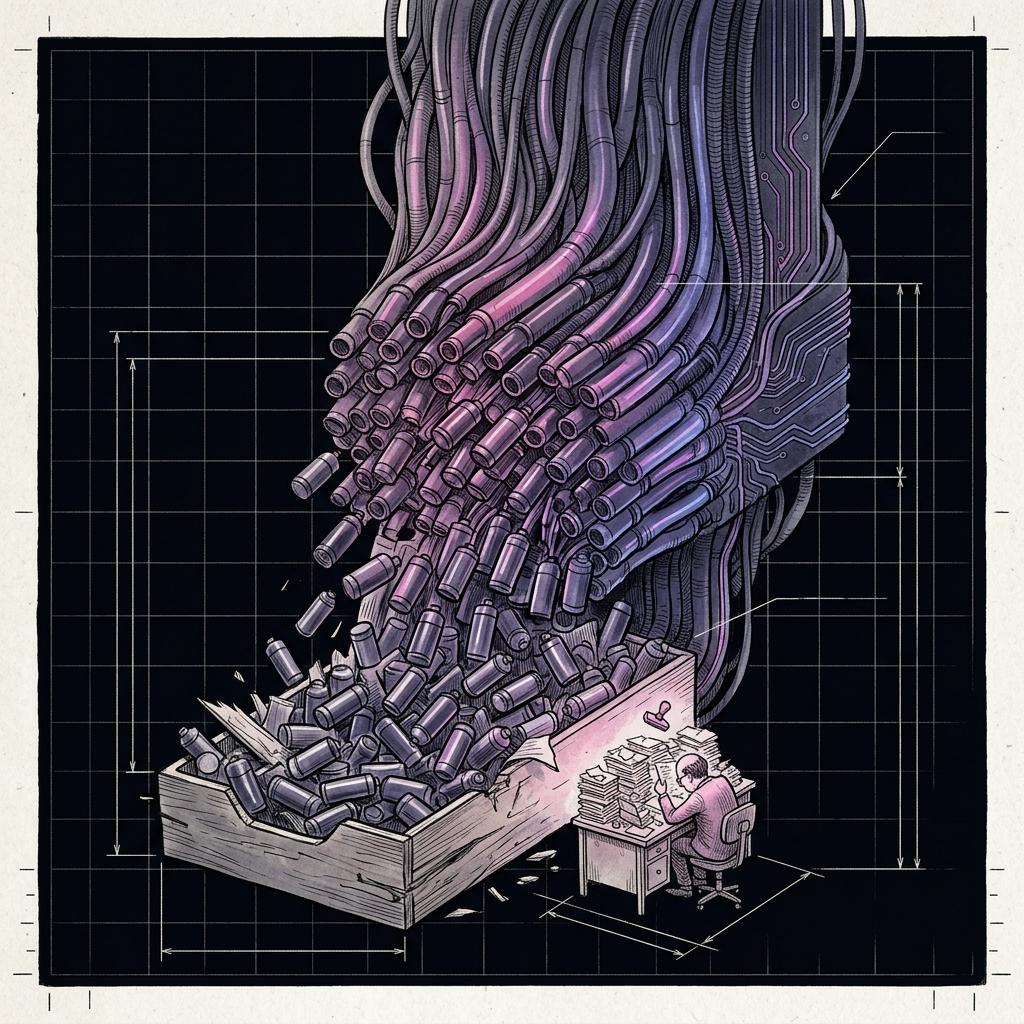
This is what happens when every decision routes through the same door. It does not matter how fast the model is. It does not matter that Anthropic just collapsed four round trips into one. The human queue absorbs the gain and turns it into a longer queue.
Klarna's fix was public and read as a defeat. Hire humans back. Admit the AI could not handle nuance. Move on. Read the transcripts more carefully and you see something else. Klarna had built a system with a single tier of decision authority. The agent decides, no gate exists, ship the outcome. Refunds flowed through that pipe. Account closures flowed through that pipe. Compliance disputes flowed through that pipe. All three decisions carried radically different consequences. All three were treated identically.
The reversal exposed the missing routing map.
Decision velocity is not a model metric
Talk to a vendor and they will pitch decision velocity as a benchmark. Time to first token, time to first action, actions per minute, agent tasks completed per hour. Those numbers are all real. They are all the wrong denominator.
The right denominator is end-to-end time from a business signal to a committed, reversible-if-needed action. That number has five components, and only two of them respond to model choice.
Sense. How long does it take for the signal to reach the agent at all? An inbound refund request, a fraud alert, a spike in a churn metric, an internal escalation. If your data pipes are batch, your agent is starving before the model even runs.
Decide. How long does the model take to plan? This is what benchmarks measure. In August 2026, it is close to free.
Approve. How long does the human review queue take? This is now the largest number by an order of magnitude in almost every enterprise deployment I audit.
Execute. How long does the action itself take to land in the system of record? Batch actions in computer use just cut this by a factor of three to five for browser-mediated actions. For API-mediated actions it was already quick.
Audit. How long after the fact does someone confirm it happened correctly, and what triggers a rollback? For most organizations this is a monthly QA sample, which means the loop closes weeks after the decision.
Add those five numbers. The total is your real decision velocity. Try it once and you will notice the model's contribution is a rounding error against the approval queue.
The routing map is the architecture
The companies who will actually get faster this year are the ones who redraw their approval routing before they buy another agent tool. That is the piece of work Anthropic cannot ship for you.
Palantir's Q2 2026 earnings on August 3 hinted at what this looks like at scale. Revenue grew 93% year over year, US commercial revenue 149%, and the earnings call kept returning to a specific pattern. AIP customers were deploying agents and re-architecting the authority envelope around those agents in the same engagement. Which actions can run autonomously with post-hoc audit. Which require a synchronous human approval. Which require a two-person rule. Which cross a regulatory boundary and need documented reasoning before they can run at all.
That is the map. It is boring. It is boring because it is old work. Any organization that has ever written a delegation of authority document, a risk matrix, or a change advisory board policy has done a first pass on it. Almost none have redone that work in light of the fact that the operator on the other side of the delegation can now be a piece of software that runs 24 hours a day, seven days a week, at 400 actions a shift.
The routing map has three dimensions.
Blast radius. If this action is wrong, how many customers does it touch? A misfiled expense hits one general ledger row. A misfired pricing update hits every purchase for the next hour. These do not deserve the same gate.
Reversibility. Can you undo it inside the SLA that matters? A charge you can refund in an hour is different from an email you already sent to 40,000 people.
Regulatory class. Does the EU AI Act, HIPAA, GLBA, SOX, or a sector regulator have an opinion about whether a machine can make this decision alone? If the answer is yes, the gate is legally required and the argument is over. If the answer is no, the gate is a choice, and every choice you make against speed compounds.
A good routing map produces four buckets. Auto with logging. Auto with async review. Sync approval. No autonomy. If you cannot draw that map today for your top 50 recurring decisions, no model release will save you.
Batch actions preview the argument
The specific technical shape of the August 19 release is worth reading closely because it makes the argument for you. Before batch actions, a computer-use agent took a screenshot, proposed one click, waited for the round trip, took another screenshot, proposed the next click. It was slow, and it was cautious. Every step was a natural place to insert a human review.
After batch actions, a full micro-task (open a file, extract a value, drop it in a doc, save) happens in one server call. There is no in-between moment where a human can wedge a review in. The atomic unit of oversight is now the whole task. The click no longer counts as a decision.
That is a design choice. Anthropic is telling you that the useful granularity of human oversight has moved up. If you were counting on click-level approvals as your safety layer, that layer is gone. The safety has to move up the stack to task admission, task audit, or task rollback.
Every organization running an agent tool has to redecide, this quarter, at what altitude oversight applies. Do it at the click level and you get the rubber-stamp failure. Do it at the task level and you have to define what a task is, what its blast radius is, and what the audit trail must contain. That second option is real work. It also produces real velocity.
Increasing decision velocity with AI is a distribution problem
If the model is fast and the human queue is slow, you get faster by distributing the decisions across policy tiers. The word to hold onto is distribute. Delegation stops scaling long before the volume gets interesting.
Delegation is one-to-one. A reviewer approves an agent's proposal. That reviewer is a fixed unit of throughput. Add more agents, hire more reviewers. The ratio stays.
Distribution is one-to-many. A policy encodes the class of decisions an agent can take without any reviewer. Another policy names the review pool, the SLA, and the escalation. A third names the actions that require synchronous approval from a specific role. The reviewers stop reviewing individual actions. They review the policies that govern classes of action, and they audit samples.
This is how large-scale trading desks have run for decades. It is how airline dispatch runs. It is how a bank's transaction fraud system runs. The idea is old. What is new is that any operating company can now write software agents that behave like traders, dispatchers, or fraud analysts, and the org structure required to supervise them looks like the one those industries figured out under earlier technology.
The place I see this go wrong most often is a company that already has a review board (change advisory, compliance council, procurement committee) and simply adds the AI agent's proposed actions to the existing agenda. The board meets weekly. The agent proposes 400 actions a day. The math does not work. The board is unchanged. The agent gets bottlenecked at the door. The vendor gets blamed for slow adoption. Everyone loses.
The vendor cannot draw your map
The tempting move is to buy a product that promises to draw the routing map for you. Several exist. Some come from the identity vendors (Okta, Auth0), some from the observability side (Datadog, LangSmith), some from the agent platform vendors themselves. They will sell you a policy engine, a review queue UI, a metrics dashboard, and an integration story.
Use them. Do not confuse the tool with the map.
The routing map is a set of judgments about your business. Only you know which customer segment is the one where a wrong refund becomes a public incident. Only you know which product line has a regulator watching this quarter. Only you know which of your systems of record has a rollback path and which requires a manual database intervention. A vendor's policy engine will let you express any map you want. It cannot tell you which map to draw.
This is the single largest blind spot in the AI budgets of Fortune 1000 companies right now. The line item for models is meaningful. The line item for agent platforms is meaningful. The line item for the redesign of the authority envelope is often zero. That is the line item that decides whether the other two produce a return.
What the next six weeks will decide
The Anthropic GA on August 19 will land unevenly. Some organizations will treat it as a version bump and see modest gains. Some will treat it as the trigger for a full redesign of how they route decisions, and by December they will be closing loops in seconds while their competitors are still pulling weekly reports.
The gap between those two outcomes will not close later. It will widen. Every routing map that gets written now becomes an operating asset that shapes how the next round of agent behavior gets governed inside that specific business. The audit trail from your bucketed decisions is a corpus. The corpus is proprietary. Late movers cannot buy it back.
That is the reason to move this quarter. Waiting a year cedes the compounding. Decision velocity compounds because the company that closes its loops in seconds gets more loop reps than the company that closes them in days, and each rep improves the routing itself. Small early gaps become large late ones.
Why architecting this is the work
Buying an agent platform is the easy part. Every major vendor now ships one and the pricing is converging. The hard part is looking at your actual decision flows, from the moment a signal arrives to the moment an action is committed, and asking at every hop who is deciding, why they are deciding, and whether their decision is a policy that can run in software or a judgment that a human has to hold.
That work sits outside any tool. A systems integrator with a slide deck cannot hand it off in six weeks. It has to be done by people who understand your business, your regulatory posture, your customer promise, and the current state of what AI agents can and cannot reliably do at the task boundary. That combination of skills is rare in most organizations because it did not need to exist until a few months ago.
Agor AI Advisory does this work with operators. We map the actual decisions in your business. We assign them to routing buckets. We design the oversight altitude for each bucket. We pick the agent platform and the identity layer that fit. We stand up the audit and rollback paths that let you go fast without losing the ability to say what happened. We do it with your team, so the map is yours when we leave. We ship in weeks. The Anthropic release on August 19 collapsed a technical bottleneck. The organizational one is still yours to move, and it will not wait for you.
Sources
- Anthropic Makes AI Agent Tools Production-Ready, EnterpriseDNA, August 2026
- Computer use tool, Claude Platform Docs
- Palantir (PLTR) earnings Q2 2026, CNBC, August 3, 2026
- How Klarna's AI Agent Strategy Backfired But Became A Useful Lesson, Forbes, July 16, 2026
- Human-in-the-Loop: A 2026 Guide to AI Oversight, Strata.io
- The Real Bottleneck in Agentic AI Is Not the Model, It Is the Handoff, Robotics Tomorrow, July 2026