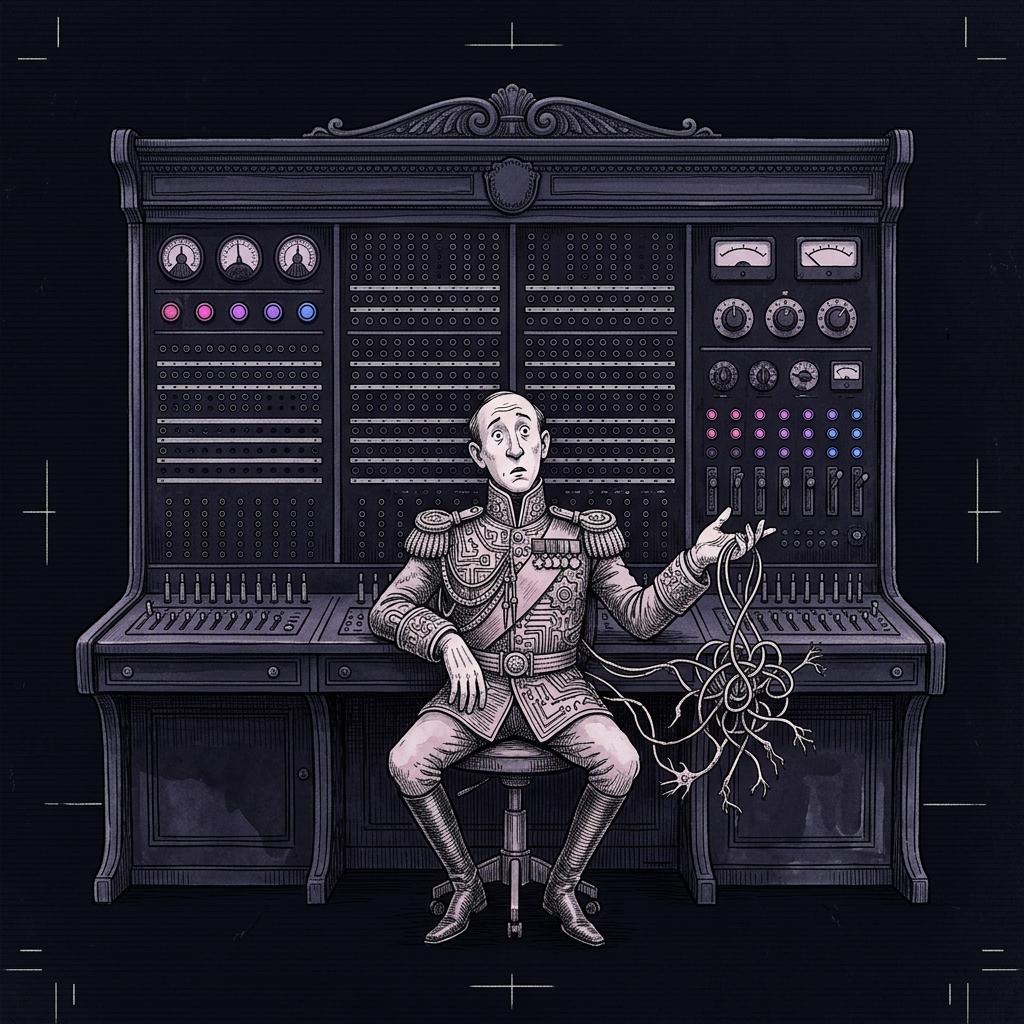
On August 12, 2026, New York Life named Zhen Zhao its first Chief AI Officer. Zhao arrived from Chubb, where he had run the AI Platform group as SVP and Global Head. The press release did what press releases do. It framed the appointment as leadership and commitment. What it did not describe was a single permission Zhao actually holds, a single agent that reports through him, or a single dollar of inference budget that flows past his signature.
That is the shape of the year. IBM's May 2026 CEO Study surveyed 2,000 chief executives across 33 geographies. Seventy-six percent of their organizations now have a CAIO. Twelve months earlier the number was twenty-six. Fifty points of adoption in a year is a stampede.
The stampede is toward a title. A title is not an operating model.
The Chart Is the Cheap Part
Designing an AI operating model has become the phrase every board uses this year, and the phrase almost every board misreads. Search interest for the term has climbed alongside the CAIO appointments, and the outputs look the same across industries. A named executive. A reporting line. A council. A quarterly review. Sometimes an "agent factory" branded like a training gym.
Then the agents ship. And in most companies the wiring under the chart is nothing.
Databricks published a numbers-heavy report through its Opsin Labs group finding that sixty percent of enterprise AI agents in production are over-permissioned. Over-permissioned means the agent can reach data, systems, or actions that its actual task does not require. It is the digital equivalent of giving every new hire root access to production because HR forgot to ask what the job needed. Gartner projects that forty percent of enterprises will demote or decommission autonomous agents by 2027 for governance failures found only after a production incident. The vendor community frames this politely as a maturity gap. It is a wiring failure. Wiring failures do not fix themselves. They compound. Every additional agent shipped into an ungoverned permission plane raises the blast radius of the next incident, because a shared account, a copied access control list, and an undocumented tool call are the three things that turn a small mistake into a headline.
Twenty-one percent of organizations report a mature governance model for autonomous agents. Sixty-two percent are actively piloting. Twenty-three percent have scaled anything into production. Read the shape of those numbers together and the picture is stark. Companies are appointing officers, running pilots, and then getting stuck the moment the pilot has to answer to real permissions, real budgets, and real escalation paths.
The chart was drawn. The wiring was not.
The Four Planes of an AI Operating Model
An AI operating model is a control plane. Titles and org diagrams are downstream from it.
In human organizations the control plane is invisible because it evolved. Employment contracts, expense policies, delegation of authority matrices, code of conduct, incident response playbooks. All of this took decades to accrete, and most of it is enforced by tacit consent and legal liability rather than by any explicit runtime.
Agents have none of that. Every part of it has to be drawn. Four planes, all of them.
Identity
Every agent needs a distinct principal identity, not a shared service account. That is Databricks' first recommendation and it is the thing companies skip first. Shared service accounts collapse three questions into one and answer none of them. Who did this. On whose behalf. Under what authority.
When an agent has its own identity, an audit trail is possible. When several agents share one, an audit trail is fiction. Every action in the log reads as if the same faceless bot did it. If a decommission is required, retiring one agent means locking every other agent that shared the credential, which usually means the credential does not get rotated.
The New York Life press release did not mention identity because a press release does not have to. The operating model does.
Permission
Sixty percent over-permissioned is systemic. It reflects how permission gets granted in most enterprises. Engineers copy the permission set of an adjacent service, which was itself copied from a legacy account that once needed database admin because a migration script asked for it in 2019. Nobody remembers.
Scoped permission means the agent sees the specific tables, columns, and documents its task requires, and nothing else. It means write access is separately granted and separately audited. It means outbound tool calls (web search, email, calendar, procurement) are enumerated in a policy and blocked outside it. Anthropic shipped exactly this pattern in August 2026 for its Managed Agents product, letting an operator set allowed_domains and blocked_domains on the web_search and web_fetch tools. The infrastructure to draw the permission plane is arriving. Most companies are not using it.
Budget
Every agent burns tokens. Tokens have a price. Anthropic made Claude Sonnet 5's promotional pricing permanent on August 10, 2026, at two dollars per million input tokens and ten dollars per million output tokens. Those numbers look small until they are multiplied by a fleet.
An operating model that does not price inference by agent, by task, and by call cannot control cost, cannot control quality, and cannot force decisions between escalation and refusal. In practice most companies push the aggregate cloud bill through a single line item and hope. When the CFO asks who authorized ninety thousand dollars of API spend last month, nobody in the room can point at the loop that produced it. The wiring is not there.
An inference budget is a governance artifact. A budget that binds every agent to a monthly ceiling, escalates to a human when the ceiling is close, and refuses actions past it is the single most powerful lever on quality and safety a company has. Companies that treat inference cost as an infrastructure line item skip the plane entirely. Then the CFO asks a question the operating model cannot answer.
Escalation
Every autonomous action has three possible answers. Do it. Refuse it. Ask a human. The third answer is where operating models live or die.
Escalation is a promise about latency. If the agent asks a human for a decision, the human has to arrive within a bounded window, or the agent has to know what to do while it waits. Anthropic's Admin API for Claude Enterprise organizations, launched in August 2026, gives operators programmable control over members, invites, groups, and custom roles. That is the machinery for encoding "who gets paged when the agent asks" as code, rather than as a Slack channel someone forgot to staff on a Friday. It lets an on-call rotation actually be enforced against agent traffic, and it lets a human's absence produce a defined fallback: refuse, defer, or downgrade to a safer action. A pager without a schedule is a suggestion. A schedule without a policy is a bystander. An operating model has both, wired to the agent.
Most escalation paths in production look like neither. The agent stops. It sends a message. Nobody replies for six hours. By the time a human answers, the request is stale, the customer has churned, and the agent has learned that stopping was worse than doing something wrong. The next time, it does not stop. This is the moment an operating model that named an officer and forgot to specify a shift produces its first casualty.
Why the Human Chart Lies to You
Human org charts encode reporting relationships. Operating models encode decision boundaries. Those are different objects.
A reporting relationship says who conducts your annual review. A decision boundary says which decisions you may make, which you must escalate, and which you may not make at all, ever, on any authority. In human organizations the two get conflated because they usually align. Your manager is the person from whom you take direction, and the delegation limits are inherited from the org level.
That alignment fails immediately for agents. An agent's "manager" is a piece of code that spawned it. That code has no accountability, no signature, no memory of authority. The decision boundary has to be encoded elsewhere or it does not exist. The org chart approach fails because it assumes the boundary comes with the reporting line. It does not.
BCG published in July 2026 what it calls an Enterprise AI Control Plane, describing exactly this gap. Identity, policy enforcement, visibility, and governance unified in one place because they were never unified anywhere before. The name is new. The pattern is a hundred years old. It is how banks structure trading desks. It is how airlines structure cockpits. It is how any regulated activity separates who does the work from who authorizes it from who watches it. AI is now regulated activity. The control plane is where the operating model lives.
The Chief AI Officer Is a Symptom
Zhen Zhao's appointment is not the problem. The seventy-six percent of companies making similar appointments this year are not the problem. The problem is that in most of those companies the appointment is the whole intervention. The board wanted a name for the annual report. The CEO wanted a phone number to call when the press asks. The CAIO wanted a title. Everyone got what they wanted. The wiring was never on anyone's list.
PwC frames the CAIO role, correctly, as bridging technical possibility with business outcome, partnering with the CTO, CIO, CDO, CISO, and CLO. That description is accurate and it hides the real work. Bridging requires bridges. A bridge is a structure. Structures require design.
The most striking split in the CAIO population as of mid-2026 is between what analysts now call the Platform CAIO and the Strategy CAIO. The Platform CAIO reports to the CTO and owns infrastructure, data, and engineering. The Strategy CAIO reports to the CEO and owns value, governance, and workforce. Both flavors exist. Both are legitimate. Neither, on its own, is an operating model. The Platform CAIO without governance authority ships wired-up agents into ungoverned business functions. The Strategy CAIO without infrastructure control writes policies that never touch the runtime. The chart with only one of them is worse than useless. It creates the illusion of coverage.
An operating model requires both roles, or one role with both authorities, plus a control plane that binds them. Very few companies have any of the three. The ones that do treat the split as a design decision rather than a hiring accident. They write the RACI for the two officers before they hire either. They fund the platform team that owns the control plane before they promote the strategy officer whose credibility depends on it.
The Four Questions Before You Appoint Anyone
Before a company names its first CAIO, or its next one, four questions have to be answered on paper, and answered specifically, not aspirationally.
Who signs for an agent's identity, and what happens the day that agent is retired. If the answer involves rotating a shared credential across ten other services, the identity plane has not been drawn.
What is the smallest permission set every agent must hold, and who audits the delta between what an agent has and what its task requires. If the answer is that nobody audits, the permission plane has not been drawn.
What is the monthly inference budget by function, and what does the system do when a function hits ninety percent of its ceiling. If the answer is that the CFO reads the AWS bill and complains at the end of the quarter, the budget plane has not been drawn.
Which decisions require human approval, who is on the pager for those approvals, and what is the response-time contract. If the answer is that the agent posts to a Slack channel and hopes, the escalation plane has not been drawn.
If any of the four is missing, the operating model does not exist. The CAIO is a communication choice, and a legitimate one, but the company remains exposed. Naming without wiring is a decision to look organized while remaining fragile.
The Wiring Is on the Shelf
August 2026 was the month enterprise-grade wiring stopped being a bespoke build. Anthropic made Sonnet 5 pricing permanent, launched the Admin API for Enterprise organizations, and shipped per-tool domain restrictions for Managed Agents. Databricks published a full governance guide with recommended identity, scoping, and audit patterns. BCG released the Enterprise AI Control Plane framework. IBM, Oracle, and Google Cloud all now publish detailed reference architectures for agent identity and policy enforcement.
The materials are on the shelf. Companies keep buying titles instead.
That gap is the market opportunity. It is also the risk. A company that appoints a CAIO in Q3 and ships forty agents in Q4 without drawing the four planes will have a governance incident in Q1 or Q2. Gartner's forty-percent-by-2027 decommission projection points at wiring quality. The models will work. The wiring will fail. The agents will be pulled.
Twenty-three percent of enterprises have scaled agents into production. The other seventy-seven percent are stuck at the pilot boundary. What separates the two groups is not access to models. Sonnet 5 costs the same for everyone. What separates them is whether they drew the operating model before they drew the org chart.
The Architecture Beneath the Title
Designing an AI operating model is architecture work. It is the work of specifying identity, permission, budget, and escalation as code, as policy, and as contract, before any agent ships into a business function that customers, regulators, or auditors can touch. It is the work of binding the CAIO's authority to the runtime. It is the work of drawing a control plane that a machine actually respects.
This work is not a slide. It cannot be produced by a strategy consultancy that hands over a diagram and leaves. The four planes have to be built into the systems the company uses to make money. The identity plane has to be enforced by the identity provider. The permission plane has to be enforced by the platform. The budget plane has to be enforced by the meter. The escalation plane has to be enforced by the pager. Every one of these is engineering. Every one of them touches something the CIO already owns. Every one of them requires a partner who can write the code and set the policy at the same time.
That is where Agor AI Advisory works. In the wiring beneath the announcement. Identity per agent. Scoped permissions per task. Inference budgets per function. Escalation contracts that actually page a human. Kill switches that actually kill. Every plane, drawn, enforced, tested against real production traffic.
If you have appointed a CAIO in the last twelve months and cannot answer the four questions above, the appointment has made you visible without making you safer. Visibility without wiring is exposure.
Sources
- August 2026: AI is an enterprise operating model, LinkedIn Pulse
- Enterprise AI Control Plane: The CIO's Guide to Governing and Accelerating AI Agents, BCG
- What's important to the chief AI officer and AI leaders in 2026, PwC
- Agents are now on the org chart. Who is managing them?, KPMG, June 2026
- 2026 State of AI Agents: Enterprise Insights on Building AI, Databricks
- Why Agent Governance Is the Real Work in August 2026, Olmec Dynamics
- Introducing Claude Sonnet 5, Anthropic
- Claude Developer Platform Updates by Anthropic, August 2026