On July 1, 2026, Microsoft raised the base price of a Microsoft 365 E5 seat by roughly a third. Copilot enterprise sits on top at $30 more per seat per month. Do the arithmetic on a 10,000 seat organization and the annual AI line item now runs past $10 million before a single Copilot Studio agent gets deployed. Existing customers keep their old rate until their next renewal falls after that date. If your contract turns over in Q4 2026, that is a real number showing up in your budget conversations right now.
Two days later, Palantir printed its Q2 earnings. U.S. commercial revenue grew 149 percent year over year to $764 million. Seventy three deals worth $10 million or more each closed in the quarter. The company that built its business selling a middle layer to spies and manufacturers just posted growth that looks like a hyperscaler in 2018.
On August 5, the Department of Defense granted Salesforce's Agentforce 360 approval to operate at Impact Level 5, meaning the platform can handle Controlled Unclassified Information. Agentforce ARR crossed $1.2 billion, up 205 percent.
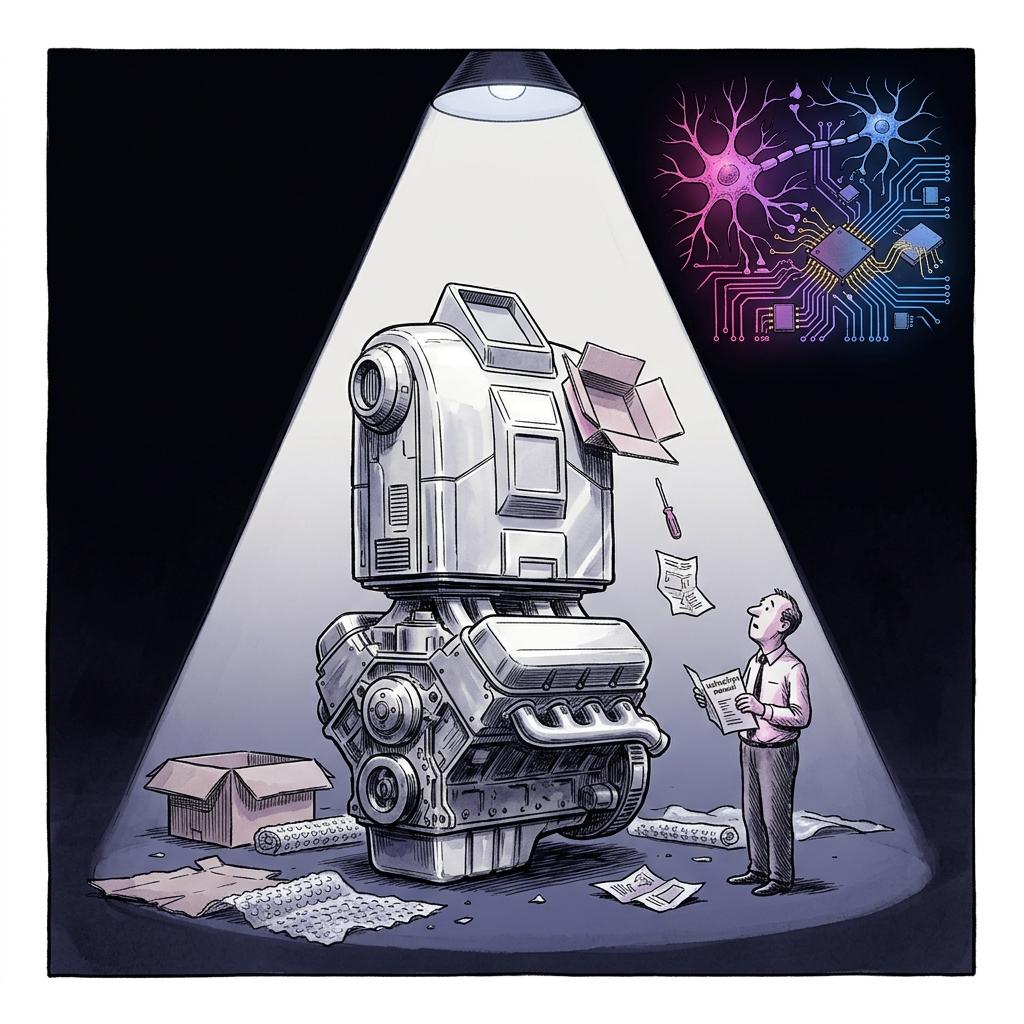
Read those three numbers together and the question of when to build vs buy AI is no longer a binary. The question is which layer of the stack you own, which layer you rent, and why the vendors have priced the rent to compound.
The wrong question
The build vs buy debate got framed as a binary the day the first Copilot license was signed. Either you write your own code and train your own models, or you pay Microsoft, Salesforce, ServiceNow, or one of a hundred other vendors and let them do it. Consultants drew the two by two matrix. Boards approved the vendor list. Procurement teams tuned SOWs.
The framing is wrong because the stack has three layers and the vendors sell two of them.
The three layers
At the bottom you have the model. Weights, tokens, an API. Anthropic sells Claude Opus 5 at $5 per million input and $25 per million output tokens as of the July 24, 2026 release. Google, OpenAI, xAI, Meta, Mistral, and a growing catalog of hosted open weights sit on the same shelf. Prices are visible, interfaces are converging, and you can swap one for another with a router and a week of eval work. This is a commodity floor. Buy it.
At the top you have the agent. A user facing surface: chat, copilot, workflow builder, agentic runner. Microsoft, Salesforce, ServiceNow, Zendesk, and a dozen coding IDEs compete here. Their ARR numbers are the ones you see in the trade press. Their pricing looks fixed until you renew.
Between them sits the layer that never makes the vendor pitch deck. Call it the judgment layer. It holds the routing rules that decide which model runs which query. The evaluation harness that catches quality regressions before customers do. The memory system that lets the assistant remember the last conversation without leaking the wrong one to the wrong user. The escalation policy that hands the hard call to a human before the call goes bad. The audit trail that tells your regulator what the model saw and why it said what it said. The context ingestion pipeline that turns your product docs and CRM notes into the substrate the assistant actually reasons over.
Vendors will happily sell you components labeled with those words. None of them ship judgment.
The reason is structural. Judgment is the layer that encodes what your business is, what your customers expect, what your regulators require, what your escalation matrix looks like, what your brand tolerates, and what your competitive advantage actually is. A vendor cannot ship that because a vendor sells to the median customer, and there is no median customer.
Klarna is the case study
Klarna went out in February 2024 with a headline number: an OpenAI powered assistant doing the work of 700 customer service agents inside its first month. The tech press covered it as an efficiency win. Executive teams around the world put "Klarna" on the slide about what AI could do to a service org.
In 2026 the company has been quietly rehiring humans and rebuilding a hybrid workflow. CEO Sebastian Siemiatkowski told Bloomberg the AI-first path was not the right one, and that customers, on complicated calls, would rather speak to a person.
Read the reversal carefully. Klarna did not swap OpenAI for Anthropic. It did not rip out the assistant. It hired back the escalation layer. The models were fine. The buy was fine. What did not exist was a judgment layer that could tell a $9 refund query from a bereavement dispute and route accordingly, that could learn from every mishandled call, that could hand a case cleanly to an agent with the full context, that could measure customer satisfaction on the outcome and adjust the routing next week.
You cannot buy that off the shelf because it lives in your customer data, your escalation matrix, your regulatory boundaries, your brand voice, and your dispute categories. Every enterprise trying to buy its way past the middle layer discovers this on the same schedule. The pilot works. Production breaks. The number that mattered in the press release does not survive quarterly review.
The MIT number
MIT's Project NANDA published a report in July 2025 finding that 95 percent of generative AI pilots produced no measurable business return, despite $30 to $40 billion in enterprise spend. Executives blame regulation and model quality. The researchers found the failure sits in integration: brittle workflows, weak contextual learning, misalignment with how the actual job gets done.
Translate that into stack language. The 5 percent that worked built their own judgment layer on top of vendor primitives. The 95 percent bought a platform and hoped judgment would come in the box.
Why Palantir is winning
Palantir's Q2 2026 U.S. commercial number, 149 percent year over year, is the market voting on the opposite proposition. Foundry and AIP are, at their core, an opinionated middle layer. Ontology modeling, data integration, evaluation, governance, agentic orchestration on top of your own data, human in the loop workflows, audit trails, and deployment tooling. The model underneath swaps out. The user interface on top varies by function. What Palantir sells is the compounding middle.
The seventy three deals over $10 million each did not close because Palantir has better models than OpenAI or Anthropic. They closed because a global manufacturer or a large hospital system looked at the alternatives, ran the arithmetic on what it costs to hire the engineering team that could build the same judgment layer in house, and wrote the check.
Two lessons sit inside that. The middle layer is where the money is. And even a company willing to build the middle in principle may rationally rent a version of it from someone whose full time job is compounding it. What that same company cannot rationally do is skip the middle entirely and expect the model plus the agent surface to deliver a business outcome.
The Copilot tax and the second renewal
Microsoft's July 1 price move is worth staring at because it makes explicit what enterprise buyers rarely price into the initial contract. A vendor that owns the top of your stack owns your renewal. The base seat went up by about a third. The AI add on stayed level, framed as continuity. But the total bill compounded, and the vendor picked when.
Zapier's 2026 enterprise survey found 81 percent of leaders concerned about AI vendor dependency and only 6 percent believing they could switch without material business disruption. That gap between concern and capability is the vendor's pricing power. If you cannot leave, the renewal price finds its equilibrium at whatever the vendor decides to bill.
The Copilot tax is not unique to Microsoft. Every vendor at the top of the stack has the same option: raise the base, hold the AI SKU level, and let the compounded bill do the work. Salesforce, ServiceNow, Adobe, Oracle, and every SaaS company adding an "AI edition" runs the same play. The build vs buy calculus that penciled out for a three year contract at 2024 prices does not pencil the same way at 2027 renewal prices, because the buy price you signed for is not the buy price you will renew at.
What building the middle actually looks like
The judgment layer is a set of concrete engineering artifacts, each boring alone, indispensable together.
A router that picks the model per query. Send most traffic to the cheap Haiku tier at $1 in and $5 out per million tokens, escalate to Claude Opus 5 or a GPT class model when the query needs it, fall over gracefully when the primary vendor rate limits or degrades. This is a two week build. It is also the difference between an AI bill that grows sub-linearly with usage and one that grows linearly and then some.
An evaluation harness that runs every model update, every prompt change, and every workflow revision against a fixed suite of your real questions with your real data. Not the vendor's benchmark. Your benchmark. This is what catches the silent regression that turns an 80 percent accurate assistant into a 65 percent accurate one after a model refresh. Without it, the day the vendor ships an update is the day your production quality drops, and you find out from customers.
A memory system that stores what happened, indexed by user, tenant, time, and topic. Long enough to remember the last conversation. Compartmented enough to keep tenant A's data out of tenant B's context window. Governed enough to expire the fields your privacy policy says will expire.
An escalation policy encoded in code, not in a Confluence page. When the model gives an answer with confidence below a threshold, when the customer says a phrase from a defined list, when the case involves a value above a threshold, when the topic touches medical or legal or financial advice: hand off to a human, with the full context, in under a minute.
An audit log that captures the prompt, the retrieved context, the tool calls, the model output, and the human review, per request, retrievable per case, defensible in front of a regulator or a litigator.
A context ingestion pipeline that keeps the assistant's reference material current: product changelog, pricing sheet, policy updates, customer history. Ten day old context is often worse than no context, because it reads like an authoritative wrong answer.
None of that is exotic. All of it is table stakes. All of it is yours.
The right build vs buy AI decision, layer by layer
Every serious build vs buy AI conversation has to stop treating the stack as a single decision and start pricing each layer separately.
At the model layer, subscribe. The model market is competitive, the interfaces are converging, and the switching cost is manageable if you built a router. Anyone selling you a private, single model, deep integration deal at the model layer is selling you a lock-in disguised as a partnership.
At the interface layer, buy carefully. Use vendor agents and copilots where the workflow is truly generic (calendar, email drafting, code completion, standard CRM notes) and the vendor will still exist and behave reasonably at your next renewal. Assume the price will go up. Negotiate a ceiling. Assume you will want to walk. Design the exit before you sign the entry.
At the judgment layer, build. Every time. This is the layer that captures your competitive advantage, your regulatory posture, your customer knowledge, and your ability to swap the layers below when a better one appears. If you rent the judgment layer, you have rented your differentiation from a company whose incentives are not aligned with yours.
The 5 percent of pilots that MIT found working built at the middle. The 95 percent that failed skipped the middle. Palantir sells the middle by hand and gets 149 percent growth for the effort. Microsoft, Salesforce, and every SaaS incumbent is trying to convince you the middle comes with the license.
It does not.
The talent question
Building the middle takes a small engineering team, not an army. Two to four senior engineers with real AI experience can stand up the router, the eval harness, the memory system, and the audit log in a quarter. Adding the domain specific workflow logic on top is another quarter of embedded work with the operators who actually own the process. A hundred person AI transformation office is unnecessary, and in most cases actively harms the outcome by pushing the work away from the operators who know where the escalations should trigger.
The talent that can do this is scarce and expensive. It is also cheaper than the fully loaded cost of a failed Copilot rollout, cheaper than the compound renewal price hike, and cheaper than the reputational cost of a Klarna style reversal.
The moat you can only build once
There is a compounding property to the middle layer that neither the model layer nor the interface layer has. Every conversation your assistant handles, every escalation your human agents resolve, every eval that gets added, every audit trail that gets reviewed: those become training data, prompt improvements, routing tweaks, memory entries. The layer gets better as it runs. The vendor's model gets better on the vendor's schedule for the vendor's median customer. Yours gets better on yours, for you.
Two years from now, an enterprise that built the middle in 2026 has an assistant that knows its business, its customers, its regulators, and its failure modes. An enterprise that bought the middle from a vendor has a subscription that renewed at 40 percent more, an assistant that knows the vendor's median customer, and a switching cost that pins it in place. The gap between those two positions widens every quarter, because the compounding is in the direction the owner controls.
The window to build this is now, while the models are commoditizing and the vendors have not yet finished pricing you into their ceilings. Every quarter of delay is a quarter of vendor lock-in accruing and a quarter of your competitors' judgment layers compounding.
Architect the layer that decides whether the buy works
Build vs buy AI is a trap when it stays a binary. Answered layer by layer, it becomes a strategy. Buy the model. Rent the interface with an exit you can actually take. Build the middle, because the middle is the enterprise. The Klarna reversal, the MIT 95 percent number, the Palantir revenue curve, and the Microsoft renewal squeeze all point at the same finding: judgment does not come in the box, and the companies that discover this in production are the ones that already lost the quarter.
Architecting the judgment layer is the specific work Agor AI Advisory does. We build the routers, the eval harnesses, the memory systems, the escalation policies, the audit trails, the context pipelines, and the human in the loop workflows that turn a vendor pilot into a durable capability. We do not sell you a platform. We help you build the layer that makes every platform you buy work harder and every vendor you renew with negotiate against a real alternative.
If you have Copilot licenses renewing in the next two quarters, an Agentforce contract on the desk, a stalled pilot to explain to the board, or a "why is our AI not working" question that will not go away: this is the conversation to have now, before the next renewal cycle prices the middle out of reach.
Sources
- MIT report: 95% of generative AI pilots at companies are failing, Yahoo Finance, August 18, 2025
- Klarna Reverses AI Customer Service Replacement, Tech.co, 2026
- Microsoft 365 Price Increase July 2026: Every SKU Listed, On-Site Technology, July 2026
- Salesforce previews plans to deliver newly authorized 'AI agents' across DOD, DefenseScoop, August 5, 2026
- Palantir vs. Salesforce: Two Visions of Enterprise AI, One Clear Winner, 24/7 Wall St., August 9, 2026
- Claude Opus 5: Benchmarks, Pricing, and Full Guide, Coursiv, July 2026
- Enterprise AI Vendor Lock-In: The Switching Cost Problem No One Is Measuring, Vaasblock Research, 2026