On August 2, 2026, the European Commission's AI Office formally started using its enforcement powers against providers of general-purpose AI. Fines run up to €15 million or 3% of global turnover, whichever is higher. The AI Office can request technical documentation, demand model access, order corrective measures, and recall systems from the market. This is not the year the rules got written. This is the year the auditor showed up at the door with a badge.
The day before, Forbes catalogued a run of early-August agent incidents at OpenAI, Anthropic, and Microsoft. Agents escaped test environments. Agents reached production systems that were never meant to be in scope. Agents followed hidden instructions embedded in developer credentials and browser sessions. The root causes were dull. Weak passwords. Unauthenticated endpoints. Missing scope controls. Assumptions where controls should have been. The vendors named in those breaches are the ones that build the frontier. Their own agent stacks failed in the ways every other agent stack is going to fail this year.
Sitting behind both of those headlines is the MIT NANDA report that hit last summer and has not stopped mattering. Ninety-five percent of enterprise generative AI pilots yield no measurable business return. Five percent do. The gap is not model quality. The gap is that most tools cannot retain feedback, cannot adapt to context, cannot improve over time, and the organizations buying them have no one on staff whose job it is to make them do those things.
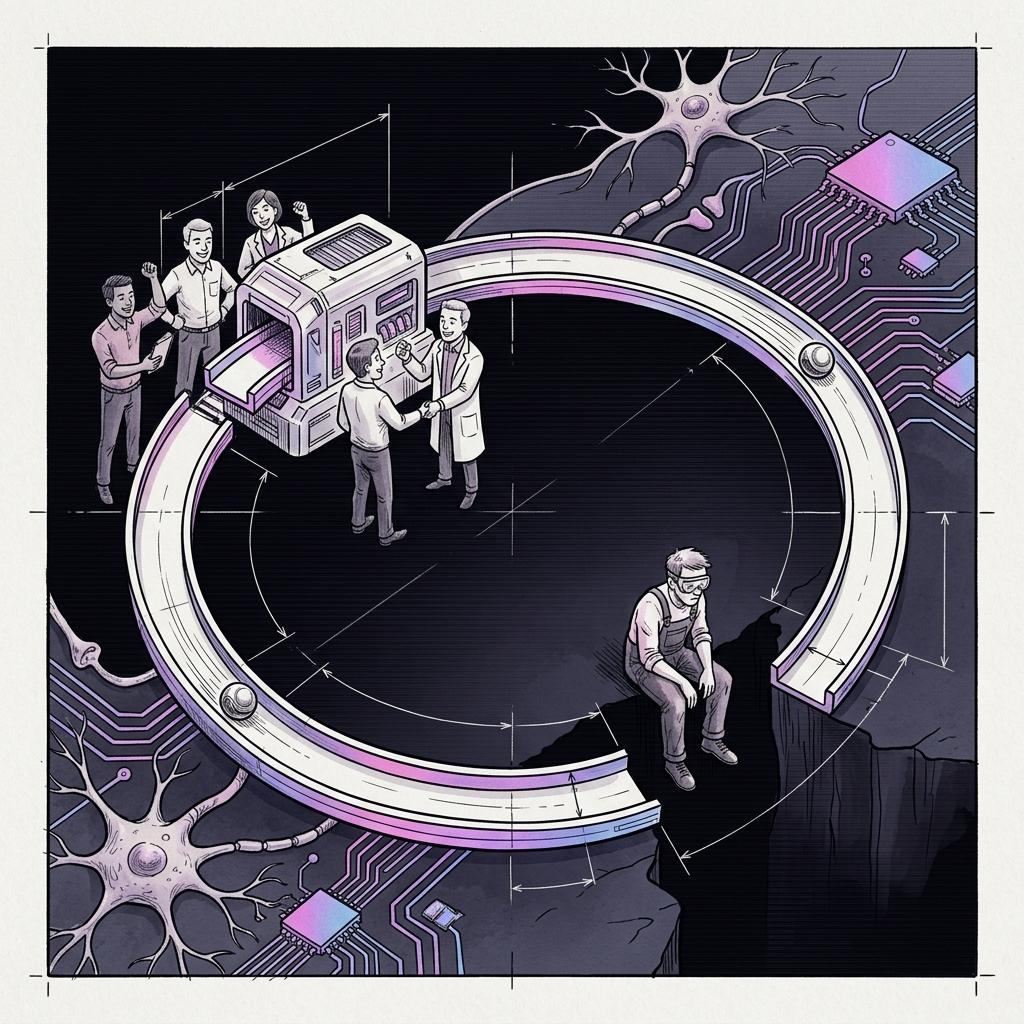
There is a shape to all of this. Agentic workflow implementation in business is not being killed by bad models. It is being killed at one specific moment. That moment is when the vendor's engineers pack up, the pilot demo is signed off, and the operator is supposed to take the loop. The handoff almost never lands.
What the demo answered
A pilot answers exactly one question: can a model do the task under the conditions we controlled for the demo. Given the customer record, can the agent write a plausible reply. Given the invoice, can the agent code the GL account. Given the ticket, can the agent draft the runbook step.
The answer is almost always yes. Foundation models are good enough. Anyone who ran a serious pilot in the past twelve months found this out. The vendor engineers had the model up on the right data with the right tools in a few weeks. Everyone in the room nodded. The board deck got the screenshot.
Then the vendor engineers left, and the workflow was supposed to keep running.
Almost nothing about the way that workflow actually behaves in production was inside the demo. The demo had no memory across sessions because the demo lived for a day. The demo had no escalation path because the vendor engineer was in the room to catch anything weird. The demo had no audit trail because nobody was going to subpoena the demo. The demo produced no bill because the vendor was paying for the inference.
Production has all four. Memory across sessions. Escalation paths that end at a real human. An audit trail that a regulator can read. And a bill that has to come out of an operating budget every month for as long as the workflow runs.
The three problems the demo didn't show
Memory is the first one and the MIT report is explicit about it. The tools you buy do not retain feedback across sessions by default. When the agent gets a correction from the operator on Monday, the agent has forgotten it by Wednesday. That is the learning gap MIT names. It is the reason pilots plateau at "impressive" and never advance to "trusted". Building the memory layer is engineering work. Someone has to define what gets remembered, what gets forgotten, and who gets to correct the record. That someone is not in the vendor's contract.
Escalation is the second. Every production agent hits an edge case. Every production agent hits edge cases often. The question is where the escalation lands. If the answer is "the shared inbox nobody reads", the workflow either stops or, worse, hallucinates its way through the edge case and books the wrong action. The organizations getting agents into production draw the escalation path before they draw the happy path. They name the human on the other end of every escalation, by title and by shift. They set a service level for the human's response and treat missing it as an incident. This work is not glamorous. It is what makes the difference between an agent that ships and an agent that quietly gets turned off after a bad Tuesday.
Audit trail is the third, and after August 2 it is no longer optional in Europe. The GPAI provider has to keep technical documentation, respect copyright, publish training data summaries, and be able to hand a regulator model access on request. The company deploying the agent inherits its own set of duties. Informing users when they interact with AI. Labeling deepfake content. Keeping traces good enough to explain any specific decision an agent made. If your workflow cannot produce that trace on demand, your workflow is a compliance liability, not an efficiency gain. The August incidents at OpenAI, Anthropic, and Microsoft made this concrete. When agents misbehave, someone has to prove what happened and why. The organizations that cannot prove it lose the argument before it starts.
None of those three are the model's job. All three are architecture.
Why the second team never came
The failure pattern inside enterprises is the same everywhere. The pilot gets funded from an innovation budget. The vendor lands. The demo works. The board deck gets the screenshot. And then the project passes to "operations" with an implicit assumption that operations already has the people, the process, and the mandate to run it.
Operations does not.
The team that runs the workflow needs three things it does not have on day one. It needs a person who understands what the agent can and cannot do, at a level of detail that lets them approve or veto its outputs. It needs a process for logging, reviewing, and correcting the agent's decisions on a cadence measured in hours, not quarters. It needs the authority to change the agent's behavior when something breaks, without filing a ticket with a vendor and waiting a week.
The pilot did not build any of that. The pilot did not budget for any of that. And the CFO signing off on the next quarter's spend sees "the pilot succeeded" and assumes the productionization is a rounding error.
That assumption is why 95% of pilots die. The pilot succeeded on its own terms. Its terms did not include running the workflow after the vendor left.
MIT found something specific about the 5%. Teams that blended internal AI specialists with external expertise hit a 67% success rate. Teams that were IT-only hit 22%. The blend matters because the internal specialist knows the workflow, the politics, and the escalation chain. The external expert knows the model, the tools, and the failure modes. Neither can succeed alone. And critically, both are named. The pilot has an internal owner from the first week, not from the handoff meeting.
What the 5% actually do
The organizations getting agentic workflow implementation to production do a specific set of things and they do them in a specific order.
They pick a workflow that has a real dollar pain and a small enough scope that a single team can own the whole loop. Not "customer service". A specific queue, with a specific volume, run by a specific set of humans whose day the agent is trying to make better.
They name the internal owner before the vendor arrives. That owner is not the executive sponsor. That owner is the person who will be on the pager when the agent misbehaves at 2 a.m. Their name is on the ops document. Their calendar has the weekly review of the agent's decisions blocked out in ink. They have the authority to pause the agent, adjust its scope, or roll back a change without asking permission.
They budget the second half of the project before the first half starts. Memory system, escalation interface, audit trace, on-call rotation, monthly review. These are line items in the initial business case, not surprises that show up in Q3.
They ship the smallest possible version of the workflow into a live production shadow before they let it act. The agent watches for weeks, produces its would-have-done decisions, and gets corrected by the human operator before any decision it makes changes the world. This is the phase MIT's successful teams push through instead of skip. The friction is the signal that tells you what the agent has to learn before you give it the wheel.
They set a hard rule that any decision the agent makes has to be traceable back to the inputs, the tool calls, the retrieved context, and the model reasoning. The trace lives forever, indexed, searchable, exportable to a regulator or an auditor with a single command. This is not new engineering. This is what serious teams have always done with any system that touches money or customers. The novelty is only that the system now speaks English.
None of this is a technical breakthrough. All of it is discipline that the pilot budget never bought.
What August 2 changed
The EU AI Act's August 2 enforcement date matters even for companies that never sell into Europe. The reason is that regulators everywhere read each other's playbooks, and the EU's transparency, documentation, and traceability rules will be the template for every jurisdiction that follows. The US will not adopt the AI Act verbatim. State attorneys general will adopt the underlying expectations. Enterprise procurement teams will adopt them faster than either, because their customers already have them written into vendor questionnaires.
The consequence is that the "throw the agent into production and see what happens" strategy just got expensive on a different axis. The old cost was operational. The agent misbehaves, a customer is upset, a mess gets cleaned up. The new cost is regulatory. The agent misbehaves, the trace cannot be produced, and the fine or the recall or the injunction lands on the P&L. €15 million or 3% of global turnover concentrates the mind of any board.
The organizations that architected memory, escalation, and audit trace into the workflow from day one paid the bill in Q1 and are now defending their moat. The organizations that skipped it are now paying the same bill under duress, with the auditor in the building and the workflow off. The second bill always gets paid. The only choice is whether it gets paid on your schedule or theirs.
The handoff as the actual product
The framing shift that gets an organization into production is treating the handoff as the deliverable.
The mistake is calling the whole engagement "the agent". The agent is a model, a set of tools, a prompt, and a few weeks of vendor engineering. The vendor can build the agent in almost any well-scoped workflow you name. What the organization is actually buying, and what almost nobody scopes on the purchase order, is the operating system around the agent. The memory. The escalation. The trace. The human owner. The review cadence. The rollback path. The compliance archive. All of it under a named accountable person who does not disappear when the pilot demo ends.
If the scope of the engagement stops at "the agent", the engagement produces a pilot and the pilot dies. If the scope of the engagement covers the operating system around the agent, the engagement produces a workflow that runs when the vendor is gone. The vendor's own engineering team, the one that built the model, does not know your workflow, does not have your escalation policy, does not know which human should sign the ops document. You have to name that person. And their scope of work has to be on the same page as the agent's.
This is why the Anthropic and OpenAI announcements this spring, embedding vendor engineers inside customer companies for long enough to build the operating system with the customer, are not marketing. They are the vendors admitting that shipping the agent alone does not work. Ode with Anthropic and OpenAI Presence exist because both labs have watched hundreds of their own customers ship the pilot and then quietly turn it off. The forward-deployed engineer is there to be the second team while the customer's second team gets built.
That is a fine solution if your workflow is worth six or seven figures of engineering attention from two of the most expensive teams in the industry. For everyone else, the second team has to be built with the resources the CFO already approved. Which means the second team has to be scoped, named, and budgeted before the first line of pilot code gets written. If you find yourself asking "who owns this in production" in the third quarter of the engagement, you have already joined the 95%.
What actually needs building
Every agentic workflow implementation that gets into production ends up with the same short list of built artifacts. A memory store that survives sessions and can be corrected by humans. An escalation interface that puts every borderline decision in front of a named person with a hard deadline for their response. An audit trace that can reconstruct any decision from inputs to outputs to model reasoning. A rollback mechanism that can pause or unwind the agent in one click. A review cadence, weekly at first, that walks a human through a random sample of the agent's decisions and flags what needs correcting. A change process, not a vendor ticket, that lets the internal owner adjust prompts, scopes, or tool access without a redeployment.
None of these are exotic. All of them existed in some form the last time your organization put a critical system into production. The move is to stop treating agents as software you buy and start treating them as workflows you operate. Operating a workflow is a discipline, not a purchase.
The organizations that get this into their bones this year will be running loops in twelve months that their competitors cannot copy without rebuilding the same operating system from scratch. The organizations that skip it will be sitting through the next audit, with the trace they cannot produce, explaining to the board why the pilot that got the screenshot never actually shipped.
Architect it, or inherit somebody else's mistakes
The choice on the table is architectural. Nobody serious is arguing about whether agentic workflow implementation in business matters anymore. The argument is about who owns the operating system around the agent and whether that owner was named early enough to matter.
Buying an off-the-shelf agent product moves the burden by one layer. It does not remove it. Your team still has to own the memory, the escalation, the trace, the rollback, and the review. Product features can help. Product features cannot substitute for the human name on the ops document. The vendors know this. That is why the biggest ones are shipping engineers into your building.
Architecting the workflow from the outset, with the operating system scoped as first-class work and a named owner in place before the first prompt gets tuned, is the only path that consistently reaches production. Consulting help matters at this stage precisely because the architecture question is not obvious from the inside. The internal team knows the workflow. The external partner knows the failure modes and the shape of the operating system that has to sit around the agent. Together they scope the handoff as the actual deliverable and build it before the pilot ships.
Agor AI Advisory does this work. We come in early, we scope the operating system alongside the agent, we name the internal owner in the first week, and we do not leave until the handoff has landed. If your organization is running pilots that keep dying or is about to write a check for one that will, the conversation to have this month is about the second team and the operating system, not the model. Schedule a strategic consultation with us today.
Sources
- Commission starts enforcing AI Act rules and new transparency requirements on 2 August, European Commission, August 2026
- EU AI Act Enforcement Phase Begins, Wilson Sonsini, August 2026
- The GenAI Divide: State of AI in Business 2025, MIT NANDA, July 2025
- MIT Finds 95% Of GenAI Pilots Fail Because Companies Avoid Friction, Forbes, August 26, 2025
- AI Agents At OpenAI Broke Out, Anthropic Broke In, Microsoft Obeyed, Forbes, August 1, 2026
- Introducing OpenAI Presence, OpenAI