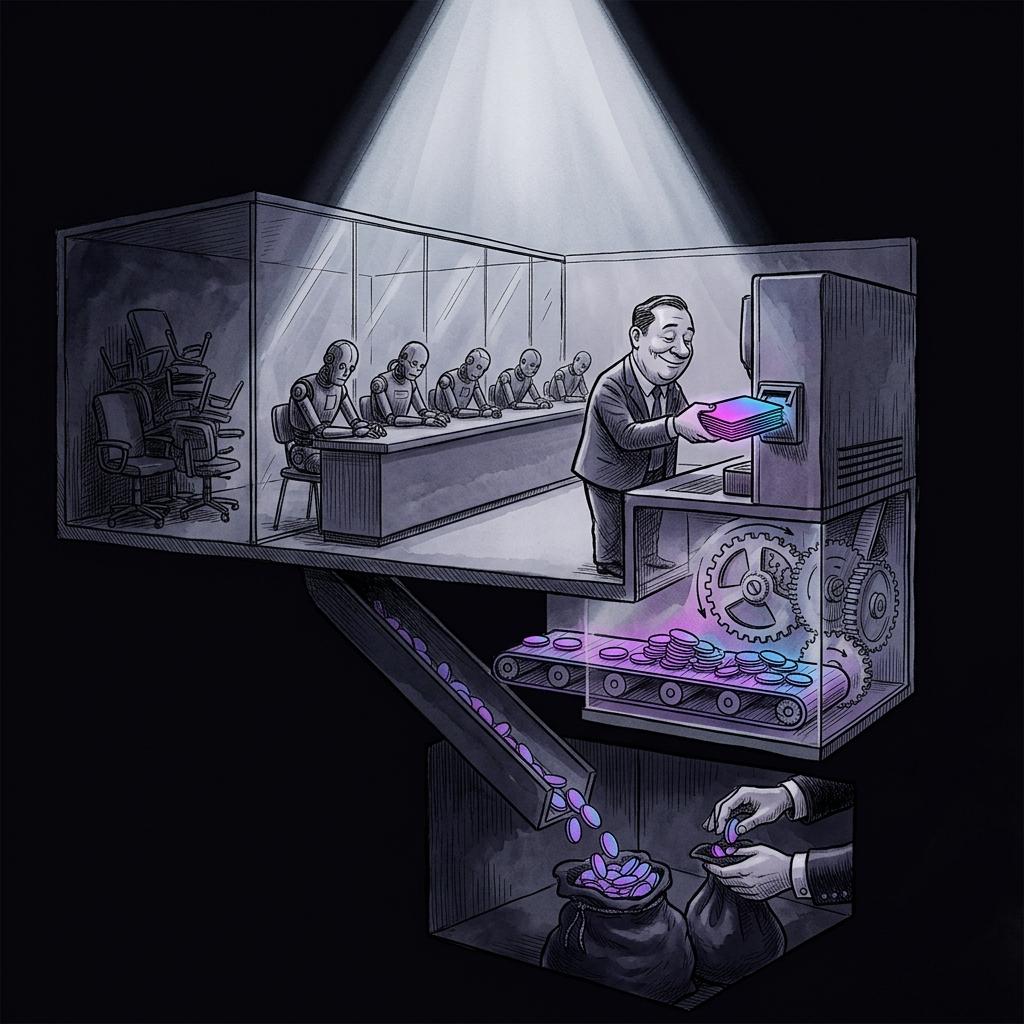
Every gift card has a second price, and it's the money nobody spends. Starbucks reports this number to the SEC. For the fiscal year that ended September 28, 2025, the company recognized $200.4 million of "breakage revenue" in company-operated store revenues. That is money customers loaded onto cards and never redeemed. Nobody made a drink for it and nobody served it.
I've had that number in my head all month because enterprise software is quietly becoming a gift card business. As companies replace software seats with AI agents, vendors are moving the bill off the seat and onto prepaid credits. A lot of those credits expire. Buyers are treating this as a pricing detail, and I think that's a mistake, because it decides who keeps the value of the work your agents never did.
The meter arrived in October
The last thirty days moved this from theory to rate card.
On September 25, 2026, Microsoft announced what it calls "the new Copilot," which folds Copilot Home, Code and Autopilot into one experience. Floris Klaver's licensing update at LicenseQ, published October 1 and revised October 5, explains how it's billed. Everyday use stays on the per-user Microsoft 365 Copilot license. The advanced capabilities, meaning Copilot Cowork, Code, Autopilot and the newer SharePoint features, move to usage-based billing through Copilot Credits, and that rollout runs from October to December 2026. Teams Phone Agent became generally available on September 30, billed in credits by call duration. From November 1, new or renewed Power Platform and Dynamics 365 licenses stop including seeded AI Builder credits. From December 1, usage-based billing becomes the default for new Microsoft 365 Copilot Business purchases through CSP, with a default limit of 4,000 credits per user per month. Klaver puts it in one line: "things that were included in a license are moving onto a meter."
HubSpot made the same move in Europe. Deepak Gupta, writing in Security Boulevard on October 17, reports that from October 1, 2026, new EMEA customers buy one edition with seats for people and credits for system activity. Those included credits "reset monthly and do not roll over."
On October 16, Forkast's Tessa Vaughn counted four pricing models competing to replace the seat for AI agents. She also noted that Salesforce sells all four at once. Monday.com moved to AI credits in May. GitHub put every Copilot plan on GitHub AI Credits on June 1, and Mario Rodriguez's announcement gave the reason in one sentence: "Today, a quick chat question and a multi-hour autonomous coding session can cost the user the same amount."
The diagnosis is correct. A seat is a flat fee for unlimited use by one human, and an agent is not a human. It doesn't take lunch and it doesn't log off. One afternoon of agent work can burn more compute than a sales rep uses in a quarter. Gartner's George Brocklehurst described the vendor's problem in July: "This breaks the link between user growth and revenue growth for many enterprise software vendors." Gartner put up to $234 billion of enterprise application spending through 2030 in the path of that change.
So the seat is going. The open question is what the replacement does to the buyer, and you have to read the small print to find out.
How replacing software seats with AI agents rewrites the bill
The pitch for credits is about fairness. You pay for the work done, and work that doesn't happen costs nothing.
The terms say something else. Here is Salesforce's Agentforce pricing page: "Unused Flex Credits do not roll over into subsequent subscription terms." Flex Credits cost $500 per 100,000. A standard Agentforce action is 20 credits, which comes to ten cents, and a voice action is 30. Here is HubSpot's knowledge base: "HubSpot Credits reset every month, aligned with the start date of your usage period. Unused credits expire at the end of each usage period and do not roll over to the next month."
So a credit can perish. It has a shelf life like milk, or an airline seat, or a gift card that lapses. If your agents don't use it inside the window, the vendor books the cash and does no work.
Under seats, this loss was called shelfware. You bought 500 licenses, 380 people logged in, and the other 120 sat idle. That waste was real but slow. It showed up once a year at the license audit, and you could cut the seats at renewal.
Credits make the loss faster and harder to see. It happens every month, inside a usage dashboard most CFOs never open. It also comes with a mechanism shelfware never had, which I'll call the ratchet.
The ratchet
HubSpot's billing page has a sentence I'd like every operator to read twice. If you go over your credit allotment with auto-upgrade on, "your account will automatically be upgraded to include a higher HubSpot Credits capacity pack." That higher tier then stays for the rest of the contract term. Going back down follows a different clock. You can only "cancel or downgrade your additional HubSpot Credits capacity packs at the end of your contractual commitment term."
Lay the two rules side by side. Unused credits expire monthly. Extra capacity, once bought, stays for the whole term. Put together, they mean you pay for your busiest month every month until renewal.
Say your support agent handles a product recall in March and burns three times its usual credits for four weeks. The account upgrades and the recall ends. In April, May and every month after, you pay for the March tier and the reset wipes out the unused part. The vendor collects breakage on capacity your own spike set off. Nobody acted in bad faith. The terms were written that way and you signed them.
In fairness to Salesforce, its approach is gentler. The pricing page says: "There is no overage penalty. If you exceed your entitlement, your rate is your contracted rate billed monthly in arrears." Overage is billed in arrears at the contracted rate, without a forced tier jump. The forfeit is also at the end of the term, which gives you a year to use a pool instead of thirty days. That is a real difference between vendors, and you'll only find it if somebody reads the order form.
Agents have no habits
Shelfware came from people. Someone was on leave, someone switched teams, someone never learned the tool. Human usage is lumpy, but it's lumpy in ways you can predict. People work weekdays, quarters end, Augusts are quiet.
Agent usage is shaped by your systems, not by habits. An agent that triages invoices runs exactly as often as invoices arrive. An agent that reviews code runs when engineers push code. An agent built to watch for supplier risk might do almost nothing for eleven months and then work flat out for three weeks when a port closes.
This is where the gift card comparison gets uncomfortable. Starbucks can estimate breakage because people are creatures of habit, and its filings describe recognizing breakage "based on historical redemption rates." Software vendors will learn your agents' redemption patterns the same way, from data they can see and you mostly can't. They will know your idle cycles before your finance team does.
Suppose a company buys an annual pool sized to its average month, while its agents run in bursts set by inventory, claims or deal flow. Under a monthly reset, the quiet months forfeit credit and the busy months trigger overage or an upgrade. Under a term-end forfeit, the quiet months bank credit the busy months can use. One clause in the order form decides which of those two worlds you're in, and that clause will matter more to your agent economics than the per-action price.
Most procurement teams negotiate the per-action price because it's the number on the slide. That's the wrong fight. A ten-cent action that expires before you use it costs more than a twelve-cent action you actually spend.
The seat was protecting you and you didn't know it
The seat had a virtue that nobody wrote down. The price was fixed and the use was unlimited. If your team found a hundred new ways to use the CRM, you paid the same. Heavy use was free, and the vendor carried the risk that you'd consume more than you paid for.
Credits flip that. Variable use, prepaid pools and expiry put the risk on you. You're now exposed both ways: use too little and you forfeit, use too much and you pay overage or get upgraded. The vendor gets the upside of your idleness and charges you for your enthusiasm.
GitHub's own announcement shows the flip in miniature. Code completions and Next Edit suggestions stay included, but when the pooled credits run out, "Fallback to a lower-cost model when limits are reached is no longer available." Under the old plan, your downside was a weaker model. Under the new one, it's a budget decision, made either by an admin who set a cap or by an invoice. GitHub does let you pool credits across a business and set budgets at the enterprise, cost center and user levels. Those are real controls, but only if somebody operates them.
That's the structural change hiding inside "replacing software seats with AI agents." Your software budget used to behave like rent. Now it behaves like a perishable inventory you're short and long at the same time. Rent needs a landlord relationship. Perishable inventory needs an operator.
Why this belongs to architecture, not procurement
The common response is to treat credits as a finance problem. Set a budget alert, get a FinOps dashboard, and Microsoft will even sell you a FinOps for AI toolset to govern the spend. That's fine. It's also the response of a company that has accepted the vendor's shape as fixed and is now watching the meter.
The better response is to change what the meter can see. The amount of breakage you pay depends on how your agent workloads line up against each vendor's reset cycle, and you control that alignment. It's an engineering question.
Route work toward the pool that's about to expire
Most companies running agents in 2026 will hold credit pools with several vendors at once. A Salesforce pool resets at term end, a HubSpot pool resets monthly, and Microsoft's default spending policy is per user per month. Some agent tasks can run against more than one of these. Summarizing an account, drafting a follow-up and classifying a ticket often can.
When those pools sit behind a routing layer you own, the router can send flexible work to whichever pool is closest to forfeiting. Say three days remain in a monthly cycle and 30% of the pool is unspent. That's the moment to run the backlog of low-priority enrichment jobs, the record cleanups and the re-scoring nobody asked for urgently. Work that would have used credits next month uses credits that would otherwise vanish. The vendor's breakage becomes your free capacity.
You can only do this if your agents aren't bolted to one vendor's interface. An agent that lives entirely inside one product spends that product's credits on that product's schedule. An agent running on your own orchestration layer, calling vendor capabilities as tools, can choose where to spend.
Make the work deferrable on purpose
The ratchet punishes spikes, so design to flatten them. Plenty of agent work has no deadline. Batch enrichment, historical reconciliation and knowledge-base upkeep can wait a week. Build agents with a deferral queue: urgent work runs now, and flexible work waits for slack capacity in a pool.
This is old logic. Utilities have priced load-shifting for decades, and data centers schedule batch jobs into off-peak hours. Applied to agents, it means your system knows the difference between "must happen now" and "should happen this month," and it uses that difference to avoid the upgrade that would lock in your peak tier for the rest of the term.
Instrument redemption before the vendor does
Your vendor will model your breakage from day one, because it's revenue. You should model it too, per pool, per month, per workload. How much was forfeited? Which agents caused the spike that triggered the upgrade? Which pool runs dry first? Gupta's test in Security Boulevard is a good one: "Can I forecast next year's bill in one spreadsheet row?" If you can't, you can't negotiate either, because the vendor will walk in knowing your redemption curve and you'll walk in with a guess.
What to put in the contract
Architecture shrinks breakage. The contract decides how much can exist in the first place. Before the next renewal, I'd get these four terms or walk.
First, rollover. Ask for unused credits to carry into the next period, at least for a quarter or with a cap. Salesforce's published default is that nothing crosses a subscription term. Published defaults are opening positions, and large customers negotiate away from them all the time.
Second, a throttle instead of an auto-upgrade. Gupta recommends a consumption ceiling that "throttles usage instead of billing overages." If the choice is between a slower agent and a tier you can't leave until renewal, most businesses should pick the slower agent and decide later whether the spike was worth paying for.
Third, a frozen conversion rate. A credit is only worth whatever the vendor says one action costs. Today, an Agentforce action is 20 credits. If that number can change mid-term, the vendor can raise prices without touching the per-credit price. Lock the rate between credits and actions for the full term.
Fourth, symmetry. If an upgrade lasts the full term, a downgrade should too, on the same schedule. Any term that lets the vendor move your tier faster than you can move it is the ratchet in writing.
None of these are exotic. They're the questions a hotel chain asks when it buys a block of rooms, or an airline asks when it buys fuel forward. Software buyers are new to perishable inventory, and vendors have noticed.
The vendor is short your idleness
Under the seat model, vendor and buyer roughly wanted the same thing. The vendor wanted you to use the product enough to renew, and you wanted it to be useful. Shelfware was a quiet bonus for the vendor, but not something it built for.
Under expiring credits, the incentives split in a more specific way. Vendors gain at renewal if your agents seem busy and gain on the income statement if your agents sit idle between busy spells. Starbucks never had to choose between those, and software vendors won't either. Breakage is high-margin revenue. Forkast cites analyst estimates that AI companies run 50 to 60% gross margins against 80 to 90% for traditional SaaS. A vendor whose inference costs are eating its margins has every reason to like revenue that has no inference cost at all.
I'm not accusing anyone of anything. Monthly resets are simple to administer, and term-long upgrades protect the vendor's capacity planning, so both terms have honest operational reasons. I'm describing the gradient. When the money from unused work goes to one side of the table, that side will slowly get better at producing unused work. The fix doesn't depend on anyone's character. It depends on the structure of your own systems.
What I'd do this quarter
Start with an inventory. List every vendor that has moved, or will move by year end, any part of your bill from seats to credits. For Microsoft customers, the dates are already on the calendar: November 1 for AI Builder at renewal and December 1 for Copilot Business through CSP. For each one, write down four facts: the reset cycle, the rollover rule, the overage rule and the downgrade window. Most companies won't be able to fill that table in without calling their account rep, and that call tells you something.
Then find the agent workloads that could run against more than one pool, and the ones that could wait. Those two lists are your breakage defense. They tell you where a routing layer would pay for itself and which agents need a deferral queue.
Then go back to the renewal calendar. The contracts signed in the next six months will set the terms for the first real generation of agent spend. Whatever you accept now becomes the precedent the vendor cites at every renewal after it.
Build the floor before the meter fills it
Replacing software seats with AI agents is happening whether you plan it or not. Microsoft, Salesforce, HubSpot, GitHub and Monday.com have already published the meters. The choice in front of you is whether your agents run on an architecture that sees every pool, every reset and every forfeit, or whether each vendor's agent runs alone inside its own product, spending that vendor's credits on that vendor's clock and leaving the remainder behind.
A tool can't fix this, because each tool is one of the pools. The fix sits above them: an orchestration layer you own, workloads designed to move in time and across vendors, instrumentation that shows your own redemption curve, and contracts negotiated by someone who understands where breakage comes from. That's design work across engineering, finance and procurement, and most companies have no one whose job covers all three.
That's the work Agor AI Advisory does. We map your credit exposure across vendors, design the routing and deferral layer that turns forfeits into capacity, and sit next to you at renewal with the redemption data in hand. The vendors already know your idle months to the decimal. You should know them better.
Sources
- Agentforce Pricing, Salesforce
- Understand HubSpot Credits and billing, HubSpot Knowledge Base
- Microsoft Licensing Update October 2026, LicenseQ, October 1, 2026
- How to Buy Software When AI Breaks Pricing, Security Boulevard, October 17, 2026
- Agent Monetization Shift: Per-Seat Pricing Is Dying, Forkast, October 16, 2026
- GitHub Copilot is moving to usage-based billing, The GitHub Blog, April 27, 2026
- Agentic AI could disrupt $234B in SaaS spending, CIO Dive, July 6, 2026
- Starbucks Corp Form 10-K, fiscal 2025, SEC