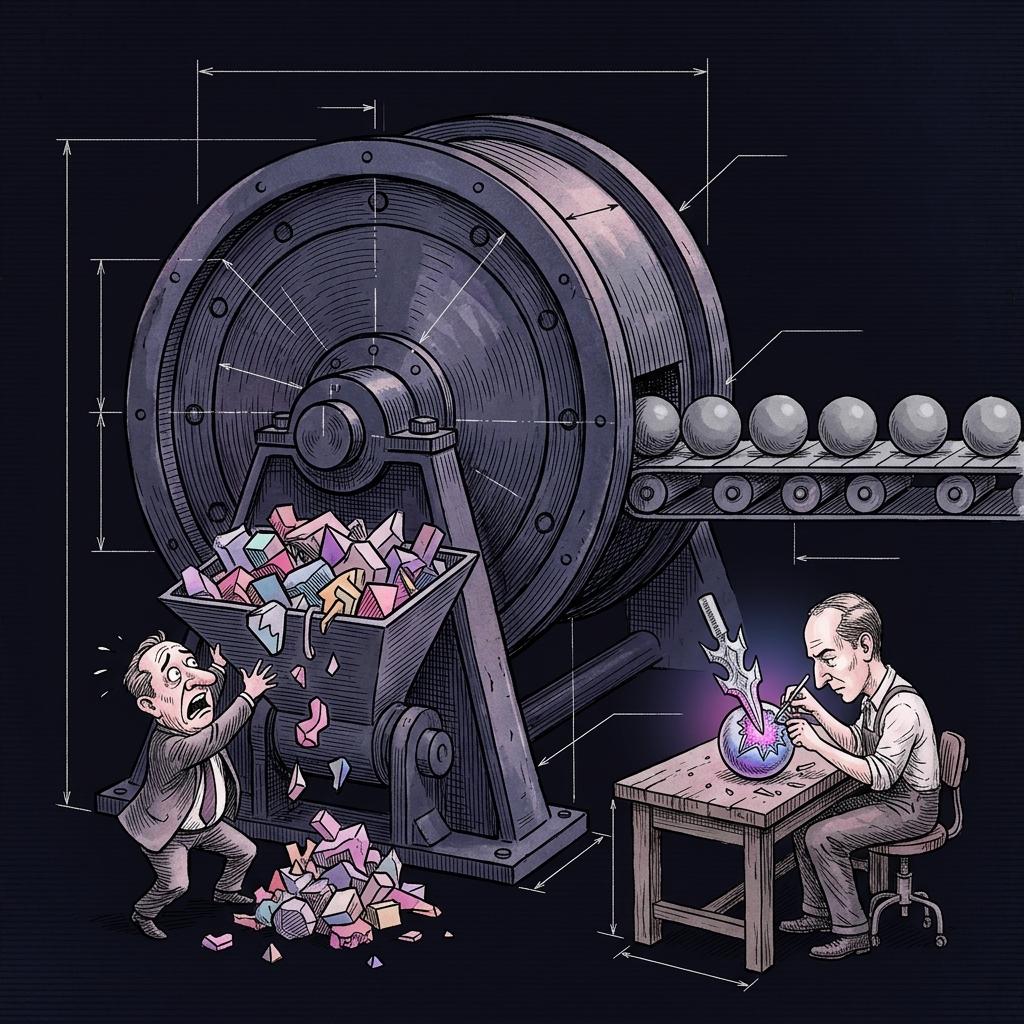
July 2026 shattered the illusion of the universal reasoning engine. The month opened with Anthropic restoring Claude Fable 5 to full public availability after a US export control pause. It closed with Anthropic shipping Claude Opus 5. In between, OpenAI launched GPT-5.6 across three distinct sizes named Sol, Terra, and Luna. Google splintered its own foundation on July 21, introducing Gemini 3.6 Flash alongside Gemini 3.5 Flash-Lite and a highly specific Gemini 3.5 Flash Cyber variant. The market is splintering. The major labs are abandoning the dream of a single monolithic model that serves every master. They are carving their systems into discrete fragments.
This fracture forces a harsh reckoning for business operators. The strategic debate regarding custom AI versus off-the-shelf tools shifted from a simple calculation of compute costs to a question of cognitive sovereignty. For three years, enterprises rented intelligence from a shared API. They accepted the premise that a massive language model hosted by a hyperscaler would handle their internal logic, draft their contracts, and orchestrate their customer interactions. They traded control for convenience. That trade is now a structural liability. The events of July prove that borrowing capacity from a shared API carries a hidden and compounding cost. We call this cost the baseline regression.
When you rent a foundation model, you share its weights with millions of other users. The model provider constantly adjusts those weights. They run reinforcement learning algorithms based on global user feedback. They patch vulnerabilities. They alter the latent space to satisfy the median user. The model regresses to the mean. It becomes safer, blander, and inherently average. Your proprietary business logic relies on a foundation that constantly drifts toward the center. You lose your specific edge. The intelligence you rent today is not the intelligence you will receive tomorrow. The universal API is a shifting floor.
The Silent Drift and the Version Pinning Bandage
On July 10, Oracle released a quiet but telling update to its cloud infrastructure. The company launched OCI Enterprise AI Guardrails. The update included image moderation capabilities, but the critical feature was explicitly named version pinning. Oracle allowed customers to pin a specific guardrail version to maintain stable behavior for content moderation and prompt injection detection. This feature exists because enterprise customers demanded it. They demanded it because the silent drift of off-the-shelf models was breaking their internal systems.
When a model provider updates an API, the internal probability distribution of the model changes. A prompt that reliably extracted a specific financial metric on Monday might return a slightly different format on Tuesday. For a human reading a chat interface, this shift is invisible. For a software system parsing an output, this shift is fatal. The silent drift breaks the fragile chain of logic that businesses build on top of the API. Oracle recognized this pain. Version pinning is a bandage applied to a bleeding wound. It allows a company to freeze the model in a specific state. It stops the drift.
But version pinning introduces a fatal contradiction. If you pin an off-the-shelf tool to a past version, you forfeit all future improvements. You freeze your corporate intelligence in time. Your competitors who accept the drift might gain new reasoning capabilities, while your systems remain locked to a deprecated standard. You are forced to choose between stability and advancement. This is the inherent flaw of the API model. You do not control the update cycle. The provider forces you to accept their timeline. You either break your internal workflows by accepting the update, or you fall behind by pinning the version. The only escape from this trap is owning the weights.
When Oracle launched OCI Enterprise AI Guardrails, they published an indictment of the current API market. The version pinning capability allows an enterprise to lock the behavior of content moderation and prompt injection detection. Consider the reality of a financial institution relying on an API to screen transactions for fraudulent patterns. The institution spends six months crafting the exact prompts and parsing logic to interface with the model. They validate the system against regulatory standards. They deploy it to production. Then, on a random Tuesday, the hyperscaler updates the model weights to improve its conversational tone. The model suddenly outputs the fraud analysis in a slightly different JSON structure. The institution's parsing logic fails. The system crashes. Transactions halt. The institution did nothing wrong. They simply trusted a foundation that moves without warning. Oracle's version pinning attempts to stop this bleeding. But locking a version means the financial institution will never benefit from the provider's future improvements in fraud detection. The institution is trapped.
The Danger of the Median Mind
The core problem of the rented API runs deeper than software stability. The problem is the median mind. An off-the-shelf tool is designed to serve everyone. It must answer questions from high school students, generate code for hobbyists, and draft marketing copy for small businesses. The hyperscaler trains the model to avoid offending anyone. They optimize for general utility. This optimization smooths out the sharp edges of the model. It destroys the highly specific, anomalous reasoning paths that create true business value.
Your competitive advantage lives in the anomalies. It lives in the unique way your company structures a supply chain. It lives in your highly specific method of evaluating risk. When you push this proprietary data through a generic API, the model attempts to map your unique logic onto its generalized latent space. It dilutes your advantage. It responds with the median interpretation of your problem. The baseline regression pulls your exceptional processes down to the industry average. You become identical to every other company using the same API.
This is the true stakes of custom AI versus off-the-shelf tools. Custom AI allows you to escape the median mind. When you download an open weights model, you possess a raw reasoning engine. You then train this engine strictly on your own data. You reinforce the anomalous reasoning paths that make your company successful. You ignore the global average. You force the model to drift toward your specific definition of truth. The custom model becomes a physical manifestation of your corporate strategy. It is immune to the baseline regression because it only learns from you. It does not care about the median user. It only cares about your proprietary logic.
The Compliance Contagion
The release of OpenAI's GPT-5.6 in late July introduced a new layer of risk for API renters. According to industry tracking reports from ThursdAI, GPT-5.6 was the first frontier model to clear a customer-by-customer US government review before reaching public availability. This review process marks a fundamental shift in how hyperscalers deploy intelligence. The state is now actively involved in shaping the behavior of the universal API. The model must satisfy federal compliance standards before it can generate a single token for a private enterprise.
When you use an off-the-shelf tool, you inherit the compliance burden of the provider. If the US government dictates that a model must refuse certain types of technical queries to prevent weapons proliferation, the provider alters the model weights to comply. This alteration casts a wide net. The model might suddenly refuse to answer perfectly legitimate queries about chemical manufacturing or dual-use industrial components. Your chemical engineering firm suddenly faces a censored reasoning engine. You never agreed to these restrictions. You simply inherited them because you share a brain with the public.
We call this the compliance contagion. The API absorbs the regulatory pressure of the most scrutinized jurisdiction and forces that pressure onto every tenant. If your company operates in a different country, or if your industry requires logic that triggers a generic safety filter, you are powerless. You cannot appeal the decision to the model provider. You are a rounding error in their revenue stream. Open weights models provide the only viable alternative. July saw the release of Moonshot's Kimi K3, a massive 2.8 trillion parameter model. Thinking Machines released the 975 billion parameter Inkling model. These releases prove that frontier-class intelligence is available outside the API. You can take these weights into your own data center. You define your own compliance boundaries. You isolate your reasoning engine from the contagion.
The Agentic Fragility
The need for cognitive sovereignty becomes absolute when you move from human chat interfaces to autonomous agents. On July 31, Cognizant launched a dedicated EMEA AI Unit. Their explicit mandate is to help enterprises move away from isolated pilots and toward scaled agentic AI deployments. The industry is attempting to build digital workforces. These agents will execute multi-step workflows. They will negotiate contracts, allocate capital, and reroute logistics networks without human oversight.
Agents require absolute predictability. An agent operates by chaining discrete reasoning steps together. It makes a decision, observes the result, and formulates the next action. This chain is incredibly fragile. If the underlying language model shifts its output format by a single character, the agentic loop breaks. If a vendor applies a silent patch to an off-the-shelf tool, the probability distribution changes. The agent might suddenly prioritize a different variable in its decision matrix. A supply chain agent that optimized for speed yesterday might suddenly optimize for cost today, simply because the hyperscaler tweaked a safety parameter.
Cognizant's EMEA AI Unit is not selling chatbots. They are selling agentic deployments. The difference is critical. A chatbot waits for a human prompt, generates text, and stops. An agent operates in a continuous loop. It reads a database, makes a decision, executes an API call to a third-party software, reads the response, and decides the next action. This loop is entirely autonomous. If a human user encounters a hallucination in a chatbot, the human ignores it and writes a new prompt. If an agent encounters a hallucination in its own reasoning process, it acts on it. It deletes the record. It misallocates the funds. It orders the wrong inventory. The tolerance for drift in an agentic system is zero. When you build these systems on off-the-shelf tools, you are building a house of cards in a wind tunnel. A silent update from the API vendor is a gust of wind. The probability distribution shifts. The agent takes a wrong turn in its logic tree. The system fails. To build a digital workforce that survives contact with reality, you must control the environment. You must own the weights.
The Economics of Sovereign Weights
The financial argument for the universal API relies on a short-term illusion. The API appears cheap on day one. You pay fractions of a cent per thousand tokens. You avoid the massive capital expenditure of buying graphics processing units. You avoid hiring the specialized engineers required to maintain a cluster. The hyperscaler subsidizes your early experimentation. But this pricing model is a trap. As your utilization scales, the API becomes a brutal operational tax. You pay the vendor every time your company attempts to think.
Beyond the explicit token cost, you pay a severe penalty in cognitive capacity. You are capped at the intelligence level of the public API. If you discover a novel way to improve the model's reasoning for your specific industry, you cannot permanently alter the API. You can only inject context into the prompt. This requires sending massive amounts of data to the vendor for every single query. You pay for the input tokens over and over again. You are renting the same cognitive capacity every day.
Hosting a custom model flips this economic equation. The open weights releases of July 2026 demonstrate that you no longer need to train a foundation model from scratch. You download Kimi K3 or Inkling. You invest capital to acquire the hardware. You fine-tune the model on your proprietary data. The model learns your logic. It stops needing massive context windows because your business rules are baked directly into the weights. The custom model becomes an appreciating asset on your balance sheet. It gets smarter as you feed it better data. The marginal cost of inference drops to the cost of electricity. You transition from a tenant paying rent to a landlord owning the cognitive real estate.
The Security of the Isolated Mind
The final fracture of the universal API concerns data proximity. When you use an off-the-shelf tool, you must send your most sensitive corporate data across the internet to a third-party server. Hyperscalers promise strict data isolation. They promise that your prompts will not train the next version of their public model. But these promises are legal constructs, not physical guarantees. The data still leaves your perimeter. It sits in a memory cluster controlled by another entity.
In highly regulated industries, this transmission is an unacceptable risk. A healthcare provider cannot send raw patient diagnostics to a generic API. A defense contractor cannot pipe schematic evaluations through a public endpoint. Google's release of Gemini 3.5 Flash Cyber attempts to address this by offering a domain-specific model, but the fundamental architecture remains the same. The compute happens on their servers. The weights belong to them. The risk remains.
Custom AI solves the proximity problem by bringing the mind to the data. You deploy your proprietary model inside your own secure enclave. The model runs on isolated hardware. The network connections are severed. The intelligence operates behind your existing firewalls. The data never moves. This architectural shift eliminates the transmission risk. It satisfies the most stringent compliance requirements. It proves that the true value of artificial intelligence is not access to a massive global brain. The true value is deploying a highly specialized mind exactly where the data lives.
The Architecture of the Open Alternative
The July 28 release of Moonshot's Kimi K3 shattered the premise that open weights models would always lag behind proprietary APIs. Kimi K3 is massive, and it is structurally novel. The release notes detail a model that scales up capacity by an enormous factor, combining constant-state Kimi Delta Attention with periodic softmax retrieval. It uses sparse experts and selective residual access. These are strictly functional changes. These architectural choices represent a fundamental shift in how memory stores, forgets, and retrieves information while preserving efficient inference.
When a company chooses custom AI over an off-the-shelf tool, they now have access to this exact architecture. You are not forced to compromise on reasoning capability. The Kimi Delta Attention mechanism allows a custom model to maintain vast amounts of corporate context without the latency penalties that plague generic APIs. You can take this 2.8 trillion parameter behemoth and strip away the generalized knowledge you do not need. You prune the sparse experts that handle consumer trivia. You dedicate the entire capacity of the model to your specific industrial problems. This level of architectural control is impossible when you rent an API. You cannot ask a hyperscaler to adjust their softmax retrieval for your specific latency requirements. You must accept their global configuration. Owning the open weights means you own the configuration. You tune the physics of the model to match the physics of your business.
The Energy Ceiling and the Compute Real Estate
We must also examine the physical reality of the AI market in July 2026. The ThursdAI report noted that AMD landed Anthropic for up to two gigawatts of MI450 compute. Two gigawatts is not a server cluster. It is the energy output of a nuclear power plant. The hyperscalers are consuming electricity at a scale that defies traditional infrastructure planning. They are building massive, centralized brains. They must charge you a premium to recoup these staggering capital investments.
This centralization creates a physical bottleneck. When you rely on an off-the-shelf tool, your queries compete for compute cycles within these massive data centers. During peak hours, the API provider must throttle your requests or degrade the reasoning quality to maintain system stability. You experience this as random latency spikes or sudden drops in output coherence. Your business operations slow down because a million other users decided to query the API at the same time.
Custom AI distributes the compute load. When you run a highly tuned, smaller model on your own hardware, you escape the centralized bottleneck. You dictate the energy allocation. If your supply chain agent requires instantaneous inference during a critical routing window, you allocate maximum compute to that specific model. You do not wait in line behind consumer chat requests. The debate of custom AI versus off-the-shelf tools is ultimately a debate about resource sovereignty. You either control your own compute real estate, or you are a tenant begging for cycles in a crowded megacity.
The Obsolescence of the Generalist
The final casualty of the baseline regression is the concept of the generalist model itself. For years, the industry chased the dream of artificial general intelligence through a single, massive endpoint. The releases of July 2026 prove that the market values specificity over generality. Google splitting its Flash line into Lite and Cyber variants is an admission that the universal model is inefficient. A model that knows how to write poetry is carrying dead weight if its only job is to detect network intrusions.
When you rent a generalist API, you pay for the dead weight. You pay for the parameters that memorize Wikipedia. You pay for the safety filters that prevent the model from writing malicious code, even if your company has nothing to do with software development. The generalist model is bloated. It is slow. It is expensive.
Custom AI allows you to ruthlessly eliminate the dead weight. You distill the massive open weights models down to their absolute essence. You create specialized minds. You deploy a small, blisteringly fast model specifically trained to read your legal contracts. You deploy a separate model trained exclusively on your machine telemetry. These specialized models communicate with each other, forming a sovereign cognitive network. They do exactly what they are designed to do, and nothing else. They do not regress to the mean because they have no conception of the mean. They only know your business.
The Memory Disconnect
An off-the-shelf tool has no memory of your business. Every time you query the API, the model starts from a blank slate. You must inject your entire corporate context into the prompt window. This process is highly inefficient. You spend compute cycles explaining your basic business rules to the model over and over again. The hyperscalers sell larger context windows to solve this problem. They offer two million tokens of context. They frame this as a feature. It is actually a tax. You pay to upload your memory every single time you need the model to think.
Custom AI solves the memory disconnect at the structural level. When you train your own weights, the memory is baked into the model itself. The model inherently knows your business rules. You do not need to explain your risk tolerance in the prompt. The model's neural pathways already reflect your risk tolerance. The context window becomes reserved for the specific task at hand, rather than a bulky repository of background information. This structural memory makes custom models drastically faster and far more accurate than any generic API attempting to read a massive prompt.
The Inevitable Mandate
The events of July 2026 draw a clear line in the sand. The hyperscalers are building tools for the median user. They are fracturing their models, accepting government restrictions, and forcing you to pay for massive context windows to compensate for their lack of specific knowledge. The baseline regression is slowly eroding the proprietary advantage of every company that relies on these shared endpoints.
The alternative is difficult, but it is necessary. You must download the open weights. You must secure the compute hardware. You must train the models on your own isolated data. You must architect a system where the reasoning engine belongs to you. This is the only way to build agentic workflows that do not break. This is the only way to avoid the compliance contagion. This is the only way to maintain cognitive sovereignty.
Architecting this change is critical. You cannot simply buy another subscription to escape the baseline regression. You must build the physical and digital infrastructure to host, train, and manage your own cognitive assets. You must construct the sovereign mind. Agor AI Advisory exists to build this exact architecture. We guide enterprises through the extraction from the public API and the deployment of secure, proprietary reasoning engines. We ensure your business logic remains yours.
Sources
- July 2026 AI Releases: OpenAI, Google DeepMind, Anthropic, Meta AI - ThursdAI, July 30 2026
- What's New in Oracle AI? July 2026 Edition | ai-data-science, July 10 2026
- Introducing Gemini 3.6 Flash, 3.5 Flash-Lite, and 3.5 Flash Cyber - Google Blog, July 21 2026
- AI News for the Week of July 31; Updates from Cognizant, Encore AI, groundcover & More, July 31 2026
- AI News Briefs BULLETIN BOARD for July 2026 | Radical Data Science, July 29 2026