On August 10, 2026, Salesforce published the second edition of its Agentic Enterprise Index. The headline number was the one every keynote will quote for the next two quarters. In February 2025, the average Salesforce customer had activated five agents on the Agentforce platform. By April 2026, that number was thirteen. Deployments across the customer base had nearly tripled in fourteen months.
The same week, Salesforce announced a new product called Agentforce Operations. VentureBeat's coverage on August 12 described its purpose in one line that ought to have made every buyer sit up straight. It was launched to fix the workflows that were breaking enterprise AI.
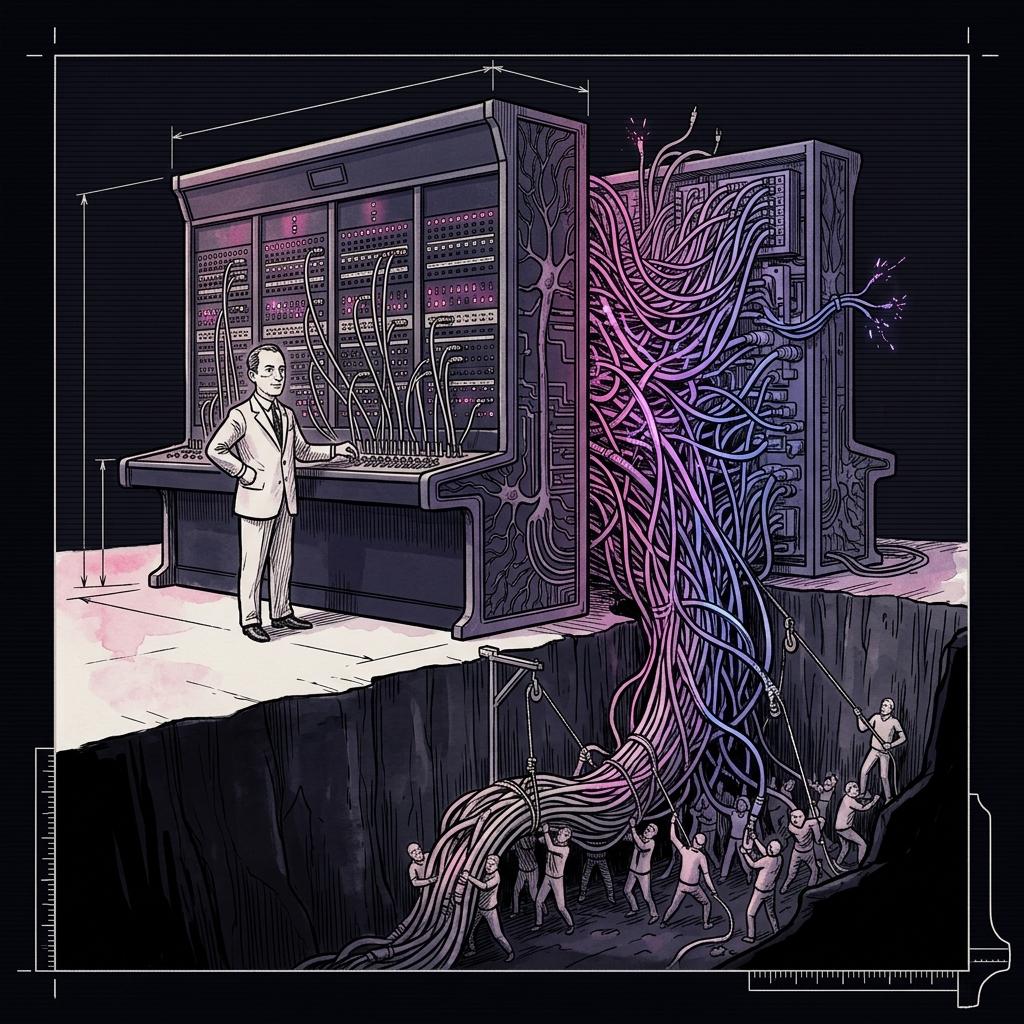
Read those two sentences together and you have the shape of the year. The largest CRM vendor on earth simultaneously reported that their customers had scaled from five agents to thirteen and that they needed to ship an entirely new product to keep those agents from breaking each other. That is not a story about capability. That is a story about coordination cost. The chorus was not free.
Thirteen is heavier than five
The naive way to model an agent is as an API call. You pay for tokens, you get an answer, the answer is worth more than the tokens. If one agent is good, thirteen agents are 13x good. This model is wrong in a way that stopped being cute around the time the average customer crossed the seven-agent line.
Anthropic published an engineering post in mid-2025 walking through what its own production research agents actually consumed in the field. A single chat with Claude used roughly four times more tokens than a comparable ChatGPT interaction. A multi-agent research system used about fifteen times more tokens than a single chat. Not fifteen times more than a bare API call. Fifteen times more than the already-expensive single-agent baseline. The extra spend paid for the agents talking to each other and to a lead orchestrator, checking each other's work, negotiating handoffs, and keeping context in sync.
That coordination overhead is not a bug in a specific vendor's framework. It is the reality of every multi-agent system for business operations that has ever been shipped. Adding an agent to a fleet does not just add a worker. It adds a set of relationships. Six agents can hold fifteen pairwise conversations. Thirteen agents can hold seventy-eight. The math is not linear and the bill is not linear, and Salesforce customers just walked into the part of the curve where the second derivative starts hurting.
The 89% number is the receipt. Deloitte's 2026 Tech Trends report put the enterprise agent pilot-to-production failure rate at 89%. The story behind that number is not that the models are bad. Claude Opus 5, released July 24, 2026, took the top spot on the Artificial Analysis leaderboard the day it shipped, at roughly half the price of the previous top-tier model, with a one million token context window. The models are the cheap part. What is failing is the seam between them, the operational scaffolding around them, and the assumption that a fleet of agents will self-organize because the underlying model can reason.
The Army did the opposite thing and it worked
On August 5, 2026, U.S. Army Human Resources Command became the first Department of War organization to deploy autonomous AI agents at Impact Level 5. IL5 is the highest sensitivity tier below classified systems. The agents serve 9.2 million soldiers, veterans, and family members, and they handle HR inquiries that were previously routed through call centers with long queues.
The instructive part is what the Army did not do. They did not stand up thirteen agents. They did not wire in every LLM available and hope emergent orchestration would sort itself out. They deployed a narrowly scoped workforce with defined jurisdiction, an audited chain of command, one accountable owner in the org chart, and a human-on-the-loop supervision model. Every action an agent took generated a trace record with the identity of the acting agent, the input it consumed, the decision it made, and the human who reviewed and cleared the class of decision it was authorized to make.
That is the shape of a multi-agent system for business operations that actually runs in production at scale. It looks less like a swarm and more like a call center staffed by employees, each with a job description, a supervisor, and a written record of what they did. The agents at U.S. Army HR Command work because they were architected with the same discipline the Army applies to putting a private on a switchboard. The private has a name, a rank, a role, a chain of command, an escalation path, and a set of things they are explicitly not allowed to do. The agent has the same, coded into its runtime harness.
Contrast this with the pattern behind the 89% failure rate. Most enterprise multi-agent pilots begin as a proof of concept that worked in a sandbox and were promoted into production on the strength of a demo. In the demo, three or four agents pass a message between themselves and solve a synthetic task. In production, the same architecture faces real data, real users, real edge cases, and a real cost meter. It falls apart because nobody drew the org chart, nobody defined the escalation paths, and nobody signed the operating manual for what happens when two agents disagree.
The attack surface grew faster than the workforce
The last three weeks of July and the first two weeks of August 2026 produced six distinct classes of AI coding agent vulnerability, disclosed by security researchers across Cursor, AWS Kiro, GitHub's Agentic Workflows, and six coding assistants at once through a shared symlink flaw. That was one month of published disclosures for one narrow slice of the agent market. The lesson generalizes.
Every agent you add is a new authenticated principal in your systems. It holds credentials. It can be prompted. It talks to other agents that hold different credentials. The blast radius of a single compromised agent in a well-designed system is bounded by its role scope and its escalation path. The blast radius of a compromised agent in a demo-grade multi-agent deployment is the intersection of every credential every agent holds, because your governance model was to let them all share a workspace and hope for the best.
Google's Agent2Agent protocol, in production at more than 150 organizations by the middle of 2026, gives you a common language for agents from different vendors to discover each other, exchange tasks, and coordinate. What it does not give you is an org chart. The Linux Foundation transferred governance of the specification. It did not transfer the discipline of running the workforce. That part is yours.
Anthropic's Claude Managed Agents beta and OpenAI's Agents SDK, both updated on their respective April 2026 release cadences with sandboxing, credential scoping, end-to-end tracing, and split control-plane architecture, are the primitives you need to build governance on top of. They are not the governance itself. Nobody ships governance in the box. That has to come from the enterprise.
What multi-agent systems for business operations actually cost
If you are budgeting for a multi-agent deployment right now and you are only pricing tokens, your model is off by an order of magnitude. Here is the real invoice for a multi-agent system for business operations, and every line item is one that enterprises hitting the 89% wall are surprised by.
The token bill is real and it compounds. Fifteen times a single-chat baseline is a working assumption for anything with more than three agents in a research loop. Salesforce's average customer at thirteen agents is not paying thirteen times what they paid at one agent. They are paying an amount closer to the pairwise-relationship count times average context length, and the context length keeps growing because the one million token window is now table stakes.
The observability bill is the one that quietly bankrupts the pilot. A 2026 study of enterprise agent deployments found that 75% of enterprises report double-digit AI failure rates and the primary cause is fragmented observability. If you cannot see what your agents did, you cannot debug them. If you cannot debug them, they will silently produce wrong outputs until a customer, a regulator, or an auditor tells you so. The observability layer is not optional and it is not free. It is a distributed tracing problem with agent identity as a first-class dimension, and if you have not solved distributed tracing for your microservices you have not solved it for your agents either.
The governance bill is what Agentforce Operations exists to sell you and what most enterprises are trying to build in-house because the platform version is not enough. Every agent needs a written scope. Every scope needs a written escalation path. Every escalation needs a human on the loop with the authority to override. Every override needs a record. Every record needs a retention policy. This is the operating manual of a real business function, and it does not write itself when you install a vendor's SDK.
The kill-switch bill is the one nobody wants to price because it feels like preparing for failure. It is not. It is the difference between an agent going wrong and an agent going wrong at scale. Every deployed agent needs a documented off switch, a documented degrade mode, and a documented human who can pull either lever at three in the morning. If the off switch lives in a vendor's dashboard you cannot reach without a support ticket, you do not have a kill switch. You have a wish.
The org chart is the product
Here is the shift that separates the 11% who are shipping from the 89% who are stuck. The successful deployments treat the org chart as the deliverable. The agents themselves are commodity. The models underneath will be better and cheaper next quarter. The vendor SDKs will consolidate. What survives from one release cycle to the next is the architecture of ownership and accountability that surrounds the agents.
A multi-agent system for business operations that ships is one where you can answer, for every agent in the fleet, four questions without opening a Slack channel. Who owns this agent. What is it allowed to decide alone. What must it escalate. Who reviews the escalation. If any of those four answers is a shrug, that agent will contribute to your production incident count within a quarter.
The U.S. Army HR Command deployment answered all four for every agent before it shipped. The Salesforce customer average of thirteen agents almost certainly does not, which is why Salesforce needed to ship a new product to help them retrofit the answers.
Notice what did not save anyone. A better model did not save them. A larger context window did not save them. An open interoperability protocol did not save them. What is saving the 11% is a disciplined ownership architecture that has more in common with running a small subsidiary than with deploying a Kubernetes cluster. Agents behave like employees under pressure and misbehave like employees under pressure, and the corrective structure has always been the org chart, the escalation path, and the accountable owner.
Vendors will sell you the platform. Consultants will sell you the pilot. Neither will build you the architecture of ownership that turns a fleet of agents into a workforce your business can rely on. That is a design decision, and it is yours.
The compounding gap
Here is the part that ought to keep every CEO up at night. The 11% is not evenly distributed. It is concentrated in enterprises that made the architectural investment early, treated multi-agent systems for business operations as a governance problem before it became a token-bill problem, and hired or built the specific expertise required to run a fleet responsibly. Those enterprises are now compounding on real production traffic while their competitors are still cycling through pilots.
Every quarter that a competitor runs a working multi-agent workforce, they collect data your pilot cannot collect. They collect production traces of what actually works in their business context. They collect a catalog of failure modes that only appear at their scale. They collect the muscle memory of running incident response on agent behavior. That catalog is a moat and it is not for sale.
The gap between the 11% who have production multi-agent systems and the 89% who are still trying to leave the sandbox will close for nobody in the current cycle. It will only widen, because the operating discipline required is the kind of discipline that takes months of real production incidents to develop and cannot be shortcut by buying a bigger LLM subscription. The chorus is not free, and the enterprises paying the bill early are collecting a return the ones still on the sidelines will never catch up to.
Architect this, do not buy it
Every enterprise leader reading this has a vendor pitching them a multi-agent platform right now. The pitch will emphasize the number of connectors, the polish of the dashboards, the pedigree of the underlying models, and the customer logos. The pitch will not emphasize the org chart because the vendor cannot sell you one. Your ownership architecture is yours to design, yours to run, and yours to be held accountable for.
This is the work Agor AI Advisory does. We come in before the deployment count reaches thirteen and help you architect the fleet as a governed workforce. We define the scopes, the escalation paths, the human-on-the-loop review points, and the kill-switch topology. We help you build the observability layer that makes production agents debuggable rather than mysterious. We help you draw the org chart that survives when the underlying models change every quarter.
The enterprises that will still be running effective multi-agent systems for business operations in three years are the ones that treated this as an architectural discipline in 2026, not a shopping exercise. The ones treating it as shopping are already in the 89%. The gap is not closing.
If you are staring at a growing fleet of agents and a growing bill and a growing list of incidents nobody quite owns, the answer is not the next platform. The answer is the architecture of ownership underneath whatever platform you already bought. Schedule a strategic consultation with us today.
Sources
- Salesforce Agentic Enterprise Index: Agent Deployments More Than Double Year over Year, August 2026
- Salesforce launches Agentforce Operations to fix the workflows breaking enterprise AI, VentureBeat, August 2026
- 89% of AI Agent Pilots Never Reach Production, 2026 refresh
- Six AI Coding Agent Incidents in One Month: A Containment Checklist for Tech Leads, August 2026
- A2A Protocol Surpasses 150 Organizations, Lands in Major Cloud Platforms, and Sees Enterprise Production Use in First Year, Linux Foundation
- AI Workforce Boom: Enterprise Agent Deployments More Than Double, Salesforce 2026 Index Insights
- Latest AI Developments: August 2026 Update, Local AI Zone
- Why AI Agents Fail in Production: Governance, Orchestration, and Reliability, The Local News, July 2026