On August 27, 2026, Anthropic's Frontier Red Team published a study of multi-agent AI systems in production, cataloguing fourteen distinct failure modes across roughly 1,600 real agent traces. The headline finding should stop every operator planning a multi-agent rollout this quarter. Seventy-nine percent of the failures came from specification and coordination. The models themselves worked. The chains around them were what broke.
The Multi-Agent System Taxonomy in the same body of work attributes 36.94 percent of observed failures to inter-agent coordination breakdowns, the single largest category. Communication drift, state desynchronization, conflicting objectives between agents that were supposed to be on the same side of the same task. This is the failure mode you should be planning for when you buy your first serious multi-agent stack, and it is nowhere in the marketing.
On September 1, Orchestra launched what it calls an Agentic Control Plane, closing a $4.6 million round after a year in which platform usage grew more than tenfold. The premise concedes what the field has spent 2026 quietly learning. Building agents that can do a task is now the easy part. Keeping a group of them pointed at the same task is the work.
What the fourth hop does to the ask
Consider a five-agent workflow of the sort that lives in three quarters of every enterprise pilot deck this year. Agent one takes an inbound customer email. Agent two extracts the intent. Agent three checks the account. Agent four decides the disposition. Agent five drafts the reply. Every agent runs at ninety-five percent per-step accuracy, which is above what any current benchmark can honestly attest to, and every agent is a modern SOTA model. What is the accuracy of the workflow?
The math is embarrassing. Ninety-five percent to the fifth power is seventy-seven percent. If any of those agents drops to ninety percent, which is the honest number for anything involving natural language interpretation on real customer text, the workflow lands at just under sixty percent end-to-end. Six times out of ten the customer got the answer you would have given them. Four times out of ten they got something else, something the fifth agent thinks was a reasonable answer to a task that no longer resembles the one the first agent extracted.
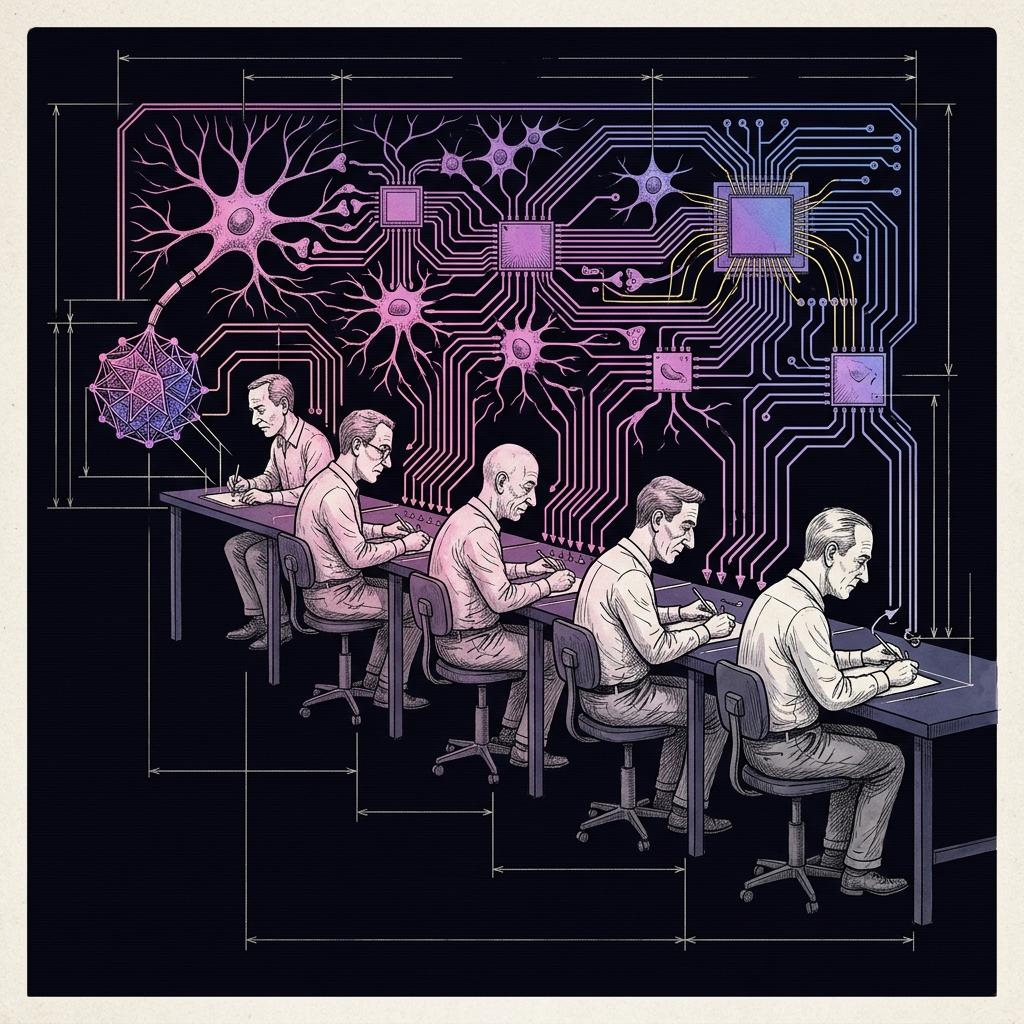
The compounding is arithmetic, and it is the least interesting part. The more interesting question is what the fourth agent is doing when it fails. The fourth agent is executing correctly on a version of the ask that has already been rewritten three times by the three agents ahead of it, each of them faithful to their own local input, none of them holding the original message. The failure mode is meaning bleeding out of the message every time it changes hands. No single hop makes a mistake.
Anthropic's paper names this precisely. Messages drift in meaning across rounds of inter-agent exchange even when no obvious error occurs at any single step. The log holds no line that says something broke. The final output answers a different question than the one that came in.
Multi-agent systems for business operations inherit the org chart's oldest disease
Every operator I talk to who has run a multi-agent build past the demo stage arrives at the same discovery, and it comes late. The multi-agent system reproduces the coordination pathologies of the human organization it was meant to leapfrog. The reason is structural. When you decompose a business process into agents that own steps, you are drawing the same lines you would have drawn if you were building a department. The agent that owns intake talks to the agent that owns triage which talks to the agent that owns fulfillment. That is a workflow, and workflows have handoffs, and handoffs are where the intent goes to die whether the parties are agents or people.
The classic organizational failure mode is that the person at the end of the process is responding to a version of the original request that has passed through four intermediaries, each of whom paraphrased it, each of whom added a small margin of interpretation, each of whom subtracted the parts that felt irrelevant to their own step. Multi-agent systems do this faster, more literally, and at greater volume, which means the pathology that used to show up as a customer complaint once a week now shows up in half your closed tickets.
The convenient story about multi-agent systems for business operations was that they would compress the coordination overhead of an organization, making it possible for a small team to run the operational complexity that used to demand a hundred people. The awkward story that the last three months of production data have been telling is that the multi-agent system did compress the coordination overhead of the organization, and then it inherited the coordination failures too. The multi-agent workflow serves the same lunch faster, to more people, with the salt substituted for sugar somewhere in the fourth station.
Why your instrumentation is measuring the wrong thing
Ask any executive running an agent workflow how they know it is working. You will get a percentage. Completion rate, resolution rate, ticket closure rate, time to disposition. Every one of those metrics reports the same thing. They report that a process finished. Whether the process finished the correct task is a separate metric, and almost nobody is running it.
This is the specific problem the Anthropic paper points at when it names task-verification gaps as one of its three high-level failure categories. The workflows built in 2024 and 2025 by teams new to agents mostly wired verification to the wrong side of the pipeline. They verified outputs against a schema, checked that the reply had a subject line and a body and a signature, and marked the ticket resolved when the disposition field held a valid enum. Nowhere in the pipeline did they check that the reply answered the original ask, because nowhere in the pipeline was the original ask still in scope.
Fixing this is unglamorous. It looks like keeping a canonical copy of the original message in a store every agent in the chain can read. It looks like a verification agent whose only job is to compare the final output to the intent extracted in step one and flag divergence. It looks like tightening chains from five hops to two and paying the compute cost of a bigger model at each hop instead of the interpretation cost of splitting the work across smaller ones. None of this shows up in a demo. All of it shows up in whether the system produces trustworthy outcomes at scale.
Hiring more agents makes it worse
The corollary that Anthropic's paper implies but does not state directly is worth stating directly. In a system where drift compounds per hop, adding an agent to solve a problem makes the problem worse.
I have watched operators respond to a multi-agent quality issue by adding a supervisor agent whose job was to review the output of the workflow before it went to the customer. This intuition works in a human context, where a supervisor is a fresh pair of eyes reading the original ticket alongside the proposed reply. It fails in a multi-agent context because the supervisor agent is now the sixth hop, receiving a summary of the workflow rather than the raw material of it, and running its own paraphrase over what it inherited. The supervisor does not catch the drift. The supervisor adds a layer of drift.
The multi-agent architecture that survives production is thinner than the one that wins the demo. Two hops with hard verification tend to outperform five hops with soft summarization on any metric that matters to a business. This is the finding buried in the Anthropic taxonomy that most operators are not yet ready to hear, because it means the org-chart-shaped agent system they spent Q3 building will lose to a thinner version of the same system with fewer moving parts.
What Orchestra's launch actually says
Read the Orchestra announcement carefully. The pitch is not about better agents. The pitch is about a control plane. The plane is the layer that holds the state, the trace, the intent, the audit trail. It exists because the field learned in 2025 and early 2026 that agents on their own are not the unit of value in a multi-agent system. The unit of value is the coherence of the group, and coherence requires an external memory that no individual agent owns.
This is the shape of the industry's response to the coordination problem. Ten times growth in a year, four and a half million in fresh capital, a landing page whose vocabulary is entirely about governance, observability, and control, and hardly a word about the underlying agents. The bet is that the agents are commoditizing and the control plane is where the durable business lives. It is a defensible bet, and it is also a concession. The naive multi-agent architecture, the one that most Fortune 500 pilots shipped in 2025, will not survive at scale without a governance layer built explicitly to fight coordination drift.
For an operator budgeting a 2027 rollout, the implication is precise. The choice you face is whether to build the coordination layer yourself, buy it from Orchestra, wire in OpenAI's Agents SDK, adopt Anthropic's Claude Agent SDK, run on Microsoft Agent Framework 1.0, or watch your multi-agent system quietly return the wrong answer four times out of ten while the completion metric holds steady at ninety-eight percent.
The GPT-6 Sol and Opus 5.5 releases raise the stakes
On September 22, one day ago, OpenAI released GPT-6 Sol and Anthropic released Claude Opus 5.5. Both models are meaningfully stronger at multi-step reasoning inside a single context than their predecessors. Both are being pitched into the same enterprise agent market that the coordination research is describing. The temptation for a buyer is to read the model release notes and assume the coordination problem is going to get solved by the next model tick.
It will not. Coordination drift is a pipeline property. Pipeline properties do not scale with model quality. A stronger model at each hop of a five-hop chain still faces four opportunities to paraphrase away the original ask. The compounding math is indifferent to whether the individual agent is Opus 5.5 or GPT-6 Sol. The improvement per hop is real. The number of hops is what dominates.
Progress Software's Chief AI Officer said in a September interview that if the last three years were pilots and prototypes, this year is about orchestration, governance, and scale. That framing is right on the surface, and structurally it is a warning. The pilots were forgiving because the chains were short and the humans were still in the middle of every decision. The 2026 stacks are longer, the humans are further from the middle, and the drift that used to be caught by a customer service rep reading the ticket is now shipping to the customer as the answer.
What this means for the operator planning the rollout
Executives making capital allocation decisions for 2027 need to hold two things at once. Multi-agent systems for business operations are real, they work, and they are quietly compressing the operational footprint of the companies that build them well. And the specific way a naive multi-agent stack fails at scale is invisible on your existing dashboards, because it fails by drifting away from the ask rather than by breaking the pipeline. The failure looks like success on every KPI you inherited from the pre-agent era.
Three moves matter now.
Keep the original ask alive at every hop. Store the raw customer message, the original intent, the human's actual sentence in a location every agent in the chain can read, and make it the reference the final agent grades itself against before it commits an action. This is a governance decision that costs a few tokens per turn and eliminates the top failure mode in the Anthropic taxonomy.
Shrink the chain. Two hops with clean verification will outperform five hops with soft summarization on every business metric you care about. When someone on the team argues for adding an agent, ask them which existing agent they are collapsing to make room for it. Additive architecture is a mistake.
Measure fidelity, not completion. Your existing metrics report that the workflow finished. Add a metric that reports whether the workflow answered the question that came in. This is the metric your customers actually experience, and it is the one your competitors who are winning the agent transition have already installed.
The architectural bet is the strategic bet
The winners in multi-agent systems for business operations, in September 2026, are the companies whose agents share a common ground truth, whose chains are shorter than the demo would suggest, and whose control plane holds the original ask against every downstream mutation. This is an architecture question. Architecture questions do not get resolved by procurement decisions.
Every company running an off-the-shelf multi-agent workflow in Q4 will hit the same wall. Some will hit it as a wave of quiet customer complaints about answers that missed the actual question. Some will hit it as a P&L attribution mystery, where the workflow completed and the KPIs looked healthy and yet the retention curve softened. Some will hit it as a regulator asking why the disposition on a compliance-adjacent ticket did not match the intent extracted at intake. All of them will discover the coordination layer they did not build, at the moment they most need it to already be there.
The consulting question is how thin the chain should be, how tightly it should be verified, and how strictly it should be instrumented against drift. That question requires an architecture partner who has read the Anthropic taxonomy, the Orchestra premise, the ASCon failure-attribution work coming out of the arXiv preprints this quarter, and the two dozen other publications that are quietly rewriting the enterprise agent playbook. Agor AI Advisory builds this layer for operators who have already discovered that the naive pipeline does not survive contact with real production volume, and for operators who would rather find out on our timeline than on the customer's.
Sources
- Anthropic Multiagent AI Systems in Production - ZenML LLMOps Database
- Multi-Agent AI Systems: Why They Fail and How to Fix Coordination Issues, 2026 - Augment Code
- Orchestra Launches Agentic Control Plane for Enterprise Data and AI - SiliconANGLE, September 1, 2026
- AI Agents News Brief September 20, 2026 - AI Agents Directory
- AI Agent Orchestration in 2026: Enterprise Guide to Multi-Agent Systems - Viston
- New AI Model Releases September 2026 Timeline - LLM Gateway
- ASCon: Failure Attribution in Multi-Agent Systems - arXiv