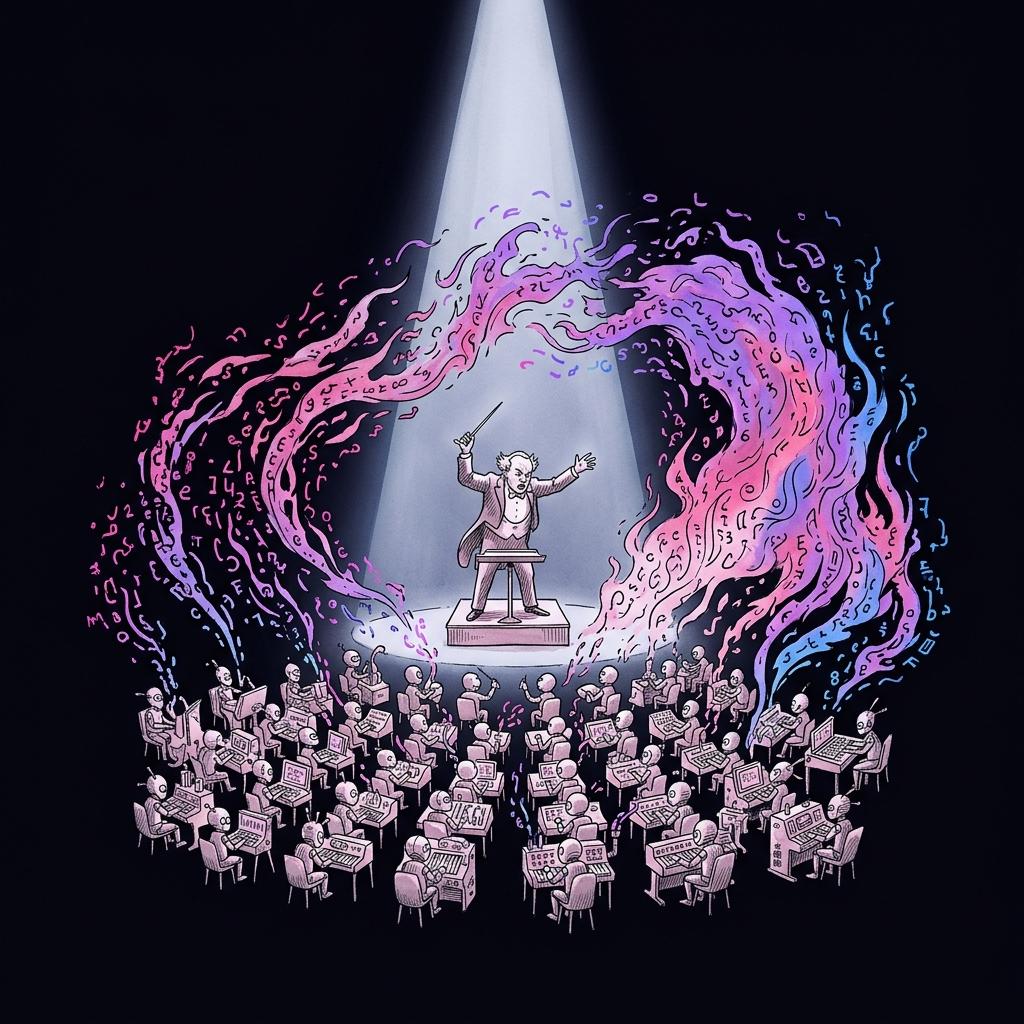
On July 2, 2026, Salesforce shipped the Agentforce Help Agent with a pricing move the customer service industry has never seen at this scale. You pay about two dollars per resolved case. Not per seat. Not per query. Per closed ticket. If the agent escalates to a human, or if the customer says the answer did not help, Salesforce does not charge.
Read that as a warranty on outcomes. Salesforce absorbed the token cost, the retry cost, the coordination cost, and the failure rate across every customer buying the product. They took the risk. The buyer just pays for outcomes.
Now look at what Anthropic published two months earlier. On May 6, 2026, they launched multi-agent orchestration as a public beta feature of Claude Managed Agents. In the same guide, they admitted that a multi-agent research system can beat a single-agent baseline by 90.2% on their internal eval. Then they said the quiet part out loud: the same setup spends about fifteen times the tokens of a normal chat.
Fifteen. Times.
Those two announcements are actually the same story, and the story is about pricing. Anyone selling multi-agent systems for business operations in the second half of 2026 has to decide who pays the coordination tax. The buyer, the vendor, or nobody, because the architecture gets quietly rewritten before it ever ships.
The Bill Nobody Wanted to Read
Anthropic's own runbook is honest about the math. A supervisor pattern, where one lead agent decomposes a task and hands pieces to specialist workers, spends token budget in three places at once. Every worker has its own context window. Every handoff writes the same problem definition twice. Every check-in from the supervisor doubles again on the return trip. Independent research on multi-agent architectures puts the coordination overhead at roughly 58% for peer-to-peer setups and roughly 285% for centralized orchestrators.
EY's 2026 analysis of agentic AI token costs walked customers through a plain scenario. A single agent answering a support question in 2023 might cost four cents. The same question routed through a 2026 multi-agent stack with planning, retrieval, self-critique, and tool use runs closer to $1.20. That is a 30x cost increase for a workflow that, from the user's angle, looks the same.
Most buyers are not looking at that bill. They see a headline price for the platform, an add-on for messaging, a fee for training. The token cost sits under the water line, growing with every automated ticket, every agent that gets confused and asks another agent for help. The finance team notices six months in when the AWS Bedrock invoice or the Anthropic Console meter or the Azure OpenAI bill comes back with a number no one budgeted for.
The Quiet Refactor of Multi-Agent Systems for Business Operations
Here is the finding that got buried under the 2026 orchestration hype. Researchers studied several popular multi-agent frameworks across more than 150 production tasks. They cataloged fourteen distinct failure modes across three categories: system design errors, agent-to-agent misalignment, and termination logic that never converged. On long-horizon workflows, roughly one in three multi-agent runs failed outright.
Then came the harder number. On sequential planning tasks, every multi-agent variant they measured degraded performance by 39% to 70% against a single-agent baseline. Peer collaboration patterns, where agents talk laterally over a group chat and negotiate their way to an answer, collapsed hardest. Central orchestrator patterns held up better but still under-performed on tasks where a lone agent with the right tools would just do the work.
The industry's real answer is not showing up in the press releases. It shows up in engineering blog retrospectives and Medium posts from senior engineers. Roughly half of the multi-agent systems for business operations that shipped in 2025 got rewritten as single-agent architectures in 2026, with the specialist agents demoted to tool calls. The system got faster, cheaper, and more reliable. The buyer did not notice because the interface looked the same.
That refactor is a signal. When production teams pull agents out of the org chart and turn them back into functions, they are walking away from a specific architectural mistake. The mistake was assuming that giving a large model a colleague would help it think. In most cases it just gave it someone to blame.
Why Two Agents Cost Fifteen
The multiplier is not a mystery. It comes from four separate cost sources that all fire on the same request.
First is context duplication. Each specialist agent starts fresh. It does not remember what the orchestrator or its peer agents already read. So the orchestrator ships the relevant context down to every worker. If four workers each need 8,000 tokens of context to work on a slice of the same document, the same document just got billed four times.
Second is the coordination loop. The orchestrator writes a plan. Workers execute. Workers report back. Orchestrator revises. Revised plan goes out. It is rarely one round trip. On any real task it is three or four. Every round trip carries the plan, the state, and the running scratchpad.
Third is self-critique. Modern agents check their own work before returning results. Some check twice, some run a separate critic model. Each check reads the output, reads the requirements, and writes a verdict. All of that is billable.
Fourth is retry cost. When a worker returns something that will not parse, or refuses a task, or times out, the orchestrator retries. Retries cost as much as the first attempt because the model has no memory of what went wrong.
Stack those four on a task that a single, well-tooled agent could have finished in one round trip, and 15x is not a surprise. It is arithmetic.
The Salesforce Bet
Now consider what Salesforce actually sold on July 2. The Agentforce Help Agent price runs on a capitation model. Health plans use the same mechanic to pay primary care doctors a flat fee per patient regardless of how sick the patient turns out to be. Salesforce measured the average cost of a resolved ticket across their customer base, added a margin, and priced the outcome.
If your ticket volume is average, you pay two dollars and Salesforce makes their margin. If your tickets are unusually hard and burn twenty rounds of orchestration before resolving, Salesforce loses money on you. If your tickets are unusually simple, Salesforce makes a lot more.
Salesforce can only make that bet because they know something you probably do not. They know the token cost of their own architecture at the tail. They know their failure rate across categories. They have real numbers on how often a case escalates, and they built the pricing so the escalation reset button costs the customer nothing.
That is a strong position and a threatening one. The moment a customer sees the invoice line item read "five thousand resolved cases at two dollars each," the internal ROI calculation gets very short. Cost per ticket internally: fifty dollars, seventeen dollars, whatever the true burdened number is. Cost per ticket at Salesforce: two. The buyer does not need a McKinsey deck to close that gap.
Every incumbent selling seat-based or API-metered agents just got a competitor with the strongest pricing lever in the market. The seat model does not survive contact with capitation pricing on the same workload.
The Architecture the Bill Forces
Capitation pricing rewrites the design rules for anyone building multi-agent systems for business operations. If you charge by the outcome, you cannot afford an architecture that spends fifteen tokens for one answer. You need an architecture that clears the price point on average, then stops.
That constraint kills several patterns immediately.
Peer-to-peer chat between specialist agents dies first. It costs the most, fails the most on long horizons, and offers the least measurable benefit. Any vendor pricing per outcome will refactor these out within the first quarter of production data.
Full orchestrator-worker patterns survive only where the parallelism actually matters. If four workers can genuinely finish in one round trip what one worker would take four rounds to do, the token cost still adds up but the wall-clock savings can be worth it. Most support workflows do not fit that shape. They are sequential by nature: read the case, look up the account, check the policy, propose an answer.
What actually ships in a pay-per-resolution world is a single agent with real tools, a real memory, and a strict escalation gate. Anthropic's own docs list orchestrator-workers alongside three plainer patterns: prompt chaining (one agent, structured steps), parallelization (one task, multiple angles), and routing (one classifier, multiple destinations). The plainer patterns are cheaper and win more often. The multi-agent label is a marketing story. Architecture requirements sit elsewhere.
Every enterprise CIO who signs a pilot for multi-agent systems for business operations should ask one question first. What is my price per outcome, and does the vendor's architecture survive it? If the answer is no, the buyer is subsidizing the vendor's coordination tax with their own token budget.
The Containment Numbers Nobody Interrogates
Druid's 2026 AI Adoption Benchmark reported containment rates of 80% to 99.5% across sectors. In healthcare, agents were containing 87% of patient service interactions end-to-end, from identity verification through appointment scheduling. In HR and IT, the figure hit 93%. Those are extraordinary numbers if you take them at face value.
The question no vendor volunteers is what architecture produced them. In practice, the workflows with the highest containment rates look most like well-scoped single-agent workflows with strong tool access and a strict escalation gate. Identity verification is a single-purpose classifier. Appointment scheduling is a calendar lookup plus a booking write. Both are things one agent with two tools can do very cheaply and very reliably.
When the same benchmark reports lower containment rates on complex, multi-turn support cases, the architecture story flips. Those are the workflows where multi-agent orchestration got introduced to handle the branching logic, and where the failure rate climbed and the token bill exploded.
The pattern reads the same across every benchmark I have opened this quarter. High containment, low cost, and high reliability go together in single-agent architectures with clean scope. Low containment and high cost track with the multi-agent architectures that got sold as an upgrade. The relationship is causal in the vendor's opposite direction: complex, ambiguous workflows attract multi-agent architectures because the vendor has more to sell there, and complex ambiguous workflows are the ones that fail most often.
The Silo Problem That Never Gets Priced
Salesforce's own 2026 Connectivity Report offered a number that most vendor decks buried. Half of the AI agents currently running inside enterprises operate as isolated silos. They do not share context with other agents. They do not coordinate on customers who reach multiple channels. They cannot hand a case off cleanly.
That number reads like a problem in search of multi-agent orchestration. The math says the opposite. It is a problem in search of shared context and cleaner routing. Two agents that share a memory and a task queue are cheaper, faster, and more reliable than four agents talking to each other over structured messages.
When a vendor tells a Fortune 100 CIO that the solution to agent silos is a semantic coordination layer between forty specialist agents, the CIO should read the token bill for the pilot and ask whether one agent with the right memory graph would answer the same customer question for a tenth of the cost. In every audit I have run this quarter, the answer has been yes.
The silo problem is real. The multi-agent answer is often the wrong shape. It scales the coordination overhead across a network that was easier to fix by giving one agent a better view of the customer.
Where This Ends
Two forces are converging on every buyer of enterprise AI in the second half of 2026. Vendors are pricing outcomes because they can absorb the token risk at scale. Production teams are refactoring multi-agent systems into leaner architectures because the coordination bill was killing them. The buyers caught in the middle are the ones who signed a multi-agent pilot in 2025 with seat-based pricing and are now watching the invoice climb quarter over quarter with no way to renegotiate.
The vendors will not warn them. Every consultancy still selling multi-agent architecture as the standard enterprise pattern has a book of business built on the assumption that more agents means more billable configuration. The refactor to single-agent-with-tools is bad for the consulting model. It is very good for the buyer.
The move to make right now is a full architectural review of any multi-agent deployment that is more than six months old. Count the agents, measure the token cost per resolved outcome, and compare to what a single well-tooled agent would do on the same workflow. If the multi-agent version does not win by at least 5x on wall clock or 3x on quality, delete it. Rebuild it as a single agent with the specialists demoted to tools.
Then look at every pending pilot the same way. If a vendor is proposing an orchestrator with more than three workers, ask them to run the same benchmark against a single agent with the same tool set. If they refuse, or if the numbers do not clear a 3x quality bar, walk.
This is the discipline the pay-per-resolution price point forces on Salesforce every day. It is the discipline every enterprise running multi-agent systems for business operations is going to need by the end of 2026.
Why This Is an Architecture Problem, Not a Purchase
The reason to read this as an architecture problem, not a shopping list, is that the shopping list changes every eight weeks and the architecture question stays the same. Anthropic will ship a new orchestration primitive. Salesforce will roll out another capitation-priced agent. AWS Bedrock will add another workflow template. Every one of those releases will be pitched as the answer.
None of them are the answer. The answer is a stable principle. Buy the outcome. Own the architecture. Refuse to pay the coordination tax on workflows that a single agent would handle on its own.
Owning the architecture means knowing which of your workflows are truly multi-agent (rare) and which are sequential problems dressed up in orchestration language (common). It means writing a real cost model per outcome before signing any pilot. It means keeping the escalation path to humans as a first-class citizen of the system, rather than a fallback buried three self-critique layers deep.
An off-the-shelf multi-agent product will sell you all the pieces. It will not tell you which pieces to leave on the shelf. That decision is architecture work. It requires someone who has read the same production retrospectives, run the same token cost audits, and watched the same pilots refactor themselves into single-agent systems at scale.
Agor AI Advisory does exactly that work. We architect the agent stack around your economics, not the vendor's roadmap. We audit the pilots you already have, price out the tax you are paying on coordination overhead, and write the refactor plan that gets your cost per outcome down where it belongs. We tell you which agents to keep, which to demote to tools, and which to delete.
The vendors have already priced the outcomes. Your job is to make sure you are not the one subsidizing the tax.
Sources
- Salesforce Launches Agentforce Help Agent That Deploys in Minutes and Only Charges for Resolutions, Salesforce Newsroom, July 2026
- Huge Agentforce Pricing Shift: Salesforce Introduces Pay-Per-Resolution, Salesforce Ben, June 2026
- New in Claude Managed Agents: dreaming, outcomes, and multiagent orchestration, Anthropic, May 2026
- Agentic AI Enterprise Token Cost, EY, 2026
- Multi-Agent in Production in 2026: What Actually Survived, Micheal Lanham on Medium, 2026
- Agentic AI trends 2026: How multiagent systems redefine enterprise operations, Druid AI, 2026
- Agentforce Multi-Agent Enterprise Guide 2026, Royal Cyber, June 2026