On November 4, 2025, Kearney published its 2025 Transformation Study, and the finding it led with should have stopped every enterprise AI rollout planned for 2026. Only 29 percent of corporate transformations deliver the value they were commissioned to deliver. Ranked above budget and ahead of technology, the top implementation barrier the 102 surveyed executives named was resistance to change.
The next quarter of board decks read the finding the way boards have read the resistance-to-change finding for thirty years. Send them to training. Build a coalition. Overcommunicate. Get the leaders visibly enthusiastic. Assign a change champion in each function. Measure sentiment monthly. Repeat until the rollout lands.
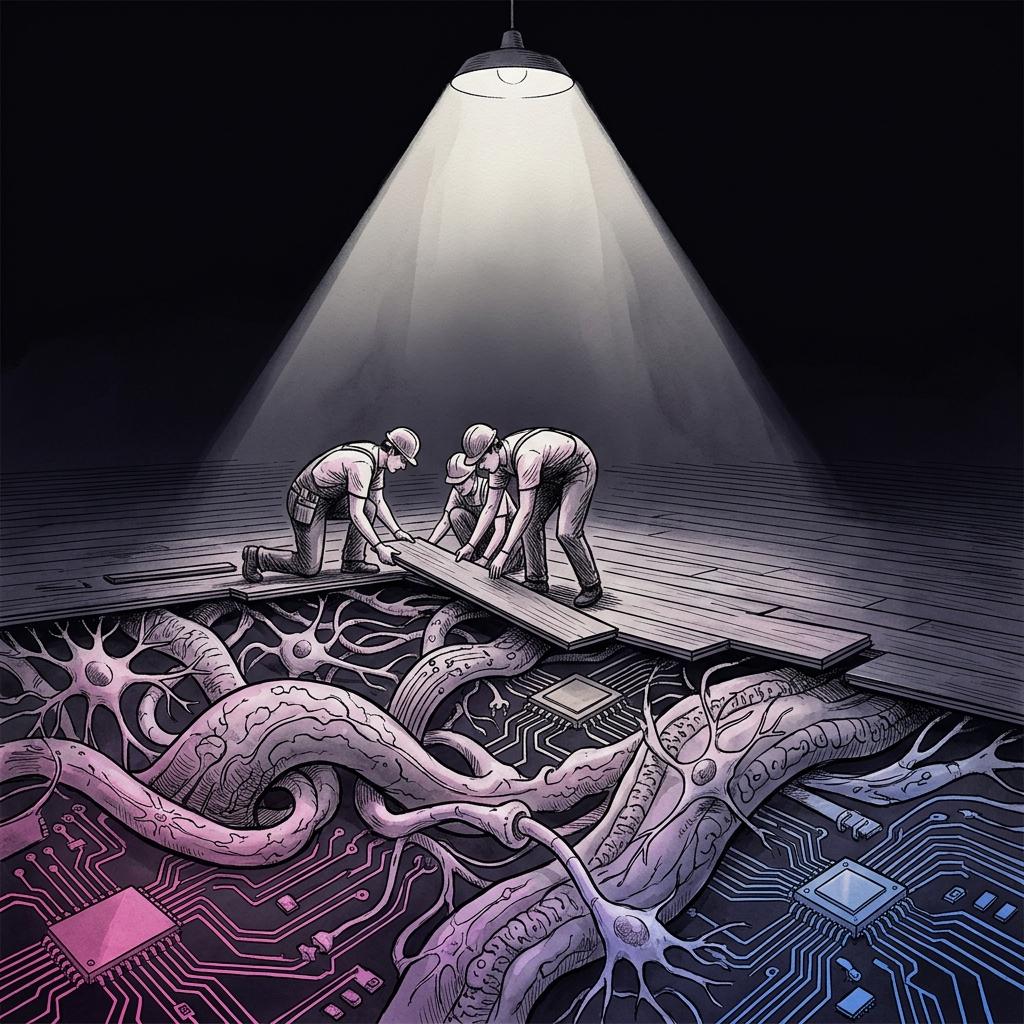
The rollout will not land, because there is nothing under it to land on.
The discipline was built for a stable target
Prosci released the ADKAR model in 1999. John Kotter's Eight Steps came out in 1996. Both frameworks were written for a corporate stack that changed on a release cadence. A vendor announced a major version. IT provisioned a pilot environment. A small population tested. Training material was written against a screen that would still exist a year later. The rollout project had a start date and a completion date. When it ended, the project team dissolved and the operations team owned the running system.
Every one of those assumptions has broken under AI change management.
Anthropic shipped Claude Sonnet 4.5 in September 2025 and Claude 5 in early 2026. OpenAI's GPT-5 landed in August 2025, with a major agent-mode update three months later. Google's Gemini 3.1 Pro superseded 2.5 Pro in the first half of 2026. Every one of those releases changed the shape of what an AI-assisted workflow could do inside a bank, a hospital, a law firm, or a factory. Every training deck built against the prior model went stale before the cohort finished it. Every screenshot in the acceptable-use policy referred to a screen that no longer existed. Every process map assumed a capability boundary that had already moved.
The discipline of change management was designed to migrate humans across a threshold. AI has a slope, and the slope keeps steepening.
The category error at the top
Boards look at the 29 percent success rate and reach for what they know. Bigger program. More training. Bigger comms plan. Sentiment surveys. A steering committee with the CEO as sponsor. This is AI change management as it is currently practiced across the Global 2000, and the practice will not close the gap, because the gap was never about employee resistance in the first place.
The Writer and Workplace Intelligence 2026 study, published in January, reported that 79 percent of enterprises face ongoing challenges with AI adoption despite record investment. McKinsey's State of Organizations 2026 report found that 85 percent of leaders consider organizational adaptability the critical capability for the next five years, and 7 percent believe their organization has it. That 78-point gap is the honest report card on what conventional change management has delivered.
The 79 percent have plenty of awareness. Every insurance adjuster at Progressive has used Claude on their phone. Every marketing manager at Unilever has generated a draft in Google Docs with Gemini. Awareness is over.
They have plenty of training too. Coursera reported that generative AI course enrollments passed 12 million globally in 2025. Deloitte, PwC, and EY each announced multi-billion-dollar internal upskilling programs. Salesforce and Google publish free certification tracks. Learners take the course, pass the quiz, and return to a workflow that has already moved past the material they studied.
What the 79 percent lack is a running system for continuously re-decomposing work around a capability that keeps moving underneath them. The discipline was never designed to produce one.
Rolling out a river
Consider a Prosci-style rollout when the underlying technology stops sitting still.
Month one, the executive sponsor signs off on the pilot. The scope names three workflows in one department. A vendor is selected. Success criteria are written. The training curriculum is drafted against the vendor's demo environment.
Month three, the vendor ships a new model. Two of the three workflows are now doable in a different pattern, one runs end to end without a human in the middle, and a fourth workflow the pilot did not touch is now the highest-leverage candidate in the department. The training material still reflects month one.
Month five, the pilot enters roll-out. Some cohort completes the training. The trainer notices during the last session that the model now handles a step the curriculum tells learners to do manually. The material stays as written, because the change control board meets quarterly and the next slot is month eight.
Month seven, half the pilot cohort has stopped using the tool because the on-screen instructions do not match what the tool actually does. The other half has quietly rebuilt the workflow on a different model they pay for out of their own credit card. The rollout report to the sponsor calls it a mixed adoption result and recommends further training.
Month nine, the sponsor rotates to a new role. The program becomes a maintenance line item. A new pilot is announced in a different function, starting again from month one.
Call this pattern latency. Every hand-off inside the program adds weeks. Every hand-off compounds against a model that keeps shipping. The gap between what the tool can do and what the curriculum says the tool can do widens with every quarter, and the widening gets logged upward as an adoption problem.
AI change management as an operational discipline
Look at the small number of enterprises where AI has actually landed. Klarna's customer service overhaul is the closest thing to a public case study. Klarna announced in February 2024 that its AI system had taken over the equivalent of 700 full-time agents worth of first-response work. It kept shipping updates to that system every quarter. There was no month one, month three, month five. There was a running product team that treated the system as a living component with a weekly release cadence and a live measurement stream.
Klarna's story is the exception that names the rule. What worked was collapsing the distance between the people who understood the workflow and the people who could ship model behavior against it, and then running that collapsed team continuously. The label "change program" did not appear in the org chart.
McKinsey's own case work reports the same shape. The 6 percent of enterprises that qualify as high performers on AI attribute more than 5 percent of EBIT to it, and they show a consistent pattern. Dedicated product teams sit inside operating functions. Model behavior gets treated as a feature owned by the business. A weekly ship cadence is measured against outcome rather than adoption. The workstream and the operating discipline are the same thing.
The mistake most large enterprises are making right now is running an AI transformation program alongside a change management workstream, both governed by the same steering committee, both timed to quarterly release windows. Both are artifacts of the frozen-target world. Both are structurally guaranteed to lag the model.
Absorption architecture
The alternative deserves a name, so operators can request it rather than reach for the old vocabulary.
Call it absorption architecture. The point of absorption architecture is that the model's next release lands in an organization already prepared to swallow it. The workflows are decomposed thinly enough that a new capability slots in without a governance meeting. The measurement runs in real time, so a change in model behavior surfaces as a metric shift the same week. Training happens on the trace rather than against a slide deck. The people who own the workflow have write access to the prompt library, the evaluation set, and the routing config.
Absorption architecture has five components you can audit for tomorrow morning.
First, thin decomposition. A workflow decomposed into thirty small steps absorbs a model upgrade by rewiring three of the steps. A workflow decomposed into three large steps absorbs a model upgrade by demanding a re-architecture. The unit of decomposition determines the marginal cost of every future model release. Most enterprise AI rollouts have decomposed too coarsely, because coarse decomposition maps to the org chart. Fine decomposition maps to the work.
Second, live evaluation. Every step carries a running measurement of quality, cost, and latency, pulling from production traces rather than synthetic tests. The evaluation set grows every week from real cases the operators disagreed with. A new model can be A/B tested against the running evaluation the same day it ships. Without this, the organization has no way of knowing whether the September Claude release helped or hurt any given workflow, and it cannot make an informed decision to move.
Third, operator-owned config. The prompt library and the routing rules live in a repository the workflow operator can edit directly, without opening a ticket for the platform team or the AI center of excellence. If a prompt change requires a ticket, the loop runs slower than the model, and the loop is where the whole system compounds.
Fourth, hand-off logging. Every place a human takes over from the model, or the model takes over from a human, writes a structured log line. This is the raw material for the next capability push. Enterprises that keep this data end up with the fastest cycle time for absorbing new model behavior. Enterprises that lose it have to guess.
Fifth, a permanent product team of three to eight people, funded from operating budget rather than transformation budget, whose job is to keep improving the system against a small set of measurable outcomes. They ship weekly. They review the evaluation set weekly. They rewire the workflow whenever the model releases something meaningful.
AI change management is a fossil word
The reason so many boards are still funding change management workstreams for AI is that the word gives everyone a legible artifact to point at. A comms plan. A learning curriculum. A champions network. Sustainment measures. These artifacts are what a program looks like when you draw it on a page. They are legible to the audit committee and to the CFO. They fit on an ESG page. They survive an audit committee review.
They are also fossilised artifacts of a rollout model that does not describe what is actually being deployed.
The reason the 7 percent of high-performing organizations look so different from the other 93 is that they stopped producing those artifacts. They stopped promising an end state. They started running absorption teams, and they got out of the way of those teams.
An honest AI change management program in September 2026 looks less like a Prosci workshop and more like Klarna's product ops team. Fewer PowerPoint decks. More runbooks. Smaller steering committees. Faster ship cadence. Measurement anchored on outcome. Governance by exception, with a review board that meets when a metric moves rather than because the calendar says so.
What to do this quarter
If you are the executive on the hook for AI transformation and you are looking at a program that already has a change management workstream, three specific moves start closing the gap.
Cut the training curriculum in half by volume. Rewrite what remains against live model behavior as it exists this week. Stand up a process to update the material inside two weeks whenever a foundation model your organization uses ships an upgrade. Assume you will do this three or four times a year for the foreseeable future.
Move the prompt library and the routing rules out of the platform team's repository into a repository the workflow owner can edit. This will feel uncomfortable to whoever runs your AI center of excellence, because it removes a control point. Restore the control point through automated evaluation gates, so a bad change fails the gate rather than waits for a human meeting to approve it.
Convert the two largest workstreams inside your AI program from projects with a completion date into standing teams with a running product backlog. Fund them from operating budget. Give them a P&L outcome to measure against, rather than an adoption target. Retire the steering committee that oversaw them, or reduce its cadence to quarterly, and let the operating measurement handle the weekly rhythm.
These three moves feel like giving up governance, and in fact restore governance to a cadence the technology respects.
The floor kept moving
Change management was a good discipline for a corporate stack that stood still after go-live. It solved a real coordination problem back when the software you deployed on Tuesday looked the same the following Tuesday. It has become a fossil vocabulary now that the software you deployed on Tuesday learns four new capabilities by Friday.
The failure rate of AI transformation programs will not fall until enterprises give up the fossil vocabulary and design their operating model around a system that never sits still. The 7 percent who have done this are the ones the next five years will build around. The 93 percent who keep running change management workstreams against a moving target will be documented in Kearney's 2028 study as the population whose transformation programs kept failing for structurally identical reasons.
The argument here calls for a different kind of rigor, one that lives at the pace of the model rather than the pace of the quarterly review. Fewer PowerPoint decks and more running dashboards. Fewer end-state promises and more weekly ship cadences.
If you are architecting the operating layer that will absorb the next three years of AI capability into your enterprise, the discipline you need is being invented right now inside a small number of running teams. The way to acquire it is to build the architecture yourself, and to bring in operators who have already built one.
Sources
- Kearney releases 2025 Transformation Study (November 4, 2025)
- Kearney: transformation success stuck around 30 percent despite surge in AI investments
- Enterprise AI adoption in 2026: Why 79% face challenges despite high investment (Writer)
- The State of Organizations 2026 (McKinsey)
- MIT: 95% of enterprise AI pilots fail to deliver measurable ROI (Healthcare IT News)
- Workforce resistance puts AI transformation returns at risk (HR Director)