On September 11, 2026, Salesforce introduced seven agents by first name. Casey handles customer service. Paige handles IT and HR. Carter handles commerce. Hunter handles outbound sales, Marshall handles supply chain, Piper handles inbound pipeline, and Fin handles customer experience. Dreamforce opens tomorrow at the Moscone Convention Center and runs through September 17. The staging is unusual. Software vendors have historically named products for what the product does. Salesforce named these products for who they replace.
Anthropic surveyed more than five hundred technical leaders and published its State of AI Agents Report earlier this year. The single number worth reading in that report is 46. Forty six percent of respondents named integration with existing systems as the primary obstacle to deploying agents. Deloitte's 2026 technology-trends work puts the pilot-to-production failure rate at 89 percent. Gartner's May forecast expects 40 percent of agentic AI projects to be canceled by the end of 2027. The pilots are working. The rollouts are dying between the demo and the org chart. That gap, and what lives inside it, is what agentic workflow implementation in business actually means.
The named agent is a business choice
The reason Salesforce called them Casey and Piper and not AutoAgentCS-v2 is that the company has stopped selling software. It is selling a colleague. The pricing pivots with the framing. A software seat is a per-user fee. A colleague is a fully-loaded cost figure the CFO already has in a spreadsheet, and Salesforce is anchoring against the second number. The Agentforce launch page markets what Salesforce calls Agentic Work Units. The company reported 7 billion of them across Agentforce and Slack, with 3.2 billion in the second quarter alone. The unit of measurement, deliberately, is not tokens or seats. It is the piece of work a person would have done.
The pilot passed because the human was still there
Every enterprise agent pilot succeeds under one quiet simplification. A human is watching. The pilot dashboard reports response quality and resolution time. The pilot pipeline is small enough that when something odd happens, someone senior sees it and steps in. When the odd thing happens in the rollout, nobody steps in, because the rollout deleted the person who would have stepped in.
Klarna is the reference incident. In 2024, Klarna replaced roughly 700 customer service roles with an OpenAI-backed agent. The agent handled 2.3 million conversations in its first month. The dashboards were clean. CEO Sebastian Siemiatkowski told the market Klarna was Sam Altman's favorite guinea pig. Twelve months later, CSAT and NPS on post-interaction surveys had collapsed on complex or emotionally charged tickets, and Klarna started rehiring humans. The volume metrics had never been the honest measure. The 2.3 million number covered the easy 80 percent. The hard 20 percent had been running on humans, and stopped running when the humans left.
What the runbook did not say
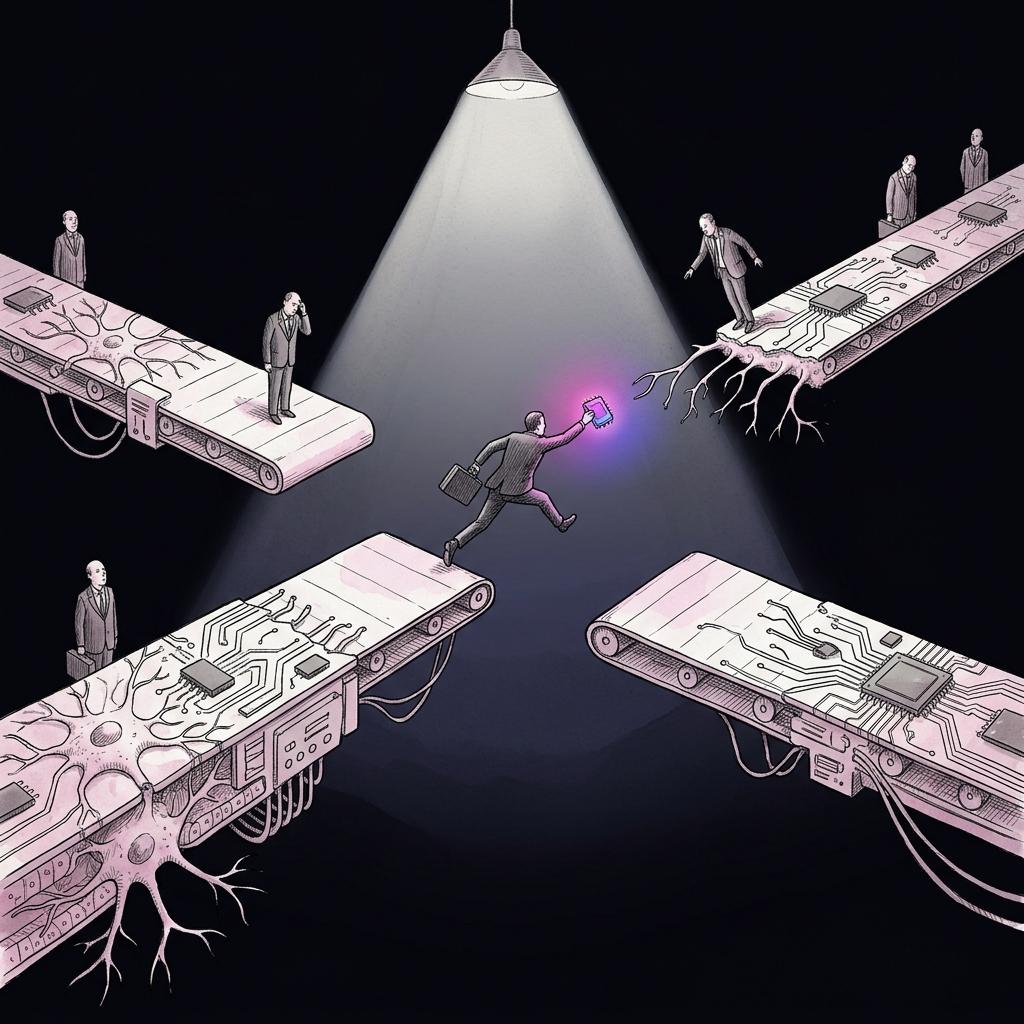
Every workflow diagram in every company has boxes and arrows. The boxes are the steps: fetch the ticket, look up the account, apply the discount, close the case. The arrows are the transitions. When a human ran the workflow, the arrows were the work. Between the box that said look up the account and the box that said apply the discount sat a human decision. Is this customer angry. Is this customer bluffing. Has this customer been screwed by us before. Do I need to check with retention first. None of that was in the runbook. All of it was in the salary.
Agentic workflow implementation in business is the discovery and codification of every one of those arrows. The steps were the visible payroll. The gaps were the invisible payroll. The gaps are what the rollout removes and cannot recover, unless the rebuild names them and turns them into artifacts.
Naming Casey does not give Casey the old job
The seven Salesforce agents inherit job descriptions written for humans, and job descriptions are always underspecified. Kate, the retention agent who used to hold Casey's queue, could ask around. Kate parked state in her head between Slack messages, tolerated missing fields on the record, escalated on a hunch, learned the small conventions the team had never written down. Casey inherits a JSON schema. Casey needs an explicit escalation policy, a durable state store, a receipt for every judgment call, and a machine-readable definition of what "this customer has been screwed by us before" means.
The Anthropic State of AI Agents Report tags this as an integration challenge. The 46 percent is doing double duty in that framing. Half of the 46 percent is genuine plumbing, meaning the agent needs to reach Snowflake, Zendesk, and the SAP instance in Germany. The other half is workflow archaeology, and the workflow archaeology is what the pilot never revealed, because the pilot's human backstop was doing it in real time and nobody wrote it down.
Agentic workflow implementation in business is a rewrite
The dominant enterprise pattern in 2026 is to buy an agent platform, drop it into an existing process, and measure the drop against the process's old numbers. Salesforce, ServiceNow, Microsoft, and Oracle have all built their sales motion around this pattern. The pattern will produce the 89 percent failure rate for the same reason every business-process-reengineering wave produced its own. The underlying process is being asked to remain the definition of the work, and the underlying process was designed around the cognitive and social capabilities of the people who ran it.
A workflow written for humans, populated with agents, is a hostile environment for agents. It has too many exceptions per step, too much implicit state, too little machine-readable authority. The teams that succeed with agentic workflow implementation in business start with a different question. They ask what the workflow would be if it were written from scratch for an agent, and they build to that answer.
What they discover in the answering is that ninety percent of the existing workflow was never work. It was compensation for the shape of the people doing it. Meetings scheduled to synchronize state that could have lived in a database. Emails written to prompt a human to remember a rule that could have been encoded. Retries and handoffs that existed because the previous step was fragile in ways a person tolerated silently. The rewrite is smaller, harder, and shaped differently, with fewer arrows, more state, and a different escalation topology.
The MCP conversation is not the workflow conversation
The Model Context Protocol crossed 97 million monthly SDK downloads by mid-2026 and reached more than 5,800 published servers. The July 28, 2026 revision of the specification moved to a stateless architecture and promoted Enterprise-Managed Authorization to stable, which removes the identity-provider friction that had blocked many Fortune 500 integrations. Linux Foundation governance, joint commitments from AWS, Cloudflare, and Google Cloud, and open participation from OpenAI and Microsoft mean the plumbing question is closer to solved than any executive would have predicted when Anthropic first shipped the protocol in November 2024.
The plumbing being solved makes the workflow question louder. When it was hard to connect an agent to Salesforce and Snowflake at once, executives could tell themselves the workflow was fine and the integration was the constraint. Now that the integration is a two-day project, the constraint is exposed. The workflow itself was the bottleneck.
The buyer's mistake is timing
The mistake enterprises are making right now, in September 2026, is buying seats before writing the workflow. Salesforce will happily sell five hundred activated Casey seats. Salesforce reports that the average number of activated agents in customer estates has nearly tripled year over year, alongside a 53 percent reduction in average agent creation time. The activation number is a leading indicator of the cancellation number.
Gartner's 40 percent projected cancellation figure is not going to hit because the vendors ship badly. It will hit because the workflow archaeology never got done and the seats got activated anyway. Casey will handle 80 percent of the tickets, the CSAT number on the hard 20 percent will collapse, someone in a board meeting will decide the agent does not work, and the seats will get deprovisioned. The vendor gets paid either way. The client absorbs the sunk cost, the change-management scar tissue, and the internal argument that agents were oversold.
What working looks like
Anthropic put 80 percent of surveyed respondents at measurable ROI in the current State of AI Agents Report, weighted heavily toward coding use cases. The organizations that will read the 2027 report as the ones with measurable ROI on non-coding workflows are running a specific sequence right now.
First, they picked one workflow narrow enough that a single team owns it end-to-end. Second, they mapped what the humans on that workflow actually did, including the between-the-steps work, and wrote it down for the first time. Third, they rewrote the workflow from scratch for an agent, because agents run a different problem than humans run and the two shapes of process are different. Fourth, they defined escalation criteria a machine can evaluate, replacing the phrase "use judgment" with specific state predicates. Fifth, they built a state store with real receipts, not chat transcripts. Sixth, they deployed with a human backstop wired in for six to twelve months, treating the backstop as instrumentation rather than overhead.
That is what the 90-day-to-production benchmark in the enterprise research actually means when it works. Ninety days is not spent shopping. It is spent rewriting the process, followed by a controlled rollout with the human loop closed on purpose so the invisible work becomes visible and gets encoded before the humans are removed.
The vendors already know this
None of what the previous section describes is what Salesforce sells at Dreamforce. Salesforce sells Casey. Accenture and Google Cloud announced their Gemini Enterprise Business Group on September 8, 2026, and the arrangement embeds trained engineers inside client offices to write production Gemini applications directly on the client's own systems. AWS put a billion dollars into its own forward-deployed engineering hub on June 30, 2026. The reason the labs and the consultancies are pushing this hard on embedded engineers is that they have understood the workflow-archaeology problem faster than most of their customers.
Models do not deploy themselves. Agents do not either. The seat sale funds the vendor and the FDE sale funds the reality. A buyer who takes the seat sale without the FDE work will produce a case study for the 89 percent. A buyer who does the FDE work with a partner whose commercial interest is a bigger platform bill will end up with an implementation that entrenches the platform rather than one that serves the workflow.
Where a specialist advisor fits
Salesforce, Google Cloud, and Microsoft each have a commercial interest in selling you their platform. Accenture, Deloitte, and the labs' forward-deployed teams have a commercial interest in billing hours on the workflow rewrite through their preferred stack. Both interests are legitimate. Neither is the buyer's interest.
The buyer's interest is a workflow that produces the same outcome with a materially different cost curve, on a platform choice the buyer can defend in three years when the current vendor's incentives have shifted. The workflow-rewriting work needs to be led by someone whose loyalty is to the workflow rather than to a vendor. That is what a specialist advisor is for.
The specialist's job is to name every arrow in the current process, price the human work in each arrow, decide which of the arrows survives the rewrite, and design the machine-readable state that carries the surviving load. The vendor choice comes after the workflow is a spec. It does not come first.
The window is short
Every quarter that a company activates a fleet of agent seats against an unrewritten workflow is a quarter of accumulated organizational memory that will be interpreted as agents failing, when the honest reading is that the workflow was written for a species of worker who has been removed. Board meetings are already scheduling the cancellation reviews Gartner projected. The organizations that will not be in those meetings are the ones that treated the last twelve months as workflow-rewriting time and the platform decision as an implementation detail.
Casey is real. Piper is real. Hunter is in pilot and targeting general availability in November. The seats will be activated regardless. The question is whether they are activated into a rewritten workflow or a workflow whose gaps were filled by people who no longer work there.
Conclusion
Agentic workflow implementation in business is not a purchase and not a deployment. It is a rewrite. It is the work of exposing every unwritten step in the current process, pricing the human labor those steps used to absorb, deciding which steps survive contact with an agent, and building explicit machinery for the ones that do. The teams that architect this work outperform the teams that buy this work by margins the case studies have not yet made public, because the winning teams are still consolidating their advantage in silence.
Architecting requires a partner whose loyalty is to your workflow and not to a seat. That is not what Salesforce sells at Dreamforce this week, and it is not what the FDE motions at AWS or Google Cloud are designed to deliver. Schedule a strategic consultation with us today.
Sources
- Salesforce Launches 7 Named AI Agents Before Dreamforce, Enterprise DNA, September 2026
- Salesforce Agentic Enterprise Index: Agent Deployments More Than Double Year over Year, Salesforce Newsroom, September 2026
- The 2026 State of AI Agents Report, Anthropic
- Why Agentic AI Projects Get Canceled and How to Ship, Digital Applied, 2026
- How Klarna's AI Agent Strategy Backfired But Became A Useful Lesson, Forbes, July 16, 2026
- The 2026-07-28 Specification, Model Context Protocol Blog
- Why Model Context Protocol is suddenly on every executive agenda, CIO, 2026