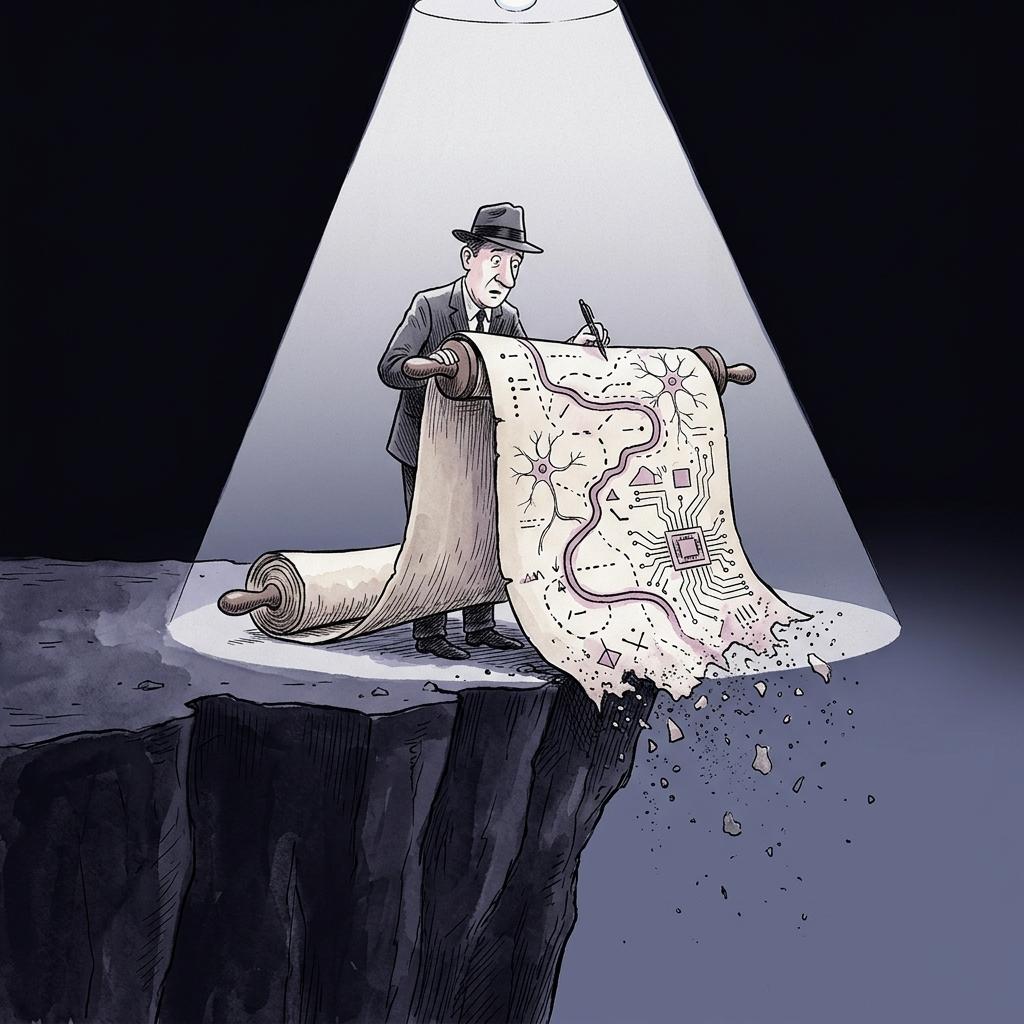
On May 21, 2026, Microsoft and EY stood on a London stage and announced a five-year, one-billion-dollar joint program. Its stated purpose was to help large enterprises move their AI work "beyond experimentation" and into scale. Bloomberg carried it. Microsoft's own press wire carried it. Every management publication picked it up within the day.
The subtext was louder than the text. Two of the largest professional-services and cloud brands on the planet had looked at the enterprise AI market and concluded, publicly, that most of it was stuck. They put a billion dollars against a single verb. Scale.
Ten weeks later, on August 10, 2026, a company called AI/R launched AI/Cockpit One. It is a control plane for governance, observability, budget, and identity across many AI tools inside a single enterprise. The press release did not put it this way, but the product exists because a large enterprise now runs many models at once, and none of them are the answer for more than a quarter.
Between those two announcements sits the shape of a problem no consulting deck names. RAND's project analysis pins the enterprise AI project failure rate at 80.3 percent. MIT's Project NANDA, whose report on the "GenAI Divide" landed in mid-2025 and has been cited into every 2026 boardroom, found that 95 percent of enterprise generative AI pilots yield no measurable business return. In the current cycle, one in three pilots is abandoned before production. Another one in three completes and underdelivers.
Every one of those failed projects had a plan. Almost every plan was called the same thing. An AI transformation roadmap for executives.
The genre was inherited from a world that no longer exists
The AI transformation roadmap for executives is a genre. It has a shape. Discovery, then use-case selection, then proof of concept, then pilot, then scale. It has a Gantt chart. It has stage gates. It has budget lines. It has a steering committee. It has a "current state" and a "future state" and a set of workstreams that flow from one to the other over eighteen to thirty-six months.
That shape is inherited. It comes from the CRM rollouts of the 2000s and the ERP rollouts of the 1990s. Those rollouts were long and painful, but they carried one large assumption. The vendor's product sat still. If your Salesforce implementation began in Q1 and finished in Q3, the Salesforce you shipped in Q3 was the same Salesforce your consultants had scoped in Q1. Oracle, SAP, Siebel, Peoplesoft. Products with release cycles measured in years. Your roadmap and their release cycle were compatible.
The AI vendors are not compatible with that clock. OpenAI, Anthropic, Google DeepMind, Meta, and xAI each ship a new frontier baseline every eight to sixteen weeks. Their release cycles are the shape of a quarter. Your roadmap is the shape of a year. The gap between those two clocks is where 80 percent of pilots die.
What actually happens over eighteen months
Consider what happens when you write a roadmap in May 2026. You scope a use case for customer support. You benchmark today's model. You size the integration. You estimate the vendor cost per token. You budget the training data and the eval harness. You promise a Q4 milestone.
Between May and Q4, the frontier moves twice. The vendor cost per token drops by half. A new model handles the entire integration you scoped as bespoke work. A fresh evaluation benchmark makes your metric obsolete. The Q4 milestone still gets shipped, and it hits its acceptance criteria on paper. It arrives as yesterday's ceiling. Your organization now owns a bespoke customer-support agent that is measurably worse than what a competitor's summer intern got by wiring up a fresh model over a long weekend.
This is what the RAND number captures. Real projects. Real teams. Real ship dates that arrived at yesterday's ceiling.
The roadmap assumes the target stands still
The reason so many consulting decks recommend the same artifact is that they are optimizing for the internal politics of committing to a plan, not for the delivery physics of a moving field. A steering committee cannot approve emergence. A budget cycle cannot commit to a compass. The roadmap is what gets approved, so the roadmap is what gets sold.
An AI transformation roadmap for executives becomes the wrong artifact the moment the frontier moves faster than the roadmap's own stage gates. That is the entire enterprise AI market in 2026. Every quarter, a model release resets the acceptance criteria for anything you scoped last quarter. Every quarter, a tool that was bespoke last quarter becomes a two-line API call. Every quarter, a category that did not exist last quarter becomes table stakes.
There is a specific version of this failure the MIT NANDA researchers named. They called it the "learning gap." Their finding was that the failed enterprise pilots were not failing on model quality. They were failing on organizational adaptation. The models were fine. The organizations could not adapt to a moving target. They shipped what was written in Q1.
Read that finding twice. The failure sits in the artifact the organization uses to plan. The model is fine. The plan is the problem.
What the frontier did in the last ninety days
Take a compressed window. Between the Microsoft and EY announcement on May 21 and today, August 11, roughly twelve weeks have passed. In that window:
Microsoft and EY placed a billion dollars against helping enterprises move from pilot to scale. That is a public bet that current enterprise AI approaches are stuck, made by two organizations whose consulting revenue depends on those enterprises being stuck.
AI/R launched a governance and observability control plane on August 10, aimed at enterprises that are now running many models, agents, and third-party tools like Langflow, Flowise, and n8n at once. That product exists because the "which model" question is now permanently unresolved. Central control planes are being built precisely because the model layer under them shifts every quarter.
Frontier labs continued their public release cadence, resetting benchmarks and pricing across text, code, and multimodal workloads. Your May roadmap benchmarked against a model that is not the model your Q4 milestone will run on.
Deloitte's State of AI in the Enterprise now puts 34 percent of surveyed organizations in a "deep transformation" bucket and 30 percent in a "redesigning core processes" bucket. That is a majority of large organizations actively rewriting their operating models around AI in flight. There is no version of a static roadmap that survives contact with a majority of your industry rewriting itself in parallel.
In ninety days. Not a year. Not five. Ninety days.
The compass, not the roadmap
The correct artifact for enterprise AI in this cycle is a compass. A compass does not tell you what turns to take. It tells you what direction to walk. When the terrain rewrites itself between sprints, the roadmap is a lie about the terrain and the compass is the truth about the direction.
A compass, for an executive team, is a small set of durable principles. What work is human-owned. What work is machine-owned. What work is jointly held and where the handoff lives. What must be reversible. What must be measured. What must escalate. What may never be autonomous. Which data lives inside your walls and which may leave. What speed of change your governance can absorb.
These principles do not name a model. They do not name a vendor. They do not name a Q3 milestone. They name a shape. Once the shape is stable, the work of translating each quarter's frontier capability into your operating model becomes a running loop, not a phased rollout.
The running loop, in plain terms
A running loop looks like this. A small team, five to fifteen people, sits at the intersection of the frontier and your business. They read the model releases the week they land. They run new capability against your existing workflows in a sandbox. They ship what works, in small reversible increments, into the parts of the business where the compass says machine-owned work is welcome. They rewrite the eval harness against the new baseline. They tell the rest of the organization what changed. Then they do it again next week.
That loop is not a project. Projects end. Loops do not. A loop is the operating-model change. A project is a purchase order.
What a compass-driven organization actually looks like
The organizational shape that ships weekly against a moving frontier is small, senior, cross-functional, and continuously funded. It reports high, usually to the CEO or the COO, because it needs the authority to reversibly change how the business runs. It owns a budget, a set of tools, a set of evals, and a set of principles. It does not own an eighteen-month plan.
The team's cadence is weekly, not quarterly. It ships every week, into a small blast radius. It writes down what it did, why, what it measured, and what it will try next. That written record is the artifact the steering committee actually needs, because it lets the committee steer against reality rather than against a plan that got printed in Q1.
The team's tools are portable. Portable evals. Portable prompts. Portable governance. Portable observability. When the frontier moves, the team swaps the model behind the eval and re-runs. If the new model wins, the team promotes it. If it loses, the team writes down why and moves on. There is no procurement cycle. There is a router.
The team's governance is guardrails, not gates. A gate is a stop sign at a milestone. A guardrail is a rule about what can never happen. Guardrails let a fast team ship without asking permission for every change. Gates force a slow team to ask permission for every change. The 80 percent failure rate is populated by organizations that put gates where they needed guardrails. The 20 percent that ship built guardrails and then let their team run.
That is what a real AI transformation roadmap for executives looks like in 2026. Not a document. A small team. A set of principles. A running loop. A portable eval harness. A set of guardrails. The document exists to describe those things to the board. The team is the artifact.
The buy, the build, and the missing verb
Consulting decks in this cycle keep offering executives two choices. Buy tools from a large vendor and integrate them. Or build custom tools and own them. That framing is a leftover from the SAP-versus-in-house debates of the 2000s. It misses the verb the current cycle demands.
The verb is architect. Not buy. Not build. Architect.
Architecting means deciding the shape of the operating model, the shape of the team, the shape of the eval harness, the shape of the governance, the shape of the data boundary, and the shape of the router that sits in front of the vendors. It means holding the shape stable while the models underneath keep changing. It means designing an organization that treats every frontier release as fuel rather than as a threat.
An enterprise that buys AI tools without architecting the shape ends up with the AI/R problem before AI/R existed. Many tools, no central plane. No shared eval. No shared governance. No shared identity. No shared budget. That is why AI/R and every product like it exist. They are selling back to enterprises the missing architecture the enterprises should have built themselves.
An enterprise that builds bespoke AI tools without architecting the shape ends up with the RAND problem. It ships in Q4 what its Q1 roadmap said, and the shipped thing is measurably worse than a fresh vendor tool. It has paid twice. Once for the bespoke build, and once for the opportunity cost of not being on the current frontier.
An enterprise that architects gets to swap what it buys and what it builds every quarter without touching its operating model. The compass holds. The runner ships. The vendors and the models change underneath.
Why AI/R and the control-plane market exist
Look at what AI/R actually shipped on August 10. It is a bundle of the things a well-architected enterprise would already have. An AI gateway. Unified identity. Budget controls. Detailed telemetry. Real-time monitoring. Model-agnostic connections to open-source orchestrators. Segregation between environments.
Every enterprise that has been buying AI tools for two years without architecting the shape now has to buy that bundle from a vendor. The bundle is the shape they should have built while they were writing their first roadmap. The market has repriced the missing architecture. It is now a line item, sold by many vendors, at margins that will accrue to those vendors for a decade.
The lesson is not that AI/R is bad. It is that the architecture layer is unavoidable. The only question is whether you own it or rent it. If you rent it, every quarter the vendor gets to decide what you can and cannot do with your own models. If you own it, every quarter you get to add whatever the frontier just shipped.
Why the architect has to sit inside your building
There is a further point that most consulting arrangements do not want to acknowledge. Architecting cannot be outsourced by the year. The architect has to sit inside your building, at the level where your operating model is actually decided, and stay there as the frontier moves. If the architect leaves at the end of a six-month engagement, the compass ossifies. The team drifts back into a phased rollout because that is what everyone else in the enterprise expects. The 80 percent pattern resumes.
The architect's job is to keep rewriting the shape of the operating model as the frontier moves, while holding the compass steady. The job is not a plan written once and handed over at close of engagement. It is a role, a running commitment, a weekly presence in the room where decisions get made.
That kind of architect is rare. They read model releases the week they land. They have shipped AI into production before, in more than one company. They can talk to a board in the morning and to an engineer in the afternoon. They have strong opinions about what may never be autonomous. They are willing to be wrong in writing every week and to revise. They know the difference between a gate and a guardrail without being told.
Agor AI Advisory exists to place that architect and that operating model inside enterprises that have already tried the roadmap route and watched it stall. We do not sell a plan. We do not sell a Gantt chart. We do not sell a stage gate. We sell the compass, the running loop, the eval harness, the guardrails, and the person who runs the loop until you can staff it yourself. Then we hand you the loop and stay on call as the frontier moves.
The imperative
If your enterprise still holds an eighteen-month AI transformation roadmap, retire it this quarter. Not next year. This quarter. The roadmap is the reason your pilots did not ship. Every week you hold onto it, the frontier moves further ahead of what it promised. Every week, the acceptance criteria you agreed to in Q1 look smaller against the free tier that just launched.
Replace the roadmap with a compass and a runner. Fund the runner permanently. Give the runner a budget, a set of tools, a set of principles, a set of guardrails, and the authority to ship weekly. Measure the runner not on adherence to a plan, but on capability shipped per quarter, reversibility of change, and closeness of your organization's evals to the current frontier.
Do not buy this from a large integrator by the milestone. Architect it. Put the architect inside the building. Hold the compass steady while the ground moves.
Sources
- Bloomberg, Microsoft and EY to Spend $1 Billion to Help Clients Adopt AI, May 21, 2026
- Microsoft Source, EY and Microsoft announce global initiative to help clients scale AI enterprisewide value creation, May 21, 2026
- GlobeNewswire, AI/R Launches Unified Platform for Enterprise AI Governance, August 10, 2026
- Healthcare IT News, MIT: 95% of enterprise AI pilots fail to deliver measurable ROI
- Virtualization Review, MIT Report Finds Most AI Business Investments Fail, Reveals GenAI Divide
- Deloitte, The State of AI in the Enterprise 2026 Report
- Pertama Partners, AI Project Failure Rate 2026: 80% Fail (RAND analysis)