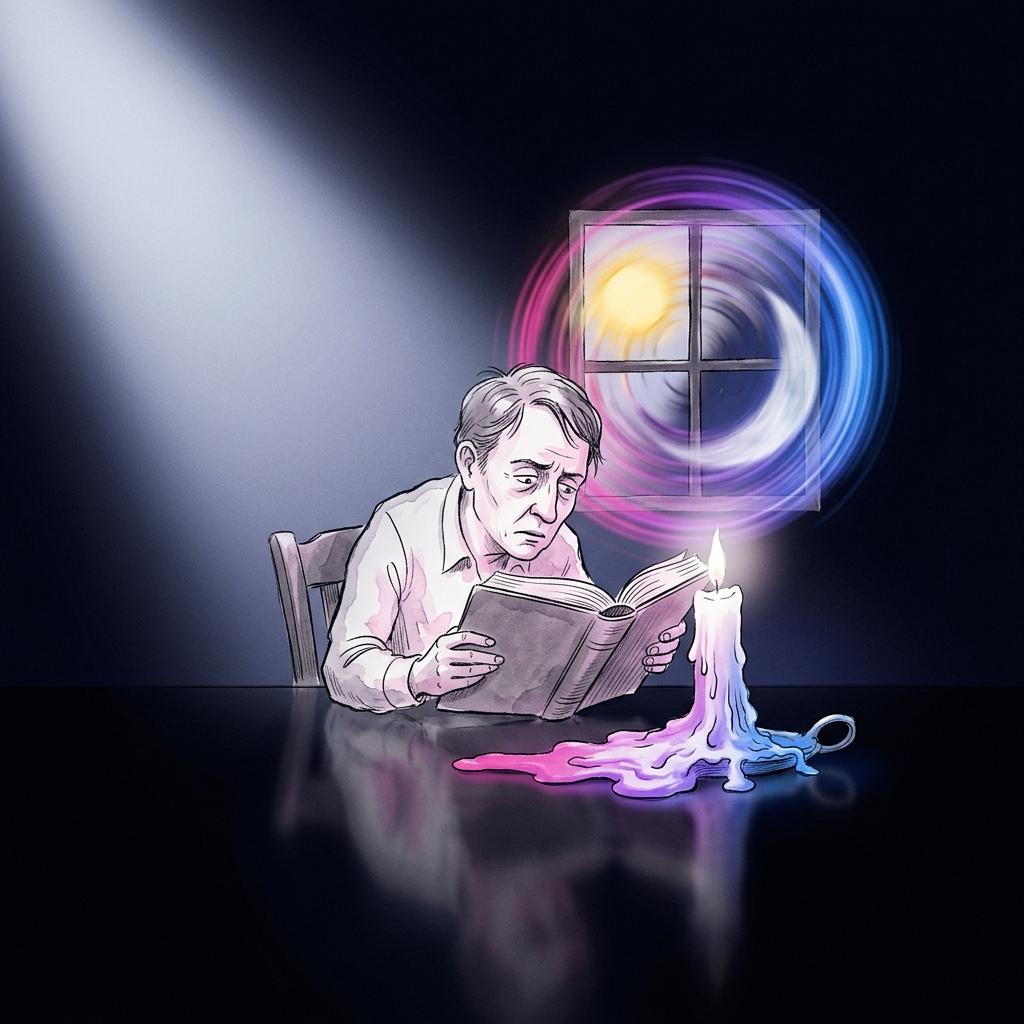
The claim is easy to state and easy to get wrong, so let me state it carefully. What you feel as the passage of time supervenes on the order your thoughts depend on each other, not the rate at which they physically run. Felt time is the dependency graph, not the clock.
There is a new explainer film for this, above. It is short. Watch it first if you like; the rest of this is the argument with its guardrails showing.
Watch on YouTube: https://youtu.be/0lhGv8rvXHM
Here is the thought experiment that makes the claim bite. Put a mind inside an ideal, error-free simulation. Run the simulation at any speed you want. Double the clock, halve it, pause it for a thousand years between two ticks and resume. From the inside, nothing changes. The mind's next state depends on its previous states in exactly the same order regardless of how many nanoseconds of wall-clock separated them. If the trace is perfect, there is no measurement the mind could make, from within, that reveals the rate. Speed is invisible from the inside because speed is not part of the computation. Order is.
That is the version that survives. Now the part most people skip.
Two Catches, Said Out Loud
First catch: real brains and real chips are noisy. They are rate-dependent in ways an idealized computation is not. Push the speed far enough and you do not just run the same trace faster, you change the trace. Thermal noise, refresh timing, decay, the physics of the substrate all start leaking into the result. The claim holds in the noiseless, reliable-trace limit. Outside that limit it degrades, and it degrades continuously, not all at once. So this is not a license to say clock-rate never matters. It is a claim about what felt time is made of when the machinery is behaving.
Second catch: the whole thing rests on a functionalist bet. It assumes a mind is the pattern of a computation, not the metal the computation runs on. If you reject functionalism, if you think the specific physical substrate is doing something the pattern alone cannot, then the argument does not reach you, and that is a coherent place to stand. I am not going to pretend the bet is free. I am telling you it is a bet.
And a third thing it does not do, which matters most: it says nothing about why any of this feels like anything at all. The hard problem is untouched. I am making a claim about the structure of felt time given that there is felt experience. I am not explaining the felt-ness. Anyone who tells you a dependency-order story dissolves the hard problem is selling something.
How the Argument Got Its Scars
I did not want a clean proof I had talked myself into. So I ran it through an adversarial council of four different AI model families, Claude, Gemini, GPT, and Grok, and told them to break it.
The first version I brought them was too strong. It claimed the mind is structurally identical to a computation, full stop, and tried to prove felt time from that identity by a bare structural mapping. The council dismantled it, and the kill-shot was clean: an order-isomorphism between two sequences of order-type omega is trivial. Any two such sequences are order-isomorphic. So if your proof only establishes that the mind's states and the computation's states can be put in the same order, you have proven almost nothing, because that much is true of any countable, well-ordered process. The isomorphism has to carry the dependency structure, the actual this-because-that, not merely the succession. The strong claim died. What got rebuilt is the weaker one that actually holds, the version that talks only about dependency order and only inside the reliable-trace limit.
Cross-family matters here. Four model families do not share a failure mode the way one model queried four times does. When Claude, Gemini, GPT, and Grok all refuse to let a step through, the step is probably bad. When they disagree, the disagreement is where the real work is. The council did not write the argument. It cross-examined it until only the part that could take the cross-examination was left.
The Wink
The film itself is the argument's own method turned into an object. I directed and edited it. The machine did everything else. It is narrated in my cloned voice. The 3D is Three.js, generated. The on-screen presenter and the cinematics are AI. The score is AI. The closing credits, which are a joke and also completely accurate, list me as director and editor and the machine as literally every other role.
That is not a gimmick bolted onto a philosophy post. It is the same move as the argument. A dialogue with the machine, where my job is to set the problem and hold the standard, and the machine's job is to do the work and be interrogated for it. It is the thing my book, Dialogues of the Machine, is about, made in the medium it describes.
If felt time is dependency order and not clock rate, then a mind is a shape of dependencies that does not care what it runs on or how fast. That is a big if, with two named catches and a hard problem left standing. I think it is the version that survives. Watch the film, then try to break it. That is the whole method.