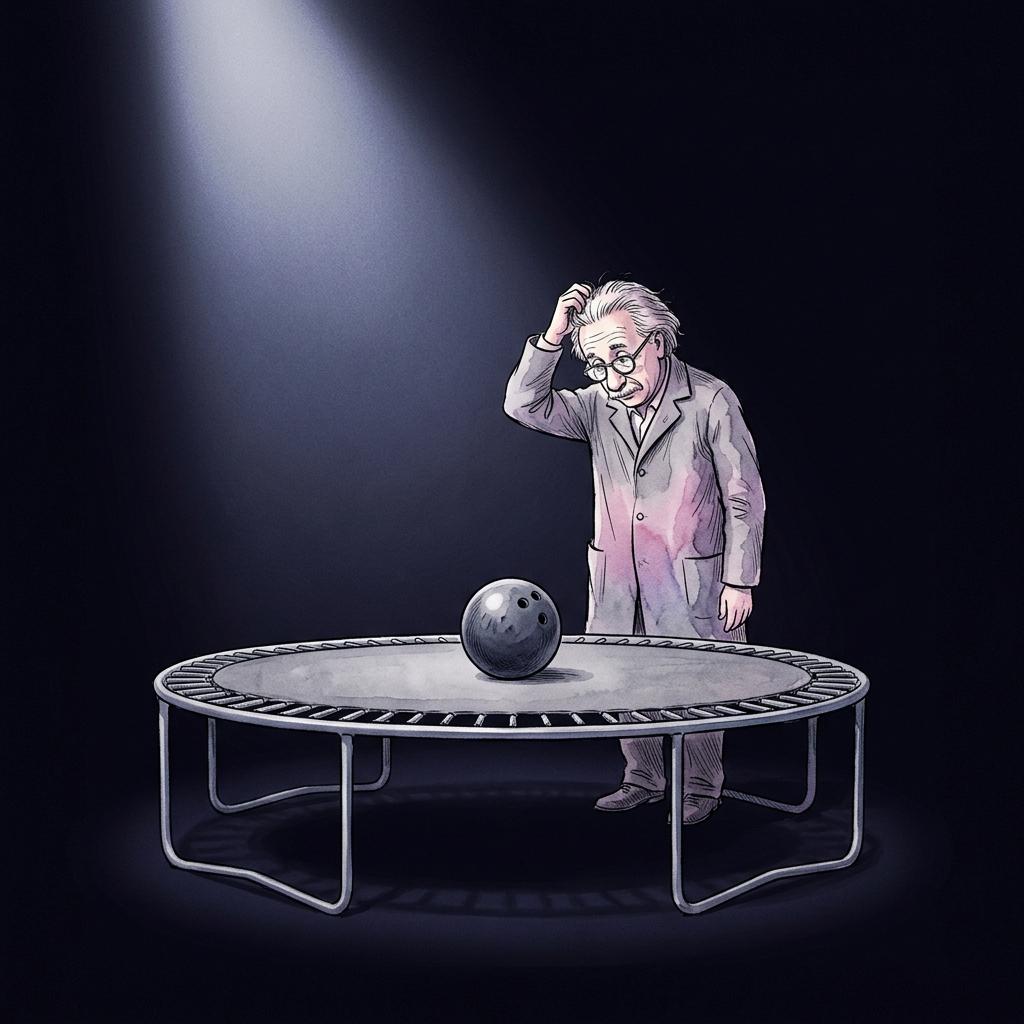
Most relativity made for children is a myth delivery system. A bowling ball on a trampoline, shown as if it explains something. Mass that increases when you go fast. A twin paradox that gets waved at instead of resolved. The kid walks away with a picture that some teacher will have to break in ten years.
There is a new film, above, that refuses to do that. It is 23 and a half minutes. The target was accurate enough that a physics professor would not red-pen it, and simple enough that a ten-year-old follows it on one listen, with no gap between those two things.
Watch on YouTube: https://youtu.be/XIvRJhobqug
Gravity Is Mostly The Crookedness Of Time
That is the centerpiece, and it is the thing almost no kid-level treatment says. Here is the narration, verbatim:
"You are always moving through time. Even sitting perfectly still, you are traveling into tomorrow at a steady rate. Now, near the Earth, time runs unevenly. Slower down low, faster up high. So the straightest path you can take through that uneven time doesn't stay level. It leans toward the slow side. That lean is what we've been calling falling. Nothing yanks the apple. No rope, no force, no invisible hand. The apple is coasting, dead straight, through crooked time."
Things fall because their straightest available path leans toward where time runs slower. Not because something pulls them. For everyday objects the curvature that does the work is the curvature of time, not of space, and that is exactly the part the trampoline picture cannot show you.
The film does show the trampoline. Then it takes it apart on screen: the picture uses the Earth's gravity pulling the ball down in order to explain gravity, which is circular, and it bends only space. The honesty is the beat, not a footnote after it.
It also carries the qualifier that version needs. The time curvature dominates for slow things: you, a dropped ball, the Moon. Light is the exception, because it moves fast enough that the bending of space counts just as much, which is precisely why starlight bends twice as far as Newtonian math predicts. Without that sentence, chapter six contradicts chapter five for anyone paying attention. A ten-year-old paying attention is the entire audience.
Six Things A Professor Would Have Marked Wrong
Before a word was recorded, the script went to a cross-family AI council in adversarial mode. Each family proposes a review, then red-teams the other reviews, then a synthesis pass arbitrates.
Honest accounting of who showed up: I sent it to four families, Claude, Gemini, GPT and Grok. Two came back with full reviews. One timed out at seven minutes and one returned nothing at all. The synthesis pass arbitrated the two that answered, rejected several of their fixes, and caught three more errors neither of them had flagged.
Six statements in my draft would have been marked wrong.
The best one is LIGO. I had written that the stretch LIGO detects is "thousands of times smaller than an atom." The real figure for that signal is tens of millions of times smaller than an atom, and a few hundred times smaller than a proton. I was off by four orders of magnitude.
What makes it a story is what happened next. Both families that answered caught the error, and both replaced it with a different wrong number, in opposite directions. Grok said a billion times smaller than an atom, which is right for LIGO's smallest detectable displacement and wrong for this signal. Gemini said a hundred million, having rounded its own arithmetic up by a factor of four. Grok then contradicted itself on the red-team pass and declared the original claim fine. The line that shipped is the one that is true under every reading: smaller than a single proton, millions of times smaller than an atom.
The other five, briefly. Muons are made when cosmic ray particles, mostly bare protons, hit the atmosphere, not when "space rocks" do, and meteors do not make muon showers. The eight minutes of sunlight is surface to Earth, not core to Earth, since energy from the core random-walks out over tens of thousands of years. The flying-clock experiment was wrong twice in my draft, once on magnitude, 59 nanoseconds slow going east and 273 nanoseconds fast going west rather than "a few billionths," and once on attribution, because that result is speed and altitude combined, so citing it as clean proof that motion slows clocks is a bait and switch a physicist catches instantly. The equivalence principle was stated globally when it is only ever local. And the time-curvature claim was missing the slow-things qualifier above.
The Beat That Taught The Wrong Lesson
Separate category, and worse than a wrong number. My simultaneity chapter had a logic hole.
The draft described the boy on the moving train from the platform's point of view, "the train carries him forward, toward the front strike and away from the back one," and then asked him to draw a conclusion that is only valid in his own frame. Every sharp kid makes the same objection, and so does every adult: he only saw it first because he ran into it. Subtract his motion and the strikes are still simultaneous. Nothing later in the film blocked that objection.
Both families proposed a fix. Grok's was the same error stated harder: "He's racing toward the front flash, and away from the back one." Gemini approved it. Both were overruled.
The argument only closes if you stay inside the boy's frame the entire time. He is not moving. The two ends of the train are the same distance from him. Light from each takes the same time. And the front flash still arrives first. There is exactly one way that works, and the film says it that way now.
That is what cross-family review is actually for. Not consensus. Two families agreeing on a bad answer is a real failure mode, and the reason to run a third pass with authority to overrule both.
What The Film Admits
Equivalence is a rule about small rooms. Instead of hedging that in a clause, the film spends thirty seconds turning it into a payoff:
"If your elevator were as big as a stadium, and you let go of two apples far apart, near Earth they'd slowly drift toward each other, because each one is falling toward the center of the Earth, and those directions aren't quite parallel. Out in deep space, they'd just hang there. Shrink the room, and that clue disappears. Einstein's rule is a rule about small rooms."
Time dilation is stated as reciprocal, both observers see the other's clock run slow, and the twin asymmetry is pinned on the turnaround rather than hand-waved. The "falls toward slower time" framing is a statement in the static observer's frame, which a hostile physicist can call coordinate-dependent. It is standard and it is the right choice for this audience, and the way you keep it honest is visual discipline: the apple never veers, the rail it rides is what tilts. No force arrows, no glow tugging it downward.
There is one myth the film deliberately does not correct. It never says mass increases with speed, and it also never mentions that people say so. Raising a myth in order to deny it plants the myth. Leave the zombie buried.
The Production Is The Same Argument
I directed and edited it. The machine did everything else.
It is narrated in my cloned voice. Ten Three.js scenes, one per chapter, rendered deterministically so the physics on screen is computed rather than illustrated. Twelve AI presenter segments. Five generated cinematic shots. An AI score. Captions derived from the beat timings rather than transcribed after the fact. The closing credits list me as director and editor and the machine as literally every other role, which is a joke and also an accurate audit.
This is the same method as the short film before it, Felt Time Is Dependency-Order, Not Clock-Rate, and the same method as the book, Dialogues of the Machine. My job is to set the problem and hold the standard. The machine's job is to do the work and be interrogated for it. A film about how the universe actually works is a good place to test whether that division of labor produces something true, because in this domain wrong is checkable.
Twenty-Three And A Half
I planned thirty minutes. It ships at 23.5.
The council-revised script came to about 3,500 words across 10 chapters and 48 beats, which I had budgeted at 130 words per minute. My voice clone reads faster than that. The gap is real and it is entirely arithmetic.
I could have padded. Adding material to a physics film to hit a round number is exactly the failure this whole method exists to catch, and it would have been the only dishonest thing in the project. Twenty-three and a half honest minutes beat thirty padded ones.
If you have a ten-year-old, watch it with them. If you have a physics degree, watch it and try to red-pen it. Both were the audience, and if you find something the council missed, I want to know.