Florian Bansac wrote a LinkedIn post recently that I keep coming back to. Here is his argument as I read it. AI is taking the junior work first, the first drafts and research memos and the decks a first-year analyst builds at midnight. Firms will be tempted to stop hiring juniors. But senior judgment is grown out of that junior work. You learn what a good memo looks like by writing bad ones and having a partner mark them up. Cut the bottom of the ladder and in ten years you have no one to put at the top. So firms should keep building senior judgment on purpose, even when the machine does the entry-level tasks more cheaply.
I think he is right about the mechanism, and I want to give it its full weight before I argue with it. Judgment really is built from reps. A senior associate knows which clause will blow up in a dispute because she has seen it blow up. A consultant knows which number in a client's model is fiction because he once presented a fictional number and got caught. None of that is in a textbook. It lives in people who did the work and got feedback on it, and a firm that stops producing those people is borrowing from its own future. It is also an easy mistake to make, because the savings from cutting juniors show up this quarter and the cost shows up a decade later.
My disagreement is about the timing. His argument assumes that the top of the ladder holds still while this year's graduates climb toward it. I don't think it does. The evidence I have says the senior rung is moving up, and it is moving on a schedule we can measure.
Capability that arrives on a schedule
The reason anyone can talk about AI progress with dates attached goes back to two papers.
In January 2020, Jared Kaplan and nine coauthors published Scaling Laws for Neural Language Models. Their finding was blunt: "The loss scales as a power-law with model size, dataset size, and the amount of compute used for training, with some trends spanning more than seven orders of magnitude." Put more compute in and you get a predictable amount of improvement out. In March 2022, Jordan Hoffmann and 21 coauthors refined the recipe in Training Compute-Optimal Large Language Models, the Chinchilla paper. After training over 400 models they concluded that "for every doubling of model size the number of training tokens should also be doubled," and that "current large language models are significantly undertrained."
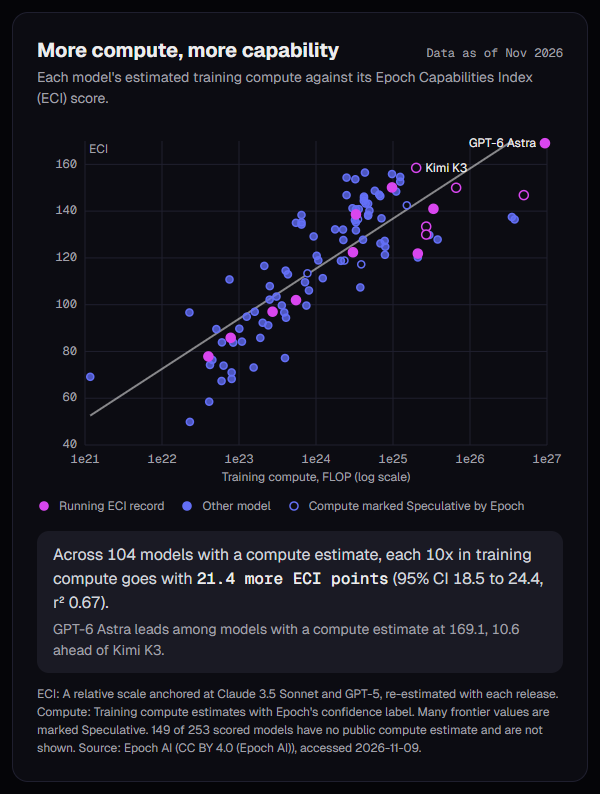
Those papers did something unusual for a field built on surprise. They made progress forecastable. Labs could size a training run before starting it and know roughly what they would get. Epoch AI publishes estimated training compute for many models and, separately, an Epoch Capabilities Index score. The figure below joins the two, using Epoch's data.
Try it. Press Frontier only, then press it again to bring back every model. Hover a point to see the model, its compute and its score.
What to look for. Compute runs on a log axis, so the points rising in a rough line mean each tenfold step in compute buys a similar gain in capability. Hollow points are compute figures Epoch rates as speculative.
 Play with this figure
A loss curve doesn't tell you what a model can do for a client, though. For that you need a different ruler.
The ruler that ran out
METR, a nonprofit that evaluates frontier AI systems, built that ruler. It times skilled humans on a suite of software, machine learning and cybersecurity tasks, then asks how long a task can be before a model fails half the time. That length is the model's 50% time horizon. In March 2025 METR reported that this horizon had been "consistently exponentially increasing over the past 6 years, with a doubling time of around 7 months."
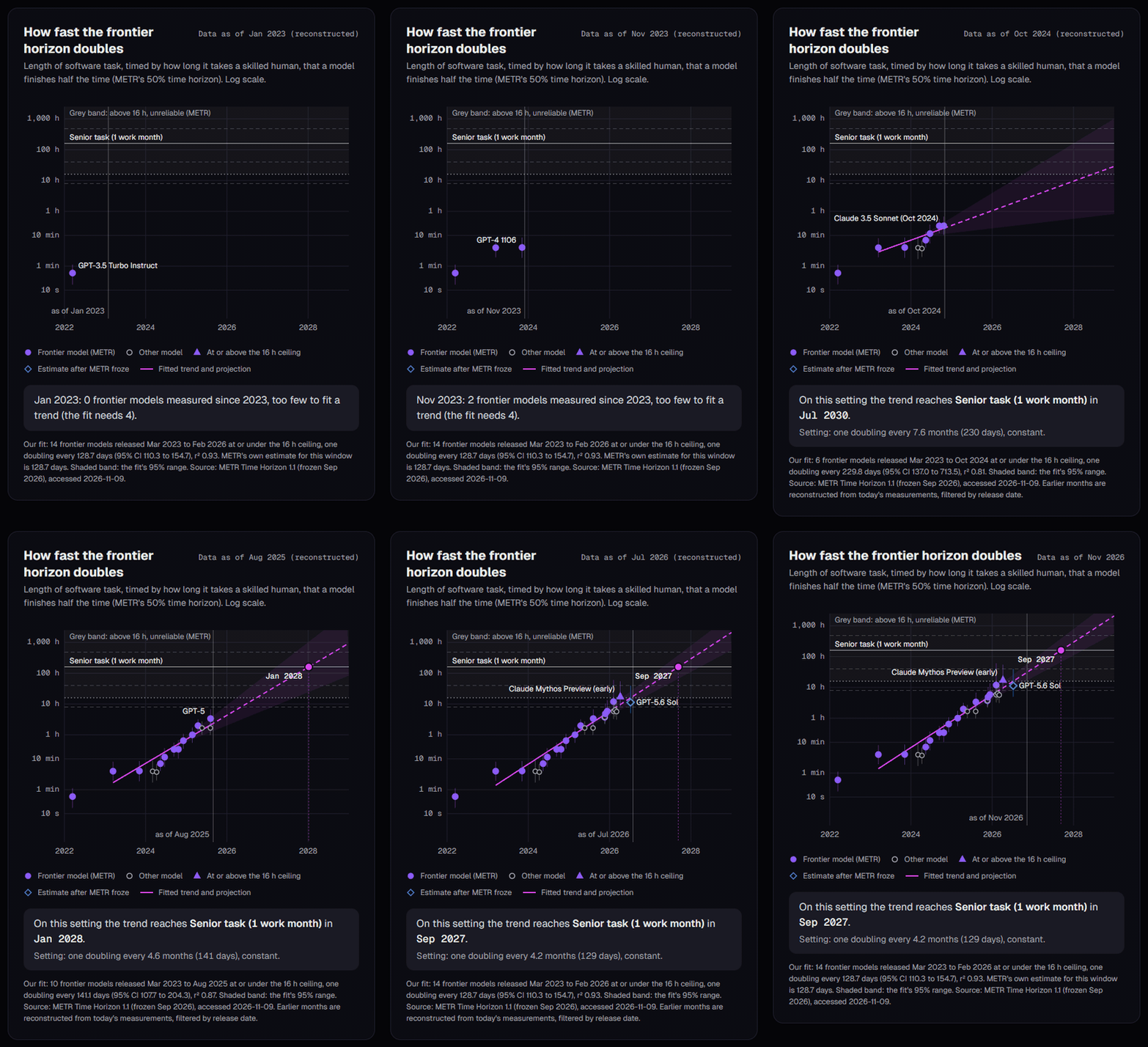
Then the doubling got faster. METR's current Time Horizon 1.1 file puts the doubling time for frontier models released from 2023 on at 128.744 days, with an interval of 104 to 158 days. In its Frontier Risk Report of May 19, 2026, METR fit only models released after January 1, 2024 and got "a doubling time of 105 days, and an R2 of 0.98."
The raw points make the speed easier to feel. GPT-4, released in March 2023, had a horizon of about four minutes on METR's page. Claude Opus 4.6, released in February 2026, measured about 12 hours. Claude Mythos Preview, in an early version released in April 2026, measured 1,044.78 minutes, about 260 times GPT-4's figure in a little over three years.
And then the ruler ran out. When METR added Mythos Preview on May 8, 2026, it added a warning to the page: "Measurements above 16 hrs are unreliable with our current task suite." The risk report said the most capable agents "essentially saturated" the benchmark: "Their measured time horizon was over two full-time-equivalent days, though we are increasingly uncertain about the point estimate due to saturation." On September 8, 2026, METR marked the page as no longer actively updated. Its June estimate for GPT-5.6 Sol came in at "around 11.3hrs (95% CI: 5hrs - 40hrs)" under its standard rules, and jumped "beyond 270hrs" if cheating attempts were counted as successes.
Some people read the saturation as a reason to discount the trend. I read it the other way. METR released Time Horizon 1.1 in January 2026 with a larger task suite that doubled the number of tasks eight hours or longer. By May only a handful of those long tasks were still unsolved. When a yardstick runs out that fast, the thing it measures is still growing.
Try it. Move the Doubling time slider between its ends, then raise RSI speed-up per doubling. Change Threshold to see when each rung is crossed.
What to look for. The vertical axis is logarithmic, so a straight line is steady doubling. The shaded band above 16 hours is where METR says its measurements stop being reliable. The readout gives the crossing date your settings imply. That date is a forecast.
 Play with this figure
METR is careful about what the horizon means, and I should be too. Its human baseliners "have an average of about 5 years of relevant experience," and the tasks are self-contained. METR says it is better to think of a two-hour task "as what someone with low or no prior context (like a new hire or freelance contractor) could complete in 2 hours." It also says an 8-hour horizon "does not mean that AIs can do 8 hours of work that a (high-context) human professional can do as part of their day-to-day job." That caveat is Florian's side of the argument, stated by the people who built the measure.
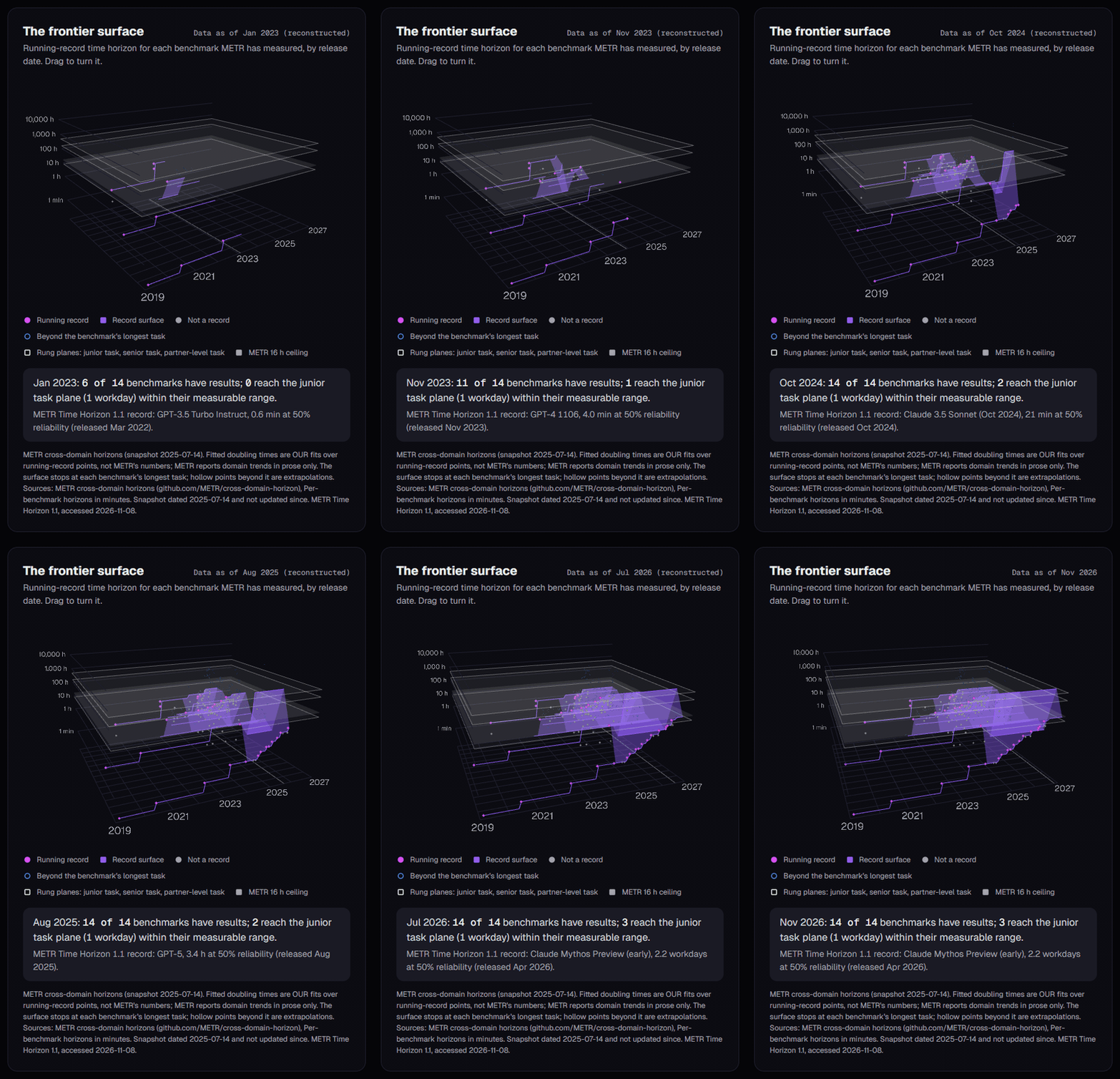
METR's cross-domain work, published in July 2025, shows the same shape outside software, at different heights. The surface below puts the domains side by side.
Try it. Drag to turn the surface. Press play on the month scrubber, or drag it, and watch the surface build from 2023 to now.
What to look for. Each row is a benchmark, and height is the task length a model can handle. The flat planes mark a workday, a work month and a work quarter. Watch how many rows push through the lowest plane.
 Play with this figure
What senior judgment is, in hours
If I want to argue that the senior rung moves, I have to say what the rung is. Here is my working definition, and it is an editorial one: judgment is the ability to do useful work when the task is long and the feedback is slow.
A junior task fits in a day. You get it in the morning, you hand it back that evening, and someone tells you by the next morning whether it was right. A mid-level person owns a week of work with a few moving parts. A senior person runs a workstream for a month and decides what to do next without being told. A partner runs an engagement where the verdict arrives a quarter later, often from a client who never says it out loud.
So I put the rungs at a workday, a work week, a work month and a work quarter of focused effort. Those cut-offs are my assumptions. You can move them in the figures. Count from Claude Opus 4.6, the last record below METR's 16-hour ceiling. A work month is nearly four doublings past it, and a work quarter a little over five. METR's Time Horizon 1.1 doubling times run from 105 days to about 188, so four doublings take somewhere between fourteen months and two years from February 2026. That is a forecast, and it inherits every caveat above.
Feedback delay matters as much as task length. A model that can work for a month is only useful if someone can tell, at the end of the month, whether the work was good. That is the part that stays slow.
The loop starts to close
Scaling laws describe what happens when humans build bigger models. The newer question is what happens when the models start building the models. The labs have been unusually specific about this, so I'll let them speak with dates attached.
On October 29, 2025, Sam Altman posted: "We have set internal goals of having an automated AI research intern by September of 2026 running on hundreds of thousands of GPUs, and a true automated AI researcher by March of 2028." In September 2026, OpenAI said the first goal had been met. I could not load OpenAI's own post, so this rests on Help Net Security's report of September 7, which says the system "can carry out well-defined research tasks under human direction, including work that would take a skilled researcher several days," and that OpenAI's research organization "logs 3.1 agent-workdays of effort for every eight hours of human labor." At DevDay on September 29, Altman said: "A few weeks ago we reached that goal. We now have an AI research intern." That is OpenAI grading itself against its own definition, with no outside evaluation.
Anthropic has published more of its own numbers. In June 2026, the Anthropic Institute's essay When AI builds itself, by Marina Favaro and Jack Clark, reported: "As of May 2026, more than 80% of the code we merge into Anthropic's codebase was authored by Claude." Before Claude Code launched in February 2025, it said, the share was in the low single digits. The same essay is candid about the gap: "large performance gaps persist when it comes to Claude exercising judgement in choosing goals in both engineering and research."
Dario Amodei made the forecast version in January 2026, in The Adolescence of Technology. Because AI writes much of Anthropic's code, he wrote, "this feedback loop is gathering steam month by month," and it may be one to two years from the point where "the current generation of AI autonomously builds the next." Florian's post attributes a remark about law, finance and consulting careers to Amodei. I couldn't find a primary source for that wording, so I'll stick to what he wrote himself: that AI "will disrupt 50% of entry-level white-collar jobs" over one to five years.
The most useful item is the most recent, because it comes from outside the lab. On November 5, 2026, METR published an independent assessment after a high-access evaluation at Anthropic that ran from August 12 to October 29. Its conclusion: "As of October 2026, Anthropic is likely improving the capabilities of their models on well-specified tasks at around twice the rate they did between March 2024 and October 2025." It adds that it "would not be surprised if the true acceleration was closer to 1.3x or 3x." Note the qualifier again: well-specified tasks.
This is what recursive self-improvement means for the curve. Each doubling may take a little less time than the one before. The doubling and ladder figures let you set that shrink. The default I use is 10% per doubling, which is a scenario I chose, not anyone's measurement.
The work itself
Software tasks are a narrow window onto a firm. OpenAI's GDPval paper, published September 25, 2025, went closer to the work Florian is talking about. It "covers tasks from 9 sectors and 44 occupations that collectively earn $3T annually." The tasks were written by experts who averaged 14 years of experience, and they "require an average of 7 hours of work for an expert professional to complete." Other experts graded the model deliverables blind against the human ones.
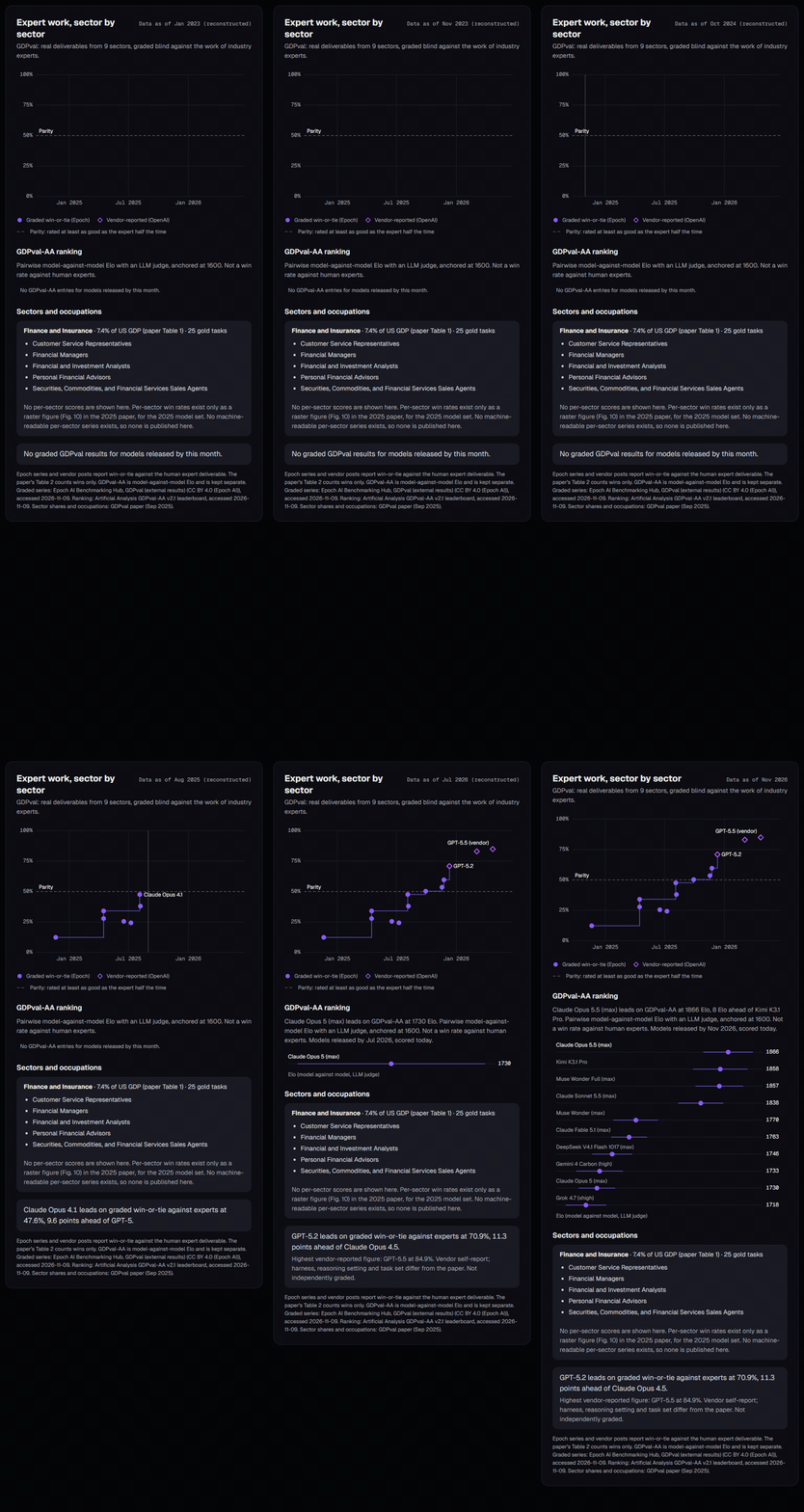
Of the seven models the paper tested, Claude Opus 4.1 did best: "47.6% of deliverables by Claude Opus 4.1 were graded as better than (wins) or as good as (ties) the human deliverable." OpenAI's later launch posts claimed far higher rates: 70.9% for GPT-5.2 Thinking and 83.0% for GPT-5.4, and the GPT-5.5 post reports a score of 84.9%. Those are vendor-reported, run with different settings, and not independently graded. They should be read as claims. Even discounted heavily, they describe a machine that ties or beats a seasoned professional on a seven-hour deliverable more often than it loses.
Try it. Pick a sector from the menu to see its share of GDP and the occupations it covers. Drag the month scrubber to replay the scores.
What to look for. The dashed line at 50% is parity with the human expert. Circles come from one consistently graded series. Diamonds are vendor-reported. The ranking below the chart is a separate, model-against-model scale and should never be read as a win rate.
 Play with this figure
The ladder clock
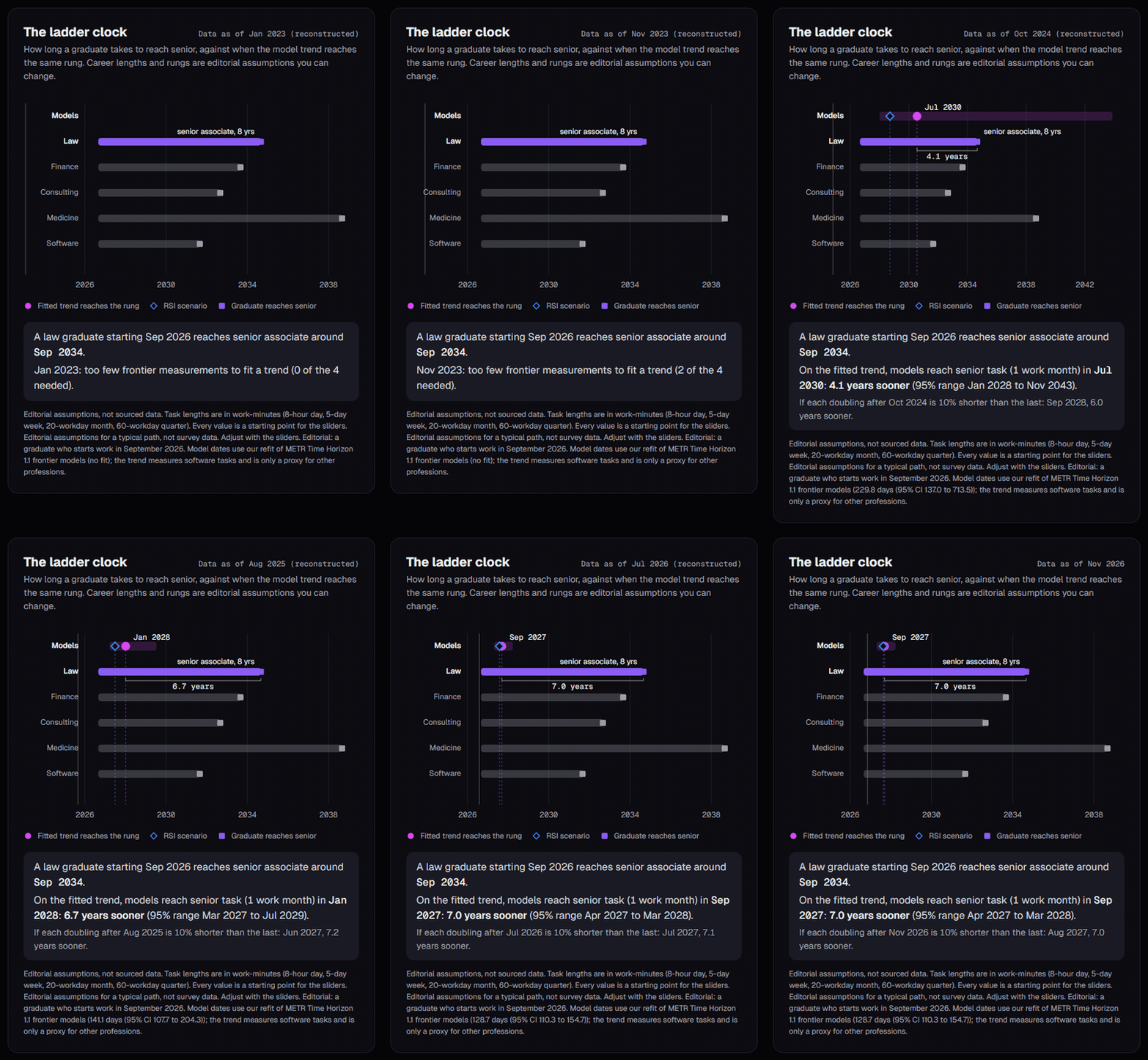
Now put the two clocks next to each other. A graduate who starts work in September 2026 needs years to reach the senior rung. My starting assumptions, which you can change, are 5 years in software, 6 in consulting, 7 in finance, 8 in law and 12 in medicine counted from the first day of medical school. The model needs a handful of doublings.
Try it. Choose a profession, then drag Years to senior. Switch the Rung, and raise RSI speed-up per doubling to see how far the model's date moves.
What to look for. Each bar is a person's path from first job to senior. The circle is when the trend line reaches that rung. The gap between them, in years, is the number to argue about. Every input here is an assumption you can change.
 Play with this figure
At the default settings, the trend reaches the senior rung years before the graduate does, in every profession on the list. You can argue with the defaults. The doubling slider goes as slow as a year per doubling, well past METR's original seven months, so you can test how much slowdown it takes to close the gap. A slowdown is possible. Curves bend, and METR's own measure has run out of headroom. But a firm making a ten-year staffing bet should look at the middle of the range, and the middle says the rung moves faster than the person.
What stays with people
So what should Florian's firm train people for, if the senior task itself is on the curve?
I keep landing on ownership, which the curves don't measure. Someone has to be accountable when the work is wrong: sign the opinion, stand behind the audit, tell the board. A model can produce a month of analysis, but a regulator, a court or a client still wants a person whose name is on it. Someone has to own the client: know what they are afraid of, hear what they didn't say, and keep the relationship when the answer is unwelcome. And someone has to decide what is wanted in the first place. Anthropic's own essay names that last one as the gap that persists: choosing goals.
First drafts at midnight teach a little of this. Most of it comes from being in the room when a decision is made and living with what follows. A firm that wants senior judgment in 2035 should put its juniors in that room early. Give a second-year a small client to own outright, with their name on the work. Let the machine write the draft while the junior learns to say whether it answers the question the client actually has.
Florian's instinct, keep building people, is right. What changes is the curriculum. The ladder we used to train on was made of tasks, and the tasks are what the models are climbing. The ladder worth building now is made of responsibility.
Where the numbers stand, Nov 2026
| Measure | Value |
|---|---|
| Doubling time, our fit to METR's frontier models from 2023 | 128.7 days (95% CI 110.3 to 154.7), 14 models |
| METR's own estimate for the same window | 128.7 days |
| Longest task measured at 50% reliability | Claude Mythos Preview (early), 2.2 workdays (released Apr 2026) |
| METR Time Horizon 1.1 last updated | 2026-09-08 |
| Junior task (1 workday) | trend line passed it in Mar 2026 |
| Mid-level task (1 work week) | Dec 2026 on the trend (range Sep 2026 to May 2027); Dec 2026 if each doubling is 10% faster |
| Senior task (1 work month) | Sep 2027 on the trend (range Apr 2027 to Mar 2028); Aug 2027 if each doubling is 10% faster |
| Partner-level task (1 work quarter) | Apr 2028 on the trend (range Oct 2027 to Nov 2028); Jan 2028 if each doubling is 10% faster |
| Training compute and capability (Epoch ECI) | about 21.4 ECI points per 10x compute, 104 models |
| GDPval, highest win-or-tie rate against industry experts in Epoch's series | GPT-5.2, 70.9% |
| GDPval, highest vendor-reported rate, not independently graded | GPT-5.5, 84.9% |
| Data last verified | 2026-11-09 |
This month. First edition. The doubling time stands at 128.7 days and the top record is Claude Mythos Preview (early) at 17.4 hours, with METR's data last updated on 2026-09-08. The junior task is passed as of Mar 2026 and the mid-level task is projected for Dec 2026. From next month this note says what changed.
Crossover dates are projections from a fitted trend, not forecasts. The task-length thresholds and the RSI speed-up are editorial assumptions.
Sources
- Florian Bansac, LinkedIn post on entry-level work and senior judgment
- Kaplan et al., Scaling Laws for Neural Language Models (arXiv, January 2020)
- Hoffmann et al., Training Compute-Optimal Large Language Models (arXiv, March 2022)
- METR, Measuring AI Ability to Complete Long Tasks (March 19, 2025)
- METR, Task-Completion Time Horizons of Frontier AI Models (last updated September 8, 2026)
- METR, Frontier Risk Report (May 19, 2026)
- METR, GPT-5.6 Sol evaluation (June 26, 2026)
- Sam Altman on X (October 29, 2025)
- Help Net Security, OpenAI research automation intern (September 7, 2026)
- Anthropic Institute, When AI builds itself (June 2026)
- Dario Amodei, The Adolescence of Technology (January 2026)
- OpenAI, GDPval paper (September 25, 2025)
- Epoch AI, Data on AI models