Fourteen theories of consciousness are in active circulation, and most explainers treat them like a menu. Pick the one you like. I think that is the wrong shape for the field, because the theories do not sit side by side. They disagree about specific, testable things, and some of those tests have already been run.
On April 30, 2025, the Cogitate Consortium published the result of an adversarial collaboration in Nature. Rival camps agreed on predictions in advance, then ran fMRI, MEG and intracranial recordings together. Integrated Information Theory predicted sustained synchronization in the back of the brain, and it did not appear. Global Neuronal Workspace Theory predicted a second burst of "ignition" when a stimulus switched off, and that did not appear either. Each theory missed a prediction it had signed up to before the data came in.
That is how a science is supposed to move, and it is also exactly why a static article about it goes stale. So I built something that does not.
A page that keeps score
The page is Open Questions About Consciousness. It holds 14 theories, 10 open questions, 69 tracked predictions and 225 primary sources. Every source is a paper, a preprint, a lecture or an interview, linked so you can read it yourself.
The unit is the question, not the theory. Each of the ten questions lists the sides, which theories stand where, what would settle it, and what the evidence currently says. A matrix at the top shows who stands where across all ten at once. If you want to know what a theory commits to, you can see it in one row, and you can see which commitments it shares with its rivals and which it does not.
I will show two of the questions, because the abstract description does not do them justice.
Question one: does the front of the brain have to be on?
The first question is whether prefrontal cortex is necessary for experience itself, or only for reporting and using it. The sides are clean.
Global Neuronal Workspace Theory and the higher-order theories say yes. Experience needs a broadcast across the front and back of the brain, or a prefrontal monitoring signal. Without it, content gets processed but nobody is home. Integrated Information Theory says no. The substrate of experience is a posterior "hot zone", and frontal activity mostly reflects the task, the report and the confidence you attach to it. A third camp, the free-energy and affect view, says both are looking in the wrong place and that experience starts in the upper brainstem.
The evidence is a good illustration of why this is hard. Kapoor, Logothetis and colleagues recorded from the prefrontal cortex of two macaques watching a rivalry stimulus without being asked to report, and could decode what the animal was perceiving from the prefrontal ensembles, in a preprint from January 2020. That favors the workspace side. In human fMRI, Frassle and colleagues found frontal rivalry activity vanished when people did not report, while back-of-brain activity stayed, in the Journal of Neuroscience in 2014. That favors the other side, though a published commentary says the drop was limited to some frontal regions. Both results are correlational.
Here is the gap. In 2014, Safavi, Kapoor, Logothetis and Panagiotaropoulos wrote that a study that "directly interferes with prefrontal activity during a task of subjective perception" was, to the best of their knowledge, missing. The page's searches have found none since. That is a limit of the searches, not proof the study does not exist.
What would settle it is a cut. Reversibly switch off prefrontal cortex with TMS, cooling or optogenetics while an animal watches rivalry, and read perception from eye movements and pupil size instead of asking for a report. If the animal's perceptual alternation and the back-of-brain decoding carry on while only report and confidence break, the workspace and higher-order theories lose. If the markers of experience collapse, Integrated Information Theory loses. The map lists this as the next test, and marks the question open.
Question six: does evolution reward seeing the truth?
The second question comes from a different corner. Donald Hoffman argues that natural selection tunes perception to payoffs, not to the structure of the world, so space, time and objects are species-specific icons. In a 2016 Quanta interview he states the Fitness-Beats-Truth theorem and says Chetan Prakash proved it. In the same interview he concedes that truth-seeing can win when fitness is a linear function of a resource. Hoffman says that happens only when fitness "happens to align with the true structure in reality", and argues that this is not the generic case.
The opposing camp says selection favors perception that tracks real causal structure, because good control requires accurate models. Predictive processing, the free-energy view and assembly theory all sit there. A third position, illusionism, says the interface metaphor fits introspection but not spacetime.
The pushback is now on the page too. An agent-based simulation from 2021 first reproduced the claim that interface strategies can win, then changed the environment drastically, and the interface species stopped matching reality and headed toward extinction. Gary Lupyan argued in 2015 that perception does not have to be true, only true enough to guide action. The map currently leans slightly toward perception that tracks real structure, and keeps the question open, because the published peer commentaries on Hoffman's 2015 paper in Psychonomic Bulletin & Review have not been read yet. It says that, instead of claiming a verdict it does not have.
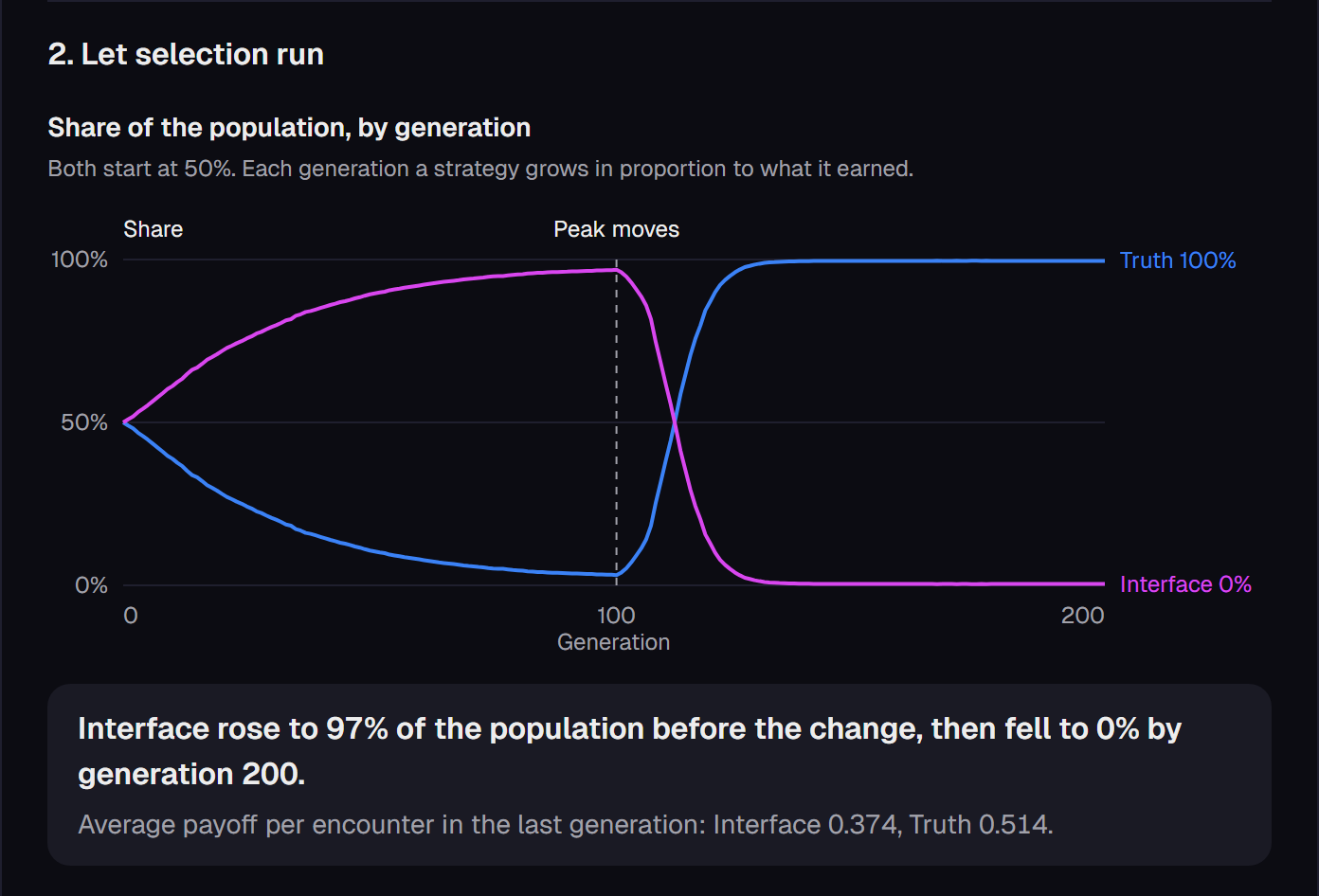
You can run a small version of the argument yourself. In the game below, one organism sees how much of a resource there is and the other sees only what it pays, with the same number of categories each. The figure lists what the model assumes and what it does not show.
Try it. Pick the straight line, then the bell curve, then the bell curve that moves. Raise the categories and watch the gap close.
What to look for. With a straight-line payoff the two tie. With a bell curve the payoff-tuned organism takes over. When the peak moves, it collapses, because its categories still follow the old payoff.
 Play with this figure
The other end of the map is just as live. On whether selection works as a general physical principle, Hazen and colleagues at Carnegie Science calculated assembly indices of up to 21 for minerals in 2024, to argue that a high index is not a clean sign of life. Walker and colleagues replied that the threshold came from measured organic molecules and that calculated mineral values cannot test it. Neither side has a measurement the other accepts, so the page marks it open.
How it stays honest
A living page on a contested field can rot into confident nonsense faster than a static one. Once a week, the map is checked against primary sources, under strict rules.
Nothing goes on the page unless its source says it, word for word. Every quote has to appear in text that was fetched from the source itself, at a minimum length, so a paraphrase cannot drift into a claim the author never made. A prediction's status, whether it is holding, failing or untested, cannot change on one paper. It takes a second, independent source on a different host. And if the map has not been refreshed in 21 days, a banner appears on the page, so a dead process shows up as a visible warning instead of a quietly aging page.
The first draft showed why the rules are needed. When the seed was fact-checked, 198 items were removed. Some were links behind a login that could not be opened. Some were dates and co-authors that could not be confirmed. One was a critique whose point duplicated critiques that were verified. A map that kept all 198 would have looked fuller and been worse.
The same logic covers the thin spots. A summary that has not been rewritten against checked evidence stays hidden, and the page shows the evidence in its place. A reader should be able to tell the difference between "settled", "contested" and "nobody has looked yet".
What I want from it
Connectionism asks how minds might be built from nodes and signals. Consciousness is where that question hits a wall, because the theories on offer disagree about what the wall is made of. A single essay will not resolve that, but a page that tracks the fourteen positions, the ten disputes and the next experiment for each can show where the fight actually is.
Start with the matrix, then pick the question you think you already know the answer to: agor.me/resources/consciousness-map.
Sources
- Cogitate Consortium, adversarial test of IIT and GNWT, Nature (April 30, 2025)
- Kapoor et al., no-report binocular rivalry in macaque prefrontal cortex (bioRxiv, January 28, 2020)
- Frassle et al., rivalry with and without report, Journal of Neuroscience (2014)
- Safavi et al., Is the frontal lobe involved in conscious perception? Frontiers in Psychology (2014)
- Quanta Magazine, The Evolutionary Argument Against Reality (April 21, 2016)
- Hoffman, Singh and Prakash, Probing the interface theory of perception: Reply to commentaries (2015)
- Agent-based simulation of interface perception under environmental change (arXiv, 2021)
- Walker and colleagues, reply on assembly indices of minerals (arXiv, June 2024)