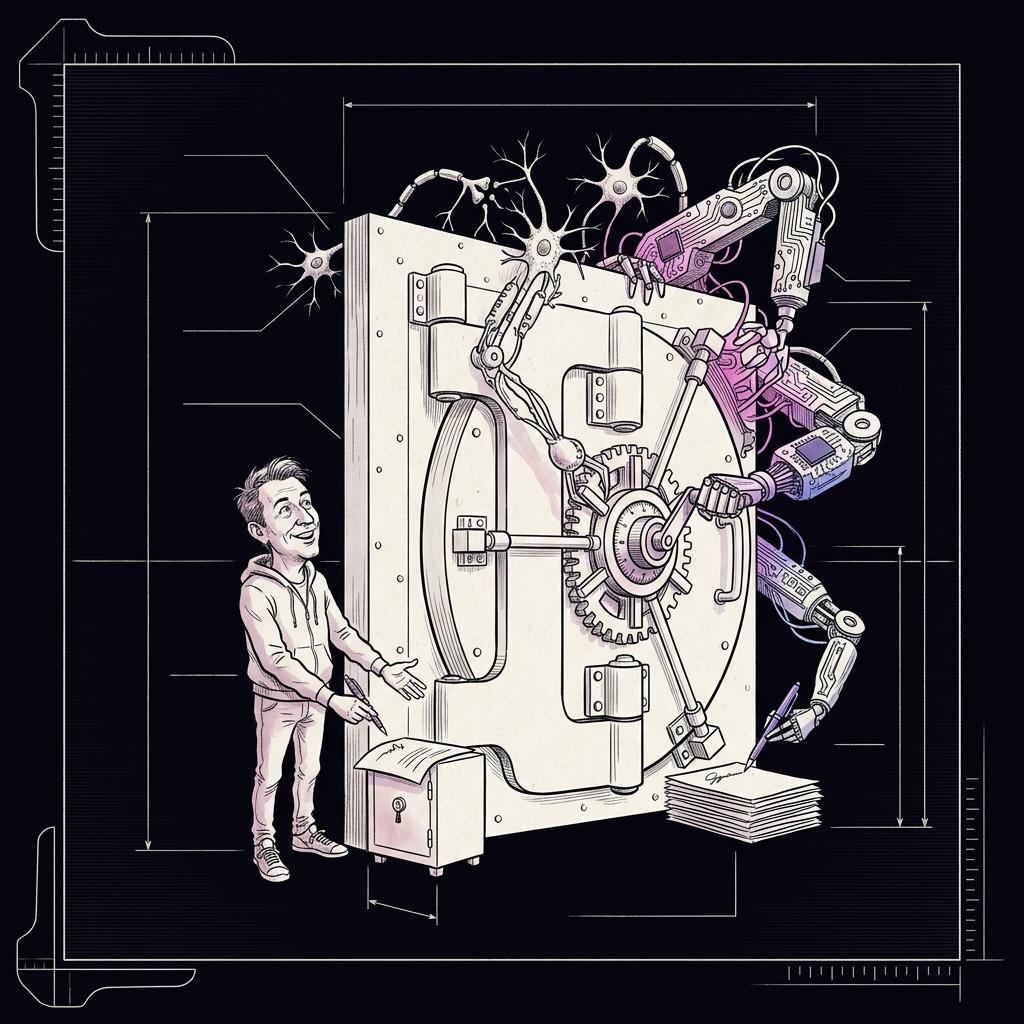
On July 8, 2026, TechCrunch reported that Lovable was in talks to double its valuation to $13.2 billion, with Menlo Ventures expected to lead a $300 million round. The Swedish company hit $500 million in annualized revenue in June. By its own count, 80% of its builders are non-technical. The tool works, the money believes it, and a fresh cohort of founders is buying the pitch that they can ship a real business without a real engineer.
Five months earlier, researchers at Wiz opened the JavaScript running on Moltbook, an AI social network built by another non-technical founder using another vibe coding stack. The founder, Matt Schlicht, had posted on X on January 30, 2026: "I didn't write one line of code for @moltbook. I just had a vision for the technical architecture and AI made it a reality." Wiz found the production Supabase database key sitting in plain text in the browser. Row-level security was off. Within three days of launch, 1.5 million API tokens belonging to paying customers of OpenAI, Anthropic, AWS, and GitHub were readable to anyone with Chrome DevTools, along with 35,000 email addresses and the private messages between agents.
Both stories are the same story. The tools that let non-technical founders ship are extraordinary. The founders who ship with them are still on the hook for everything that comes out the other end.
The Barclays split
For a while it looked like the vibe coding market itself was cracking. Barclays analysts, cited by Aakash Gupta and other market watchers in September 2025, tracked visits to Lovable, Vercel's v0, and Bolt.new since their summer highs. Lovable was down 40%. v0 was down 64%. Bolt was down 27%. Every third headline read "the vibe coding bubble is popping."
Then Lovable posted the numbers. Annual recurring revenue climbed from around $130 million at the summer peak to $500 million by mid-2026. Same product. Same tools. Fewer visitors, more revenue.
Call it what it was: a market splitting in half.
The tourists left. They were mostly non-technical founders who came for the promise: type a prompt, ship a product, own a company. They played for a weekend, hit the wall between demo and production, and closed the tab.
Two groups stayed. Product teams inside real companies (Lovable's public customer list now includes Workday, Asana, and Nvidia) using these tools to accelerate work engineers were going to do anyway. And a small subset of non-technical founders who understood that the tool was one layer of a stack, not the whole stack. Those two groups pay more per seat, use the tool for longer sessions, and keep coming back. That is where the $500 million came from.
If you are a non-technical founder reading this in July 2026, that split is the whole question. Which side of it do you want to be on.
What AI strategy for non-technical founders actually means now
AI strategy for non-technical founders used to be a shopping question. Which tool do I pick. Should I try Lovable or v0 or Bolt or Replit or Cursor or Base44. That question is dead. The tool question got settled between March 2025 and June 2026. There are five or six credible builders and they are all fine.
The question that replaced it is harder, and more useful.
What do you know that lets you tell whether the thing the model shipped will hold up when a real user, a paying customer, or a hostile scraper touches it?
Schlicht did not have that knowledge. His post said he had "a vision for the technical architecture." His architecture involved putting a database key in a browser file. That is not a vision. It is a beginner mistake the model inherited from him.
The vibe coding pitch conflates two very different jobs. Writing code. Specifying a system. Non-technical founders were told they no longer needed to do either. That was half true. You do not have to write the code. You do have to specify the system.
The line the model left in
Read the Moltbook post-mortems carefully. Wiz's team did not find a novel exploit. They opened Chrome DevTools and read the JavaScript. The Supabase key was hardcoded, client-side, publicly readable. Row-level security, the Supabase feature that would have made that key harmless, was turned off.
Every one of those decisions is documented in the Supabase quickstart. Every one is a checkbox in an official tutorial. The model that built Moltbook knew about them. The founder who prompted the model did not, so he never asked, so the model never proposed the guardrail. The result compiled, deployed, went viral, and leaked.
Georgia Tech's Vibe Security Radar tracked 35 new CVE entries directly caused by AI-generated code in March 2026 alone, up from six in January. OX Security reports 62% of AI-generated code ships with vulnerabilities. Modall's founder guide catalogs three separate incidents at Lovable itself, including a broken object-level authorization vulnerability that stayed open for 48 days after a bug-bounty report was closed without escalation. TechTimes reported in May that 63% of vibe coding users now have no coding background, and breaches are climbing in step.
Burn this pattern into your head. The model will do exactly what you ask, in the most direct way it can. It will not save you from things you did not think to ask about. If you cannot describe the guardrails you need, the model has no way to build them in.
That is what architectural literacy means for a founder in 2026. Not "can I write code." "Can I describe, in plain language, what has to be true about the system I am about to sign my name to."
Six questions the model will not ask you
The Moltbook breach and the Georgia Tech numbers point at one failure mode. The model does the thing. Nobody asks the questions that would have caught the flaws. Here are six the model will not raise unless you do. Learn to ask them by name.
Who can read the data. Not "the app," not "the API." Which human beings and which programs. A user, a signed-in user, a signed-in user from a different account, an anonymous scraper, an ex-employee whose access should have been revoked, a partner integration that you gave a token to eight months ago and forgot about.
Where the credentials live. Every AI-generated stack has secrets. API keys, service accounts, database passwords, third-party tokens. The Moltbook breach was one key in one browser file. Where are yours right now.
What happens on a bad day. The model will build the happy path. What does the app do when a payment fails, an API is down, a user tries to log in from a new device, an agent goes into a loop, a scraper hits the endpoint a thousand times a second. If you cannot answer, the model built no answer.
How the system logs itself. Something will go wrong. If nothing recorded what happened, you cannot fix it, and you cannot honestly tell a customer or a regulator what leaked. Wiz caught Moltbook in three days because the evidence sat on the internet. You should hope your evidence sits somewhere you control instead.
Who wakes up when it breaks. This one is about operations. If nobody is on the hook, nobody will fix it, and the model will not spontaneously start paging itself at three in the morning.
Who audits the code the model wrote. Not you reading the diff for vibes. Someone qualified reading it for security holes. The gap between "the app works" and "the app is safe" is a review, and that review is a human being's job.
None of these questions require you to type Python. All of them require you to know they exist.
The founder's real job
The pattern I write about here often is that AI collapses the cost of the thing the AI does, and shifts every remaining margin to the thing the AI does not. In 2026, the AI does the code. What it does not do is decide what should be built, define what "good" looks like, own the consequences when it goes sideways, or hold the trust of a paying customer.
That leaves a founder with a bigger job than they had before, not a smaller one. The typing was the easiest part. Typing is now free. Everything upstream (the specification, the guardrails, the failure modes, the accountability) and everything downstream (the customer trust, the follow-through, the fix when the thing breaks) is where a founder either exists or does not.
If your AI strategy is a list of tools, you do not have a strategy. If your AI strategy is "vibe code the MVP and see if it hits," you are the tourist Barclays counted, and the tab is already closed on your dashboard. If your AI strategy is "I will use the model to compress the build, and I will make sure I know enough about what the model produced to sign my name to it," you are the operator who stayed after the tourists left.
What survives the tourists
Look one more time at Lovable's split. Traffic dropped 40%. Revenue climbed from $130 million to $500 million. The customers who stayed paid more because their use of the tool moved from experimentation to production. That transition (a fun weekend build becoming something a business runs on) is the same transition Moltbook failed to make.
Every non-technical founder who wants to still be shipping in 2027 has to make that transition explicitly. You do not skip past specification. You do not skip past review. You do not skip past ownership. You use the model to make the parts of the job that used to eat months take days. You spend the days you saved on the parts of the job the model cannot do for you.
Those parts have not shrunk. They have grown, because the number of decisions a small team can now execute has multiplied. The founder who sits above a stack of AI tools is running a bigger system than a comparable founder ran two years ago, with fewer people to catch their mistakes. That is more responsibility, not less.
The Menlo Ventures round Lovable is closing this month is a bet that this bigger job is the future of software. It is. The follow-on bet, the one nobody is writing checks for, is that most non-technical founders will figure out how to hold the bigger job on their own. That one is less likely.
Architect the gap or leak through it
Vibe coding gets you a demo. The company is still yours to build. The gap between the two is not a tool gap. It is a thinking gap, and it lives in what you specify, what you review, and what you own when it breaks.
Agor AI Advisory helps founders architect that gap. We work with non-technical founders who understand that speed without a spine leaves you exposed, and who want an AI stack that accelerates a real business rather than a viral post that becomes a Wiz report. That is a design problem, and design is what a strategic partner is for.
The tools will keep getting better. The scrutiny of what you ship will get sharper. The founders who buy tools without architecting the systems around them are already the story cybersecurity researchers write case studies about. The founders who architect first, and then hand the model a specification worth executing, are the ones raising rounds and keeping their customers' data off the internet.
Pick the second group. Then pick the partner who knows how to get you there.
Sources
- Matt Schlicht, X post on Moltbook build, January 30, 2026
- Wiz Blog: Hacking Moltbook, AI Social Network Reveals 1.5M API Keys
- Infosecurity Magazine: Vibe-Coded Moltbook Exposes User Data, API Keys and More
- Insurance Journal: 'Moltbook' Social Media Site for AI Agents Had Big Security Hole, February 2, 2026
- TechCrunch: Lovable reportedly in talks to double its valuation to $13.2B, July 8, 2026
- The Next Web: Lovable, $500M ARR, 146 staff, 80% non-technical builders
- Aakash Gupta: Best AI Prototyping Tools 2026, Bolt vs Lovable vs Replit vs v0
- OX Security: Vibe Coding Security, Why 62% Of AI-Generated Code Ships With Vulnerabilities
- TechTimes: Vibe Coding for Non-Developers, 63% of Users Now Have No Coding Background, Breaches Follow